Challenges, and Solutions A Presentation on the Study Results by the - - PowerPoint PPT Presentation

challenges and solutions
SMART_READER_LITE
LIVE PREVIEW

Challenges, and Solutions A Presentation on the Study Results by the - - PowerPoint PPT Presentation

An Action Plan for Carbon Capture and Storage in California: Opportunities, Challenges, and Solutions A Presentation on the Study Results by the Project Executives Professor Sally Benson, Stanford University Melanie Kenderdine, Energy Futures


slide-1
SLIDE 1

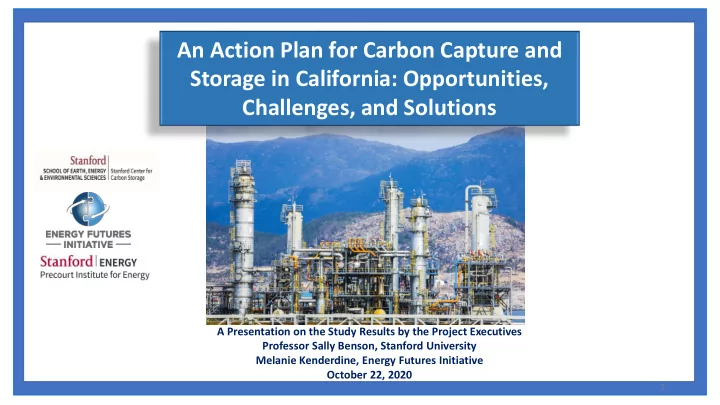
An Action Plan for Carbon Capture and Storage in California: Opportunities, Challenges, and Solutions

A Presentation on the Study Results by the Project Executives Professor Sally Benson, Stanford University Melanie Kenderdine, Energy Futures Initiative October 22, 2020

1

slide-2
SLIDE 2

Significant Challenges for Utility Scale Battery Storage Study Approach and Framing

Analysis focused on five key areas

  • Meeting California’s Decarbonization Targets: The Critical Role of CCS

in Carbon Dioxide Removal

  • The Status of CCS in California
  • The CCS Opportunity in California
  • The Challenges for CCS Project Development in California
  • A Policy Action Plan for Maximizing the Value of CCS in California

Bottom line up front

An Action Plan for Policymakers was developed to fulfill California’s CCS potential, supporting the report’s high-level goals of: ✓ Maximizing the value of CCS for meeting the state’s economywide decarbonization goals affordably and equitably ✓ Motivating the private sector to decarbonize ✓ Enabling economic and reliability benefits from existing industries and power generation, and -- ✓ Unlocking new clean energy industries and jobs

2

slide-3
SLIDE 3

What CCS Can Do for California: Emissions Reductions

Electricity 14.9%

Total 2017 Emissions: 424 MtCO2e

Buildings 9.7% Industry* 21% Transportation* 40% Other 3.6% Other 3.6%

Aviation 1.1% Rail 0.4% Ships 0.8% Other 1.3%

Heavy Duty Vehicles Heavy Duty Vehicles 8.4% Passenger Vehicles 28.0% Waste 2.1% High GWP 4.9%

Agriculture 7.6%

Other 2.3% Livestock 5.3% Residential 6.1% Commercial 3.6% In-state Generation 9.1% Imports 5.8% Refineries 7% General Fuel Use 4.5% Oil & Gas 4.1% Thermal Cogen. 1.8% Cement 1.8% Other 1.8%

Source: Adapted from CARB,2020

Emissions Reduction Potential from CCS in California

  • Approx. 15% of state’s total

CO2 emissions can be captured and stored with CCS

  • This is 65% greater than

emissions from in-state power generation in 2017

  • 44% greater than emissions

from the entire buildings sector

  • 84% greater than all

emissions from the agriculture sector

  • 66% greater than emissions

from all heavy-duty vehicles

3

slide-4
SLIDE 4

What CCS Can Do For California: Meet Climate Targets While Supporting Economic Base/Jobs

2020 Goal: Equal to 1990 Emissions Level of 427 MtCO2e 2030 Goal: 40% Reduction from 1990 Emissions Level, 256.2 MtCO2e

Maximize options for meeting 2030 and 2045 GHG targets to reduce associated costs, improve the likelihood of achieving the targets, and foster innovation.

2045 Goal: Carbon Neutrality and Net-negative Emissions Thereafter “California’s manufacturing accounted for roughly $315 billion in economic

  • utput in 2018 -- 11 percent of gross

state product-- with more than 35,000 firms employing 1.3 million employees... The use of CCS could enable difficult-to-decarbonize industries to stay in business and continue making large contributions to California‘s economy while dramatically reducing their GHG emissions.” -National Association of

Manufacturers, “2019 California Manufacturing Facts.”

California

✓ Industry 21% of total emissions ✓ Largest manufacturing state in the country ✓ Few technology options for decarbonization

Source: Adapted from PortlandCement Association, 2017

California Cement Cement & Related 1,449 16,774 101 million 924 million 35.6 million 412 million 2.4 billion 12.1 billion Payroll ($) Economic Contribution ($) # Employees Contribution to State Taxes Revenues ($)

Motivate the private sector to deeply decarbonize its operations.

4
slide-5
SLIDE 5

Hourly trends in solar and wind capacity factors in CA for 2017 aligned to normalized variation in hourly load relative to peak daily load

Source: Energy Futures Initiative,

  • 2019. Compiled using data from

CAISO, 2017

1 2 3 4 5 7 8 9 10111213 14 15 16 1718 19 2021 22 2324 2526 27 28 2930 31 32 333435 363738 39 40 42 41 43 44 45 464748 49 50 51 53 55 54 57 52 56 59 58 64 63 67 6566 62 61 60 6 68 70 69 72 71 7374 76 75 78 80 77 82 81 79 83 84858687888990

Significant Challenges for Utility Scale Battery Storage

What CCS Can Do For California: Support for Grid Reliability, Variable Renewable and Climate Targets

Enable continued reliability benefits from clean firm power generation ...

5

slide-6
SLIDE 6

31 14 6 4 8 12 12 17 51 43 2 37 27 20 40 60 80 100 120 140 Capacity (GW)

System capacity in 2018 and 2030 for a scenario with and without NGCC-

  • CCS. The scenario with CCS shows
  • approx. 4 GW of CCS in the system, and
  • verall lower capacity needs than a

system without CCS. The annual generation system cost for a scenario with CCS is approximately $750 million/year lower as well.

2018* No CCS CCS

  • Approx. $750 M/yr

Cost Savings

What CCS Can Do for California: Enable Affordable Clean Firm Power and Renewable

CCS Natural Gas Hydro Bio+Gen+Nuc Wind Battery Storage PV

Source: Energy Futures Initiative and Stanford University, 2020.

...and enable continued reliability benefits from clean firm power generation at lower cost

Natural Gas Note: figure updated 10/25/20 to reflect final results 6

Note: Capacities include in-state generation capacity and

  • ut-of-state generation capacity dedicated to California.

*2018 Baseline is California’s generating capacity based

  • n 2018 eGRID database including planned natural gas

and nuclear retirements, as well as planned capacity additions for PV and wind.

slide-7
SLIDE 7

Translate Oil and Gas Skillsets to CCS Industry Job

What CCS Can Do for California: Enabling New Clean Energy Industries and Jobs

Source: Energy Futures Initiative and Stanford University, 2020.

  • Improved process energy

efficiency

  • Lifecycle analyses
  • Low-carbon capture

requirements/ systems

  • Low-carbon heat
  • Geologic storage
  • Material manufacturing

& scale-up

  • Novel: catalysts;

membranes; solvents; sorbents

  • Simulation
  • Sensors and controls

Similarities with CCS

Enable Carbon Dioxide Removal/Direct Air Capture Industry

  • Half of ports’ drayage

fleet (5,000 trucks)

  • Entire ports’ electricity

requirement (50MW/h)

  • 80% of SCG’s

petroleum refiner demand

  • 10% of SCG’s

residential gas demand (as blend)

  • CO2 sequestration

equivalent to half an average coal plant emissions

Support Development of A Hydrogen Economy

3

Onshore Sequestration 2 Steam Methane Reformers with CCS H2 Storage

Combined Cycle Power Plant

1.5 million kg H2/day

Electrolysis

100,000 kg H2/day

Natural Gas CO2 H2 Petroleum Refining Retail Gas

... Unlock new, potentially multi-billion-dollar clean energy industries, creating new jobs in the process. “The oil and gas industry…[w]as a major employer and leading economic drive in California responsible for 368,100 jobs in 2015, or 1.6 percent of California’s employment, with almost $66 billion in total value- added, contributing 2.7 percent of California’s state product.” -LA County Economic Development Corporation

7

slide-8
SLIDE 8

CCS: An Important Technology for Meeting Global Sustainable Development Targets

Source: Adapted from IEA,2019

Stated Policies Scenario 32% Renewables 37% Efficiency 8% Fuel Switching 9% CCUS 12% Other Sustainable Development Scenario

2010 2020 2030 2040 2050

10

GtCO2

20 40 30 3% Nuclear

“Reaching net zero will be virtually impossible without CCUS” IEA, 02/20

“Our collective failure to act early and hard

  • n climate change

means we now must deliver deep cuts to emissions... We need quick wins to reduce emissions as much as possible in 2020... We need to catch up on the years in which we procrastinated... If we don’t do this, the 1.5°C goal will be out

  • f reach before 2030.”

UNEP Executive Director, 0919 8

slide-9
SLIDE 9

Large scale CCS facilities in operation or under construction Large scale CCS facilities in advanced development Large scale CCS facilities completed Pilot and demo in operation or under construction Pilot & demo scale facility in advanced dev. Pilot & demo scale facility completed Test center

Global CCS Projects, 2019

Source: Global Status of CCS, 2019, Global CCS Institute

9

slide-10
SLIDE 10

AK MT WY ID WA OR NV UT CA AZ ND SD NE CO NM TX OK KS AR LA MO IA MN WI IL IN KY TN MS AL GA FL SC NC VA WV OH MI NY PA MD DE NJ CT RI MA ME VT NH

Lost Cabin Gas Plant Gas Processing 12 mile pipeline Operating since 2013 Hydrogen plant source Shute Creek Gas Processing Plant 30 mile pipeline Operating since 1986 Gas processing source Coffeyville Gasification Plant 70 mile pipeline Operating since 2013 Fertilizer prod. source Century Plant 27mile pipeline Operating since 2010 Gas processing source Petra Nova Carbon Capture Plant 80 mile pipeline Operating, 2017-2020 Coal generation source Terrell Natural Gas Processing Plant 83 mile pipeline Operating since 1972 Gas processing source Air Products Steam Methane Reformer 12 mile pipeline Operating since 2013 Hydrogen prod. source Enid Fertilizer 140 mile pipeline Operating since 1982 Fertilizer prod. source Illinois Industrial CCS 1 mile pipeline Operating since 2017 Ethanol prod. source

US CO2 Project, Emissions Sources, Age

Great Plains Synfuels Plant Processing Plant 205 mile pipeline Operating since 200 Synthetic gas source

Source: Energy Futures Initiative and Stanford University, 2020. Compiled using data from Global CCS Institute, 2020.

10

slide-11
SLIDE 11

Four In-Development CCS Projects Pursuing LCFS, as of October 2020

Clean Energy System. Existing, mothballed biomass

facility in California with new technologies to produce hydrogen through gasification of biomass and capture of

  • CO2. Onsite geologic storage into saline reservoir via short

pipeline.

California Resources Corporation. Existing and

  • perating NGCC used for combined heat and power (CHP)

located within an oilfield in California paired with post- combustion carbon capture facility. Captured CO2 is transported onsite via pipeline to injection well(s) for EOR.

Interseqt LLC (White Energy and Oxy Low Carbon Ventures). Two existing ethanol plants in Texas which sell

bioethanol into California for fuel blending, each paired with carbon capture equipment. Captured CO2 will be injected for EOR.

1PointFive (Oxy Low Carbon Ventures and Rusheen Capital Management) and Carbon

  • Engineering. DAC facility located in Texas. Captured

CO2 will be injected for EOR.

CCS in CA: Agencies of Jurisdiction, Projects Seeking LCFS Incentives

Application Process for Projects Seeking LCFS Credits, and Project Dependent Requirements

Source: Energy Futures Initiative and Stanford University, 2020.

11

slide-12
SLIDE 12

CO2 Source Identification

  • Industry
  • Electricity

Assessment

  • f Storage

Potential

  • Oil and gas

reservoirs

  • Saline

Formations

Technoeconomic Analysis

  • SB100 2030 goals
  • Source/Sink

Matching

  • Cash flow analysis

Social Equity & Community Benefits

  • Local Air

Quality

  • Jobs

Assessment of Opportunities for CCS in California

MtCO2/yr $/t CO2

40 60 80 20

Capture Costs

CHP NGCC Hydrogen Refineries Cement Ethanol

Source: Energy Futures Initiative and Stanford University, 2020.

12

slide-13
SLIDE 13

Industry Sources

  • 35.8 MtCO2/yr current emissions
  • 31.8 MtCO2 /yr capturable emissions
  • 51 Facilities

Industrial Candidates

  • >100,000 tCO2/yr
  • Operating and reporting

emissions in 2018

  • Larger sources at

refineries

Opportunities for CCS in the Industrial Sector

Mt/yr Cement (8) CHP (15) Ethanol (3) Hydrogen (16) Refineries (9)

2 4 6 8 10 12 Hydrogen CHP Cement Refineries Ethanol

Current CO2 Emissions

Source: Energy Futures Initiative and Stanford University, 2020.

13

slide-14
SLIDE 14
  • 25 natural gas combined cycle

(NGCC) power plants meet CCS retrofit criteria

  • 14 GW total capacity
  • 21.6 MtCO2/yr current emissions
  • 27.5 capturable emissions

MtCO2/yr*

Retrofit Candidates

  • Combined Cycle
  • Built after 2000
  • No planned retirement
  • Capacity >250 MW

* Capacity factor to increase to 60%

Opportunities for CCS Electricity Sector in California

Potential NGCC-CCS Retrofit Sites Other Gas Power Plant Sites

Source: Energy Futures Initiative and Stanford University, 2020.

14

slide-15
SLIDE 15

WESTCARB 2003 - 2013 U.S. DOE and CEC U.S.G.S. National Labs

Data Sources Screening Criteria

Storage Capacity (GT CO2) Saline Formations 70 Oil and Gas Low High 1.1 2.1 California could store 60 Mt/year for more than 1000 years.

California Has Abundant and High-Quality CO2 Storage Resources

Exclusion Zone CO2 Emission Sources Potential CO2 storage sites Saline Reservoir Storage Oil Fields with CO2- EOR potential Other Oil & Gas Fields

Source: Energy Futures Initiative and Stanford University, 2020.

15

slide-16
SLIDE 16

MillionTonnesof CO2 1.0 .8 .6 .4 .2

Average Cost for Capture for Different CO2 Sources

NGCC Hydrogen Production CHP Cement Production Ethanol Production Refinery

Comparison of Emissions and Capture Costs by Subsector

Average Emissions for Different CO2 Capture Sources $/t CO2

1.0 .8 .6 .4 .2

Million Metric Tons CO2 (MtCO2)

80 60 40 20

Source: Energy Futures Initiative and Stanford University, 2020.

16

slide-17
SLIDE 17

$100 50

  • 50
  • 100
  • 150

TotalCost with LCFS, 45Q ($/tCO2) 10 20 40 50 60 30 Millions of tC02 peryear

NGCC Hydrogen Production CHP Cement Production Ethanol Production Refinery

With Current Incentives About 20 MtCO2/yr Could Be Captured Cost Effectively

Policy Incentives

  • LCFS at $100/ton
  • 45Q tax credit

Million Metric Tons of CO2 per year

Source: Energy Futures Initiative and Stanford University, 2020.

17

slide-18
SLIDE 18

Infrastructure Buildout for 60 MtCO2/yr CCS

  • 3 ethanol plants, 6 NGCC, 6 CHPs

and 1 cement plant

Co-located capture and storage

  • 8 hydrogen 4 refineries, 5 CHPs,

and 3 NGCC

  • 1. Northern California

Gathering System and Storage Hub

  • 8 hydrogen, 5 refineries, 4 CHPs,

1 cement, and 5 NGCC

  • 2. Southern California

Gathering System and Storage Hub

  • 5 cement, 1 CHP, 6 NGCC
  • 3. Desert and Salton

Sea Gathering Systems

  • 1 cement, 5 NGCC
  • 4. Central California

and S. Bay Gathering System

1 2 3 3 4 4

  • Emissions Sources

Notional CO2 Pipeline Potential Geologic Storage

Source: Energy Futures Initiative and Stanford University, 2020.

18

slide-19
SLIDE 19

Social Equity and Community Benefits

  • Some industrial facilities with high CO2 emissions also emit high levels of criteria

air pollutants such as sulfur dioxide (SO2), nitrous dioxide (NO2), and particulates

  • Post-combustion carbon capture requires reduction of these other pollutants

creating local air quality benefits

Local Air Quality Improvements

  • CCS projects can stimulate local economic activity, including new construction,
  • perations, and maintenance jobs
  • Multiplier effects across the supply chain can drive additional economic benefits

Local Economic Activity

  • The economic benefits associated with job training could provide new

employment opportunities in the low carbon economy

  • CCS activities support employment for skill sets which may otherwise become
  • bsolete in a clean energy transition

Job Creation and Preservation

Source: Energy Futures Initiative and Stanford University, 2020.

19

slide-20
SLIDE 20
  • Technology developers
  • Industry
  • Power producers
  • Project financers
  • NGOs

Stakeholder interviews

  • Ambiguity
  • Regulatory complexity
  • Financial uncertainty
  • Education and public

support

Assessment

  • f challenges

Engaging Stakeholders to Identify Challenges for CCS

Industry/Affiliation # Cement 3 Chemicals 3 Diversified Energy 15 Environmental Advocacy 5 Infrastructure 8 Investment 3 Labor Unions 2 Power 6 Private Equity 2 Public Sector 3 Refinery 5 Reinsurance 2 Utility 2

Total* 59

* Indicates number of interviews; most interviews included multiple interviewees.

Analysis identified key challenges for CCS project development in California through interviews with project developers, financiers, and industry stakeholders, as well as archival research and analysis of California’s policy landscape.

Source: Energy Futures Initiative and Stanford University, 2020.

20

slide-21
SLIDE 21

CCS is Not Included in Other State Energy Planning Historic Inequities in Energy Infrastructure Siting Cost Challenge: Aligning Players, Permitting,and Financing Inadequate Legal Framework forObtaining Pore Space Rights Cost Challenge:Financial Responsibility Associated with UIC Class VI Wells Unclear Eligibility of CCS for SB100 Zero-Carbon Electricity T arget CCS Ineligible Under Cap-and-Trade

Ambiguous Position

  • f the State on the

Future Role of CCS

State and Federal Post- Injection Site Care Requirements Vary Uncertain Permitting Timelines Numerous Regulatory Jurisdictions and Unclear CEQA Lead for Industry CCS Projects

Complex and Untested Regulatory Process for Getting Permits for CCS

Revenue Challenge: Limitations of the Federal 45Q T ax CreditDesign Revenue Challenge:LCFS CreditMarket Uncertainty and Policy Risk

Revenue and Cost Uncertainty Discourage Project Finance

Low Public Awareness and Varied Opinions of CCS Concern that CCS Allows for Continued Fossil Fuel Use

Lack of Public Awareness and Support for CCS

Source:EnergyFuturesInitiative andStanfordUniversity,2020.

Complexity and Uncertainty Reduce Attractiveness of Investment in CCS

21

slide-22
SLIDE 22

OPPORTUNITIES TO LEAD GLOBAL ACTIONONCLIMATE NEAR-TERM ACTIONSFORMEETINGCALIFORNIACLIMATETARGETS KEYENABLERSFORCARBONNEUTRALITY

Support Innovation atResearch Institutions & Laboratories

Support Options to Ensure Adequate Clean Firm Power

CreateCO2 Transport and Storage Operator Incorporate CCSProtocol in Cap-and- Trade Enhance Support Mechanisms for CCS Establish Public-Private Partnership to Create LA & Bay Area Hubs Set Statewide Carbon Removal Targets Affirm State Support for CCS in Meeting Emissions Targets Improve and Coordinate CCS Permitting Processes Issue Policy Guidance to Clarify CCS Eligibility Issue Guidance for CO2 Storage Develop State SupportedCCS Demos with Industry Potential to Rapidly Reduce 15%of Today’s Emissions with CCS Capacity to Store 60 MtCO2/yr. for

  • ver 1,000 Years

Robust Clean Energy Policy Frameworks to Support CCS Large Industrial Base with Few Alternatives to Decarbonize Commitment to Equitable CleanEnergy Transition

CALIFORNIA’SFOUNDATIONS

A Policy Action Plan for CCS in California to Meet the High-Level Goals

Maximize Options for Meeting 2030&Mid-Century Greenhouse GasTargets Motivate the Private Sector to Deeply DecarbonizeActivities Unlock New Clean EnergyIndustries and Jobs, including in Hydrogen & Direct AirCapture Enable Continued Economic and Reliability Benefitsfrom Existing Industry & Electricity Generation

Source:EnergyFuturesInitiative andStanfordUniversity,2020.

22

slide-23
SLIDE 23

NEAR-TERM ACTIONS FOR MEETING CALIFORNIA CLIMATE TARGETS

Affirm State Support for CCS in Meeting Emissions Targets Improve and Coordinate CCS Permitting Processes Issue Policy Guidance to Clarify CCS Eligibility Issue Guidance for CO2 Storage Develop State Supported CCS Demos with Industry

Near-Term Actions for Meeting California’s Climate Targets with CCS

Issue Policy Guidance to Clarify CCS Eligibility

As new energy technologies emerge, questions often emerge of their compatibility with existing policies and regulations.

  • California could incorporate CCS into its biennial integrated

resource plan and long-term procurement planning process.

  • California could make CCS an eligible resource under the SB100

goal of 100 percent of retail electricity sales from renewable and zero-carbon resources by 2045.

Develop State Supported CCS Demos with Industry

Demonstration projects could provide valuable insights into the technical and regulatory challenges of a CCS project.

  • California should consider supporting a large CCS demonstration

project to help overcome high at-risk costs in the project’s early stages; untested permitting processes throughout the value chain; and public acceptance of CCS.

  • California could prioritize projects that have demonstratable

local air quality benefits and local job opportunities in line with its climate and equity goals.

Source:Energy Futures Initiativeand Stanford University, 2020.

23

slide-24
SLIDE 24

KEY ENABLERS FOR CARBON NEUTRALITY

Incorporate CCS Protocol in Cap- and-Trade

Enhance Support Mechanisms for CCS Establish Public-Private Partnership to Create LA & Bay Area Hubs Set Statewide Carbon Removal Targets

Incorporate CCS Protocol into Cap-and-Trade Program

CCS is not an eligible pathway under California’s Cap-and-Trade program. There is no incentive for covered entities to deploy CCS though it could contribute large emission reductions.

  • CARB could adopt the CCS Protocol from the LCFS program into the existing Cap-and-Trade

Program to provide additional financial incentive for projects to pursue CCS. This is especially important for NGCCs and cement, which are not eligible for LCFS credits but are covered under Cap-and-Trade.

Key Enablers for Carbon Neutrality

Source:Energy FuturesInitiative andStanford University,2020.

24

slide-25
SLIDE 25

OPPORTUNITIES TO LEAD GLOBALACTIONON CLIMATE Support Innovation atResearch Institutions & Laboratories

Support Options to Ensure Adequate Clean Firm Power

CreateCO2 Transport and Storage Operator

Opportunities to Lead Global Action

  • n Climate Change

Support Options to Ensure Adequate Clean Firm Power

Studies show clean firm resources can have significant benefits to a deeply decarbonized electric grid. Clean firm resources can reduce overall system costs, complement renewable energy resources, and enable overall operational

  • flexibility. These benefits will be even more critical as California faces increasing threats from climate change.

California should support policies that:

  • provide a more precise understanding of how much firm power is needed for a grid that is decarbonizing;
  • inform grid reliability planning processes;
  • identify key technologies for providing clean firm power; and
  • identify policy options for the scaleup and deployment of those technologies that are essential for ensuring reliable,

affordable, and clean power.

Source:Energy Futures Initiativeand Stanford University, 2020.

25

slide-26
SLIDE 26

Significant Challenges for Utility Scale Battery Storage Thank You for Joining Us!

  • California has some of the most ambitious decarbonization targets in the country. Additional actions to accelerate

meeting these targets—by a coalition of Californians—are needed to ensure that the state rapidly and equitably transitions to a carbon neutral economy.

  • Strong foundations for CCS in California include: the urgent need for rapid emission reductions; policy support

from LCFS CCS Protocol; the commercial readiness of CCS; commitment to equitable and clean transition, among

  • thers.
  • Opportunities to leverage CCS to rapidly decarbonize and create new clean industries and jobs:
  • sizeable geologic storage resources
  • the need for clean firm electricity generation as intermittent renewable generation grows;
  • the need for clean transportation fuels, such as hydrogen;
  • and the state’s experience advancing strong climate policies and innovative industries.
  • An Action Plan for Policymakers was developed to fulfill California’s CCS potential and to:

✓ Maximize the value of CCS for meeting the state’s economywide decarbonization goals ✓ Motivate the private sector to decarbonize ✓ Enable economic and reliability benefits from existing industries and power generation, and ✓ Unlock new clean energy industries and jobs

26

slide-27
SLIDE 27

Significant Challenges for Utility Scale Battery Storage Thank You to Our Project Team

SALLY M. BENSON Stanford University MELANIE KENDERDINE Energy Futures Initiative

PROJECT MANAGERS

ANNE CANAVATI Energy Futures Initiative SARAH D. SALTZER Stanford University EJEONG BAIK Stanford University ALEX BRECKEL Energy Futures Initiative JEFF BROWN

Brown Brothers Energy & Environment, LLC

VICTOR CARY Energy Futures Initiative STEPHEN COMELLO Stanford University ALEX KIZER Energy Futures Initiative ALEX MARANVILLE Energy Futures Initiative ERICK ARAUJO Stanford University JUSTIN BRACCI Stanford University TIM BUSHMAN Energy Futures Initiative MAX DRICKEY Energy Futures Initiative DAVID ELLIS Energy Futures Initiative CATHERINE HAY Stanford University JOE HEZIR Energy Futures Initiative TAE WOOK KIM Stanford University ANTHONY R. KOVSCEK Stanford University TOM MILLER Stanford University JEANETTE PABLO Energy Futures Initiative RICHARD RANDALL Energy Futures Initiative EMILY TUCKER Energy Futures Initiative NATALIE VOLK Energy Futures Initiative SEAN YAW Montana State University MARK ZOBACK Stanford University

ADDITIONAL CONTRIBUTORS CONTRIBUTING AUTHORS PROJECT EXECUTIVES

27

slide-28
SLIDE 28

Significant Challenges for Utility Scale Battery Storage Thank You to Our Advisory Board

ERNEST MONIZ Energy Futures Initiative

MATTHEW BARMACK Calpine BRIAN CHASE Chevron & OGCI JAMES HARRISON Utility Workers Union of America DAVID HAWKINS Natural Resources Defense Council JANE LONG Environmental Defense Fund DEEPIKA NAGABHUSHAN Clean Air Task Force KATIE PANCZAK DTE Energy GEORGE PERIDAS Lawrence Livermore National Lab CARLA PETERMAN Southern California Edison DAN REICHER Stanford University Law School

BOARD MEMBERS BOARD CO-CHAIRS

MAXINE SAVITZ National Academy of Engineering JOHNNY SIMPSON IBEW International 9th District ERIC TRUSIEWICZ Breakthrough Energy Ventures & Stanford University ROGER ULLMAN Linden Trust for Conservation

FRANKLIN ORR Stanford University

EFI and Stanford wish to thank the following individuals for contributing subject-matter expertise during the development of this study. Their participation does not imply endorsement of the analysis approach or conclusions.

28

slide-29
SLIDE 29

Significant Challenges for Utility Scale Battery Storage Thank You to Our Sponsors

EFI and Stanford would like to thank the following organizations for sponsoring this report. WILLIAM AND FLORA HEWLETT FOUNDATION LINDEN TRUST FOR CONSERVATION CASE FOUNDATION STEPHENSON FOUNDATION OIL AND GAS CLIMATE INITIATIVE (OGCI) CALPINE CORPORATION UNITED MINE WORKERS OF AMERICA CALIFORNIA STATE ASSOCIATION OF ELECTRICAL WORKERS STATE BUILDING & CONSTRUCTION TRADES COUNCIL OF CALIFORNIA INTERNATIONAL BROTHERHOOD OF BOILERMAKERS

29