
SLIDE 1
Certificates for cs.washington.edu
1
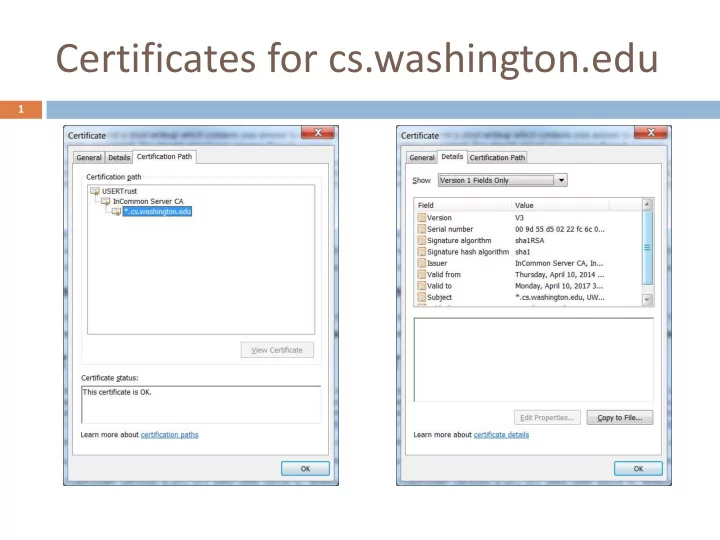
Certificates for cs.washington.edu 1 Certificates for GMail - - PowerPoint PPT Presentation
Certificates for cs.washington.edu 1 Certificates for GMail Important fields: Testing SSL Configuration (1) 3 Client completed verification of received certificate chain Testing SSL Configuration (2) 4 Received certificate chain (two
1
3
Client completed verification of received certificate chain
4
Received certificate chain (two certificates) Size of received certificate chain
5
Issued session identifier (Ses ession-ID ID) for stateful TLS resume.
Example from “High Performance Browser Networking”
Login page? Where else? What about JavaScript
includes? Image includes?
Why not encrypt
everything?
6
Some browsers may not
support SSL
SSL may decrease
performance somewhat. If users are downloading large, public files, there may be a system burden to encrypt these each time.
You will probably want
the home page accessible via HTTP, so that users don't have to remember to type https to get to it.
7
Assume you are using the
facebook.com site over an unsecured Wi-Fi network such as in shopping malls and coffee shops.
When you visit the Facebook
site, you are required to enter the username and password.
When you send that request and
sends you an auth then enti tication tok
sent every time you browse Facebook pages
8
9
10
Black-box fuzzing is far
Very little insight into
Makes you appreciate
C programming is tricky Bounds are far from
Makes you appreciate
11
A.
I will never try to black- box fuzz a server again for as long as I live
B.
I had an aha moment about a timing channel when solving this lab
C.
I feel that having hiding the source code makes programs more secure
A.
I will never program in C for as long as I live
B.
Working on this lab makes me appreciate how hard static analysis tools have to work
C.
I will allocate truly gigantic buffers so they can never ever overflow
12
Often, that’s the user is
the weakest lin link
Extended Validation
(EVSSL) certificate
Issued according to a
specific set of identity verification criteria.
These criteria require
extensive verification of the requesting entity's identity by the CA before a certificate is issued
14
15
16
17
18
19
20
21
A virus is a computer
program that is capable of making copies of itself and inserting those copies into
A worm is a virus that uses
a network to copy itself
Spyware is software that aids in
gathering information about a person or organization without their knowledge and that may send such information to another entity
A Trojan often acts as a
backdoor, contacting a controller which can then have unauthorized access to the affected computer.
A drive-by-download attack is a
malware delivery technique triggered when the user visits a website.
23
24
25
The AV-TEST Institute registers over 450,000 new malicious programs every day
http://www.av-test.org/en/statistics/malware/
26
http://www.marketsandmarkets.com/PressReleases/cyber-security.asp
28
Mac users can often be heard to say “I don’t need antivirus software, I have an Apple”. Unfortunately, this is a misguided
with Windows computers, they do exist nonetheless. Mac users who think they do not need to concern themselves have created an illusion. The claim that Apple users are less threatened than Windows users is currently still correct, but could change rapidly. It was the low market share of Macs that limited the attentions of online criminals; now that Macs are becoming more popular, this state of affairs is changing. http://www.itsecuritywatch.com/
Wait for user to
Infect other (binary)
Spread that way
Identify a sequence of
Formulate a signature Scan all files Look for signature
Bottleneck: scanning
29
30
31
Place virus at the entry
point or make it directly reachable from the entry point
Make virus small to avoid
being easily noticed by user
Entry point scanning Do exploration of
Continue until no more
32
Decryption routine Virus body Decrypt into memory, not
do disk
Set PC to the beginning of
the decryption buffer
Encrypt with a different
key before adding virus to new executable
Decryption (and encryption)
routines (packers) used by viruses are easy to fingerprint
Develop signatures to match
these routines
Attempt to decrypt the virus
body to perform a secondary verification (x-raying)
33
D E
34
35
Use a mutation engine to generate a (decryption routine, encryption routine) pair
Functionally similar or the same, but syntactically very different
Use the encryption routine to encode the body of the virus
No fixed part of the virus preserved (decryption, encryption, body)
Custom detection program
designed to recognize specific detection engines
Generic decryption (GD) Emulator Signature matching engine Scan memory/disk at regular
intervals in hopes of finding decoded virus body
36
D1
E1
D2
E2
37
How long to emulate the execution? Viruses use
What is the quality of the emulator? How many CPUs
What if decryption starts upon user interactions? How
What about anti-emulation tricks?
Signature-based virus
Emulation-based
Generally, both are
38
39
this happens, it can cause serious problems.
infected files, a false positive in an essential file can render the operating system or some applications unusable.
In May 2007, a faulty virus signature issued by Symantec mistakenly removed essential
Also in May 2007, the executable file required by Pegasus Mail was falsely detected by
Norton AntiVirus as being a Trojan and it was automatically removed, preventing Pegasus Mail from running. Norton anti-virus had falsely identified three releases of Pegasus Mail as malware, and would delete the Pegasus Mail installer file when that happened n response to this Pegasus Mail stated:
On the basis that Norton/Symantec has done this for every one of the last three releases
recommend in the strongest terms that our users cease using it in favor of alternative, less buggy anti-virus packages
40
In April 2010, McAfee VirusScan detected svchost.exe, a normal Windows binary, as a virus on machines running Windows XP with Service Pack 3, causing a reboot loop and loss of all network access
In December 2010, a faulty update on the AVG anti-virus suite damaged 64-bit versions of Windows 7, rendering it unable to boot, due to an endless boot loop created
In October 2011, Microsoft Security Essentials removed the Google Chrome browser, rival to Microsoft's own Internet Explorer. MSE flagged Chrome as a Zbot banking trojan
41
42 As long as user has the right virus signatures and computer has recently
been scanner, detection will likely work
But the virus landscape changes fast This calls for monitoring techniques for unknown viruses http://www.m86security.com/documents/pdfs/security_labs/m86_security_labs_vulnerability_report.pdf
43
Reactive approach renders existing security
While the reactive signature approach provides
44
https://www.youtube.com/watch?v=PGLGyPuxP7c
Collect signals Build a model of
Process logs and
Notify system
Behavioral models can
Are often graph-based Or regex-based Influence false
45
Log analyzers Signature-based
System call analyzers Application behavior
File integrity checkers Scan incoming and
Primarily signature-
Combined into
Can be located on a
46
47
11:33:27;[pid 1286] open 11:33:27;[pid 1286] mmap 11:33:27;[pid 1286] mmap 11:33:27;[pid 1286] munmap 11:33:27;[pid 1286] mmap 11:33:27;[pid 1286] mmap 11:33:27;[pid 1286] close 11:33:27;[pid 1286] open 11:33:27;[pid 1286] mmap 11:33:27;[pid 1286] mmap 11:33:27;[pid 1286] munmap 11:33:27;[pid 1286] mmap 11:33:27;[pid 1286] close 11:33:27;[pid 1286] open 11:33:27;[pid 1286] mmap 11:33:27;[pid 1286] mmap 11:33:27;[pid 1286] munmap 11:33:27;[pid 1286] mmap 11:33:27;[pid 1286] mmap 11:33:27;[pid 1286] close 11:33:27;[pid 1286] open 11:33:27;[pid 1286] mmap 11:33:27;[pid 1286] close 11:33:27;[pid 1286] open 11:33:27;[pid 1286] mmap 11:33:27;[pid 1286] mmap 11:33:27;[pid 1286] munmap 11:33:27;[pid 1286] mmap 11:33:27;[pid 1286] close 11:33:27;[pid 1286] open 11:33:27;[pid 1286] mmap 11:33:27;[pid 1286] mmap 11:33:27;[pid 1286] munmap 11:33:27;[pid 1286] mmap 11:33:27;[pid 1286] close 11:33:27;[pid 1286] open 11:33:27;[pid 1286] mmap 11:33:27;[pid 1286] mmap 11:33:27;[pid 1286] munmap 11:33:27;[pid 1286] mmap 11:33:27;[pid 1286] mmap 11:33:27;[pid 1286] close 11:33:27;[pid 1286] open 11:33:27;[pid 1286] mmap 11:33:27;[pid 1286] mmap 11:33:27;[pid 1286] munmap 11:33:27;[pid 1286] mmap 11:33:27;[pid 1286] close 11:33:27;[pid 1286] open 11:33:27;[pid 1286] mmap 11:33:27;[pid 1286] mmap 11:33:27;[pid 1286] munmap 11:33:27;[pid 1286] mmap 11:33:27;[pid 1286] close 11:33:27;[pid 1286] open 11:33:27;[pid 1286] mmap 11:33:27;[pid 1286] mmap 11:33:27;[pid 1286] munmap 11:33:27;[pid 1286] mmap 11:33:27;[pid 1286] close 11:33:27;[pid 1286] close 11:33:27;[pid 1286] munmap 11:33:27;[pid
48
Entry(f) Entry(g) Exit(f) Exit(g)
close() exit() getuid() geteuid()
f(int x) { x ? getuid() : geteuid(); x++ } g() { fd = open("foo", O_RDONLY); f(0); close(fd); f(1); exit(0); }
If the observed code behavior is inconsistent with the statically inferred model, something is wrong