Centre Brief 13 November 2017 Dr Mike Ryan Dr Sondoss Elsawah - - PDF document

centre brief
SMART_READER_LITE
LIVE PREVIEW

Centre Brief 13 November 2017 Dr Mike Ryan Dr Sondoss Elsawah - - PDF document

13/11/2017 Capability Systems Centre Centre Brief 13 November 2017 Dr Mike Ryan Dr Sondoss Elsawah Capability Systems Centre An independent think tank that offers cutting edge research and analysis to the ADO. Provides world-class


slide-1
SLIDE 1

13/11/2017 1

Capability Systems Centre

Centre Brief

13 November 2017 Dr Mike Ryan Dr Sondoss Elsawah

Capability Systems Centre

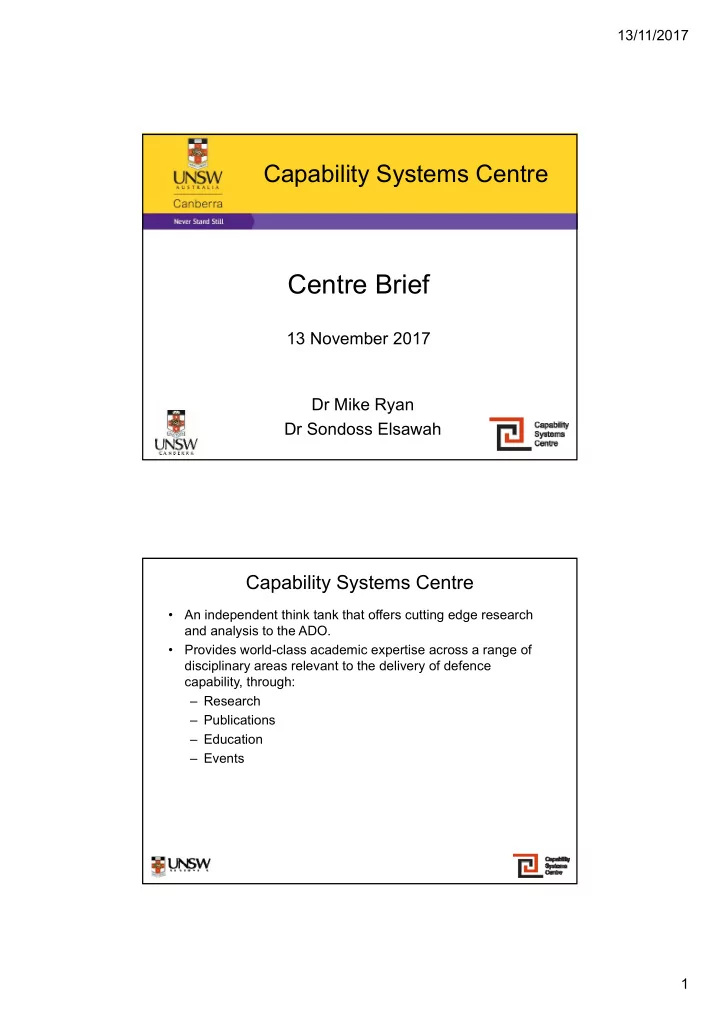
  • An independent think tank that offers cutting edge research

and analysis to the ADO.

  • Provides world-class academic expertise across a range of

disciplinary areas relevant to the delivery of defence capability, through: – Research – Publications – Education – Events

slide-2
SLIDE 2

13/11/2017 2

About the Centre

  • Only Industry Research Centre in UNSW
  • Focused on research related to capability systems:

– Systems science – Systems thinking and modelling – Systems engineering – Requirements engineering – Project management

  • Above-above-the-line assurance that does not encroach on

DSTG and RPDE, nor compete with industry consultancy available from various panels

Our Principal Activities

  • Independent Assurance
  • Research and Independent Advice
  • Education, Training and Events
slide-3
SLIDE 3

13/11/2017 3

Independent Assurance

  • Project and program reviews:

– Schedule Compliance Risk Assessment Methodology (SCRAM)

  • Technical and Engineering Risk Assessments
  • Business and Innovation Assessments

Research and Independent Advice

  • Mentoring
  • Technical Deep Dives and Investigations
  • Technical Risk Reduction
slide-4
SLIDE 4

13/11/2017 4

Research

  • Research team include academics, industry fellows, research

associates, and professional staff.

  • Context removed to focus the research team

– Modelling for Force Design – Capability Analytics – Robustness and Future Proofing – Modularity – Composability – Project Management – Supply Chain Management

Workshops

  • Facilitated by Centre staff
  • Structured top-down approach

– Force design – Business Case Development – Needs Statement development – Design for System Lifecycle (life-cycle cost analysis) – Scope development – OCD development – FPS development

slide-5
SLIDE 5

13/11/2017 5

Education, Training and Events

  • Tailored education and training packages

– Postgraduate programs and courses – Professional education short courses

  • Annual events program plus ad hoc public seminars

Crafting and Implementing Project Execution Strategies

10 August 2017 UNSW Canberra

Force Design Conference

26-27 September 2017 UNSW Canberra

Systems Modelling Conference

28 September 2017 UNSW Canberra

PARARI: Australian Explosive Ordnance Safety Symposium

21-23 November 2017 UNSW Canberra

Centre Staff

  • Director: Dr Michael Ryan
  • Deputy Director: Dr Alan McLucas
  • Centre Manager: Mr Wayne Hargreaves
  • Modelling Lead: Dr Sondoss Elsawah
  • Industry Fellows: 6
  • Research Associates: 5
  • Software Developer: 1
slide-6
SLIDE 6

13/11/2017 6

Centre Focus—Systems Thinking and Modelling Resource-Activity Modelling

slide-7
SLIDE 7

13/11/2017 7

Applications of Resource-Activity Modelling

  • Organisational Problems (workforce planning)
  • Capability Planning (asset and resource requirements)
  • Supportability Analysis (ILS and FIC, LCCA)
  • Technical Trade-off Analyses

System Dynamics Discrete Event Simulation

Basis of Provisioning Maintenance View Fleet View Crew View Supply View Resource Pool Resources Eg Opus

Layers of Modelling Methodology

slide-8
SLIDE 8

13/11/2017 8

Capability

Mission System Support System

(appropriate elements of FIC):

  • Facilities &

Training Areas

  • Support
  • Supplies
  • Industry
  • Personnel
  • Collective

Training

  • Command and

Management

  • Industry

Activities Resources Resources Activities

Business Rules

Capability Planning: Modelling Elements

Resources

Business Rules

Capability Strategies

Model

Performance Measures

Basic Resource Modelling approach

Activities

slide-9
SLIDE 9

13/11/2017 9

Resources

Business Rules

Capability Strategies

R1 R2 A2 A1

Model

Option 1 Option 2 Option 3 … Defined Relationships between Activities, Resources and Performance Measures (PM) that deliver the capability (eg dependencies, timings)

Performance Measures Evaluate and Compare to identify suitable strategy

Basic Resource Modelling approach

Activities

…. ….

Capability Resources Activities R1 A1

Business Rules

A2 A3 R2 R3 R4

Performance Measures

Capability: Model Hierarchy

slide-10
SLIDE 10

13/11/2017 10

Capability Resources Activities

Mission System Operations

Business Rules

Realisation:

Acquisition & Transition

Sustainment Docks Crew Industry Workforce

Activities and Resources are location dependent: enables prioritisation of all resources based on location

Performance Measures Based on elicited relationships for maritime capability operations, development and management

Capability: Basic Maritime Model

Performance Measures

Capability Resources Activities

Mission System

Operations

Business Rules

Realisation:

Acquisition & transition

Sustainment

Docks Crew Industry Workforce

Modify Maintain Upgrade

ID

Dispose

MCD FCD Crew Under Training Trained Crew Shore‐based Support IM

Adaptive dynamic adjustment of decision rules eg adjusting the

  • perating profile of subs

dependent on operational context and resource availability

Model Hierarchy: Adding depth

slide-11
SLIDE 11

13/11/2017 11

Performance Measures

Capability Resources Activities

Mission System

Operations

Business Rules

Realisation:

Acquisition & transition

Sustainment

Docks Crew Industry Workforce

Modify Maintain Upgrade

ILM

Dispose

MCD FCD Crew Under Training Trained Crew Shore‐based Support

Model Hierarchy: Adding depth

Performance Measures

Capability Resources Activities

Mission System Operations

Business Rules

Realisation:

Acquisition & transition

Sustainment Docks Crew Industry Workforce

Modify Maintain Upgrade Dispose

Integration Labs

Model Hierarchy: Adding breadth

slide-12
SLIDE 12

13/11/2017 12

Model Hierarchy: Adding breadth—SoS Model Hierarchy: Adding breadth—SoS

System of Systems (SoS)

slide-13
SLIDE 13

13/11/2017 13

Model Hierarchy: Adding breadth—SoS

SoS Business Rules System of Systems (SoS)

Modelling Toolbox

  • A set of tools (including mapping, simulation, optimization)

developed to design, test and compare a capability’s performance (such as availability) under different: – requirements (e.g. required availability) – resource supply and demand scenarios – resource management decisions (e.g. procurement decisions) – constraints (e.g. maintenance cycles)

slide-14
SLIDE 14

13/11/2017 14

Modelling Toolbox

Modelling Toolbox Modelling for Force Design

slide-15
SLIDE 15

13/11/2017 15

Modelling for Force Design Modelling for Force Design

slide-16
SLIDE 16

13/11/2017 16

DUMMY DATA - EXAMPLE ONLY

UNCLASSIFIED

DUMMY DATA - EXAMPLE ONLY

UNCLASSIFIED

slide-17
SLIDE 17

13/11/2017 17

DUMMY DATA - EXAMPLE ONLY

UNCLASSIFIED

DUMMY DATA - EXAMPLE ONLY

UNCLASSIFIED

slide-18
SLIDE 18

13/11/2017 18

Life-cycle analysis

Lifetime extension decision

Life-cycle analysis

slide-19
SLIDE 19

13/11/2017 19

Trade-off analysis Trade-off analysis

Invest in new maintenance line vs buying a new aircraft No performance difference between 13 and 14 aircrafts

slide-20
SLIDE 20

13/11/2017 20

  • Strategy I: High Acquisition

Low Maintenance

  • Strategy II: Medium Acquisition

Medium Maintenance

  • Strategy III: Low Acquisition

High Maintenance

Exploratory Analysis

Uncertain parameter Range The risk that that an aircraft is lost during operation 0.00026 – 0.00234 (-) Lifetime of aircraft 37440 – 336690 (hour) Total required flying hours with a uniform distribution 12 – 109 (hour/week) Expected time spent by an aircraft in CAP 20 – 28 (week) Time between CAP events 16 – 24 (week) Expected time spent by an aircraft in DM 8 – 10 (week) Time (flying hours) between DM events 200 – 1800 (hour) Expected time spent by an aircraft in OM 3 – 5 (week) Time between OM events 50 – 450 (hour) Cost of OM 0.1 – 2.0 ($ billion)

Strategies Uncertainties

How vulnerable are our strategies in securing average flying hours > 5000 hours and total costs < $1300 billion?

Flying hours

  • bjective

5000 hours Cost

  • bjective

< $1300 B

Exploratory Analysis

slide-21
SLIDE 21

13/11/2017 21

Flying hours

  • bjective

5000 hours Cost

  • bjective

< $1300 B

Exploratory Analysis Exploratory Analysis

42

Flying hours

  • bjective

5000 hours Cost

  • bjective

< $1300 B

Scenarios leading to less than 5000 (hour) average flying hours

strategy Measure of quality Uncertainty Range of failure P- value Medium Acquisition- Medium Maintenance Coverage: 0.54 Time between deep maintenance 330 – 930 (hour) 1.7e-10 Density: 0.88 Cost of operational maintenance 1 – 2 ($ billion) 1.9e-7 Time between

  • perational maintenance

170 – 450 (hour) 4.1e-03 Low Acquisition- High Maintenance Coverage: 0.46 Time between deep maintenance 210 – 960 (hour) 9.1e-16 Density: 0.98 Required rate of effort 39 – 110 (hour/week) 7.1e-6 Time between

  • perational maintenance

140 – 450 (hour) 1.6e-5 Risk of loss 0.00026 – 0.0018 (–) 4.6e-5 Lifetime 44000 – 320000 (hour) 2.5e-2 Time spent in operational maintenance 3 – 4.8 (week) 3.4e-2 Cost of operational maintenance 0.18 – 2 ($ billion) 5.0e-2

Scenarios leading to less than 5000 (hour) average flying hours Scenarios leading to more than 1300 ($ billion) costs

Strategy Measure of quality Uncertainty Range of failure P- value Medium Acquisition- Medium Maintenance Coverage: 0.36 Time between

  • perational

maintenance 50 – 140 (hour) 2.7e-23 Density: 1 Low Acquisition- High Maintenance Coverage: 0.59 Time between

  • perational

maintenance 51 – 220 (hour) 1.4e-6 Density: 0.48 Time between deep maintenance 290 – 1300 (hour) 1.4e-2
slide-22
SLIDE 22

13/11/2017 22

Composable Design

(Value Driven Design) (Trade Space Exploration)

Composability

“Systems” from a bag of parts Short development cycle Cost savings Wide diversity of operational context

slide-23
SLIDE 23

13/11/2017 23

Designing Composable Systems

  • Requires considering large amounts of qualified candidate

designs tied to a value metric such as performance, cost, risk and schedule, for design decisions.

  • To harness the power of composability, a systematic

framework is required.

  • Composable 1U CubeSat Example

Composed “Systems”

slide-24
SLIDE 24

13/11/2017 24

Full Design Tradespace Full Design Tradespace

slide-25
SLIDE 25

13/11/2017 25

Design Sub-Optimization Risk Exploiting the power of composability (Creating higher-value designs)