CEE 690K ENVIRONMENTAL REACTION KINETICS Lecture #13 Kinetic - - PDF document

cee 690k
SMART_READER_LITE
LIVE PREVIEW

CEE 690K ENVIRONMENTAL REACTION KINETICS Lecture #13 Kinetic - - PDF document

4/12/2008 Updated: 12 April 2008 CEE690K Lecture #13 1 Print version CEE 690K ENVIRONMENTAL REACTION KINETICS Lecture #13 Kinetic Theory: Transition State Model & Ionic Strength Effects Brezonik, pp.137-158 Introduction David A.


slide-1
SLIDE 1

4/12/2008 1

CEE690K Lecture #13 1

Updated: 12 April 2008

Print version

CEE 690K

ENVIRONMENTAL REACTION KINETICS Lecture #13

Introduction

David A. Reckhow

Kinetic Theory: Transition State Model & Ionic Strength Effects

Brezonik, pp.137-158

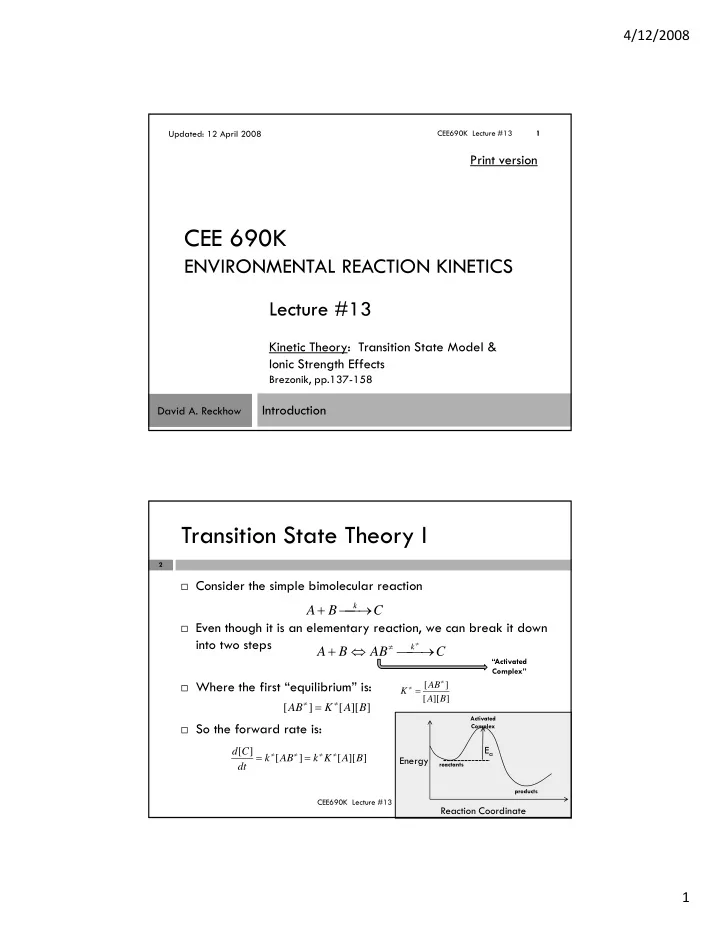
Transition State Theory I

2

Consider the simple bimolecular reaction

C B A

k Even though it is an elementary reaction, we can break it down

into two steps

Where the first “equilibrium” is:

C B A

k

⎯→ ⎯ + C AB B A

k

⎯→ ⎯ ⇔ +

] ][ [ ] [ B A AB K

≠ ≠ =

] ][ [ ] [ B A K AB

≠ ≠ =

“Activated Complex”

David A. Reckhow

CEE690K Lecture #13 So the forward rate is:

] ][ [ ] [

] ][ [ ] [ ] [ B A K k AB k dt C d

≠ ≠ ≠ ≠

= = Energy Reaction Coordinate

reactants products Activated Complex

Ea

slide-2
SLIDE 2

4/12/2008 2

Transition State Theory II

3

Now the transition state is just one bond vibration away from

conversion to products conversion to products

Planks Law: Bond energy must be in the thermal region: So equating, we get:

ν h E vib=

vibrational energy Frequency of vibration (s-1) Planck’s constant (6.62 x 10⁻²⁷ ergs·s)

kT Ebond≈

Bond energy Temperature (ºK) Boltzman constant (1.3807×10⁻¹⁶ ergs ºK-1)

kT h = ν h kT = ν

David A. Reckhow

CEE690K Lecture #13 And since conversion occurs on the next vibration:

kT h = ν h ν

≠ ≠ ≠

= = K h kT K k k

Transition State Theory III

4

Now from basic thermodynamics:

K RT Go l

Δ Go

Δ

And also So: And combining:

K RT Go ln − =

Δ

  • r

RT

e K = S T H Go

Δ Δ Δ

− =

RT H R S e

e K

Δ Δ

=

RT H R S

e e h kT k

≠ Δ ≠ Δ

=

David A. Reckhow

CEE690K Lecture #13

Recall: And substituting back in:

H V P H E

Δ Δ Δ Δ

≈ − =

RT E R S

a

e e h kT k

⎟ ⎠ ⎞ ⎜ ⎝ ⎛ =

≠ Δ

A

slide-3
SLIDE 3

4/12/2008 3

Activation Energy

5

Activation Energy must always be positive

U lik ∆H hi h b i i i

Unlike ∆H, which may be positive or negative Differing reaction rates E

Activated Complex

Ea E

Activated Complex

Ea

David A. Reckhow

CEE690K Lecture #13

Energy Reaction Coordinate

reactants products

Energy Reaction Coordinate

reactants products

f

H E

Δ Δ = f

H E

Δ Δ =

Temperature Effects

6

Arrhenius Equation L k

Log A

2

ln RT E dT k d

a

=

RT Ea

Ae k

/ −

=

( )

2 1 1 2 1 2

ln T RT E T T k k

a

− =

( )

1 2 2

ln H T T K

Δ

− =

David A. Reckhow

CEE690K Lecture #13

Log k 1/T Ea/2.3R

2 1 1

ln T RT K =

Analogous to Van’t Hoff Equation for Equilibria

slide-4
SLIDE 4

4/12/2008 4

Ionic Strength Effects

7

Ion-ion Reactions Based on activated complex theory Based on activated complex theory So let’s look at the equilibrium constant Which means:

C AB B A

k

⎯→ ⎯ ⇔ +

] ][ [ ] [ ] [ B A K k AB k dt C d

≠ ≠ ≠ ≠

= =

B A AB

B A AB B A AB K γ γ γ ] [ ] [ ] [ } }{ { } {

≠ ≠ ≠

= =

⎟ ⎟ ⎠ ⎞ ⎜ ⎜ ⎝ ⎛ =

≠ ≠ AB B A

B A K AB γ γ γ ] ][ [ ] [

  • r

David A. Reckhow

CEE690K Lecture #13 Which means:

⎟ ⎟ ⎠ ⎞ ⎜ ⎜ ⎝ ⎛ =

≠ AB B A

B A K h kT dt C d γ γ γ ] ][ [ ] [ K2

  • (for I=0)

Reactions with charged ions

8

Using the Debye-Huckel Equation

I<0 005

5 . 2

55 . log I zi

i =

− γ I<0.005

Using the Guntelberg Approximation

I<0.01

( )

{ }

5 . 2 5 . 2 2 2 2 2

02 . 1 log 51 . 51 . 51 . log log I z z k I z z z z k k

B A

  • B

A B Z

  • +

= + + − − + =

2 2

2

B B A A

z z z z + +

) 1 ( 55 . log

5 . 5 . 2

I I zi

i

+ = − γ

02 1 log log

5 .

I z z k k

  • +

=

David A. Reckhow

CEE690K Lecture #13

) 1 ( 02 . 1 log log

5 . 2 2

I z z k k

B A

+ + =

slide-5
SLIDE 5

4/12/2008 5

9

David A. Reckhow

CEE690K Lecture #13

I corrections (cont.)

10

Neutral species

I bi

i =

− γ log

Some case studies:

i i

γ g

{ }I

b b b k k

AB B A

− + + =

2 2

log log

David A. Reckhow

CEE690K Lecture #13

slide-6
SLIDE 6

4/12/2008 6

Case Study: TCP

11

Observed loss of 1,1,1-

trichloropropanone in

Note: both TCP and TCAC refer to the 1,1,1-trichloropropanone

trichloropropanone in distribution systems

Lab studies show that

chloroform is the product

Logically presumed to be

a simple hydrolysis

David A. Reckhow

CEE690K Lecture #13

Reckhow & Singer, 1985

“Mechanisms of Organic Halide Formation During Fulvic Acid Chlorination and Implications with Respect to Preozonation”, In Jolley et al., Water Chlorination; Chemistry, Environmental Impact and Health Effect, Volume 5, Lewis.

TCP (cont.)

12

Ionic strength effects

I kH 4 . 1 81 . 4 ln − − = I kH 6 . 08 . 2 log − − =

Rate with chlorine

Increases greatly High intercept

David A. Reckhow

CEE690K Lecture #13

[ ]

T T

HOCl k 32 024 . + =

slide-7
SLIDE 7

4/12/2008 7

13

Gurol & Suffet showed 10x

higher rate constants

Disagreement with prior study

higher rate constants

Phosphate?

David A. Reckhow

CEE690K Lecture #13

14

Putting it together

David A. Reckhow

CEE690K Lecture #13

slide-8
SLIDE 8

4/12/2008 8

Catalysis

15

Homogeneous Catalysis

D fi i i

Definition

Liquid-phase substances which react with the main reactants or

intermediates thereby providing an alternative pathway to products with a lower activation energy or a higher frequency factor. Catalysts are often regenerated over the course of the reaction.

3 2

2 2

+ + + +

+ → + B A B A termolecular reaction? – be skeptical

David A. Reckhow

CEE690K Lecture #13

3 3 3 2 2 2 2 + + + + + + + + + + + +

+ → + + → + + → + B C B C C A C A C A C A

3 2

2 2

+ + + +

+ → + B A B A What really happens:

“C” serves as a sort of charge- transfer facilitator, since “B” does not exist in a divalent state

16

Summary

David A. Reckhow

CEE690K Lecture #13

slide-9
SLIDE 9

4/12/2008 9

17

To next lecture

David A. Reckhow

CEE690K Lecture #13