
SLIDE 1
CEE 577 Lecture #15 10/23/2017 1
Lecture #15 Gas Transfer
(Chapra, L20)
David Reckhow CEE 577 #15 1
Updated: 23 October 2017
Print version
The two film theory
David Reckhow CEE 577 #15 2
Interface pi pg cl ci
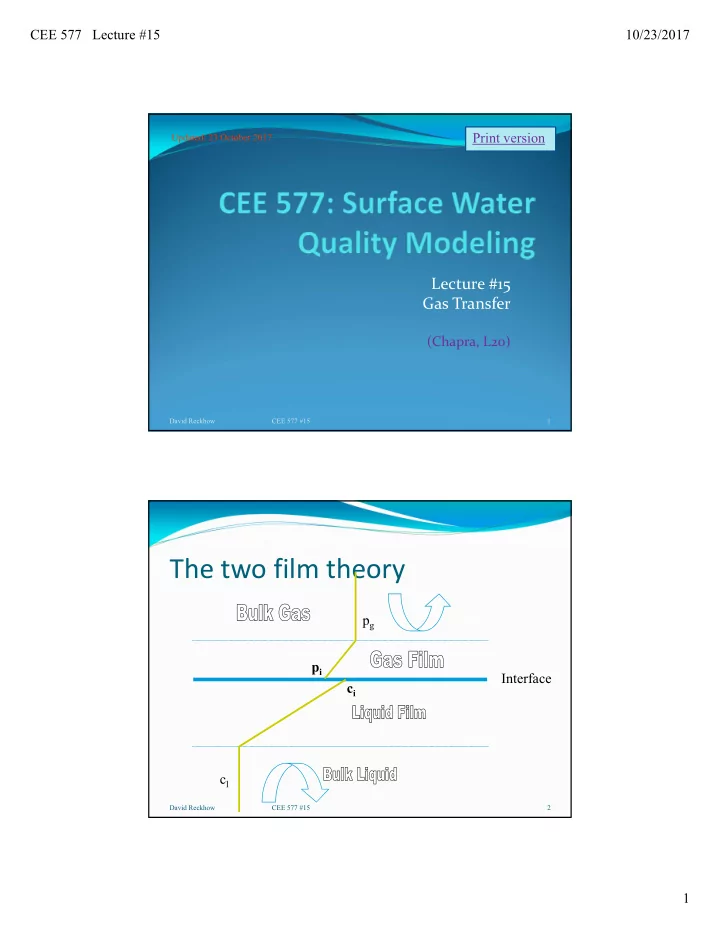
The two film theory p g p i Interface c i c l David Reckhow CEE - - PDF document
CEE 577 Lecture #15 10/23/2017 Print version Updated: 23 October 2017 Lecture #15 Gas Transfer (Chapra, L20) David Reckhow CEE 577 #15 1 The two film theory p g p i Interface c i c l David Reckhow CEE 577 #15 2 1 CEE 577 Lecture #15
CEE 577 Lecture #15 10/23/2017 1
(Chapra, L20)
David Reckhow CEE 577 #15 1
Updated: 23 October 2017
Print version
David Reckhow CEE 577 #15 2
Interface pi pg cl ci
CEE 577 Lecture #15 10/23/2017 2
Flux from the bulk liquid to the interface Flux from the interface to the bulk gas
And the K’s are related to the molecular diffusion
coefficients by:
David Reckhow CEE 577 #15 3
l l i l
J K RT p p
g g a g i
( ) Mass transfer velocities (m/d)
K D z
l l l
K D z
g g g
a
Universal Gas Law Molar concentration
interface concentrations cannot be directly measured
David Reckhow CEE 577 #15 4
l e g v
c H p v J
CEE 577 Lecture #15 10/23/2017 3
According to Henry’s law: And relating this back to the bulk concentration now solving and equating the fluxes, we get (pg. 371 in
David Reckhow CEE 577 #15 5
i e i
p H J K c
i e l l l
v l a e g
The net transfer velocity across the air- water interface (m/d) J K c c
l l i l
( )
l l l i
c K J c
Recall: So:
David Reckhow CEE 577 #15 6
Figure 20.4, page 373 in text. (atm m3 gmol-1) correction
CEE 577 Lecture #15 10/23/2017 4
The reaeration coefficient
represented by ka or k2 or sometimes kLa is the first order rate constant for the loss of D.O. deficit
in a water body
it is equal to the net transfer velocity divided by the
water depth
David Reckhow CEE 577 #15 7
v a
Units of L/T Units of 1/T
Reaeration Constant, ka, depends on:
temperature internal mixing wind induced mixing waterfalls, dams, rapids surface films
David Reckhow CEE 577 #15 8
CEE 577 Lecture #15 10/23/2017 5
David Reckhow CEE 577 #15 9
where D =
DOsat= saturation value of dissolved oxygen, [mg/L] DOact= actual dissolved oxygen value for the stream, [mg/L]
Let us assume that the rate of oxygen entering the stream
through the atmosphere is proportional to the dissolved
the rate of oxygen consumed or leaving the stream is proportional to the amount of organic matter in the stream, expressed as BODu (ultimate BOD).
David Reckhow CEE 577 #15 10
Where: t = time, [days] L = ultimate stream BOD, [mg/L] kd = deoxygenation constant, [day-1] ka = reaeration constant, [day-1]
a d
CEE 577 Lecture #15 10/23/2017 6
reaeration from atmosphere photosynthesis loading from aqueous inflow
point: tributaries non‐point: runoff
CBOD oxidation NBOD oxidation SOD Plant Respiration
David Reckhow CEE 577 #15 11
To next lecture
David Reckhow CEE 577 #15 12