CH 4(G) + 2O 2(G) 2H 2 O (G) + CO 2(G) + energy We know a lot - - PDF document

ch 4 g 2o 2 g 2h 2 o g co 2 g energy
SMART_READER_LITE
LIVE PREVIEW

CH 4(G) + 2O 2(G) 2H 2 O (G) + CO 2(G) + energy We know a lot - - PDF document

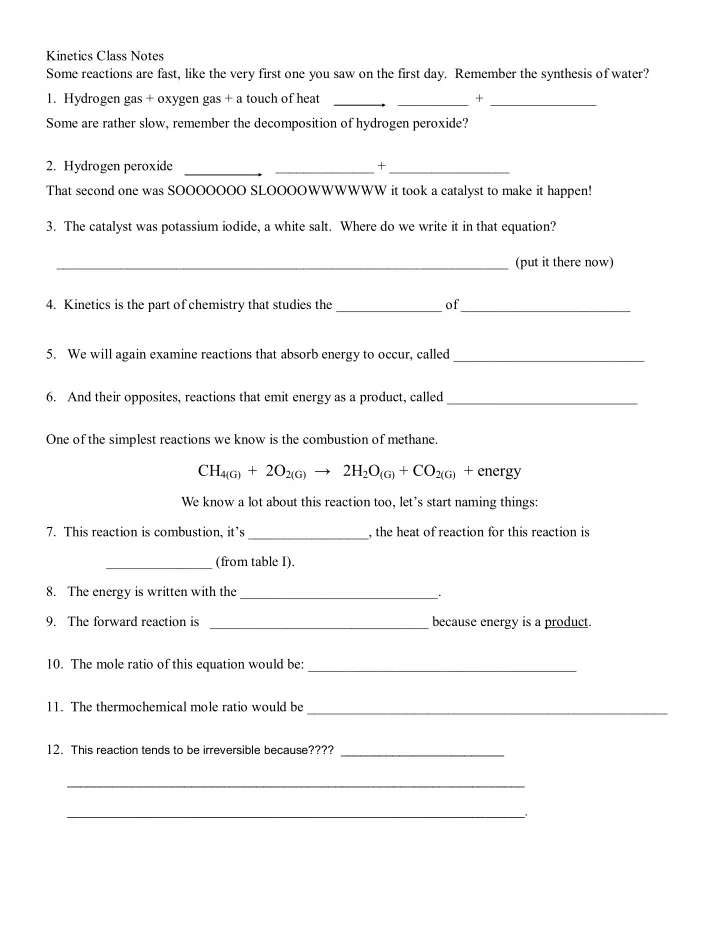
Kinetics Class Notes Some reactions are fast, like the very first one you saw on the first day. Remember the synthesis of water? 1. Hydrogen gas + oxygen gas + a touch of heat __________ + _______________ Some are rather


slide-1
SLIDE 1

Kinetics Class Notes Some reactions are fast, like the very first one you saw on the first day. Remember the synthesis of water?

  • 1. Hydrogen gas + oxygen gas + a touch of heat __________ + _______________

Some are rather slow, remember the decomposition of hydrogen peroxide?

  • 2. Hydrogen peroxide ______________ + _________________

That second one was SOOOOOOO SLOOOOWWWWWW it took a catalyst to make it happen!

  • 3. The catalyst was potassium iodide, a white salt. Where do we write it in that equation?

________________________________________________________________ (put it there now)

  • 4. Kinetics is the part of chemistry that studies the _______________ of ________________________
  • 5. We will again examine reactions that absorb energy to occur, called ___________________________
  • 6. And their opposites, reactions that emit energy as a product, called ___________________________

One of the simplest reactions we know is the combustion of methane.

CH4(G) + 2O2(G) → 2H2O(G) + CO2(G) + energy

We know a lot about this reaction too, let’s start naming things:

  • 7. This reaction is combustion, it’s _________________, the heat of reaction for this reaction is

_______________ (from table I).

  • 8. The energy is written with the ____________________________.
  • 9. The forward reaction is _______________________________ because energy is a product.
  • 10. The mole ratio of this equation would be: ______________________________________
  • 11. The thermochemical mole ratio would be ___________________________________________________
  • 12. This reaction tends to be irreversible because???? _________________________

______________________________________________________________________ ______________________________________________________________________.

slide-2
SLIDE 2

This reaction is different: 2H2O(L) + energy → O2(G) + 2H2(G)

  • 14. For starters, since energy is a reactant, this reaction must be _____________________ with a ______ΔH.
  • 15. In fact, on table I, the actual ΔH is ____________________________(?)
  • 16. Wait a second, is this reaction even on table I? ______________________________________________

________________________________________________________________

  • 17. What is the ΔH then? __________________

This reaction is

  • 18. __________________, and the energy is written with the ____________________________ (it’s ab-

sorbed)

  • 19. It is also ______________________ because it has but one reactant.

Look at 7 reactions. You decide if they are exothermic or endothermic, PLUS you indicate a +ΔH, or a – Δ something special about 25 and 26, see if you can figure that out.

Reactions from table I Actual ΔH Exo

  • r endo

20

2C8H18(L) + 25O2(G) → 16CO2(G) + 18H2O(G)

21

N2(G) + O2(G) → 2NO(G)

22

2C(S) + H2(G) → C2H2(G)

23

4Al(S) + 3O2(G) → 2Al2O3(S)

24

C3H8(G) + 5O2(G) → 3CO2(G) + 4H2O(G)

25 *

CO2(G) → C(S) + O2(G)

26 *

NaOH(S) Na+1

(AQ) + OH–1 (AQ)

slide-3
SLIDE 3

Something special about #25 and #26. See if you can figure that out!

25* CO2(G) → C(S) + O2(G) 26* NaOH(S) Na+1

(AQ) + OH–1 (AQ)

#25 is backwards on table I from the way it’s written here. On Table I the reaction that has carbon + oxygen forming into CO2 and it has a ΔH o f –393.5 kJoules/mole. Since this reaction is written in reverse, we reverse the ΔH also: the ΔH of this reaction is +393.5 kJ/mole. #26 is NOT really a reaction, rather it is a phase change for the NaOH from Solid → Aqueous Let’s talk about driving from our school to Johnson City High School. It’s 7.07 miles according to mapquest.com If you drive there in 20 minutes, you are driving 7.07 miles in 0.33 hours. That works to be about 21.1 miles per hour. The time it takes to drive there is related to, but…

  • 27. ______________________________________________________________________________________
  • 28. ________________________________________________________________________________
  • 29. The rate has a weird unit of ____________________ or it can be understood to be:

The 4 factors that affect the rate of a chemical reaction (NOT the time it takes)

  • 30. _______________________________________ – hotter usually means the reaction will happen faster
  • 31. ______________________________________ – which allows the reactants to react faster
  • 32. _____________________________________ – more stuff, more chance for a reaction to happen
  • 33. Adding a ______________________________

The first three of these will work because of ONE reason, the catalyst works a different way. All of these four ways will increase the rate of a chemical reaction

slide-4
SLIDE 4

The first three factors are all related to making the particles that are in the reaction move faster. Why would more particle motion make for a faster reaction?

  • 34. ____________________________________________________________

What actually happens at the invisible atomic level during a chemical reaction?

  • 35. _______________________ _______________________

With _________________________________and also ____________________ _____________________.

  • 36. When particles don’t collide, they ____________ ___________________.

Let’s review those 4 factors right here, do they increase the likelihood of collisions??

  • 37. Increase in Temperature – YES OR NO
  • 38. Increase reactant surface area – YES OR NO
  • 39. Increase the concentration of the reactants – YES OR NO
  • 40. Adding a catalyst – YES OR NO That’s 3 yes votes in a row, but #4 is a big no here!

What’s a POTENTIAL ENERGY DIAGRAM?

  • 41. Potential energy diagrams _______________________________________________________________

______________________________________________________________________________________

  • 42. They come in two flavors, one for the ________________________ reactions with a _____ΔH and another

kind for the ______________________reactions with a _____ΔH. We will draw on the next pages an exothermic potential energy diagram for the combustion of methane. All exothermic potential energy diagrams “look” similar, the only real difference is the Y axis scale. The exothermic reactions (think now) give off energy as a product, so they must START with more energy than the end up with since much energy is released into the Universe. It’s “lost” from the reaction, but hardly

  • lost. The Law of Conservation of energy is:
  • 43. _________________________________________________________________________________.
slide-5
SLIDE 5

Make sure this diagram has these labels with units, and these definitions below:

  • 45. Potential Energy of Reactants: _________________________________________________
  • 46. Potential Energy of Products: _________________________________________________
  • 47. ΔH: _________________________________________ Here the ΔH is ____________________
  • 48. Activation Energy (AE): _________________________________________________________________
slide-6
SLIDE 6

Endothermic Potential Energy Diagrams

These are nearly identical to the exothermic diagrams, but since the ΔH is a different sign, the graph “goes the

  • ther direction. The Products have MORE POTENTIAL ENERGY than the reactants started with, because

these endothermic reactions ABSORB ENERGY from the environment.

  • 49. Table I shows us that the heat of reaction (ΔH) for the synthesis of C2H2 is __________
  • 50. Draw the curve as shown by your teacher. Label the AE which stands for __________________________
  • 51. Label the PE Reactants and PE Products, which stands for:
  • 52. Indicate the ΔH with an arrow (mark it with a SIGN, as necessary).
slide-7
SLIDE 7
  • 53. Now we will draw the PE Diagram for the synthesis of acetylene C2H2 using Tale I

Include: PE Reactants, PE Products, ΔH (positive or negative), AE, Activated Complex (AC), and a decent title with axis labels with proper units.

  • 54. Do the same for dissolving of NaOH into water (not a real chemical reaction, but is ener-

getic)

slide-8
SLIDE 8
  • 55. Define POTENTIAL ENERGY – _____________________________________________________________
  • 56. Define ACTIVATION ENERGY – _____________________________________________________________
  • 57. Define ACTIVATION COMPLEX – ___________________________________________________________
  • 58. Define ΔH – ___________________________________________________________________________
  • 59. Define POTENTIAL ENERGY DIAGRAM – _____________________________________________________

_____________________________________________________________________________________

  • 60. Draw the PE Diagram for the synthesis of Aluminum Oxide. Make the balanced thermochemical

equa3on your 3tle.

slide-9
SLIDE 9
  • 61. We will attempt to draw the PE diagram for the dissolving of sodium chloride into water. (include all)
  • 62. Draw the PE diagram for the combustion of propane.
  • 63. Where is the “missing energy” if the products have LESS potential energy than the reactants did?

_____________________________________________________________________________________.

slide-10
SLIDE 10
  • 64. Draw the Potential Energy Diagram for the combustion of glucose. (show all parts to diagram)
  • 65. Draw the Potential Energy Diagram for the synthesis of HI gas. (show all parts to diagram)
  • 66. Define Catalyst: ________________________________________________________________________

_____________________________________________________________________________________. _____________________________________________________________________________________.

  • 67. Using DOTTED lines, show the affect of a catalyst on the above two PE diagrams.
slide-11
SLIDE 11

Repeat: How does a catalyst work?

  • 68. _____________________________________________________________________________________
  • 69. _____________________________________________________________________________________

The reaction we watched was how a catalyst (potassium iodide) speeds up the decomposition reaction of hydrogen peroxide into water and oxygen

  • 70. Does the amount of heat energy given off change between the uncatalyzed or catalyzed reactions? ______
  • 71. Does it “seem so”? _______________
  • 72. How would we explain that the reaction with the catalyst “seems to give off so much more energy”?

_____________________________________________________________________________________

  • 73. Are most chemical reactions REVERSIBLE? _____________, but some are because…

_____________________________________________________________________________________

  • 74. What is one of the MOST IMPORTANT reversible reactions? __________________________________
  • 75. Define Dynamic Equilibrium: _____________________________________________________________

_____________________________________________________________________________________.

  • 76. If you have a closed system with this ammonia/nitrogen + hydrogen reaction, and you pump in extra NH3,

what happens?

slide-12
SLIDE 12
  • 77. State LeChatleier’s Principle
  • 78. List the 4 types of chemical stresses you can apply to a dynamic equilibrium

Using this dynamic equilibrium, determine which way the equilibrium must shi: when these par3cular stresses are applied. N2 + 3H2 2NH3 + energy

  • 79. Add nitrogen
  • 80. Add hydrogen
  • 81. Add ammonia
  • 82. Add energy (heat)
  • 83. Add pressure
  • 84. Remove nitrogen
  • 85. Remove hydrogen
  • 86. Remove ammonia
  • 87. Remove energy (cool system)
  • 88. Lower pressure
slide-13
SLIDE 13

We will ASSUME this is a dynamic equilibrium because of the arrows, but in truth the reverse will be not likely. Here we are learning about dynamic equilibrium and the impact different chemical stresses have on a reaction. That this reaction does not normally reverse is to be overlooked now. This is conceptual chemistry, not actual chemistry.

4Al + 3O2 2Al2O3 + Energy

  • 89. Add aluminum oxide
  • 90. Remove oxygen
  • 91. Remove heat (cool system)
  • 92. Add aluminum
  • 93. Add Heat
  • 94. Increase pressure
  • 95. In dynamic equilibrium, pressure ONLY affects ________________________. It has no affect on either

_________________________________ or _____________________________________________.

CH4(G) + 2O2(G) CO2(G) + 2H2O(G) + energy this again is NOT normally reversible, we are just “playing” with concepts here.

  • 96. Add methane
  • 97. Add water
  • 98. Add heat
  • 99. Remove carbon dioxide
  • 100. Remove heat
  • 101. Remove methane
  • 102. Add carbon dioxide
  • 103. Increase pressure
  • 104. Decrease pressure
slide-14
SLIDE 14

Using this diagram, answer the following questions. Use ACTUAL numbers whenever possible.

Time of the reacon Potenal Energy kJ/mole

  • 105. Is this an exo or endothermic reaction? _________________________
  • 106. What is the potential energy of the activated complex? ___________________________
  • 107. What is the PE of the products? ______________________________
  • 108. What is the ΔH? __________________________________
  • 109. What would be a possible activation energy with a catalyst? _______________________________
  • 110. What is the PE of the reactants? _____________
  • 111. What is the activation energy

for this reaction? ____________________

  • 112. Is this reaction exo or endothermic? ________
  • 114. What are possible AE values for this reaction with a catalyst? ___________________________
  • 115. What is the ΔH for this reaction? __________________________
  • 116. Would the ΔH for this reaction change with a catalyst? ____________________________
slide-15
SLIDE 15

This is NOT a real chemical reaction but you should be able to manage with the symbols.

3A(G) + B(S) 3C(G) + D(G) + energy

  • 118. Add heat
  • 119. Add B
  • 120. Inc. pressure
  • 121. Remove D
  • 122. Add C

123.State LeChatleier's Principle (again, without looking) this is important to memorize.

  • 124. State the four types of chemical stresses you could apply to a dynamic equilibrium to upset it.
  • 125. What are the 4 things you could do to speed up a chemical reaction? Three go together (why?) and
  • ne works differently (how?)
  • 126. Compare or Rank these phases of matter for entropy: Water Steam Ice
  • 127. If all of these particles are at the same temperature (305 K) and the same pressure (105 kPa),

rank them for most to least entropy? Carbon monoxide octane Sucrose (table sugar)

  • 128. What does the NYS Chemistry Curriculum have to say that might be worth memorizing as well?