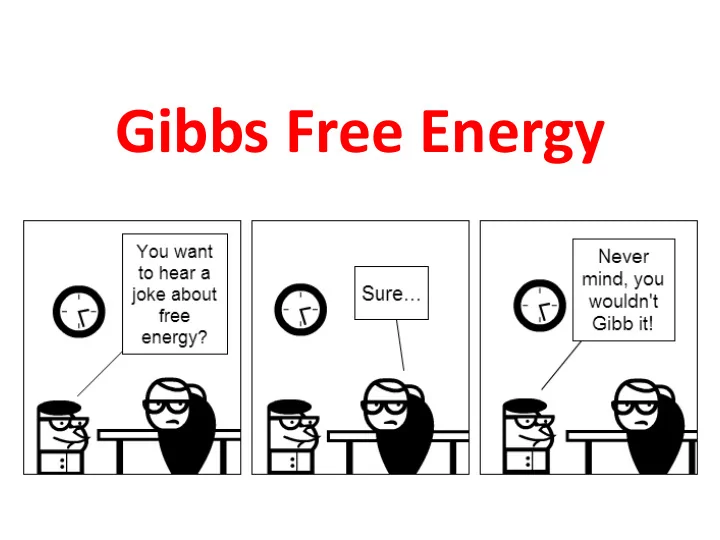
Gibbs Free Energy What is free energy? Amount of available energy - - PowerPoint PPT Presentation

gibbs free energy
SMART_READER_LITE
LIVE PREVIEW

Gibbs Free Energy What is free energy? Amount of available energy - - PowerPoint PPT Presentation

Gibbs Free Energy What is free energy? Amount of available energy to do work Equation for Gibbs free energy: G = H - TS G = H - TS G change in Gibbs free energy H change in enthalpy (total energy of a


slide-1
SLIDE 1

Gibbs Free Energy

slide-2
SLIDE 2

What is free energy?

  • Amount of available energy to do work
  • Equation for Gibbs free energy:

∆G = ∆H - T∆S

slide-3
SLIDE 3

∆G = ∆H - T∆S

  • ∆G – change in Gibbs free energy
  • ∆H – change in enthalpy (total energy of a

system)

  • T – temperature in Kelvin (°C + 273)
  • ∆S – change in entropy (measure of disorder
  • f a system)
slide-4
SLIDE 4

Spontaneous Reaction

  • A “spontaneous” reaction means that the

reaction is thermodynamically capable of happening (reacting)

  • It DOES NOT mean “quickly”
slide-5
SLIDE 5

What does a change in Gibbs free energy (∆G ) mean?

  • If ∆G is less than 0, then the reaction will

release energy (exergonic) – reactions occur spontaneously

  • If ∆G is greater than 0, then the reaction

absorbs energy (endergonic) – reactions do not occur spontaneously

  • If ∆G is equal to 0, then the system is at

equilibrium

slide-6
SLIDE 6
slide-7
SLIDE 7

Coupled Reactions

(Watch this 6 minute Bozeman Video on Coupled Reactions)

  • One reaction is used to power another

reaction OR

  • The transfer of energy from an exergonic

process to an endergonic process

slide-8
SLIDE 8

Cellular Respiration

  • Exergonic reaction
  • ∆G = - 686 kcal/mol of energy
  • ∆G < 0, the reaction releases energy when

glucose is metabolized

slide-9
SLIDE 9

Photosynthesis

  • Endergonic reaction
  • ∆G = 686 kcal/mol of energy
  • ∆G > 0, the reaction absorbs energy from the

sun and stores the energy in the chemical bonds of glucose

slide-10
SLIDE 10

Synthesis of ATP

  • ADP + Pi → ATP
  • Endergonic
  • ∆G = 7.3 kcal/mol of energy
  • ∆G > 0, the reaction absorbs energy when ADP

is bonded to inorganic phosphate to produce ATP

slide-11
SLIDE 11

Hydrolysis of ATP

  • ATP → ADP + Pi
  • Exergonic
  • ∆G = - 7.3 kcal/mol of energy
  • ∆G < 0, the reaction releases energy when the

terminal (last) inorganic phosphate is removed from ATP to produce ADP

slide-12
SLIDE 12

ADP + Pi ATP