The Gibbs Sampler CSE 527 Lecture 9 Lawrence, et al. Detecting - - PowerPoint PPT Presentation

the gibbs sampler cse 527 lecture 9
SMART_READER_LITE
LIVE PREVIEW

The Gibbs Sampler CSE 527 Lecture 9 Lawrence, et al. Detecting - - PowerPoint PPT Presentation

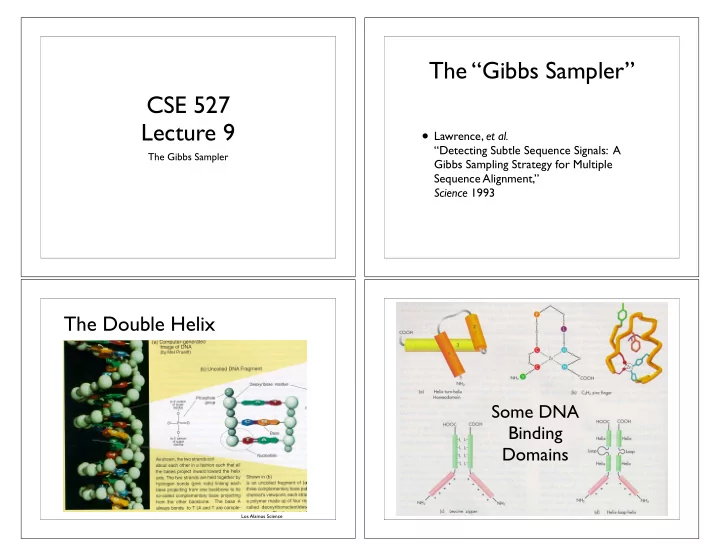
The Gibbs Sampler CSE 527 Lecture 9 Lawrence, et al. Detecting Subtle Sequence Signals: A The Gibbs Sampler Gibbs Sampling Strategy for Multiple Sequence Alignment, Science 1993 The Double Helix Some DNA Binding Domains


slide-1
SLIDE 1

The Gibbs Sampler

CSE 527 Lecture 9

  • Lawrence, et al.

“Detecting Subtle Sequence Signals: A Gibbs Sampling Strategy for Multiple Sequence Alignment,” Science 1993

The “Gibbs Sampler”

The Double Helix

Los Alamos Science

Some DNA Binding Domains

slide-2
SLIDE 2
  • Geman & Geman, IEEE PAMI 1984
  • Hastings, Biometrika, 1970
  • Metropolis, Rosenbluth, Rosenbluth, Teller,

& Teller, “Equations of State Calculations by Fast Computing Machines,” J. Chem. Phys. 1953

  • Josiah Williard Gibbs, 1839-1903, American

physicist, a pioneer of thermodynamics

Some History How to Average

An old problem:

  • n random variables:
  • Joint distribution (p.d.f.):
  • Some function:
  • Want Expected

Value:

x1, x2, . . . , xk P(x1, x2, . . . , xk) E(f(x1, x2, . . . , xk)) f(x1, x2, . . . , xk)

slide-3
SLIDE 3

How to Average

  • Approach 1: direct integration

(rarely solvable analytically, esp. in high dim)

  • Approach 2: numerical integration

(often difficult, e.g., unstable, esp. in high dim)

  • Approach 3: Monte Carlo integration

sample and average:

E(f(x1, x2, . . . , xk)) =

  • x1
  • x2

· · ·

  • xk

f(x1, x2, . . . , xk) · P(x1, x2, . . . , xk)dx1dx2 . . . dxk

E(f( x)) ≈ 1

n

n

i=1 f(

x(i))

  • x(1),

x(2), . . . x(n) ∼ P( x)

Markov Chain Monte Carlo (MCMC)

  • Independent sampling also often hard, but

not required for expectation

  • MCMC w/ stationary dist = P
  • Simplest & most common: Gibbs Sampling
  • Algorithm

for t = 1 to for i = 1 to k do :

P(xi | x1, x2, . . . , xi−1, xi+1, . . . , xk)
xt+1,i ∼ P(xt+1,i | xt+1,1, xt+1,2, . . . , xt+1,i−1, xt,i+1, . . . , xt,k)

t+1 t

  • Xt+1 ∼ P(

Xt+1 | Xt)

1 3 5 7 9 11 ... Sequence i

  • Yi,j
  • Input: again assume sequences s1, s2, ..., sk

with one length w motif per sequence

  • Motif model: WMM
  • Parameters: Where are the motifs?

for 1 i k, have 1 xi |si|-w+1

  • “Full conditional”: to calc

build WMM from motifs in all sequences except i, then calc prob that motif in ith seq

  • ccurs at j by usual “scanning” alg.

P(xi = j | x1, x2, . . . , xi−1, xi+1, . . . , xk)

slide-4
SLIDE 4

Randomly initialize xi’s for t = 1 to for i = 1 to k discard motif instance from si; recalc WMM from rest for j = 1 ... |si|-w+1 calculate prob that ith motif is at j: pick new xi according to that distribution

Similar to MEME, but it would average over, rather than sample from

P(xi = j | x1, x2, . . . , xi−1, xi+1, . . . , xk)

  • Burnin - how long must we run the chain

to reach stationarity?

  • Mixing - how long a post-burnin sample

must we take to get a good sample of the stationary distribution? (Recall that individual samples are not independent, and may not “move” freely through the sample

  • space. Also, many isolated modes.)

Issues

  • “Phase Shift” - may settle on suboptimal

solution that overlaps part of motif. Periodically try moving all motif instances a few spaces left or right.

  • Algorithmic adjustment of pattern width:

Periodically add/remove flanking positions to maximize (roughly) average relative entropy per position

  • Multiple patterns per string

Variants & Extensions

slide-5
SLIDE 5