CEE 690K ENVIRONMENTAL REACTION KINETICS Lecture #10 Special - - PDF document

cee 690k
SMART_READER_LITE
LIVE PREVIEW

CEE 690K ENVIRONMENTAL REACTION KINETICS Lecture #10 Special - - PDF document

4/12/2008 Updated: 12 April 2008 CEE690K Lecture #10 1 Print version CEE 690K ENVIRONMENTAL REACTION KINETICS Lecture #10 Special Topics: Pharmaceuticals in Water I Primary Literature (e.g., Westerhoff et al., 2005) Introduction David


slide-1
SLIDE 1

4/12/2008 1

CEE690K Lecture #10 1

Updated: 12 April 2008

Print version

CEE 690K

ENVIRONMENTAL REACTION KINETICS Lecture #10

Introduction

David A. Reckhow

Special Topics: Pharmaceuticals in Water I

Primary Literature (e.g., Westerhoff et al., 2005)

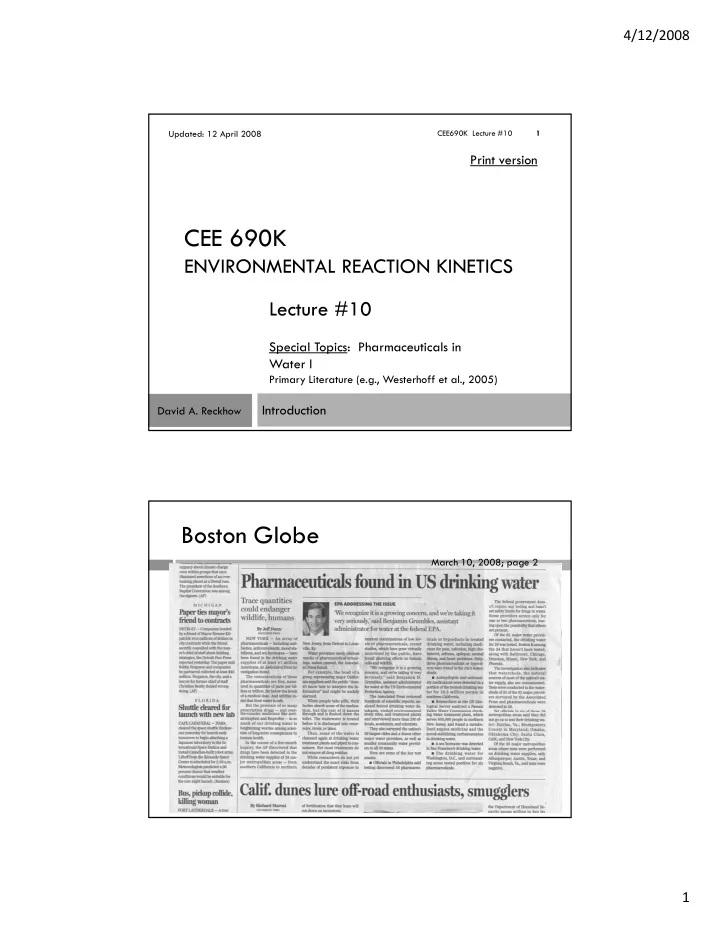
Boston Globe

March 10, 2008; page 2

slide-2
SLIDE 2

4/12/2008 2

3

EDCs and PPCPs

Why study these? Di

t i t h h lth

Direct impacts on human health

Maybe not the most important?

Public perception

Becoming a very sensitive issue

Direct impacts on ecological health

Well documented: feminization of fish, etc.

Tracers of wastewater contamination Indicators & promoters of antibiotic resistance Precursors to more Hazardous DBPs

4

WW Tracers

WW contributions: Near conservative PPCP tracers Primidone Primidone Others? Carbamazepine, caffeine, etc. Raw vs Treated: Chiral PPCPs Racemic mixtures that undergo enantioselective

biodegradation

Analysis of enantiomeric fractions may permit discrimination

b t d t t d WW t ib ti between raw and treated WW contributions

Propranolol example: Fono & Sedlak, 2005 [ES&T]

slide-3
SLIDE 3

4/12/2008 3

Sources (2)

6

Primidone

Krasner et al., 2006 WQTC

slide-4
SLIDE 4

4/12/2008 4

7

Antibiotic Resistance

One of the most critical human health challenges of

the 21st century (WHO report) y ( p )

>1,000,000 Americans infected each year 14,000 deaths annually Cause: antibiotics are everywhere Up to 95% of antibiotics in US are excreted in an unaltered

state

Over prescription in humans Heavy use in agriculture Result: Antibiotic resistant genes (ARGs) are ubiquitous

in the aquatic environment

e.g., Pruden et al., 2006 [ES&T]

8

Precursors to NDMA??

NDMA (nitrosodimethylamine)

is a very potent probable human carcinogen

HN CH3 CH3 ClN CH3 CH3 HOCl

human carcinogen

Formation of NDMA from

chloramination of dimethylamine (DMA)

Not enough DMA to account for

anything much

NDMA formation is much

higher in municipal WW than

NH2Cl NH3 DMA DMCA

in pristine natural waters

Major precursor is not

natural???

N CH3 CH3 N CH3 CH3 N CH3 CH3 H2N ON NDMA UDMH NH2Cl

slide-5
SLIDE 5

4/12/2008 5

9

The Unnatural Precursor?

Ranitidine (Zantac) 63% conversion to NDMA Schmidt et al., 2006 [WQTC] Introduced in 1981, largest selling prescription drug by 1988 Stomach ulcers and esophageal reflux Mean concentration of 3000 ng/L estimated for raw municipal WW

(national average) (national average)

Sedlak 2005 AWWARF report 450 ng/L formation in raw WW expected Unknowns: how much does this persist in treatment and in the

environment?

10

USGS Survey

138 stream sampling sites K l i t l 2002 Kolpin et al., 2002

slide-6
SLIDE 6

4/12/2008 6

11

Removal by coagulation & disinfection/oxidation

Coagulation Generally no Generally no

Nearly all EDCs and PPCPs are too small or too low in functional

group density to be susceptible

Oxidation/Disinfection Yes to some Chlorination: primary amines and activated aromatics

(especially phenolics) and activated aliphatics (especially phenolics) and activated aliphatics

Ozonation: Many aromatics; aliphatics if hydroxyl radicals

are formed

Oxidation & Biofiltration Almost nothing is known

12 Ozonation

Removal by ozone

Westerhoff et al., 2005 [EST 39:17:6649]

slide-7
SLIDE 7

4/12/2008 7

13 Selected Compounds

EDC PhAC WW associated 17β-estradiol Atorvastatin or Nitrosodimethylamine β Gemfibrozil y Estriol Naproxen Estrone Sulfamethoxazole 17α-ethinylestradiol Trimethoprim Perchlorate Atenolol Ranitidine Primidone?

14

Beta-Blockers: Atenolol

Atenolol is a representative of the group of Beta-blockers, for treating

cardiovascular disease.

This particular drug has been in use since 1976. Sedlak and co-workers (2005) estimate a nationwide average raw

municipal wastewater concentration of about 1500 ng/L.

This compound is rather unreactive with free chlorine, as it lacks activated

aromatic structures as well as reactive nitrogen sites.

It does not appear to have been tested for reaction with ozone May be used as an indicator of treated vs raw WW as propranolol was

by Fono & Sedlak

slide-8
SLIDE 8

4/12/2008 8

15

Statins: Atorvastatin

This compound is more commonly known as

Lipitor, and it is representative of a larger group of cholesterol-reducing drugs called statins.

It does not appear to have been tested for

removal by coagulation or reaction with either chlorine or ozone.

Based on its structure, we would expect it to

b li htl ti ith b t littl be slightly reactive with ozone, but little affected by the other treatments

16

Reproductive Hormones: 17b-estradiol, 17a- ethinylestradiol, Estrone, Estriol

  • Three of these four (17b-estradiol, Estrone, Estriol) are naturally occurring human
  • estrogens. Ethinylestradiol is the estrogen component of oral contraceptives.

All four of these compounds have the fundamental steroid skeleton, with many similarities in

positioning of the functional groups.

All f h d idl d d b f hl i

Estriol

  • All of these compounds are rapidly destroyed by free chlorine

(Westerhoff et al., 2005; Deborde et al., 2004). It’s quite likely that the phenolic “A” ring

is the initial site of attack and the most reactive structure within each of these compounds.

  • Reaction with chlorine should result in large fragments that are partially oxygenated
  • r even halogenated.

Estradiol has been found to produce at least 7 daughter products that persist in treated

waters (Irmak et la., 2005; Hu et al., 2003)
slide-9
SLIDE 9

4/12/2008 9

17

Non-steroidal anti-inflammatory: Naproxen

Naproxen is a common arthritis treatment, intended to reduce

pain and inflammation.

Its mean concentration in US wastewaters has been estimated to

be about 2400 ng/L (Sedlak et al 2006) Limited occurrence be about 2400 ng/L (Sedlak et al., 2006). Limited occurrence data has centered around 300 ng/L in US wastewaters

It is quite reactive with ozone, and surprisingly reactive with

chlorine too.

Probably many daughter products

18

Sulfonamide Antibiotic: Sulfamethoxazole

This antibiotic is a major component of Bactrim. Its median concentration in treated wastewaters has

been mesured at 1400 ng/L, a value quite close to its nationwide estimated level of 3200 ng/L. nationwide estimated level of 3200 ng/L.

This compound is moderately reactive with free

chlorine and ozone

slide-10
SLIDE 10

4/12/2008 10

19

Bacteriostatic Antibiotic: Trimethoprim

This particular antibiotic is widely used for treatment or urinary

tract infections. It is also a member of the group of dihydrofolate reductase inhibitors.

It is quite prevalent in US wastewaters (500 ng/L median;

/ 1500 ng/L estimated nationwide).

It is extremely reactive with free chlorine, as would be

expected from its structure. It is quite likely that the molecule is extensively degraded and oxidized by chlorine or ozone treatments.

slide-11
SLIDE 11

4/12/2008 11

Removal by Residual Disinfectants

>80%

Acetaminophen Estradiol Estriol Estrone Ethynyestradiol

Snyder et al., 2007 [AwwaRF report]

20-50% 50-80% >

moval by Chloramines

Ethynyestradiol Triclosan Benzo(a)pyrene Diclofenac Oxybenzone Hydrocodone Galaxolide

<20% 20-50% 50-80% >80%

Removal by Free Chlorine

<20%

Re

Iopromide Trimethoprim Ibuprofen Testosterone Gemfibrozil TCEP g-BHC Sulfamethoxazole Fluoxetine Progesterone Fluorene Pentoxifylline Erythromycin Naproxen Dilantin Musk Ketone Diazepam Metolachlor DEET DDT Meprobamate Carbamazepine Caffeine Atrazine Androstenedione

Rates Pinkston & Sedlak 2004 Pinkston & Sedlak, 2004

slide-12
SLIDE 12

4/12/2008 12

Aromatic EDCs

Rates

D b d l 2004

Deborde et al., 2004

  • Env. Sci Technol.

38:5577

Aromatic EDCs (cont.)

Rates D b

d t l 2004

Deborde et al., 2004

products H HOCl EDC

k

⎯→ ⎯ + +

+

1

products HOCl EDC

k

⎯→ ⎯ +

2

products HOCl EDC

k

⎯→ ⎯ +

3

slide-13
SLIDE 13

4/12/2008 13

25

To next lecture

David A. Reckhow

CEE690K Lecture #10