CEDIC March 6-8, 2015 Baader Planetarium GmbH Bernd - - PowerPoint PPT Presentation

cedic march 6 8 2015 baader planetarium gmbh bernd koch
SMART_READER_LITE
LIVE PREVIEW

CEDIC March 6-8, 2015 Baader Planetarium GmbH Bernd - - PowerPoint PPT Presentation

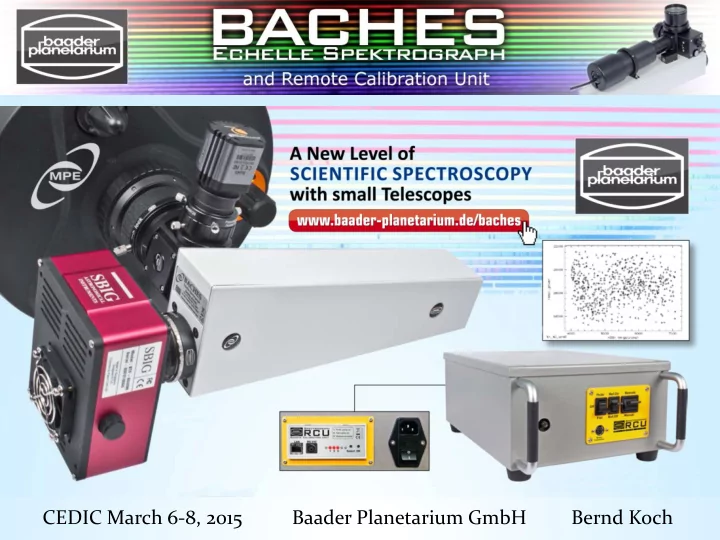
CEDIC March 6-8, 2015 Baader Planetarium GmbH Bernd Koch The BACHES Echelle Spectrograph BACHES is the acronym for BAsic ECHElle Spectrograph Echelle is a french word, which means ladder Developed by ESO


slide-1
SLIDE 1

CEDIC March 6-8, 2015 Baader Planetarium GmbH Bernd Koch

slide-2
SLIDE 2

CEDIC March 6-8, 2015 Baader Planetarium GmbH Bernd Koch

The BACHES Echelle Spectrograph

 BACHES is the acronym for BAsic ECHElle Spectrograph  „Echelle“ is a french word, which means „ladder“  Developed by ESO Scientists and Baader Planetarium GmbH

slide-3
SLIDE 3

A conventional Blazed Grating Spectrograph

CEDIC March 6-8, 2015 Baader Planetarium GmbH Bernd Koch

m = -1 m = 0 m = 1 m = 2 m = 3 Fluorescent lamp Higher orders order not useable due to overlap Designed for maximum efficiency in the first order

Additive interference occurs when the total path difference D of light from adjacent slits (S1) and (S2) is an integer multiple of the wavelength λ: The phase is then the same, so the beams’ intensity add.

D = m l = D1 – D2 = g(sin a - sin b) with m =0, ±1, ±2 g: Groove spacing, m: Order number

S1 S2

slide-4
SLIDE 4

A conventional Blazed Grating Spectrograph

CEDIC March 6-8, 2015 Baader Planetarium GmbH Bernd Koch

First order Zero order First order Second order Third order Fluorescent lamp ‘‘wasted space“ on CCD sensor Low resolution when a full frame spectrum from 360 nm to 1000 nm is required Higher orders order not useable due to overlap Designed for maximum efficiency in the first order ‘‘wasted space“ on CCD sensor High resolution only in a small wavelength range due to limited size on a CCD sensor

slide-5
SLIDE 5

CEDIC March 6-8, 2015 Baader Planetarium GmbH Bernd Koch

The Echelle Optical Path

BACHES echelle grating in high

  • rder

Incoming light Mixed color Cross Disperser separating the orders ca. #33 to ca. #58 High resolution spectrum separated from about 390 nm (top) to 760 nm (bottom)

Adopted from C. R. Kitchin, Optical Astronomical Spectroscopy

slide-6
SLIDE 6

CEDIC March 6-8, 2015 Baader Planetarium GmbH Bernd Koch

BACHES High Resolution Solar Spectrum („Daylight“)

slide-7
SLIDE 7

CEDIC March 6-8, 2015 Baader Planetarium GmbH Bernd Koch

ThAr Lamp Guiding Port Starlight BACHES Calibration Version Standard

slide-8
SLIDE 8

CEDIC March 6-8, 2015 Baader Planetarium GmbH Bernd Koch

BACHES Calibration Version Professional with Remote Calibration Unit RCU

RCU with ThAr Reference & Halogen Flatfield lamp Optical fiber Remote Flip-Mirror control SBIG ST-1603ME Focusing

slide-9
SLIDE 9

CEDIC March 6-8, 2015 Baader Planetarium GmbH Bernd Koch

  • 1. Glass fiber coupler
  • 2. Power connector for motor
  • 3. Three position switch for OFF, Th/Ar ON, or flat-field ON
  • 4. Two position switch for coupling calibration mirror in BACHES
  • 5. Two position switch to select remote and manual operation

Rear panel Remote control by Internet Browser

slide-10
SLIDE 10

CEDIC March 6-8, 2015 Baader Planetarium GmbH Bernd Koch

Calibration of BACHES Echelle Spectra

  • Prominent spectral lines from

Ca II (K) to Ha

  • Daylight spectrum -> Class G2 V
  • 1. Manual calibration by identification of

spectral lines -> selected orders only

slide-11
SLIDE 11

CEDIC March 6-8, 2015 Baader Planetarium GmbH Bernd Koch

Calibration of BACHES Echelle Spectra

  • The Thorium-Argon spectrum

provides about 1,000 precisely known wavelengths for calibration

  • Daylight spectrum -> Class G2 V
  • 2. Manual wavelength calibration with the Thorium-Argon reference lamp
slide-12
SLIDE 12

CEDIC March 6-8, 2015 Baader Planetarium GmbH Bernd Koch

Calibration of BACHES Echelle Spectra

Daylight spectrum -> Class G2 V

  • 3. Semi-automatic calibration with the RCU‘s Thorium-Argon reference lamp

and flatfield lamp with ESO-MIDAS  ThAr reference spectrum  Halogen flatfield spectrum

slide-13
SLIDE 13

CEDIC March 6-8, 2015 Baader Planetarium GmbH Bernd Koch

Calibration of BACHES Echelle Spectra

Daylight spectrum, BACHES 25mm slit

  • 4. Result: Fully calibrated daylight spectrum from 3923Å to 7084Å (KAF-1603ME)
  • Wavelength calibration: Mean RMS= 0.015Å
slide-14
SLIDE 14

CEDIC March 6-8, 2015 Baader Planetarium GmbH Bernd Koch

Calibration of BACHES Echelle Spectra

  • 5. How to semi-automatically calibrate with ESO-MIDAS -> Video Tutorial

Wavelength calibration of the emission line star zeta Tau: www.baader-planetarium.de/baches/

slide-15
SLIDE 15

CEDIC March 6-8, 2015 Baader Planetarium GmbH Bernd Koch

Calibration of BACHES Echelle Spectra

  • 6. How to semi-automatically calibrate with ESO-MIDAS -> manual & exercise files:

www.baader-planetarium.de/baches/download/midas_manual_e.pdf

slide-16
SLIDE 16

CEDIC March 6-8, 2015 Baader Planetarium GmbH Bernd Koch

Scientific Application of BACHES Echelle

  • Emission line stars: Simultaneous monitoring of variations in stellar flux at

different wavelengths Example: Semi‐detached binary star beta Lyrae. Purpose: Tracking variations during a binary orbit silmultaneously at different wavelengths in the BACHES echelle spectrum

slide-17
SLIDE 17

CEDIC March 6-8, 2015 Baader Planetarium GmbH Bernd Koch

Scientific Application of BACHES Echelle

www.baader-planetarium.de/baches/

slide-18
SLIDE 18

CEDIC March 6-8, 2015 Baader Planetarium GmbH Bernd Koch

Scientific Application of BACHES Echelle

http://www.baader-planetarium.de/baches/download/beta_lyr_baches_poster_e2_bernd_koch.pdf

slide-19
SLIDE 19

CEDIC March 6-8, 2015 Baader Planetarium GmbH Bernd Koch

Scientific Application of BACHES Echelle

The average spectral resolution of R=18,000 and precisely coverage of the full visible spectrum from 392nm to 760nm make BACHES scientifically useful for the

  • Analysis of stars with orbiting Exoplanets. The planet influence on the radial

velocity of the parent star by approximately Jupiter‐sized exoplanets can be studied by means of spectroscopy (revealing a lower mass limit) and photometry (planet size and orbit)

slide-20
SLIDE 20

CEDIC March 6-8, 2015 Baader Planetarium GmbH Bernd Koch

Thank you very much for your attention

BACHES Website: www.baader-planetarium.de/baches/ Contact: Bernd Koch B.Koch@Baader-Planetarium.de Bernd.Koch@astrofoto.de

a Cyg (Deneb)

Variable Ha line due to stellar wind 2014-09-08