Categorial Semantics for FILL Proof Theory of FILL: problem and - - PDF document

categorial semantics for fill proof theory of fill
SMART_READER_LITE
LIVE PREVIEW

Categorial Semantics for FILL Proof Theory of FILL: problem and - - PDF document

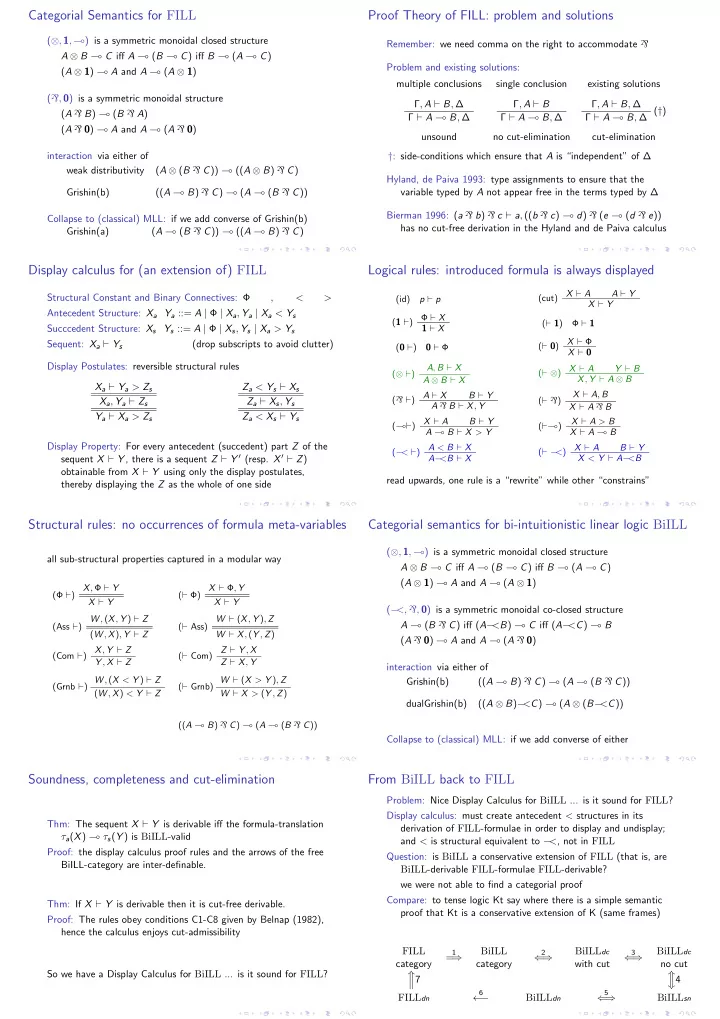
Categorial Semantics for FILL Proof Theory of FILL: problem and solutions ( , 1 , ) is a symmetric monoidal closed structure Remember: we need comma on the right to accommodate ` A B C iff A ( B C ) iff B ( A C )


slide-1
SLIDE 1

Categorial Semantics for FILL

(⊗, 1, ⊸) is a symmetric monoidal closed structure A ⊗ B ⊸ C iff A ⊸ (B ⊸ C) iff B ⊸ (A ⊸ C) (A ⊗ 1) ⊸ A and A ⊸ (A ⊗ 1) (`, 0) is a symmetric monoidal structure (A ` B) ⊸ (B ` A) (A ` 0) ⊸ A and A ⊸ (A ` 0) interaction via either of weak distributivity (A ⊗ (B ` C)) ⊸ ((A ⊗ B) ` C) Grishin(b) ((A ⊸ B) ` C) ⊸ (A ⊸ (B ` C)) Collapse to (classical) MLL: if we add converse of Grishin(b) Grishin(a) (A ⊸ (B ` C)) ⊸ ((A ⊸ B) ` C)

Proof Theory of FILL: problem and solutions

Remember: we need comma on the right to accommodate ` Problem and existing solutions: multiple conclusions single conclusion existing solutions Γ, A ⊢ B, ∆ Γ ⊢ A ⊸ B, ∆ Γ, A ⊢ B Γ ⊢ A ⊸ B, ∆ Γ, A ⊢ B, ∆ (†) Γ ⊢ A ⊸ B, ∆ unsound no cut-elimination cut-elimination †: side-conditions which ensure that A is “independent” of ∆ Hyland, de Paiva 1993: type assignments to ensure that the variable typed by A not appear free in the terms typed by ∆ Bierman 1996: (a ` b) ` c ⊢ a, ((b ` c) ⊸ d) ` (e ⊸ (d ` e)) has no cut-free derivation in the Hyland and de Paiva calculus

Display calculus for (an extension of) FILL

Structural Constant and Binary Connectives: Φ , < > Antecedent Structure: Xa Ya ::= A | Φ | Xa, Ya | Xa < Ys Succcedent Structure: Xs Ys ::= A | Φ | Xs, Ys | Xa > Ys Sequent: Xa ⊢ Ys (drop subscripts to avoid clutter) Display Postulates: reversible structural rules Xa ⊢ Ya > Zs Xa, Ya ⊢ Zs Ya ⊢ Xa > Zs Za < Ys ⊢ Xs Za ⊢ Xs, Ys Za < Xs ⊢ Ys Display Property: For every antecedent (succedent) part Z of the sequent X ⊢ Y , there is a sequent Z ⊢ Y ′ (resp. X ′ ⊢ Z)

  • btainable from X ⊢ Y using only the display postulates,

thereby displaying the Z as the whole of one side

Logical rules: introduced formula is always displayed

(id) p ⊢ p X ⊢ A A ⊢ Y (cut) X ⊢ Y Φ ⊢ X (1 ⊢) 1 ⊢ X (⊢ 1) Φ ⊢ 1 (0 ⊢) 0 ⊢ Φ X ⊢ Φ (⊢ 0) X ⊢ 0 A, B ⊢ X (⊗ ⊢) A ⊗ B ⊢ X X ⊢ A Y ⊢ B (⊢ ⊗) X, Y ⊢ A ⊗ B A ⊢ X B ⊢ Y (` ⊢) A ` B ⊢ X, Y X ⊢ A, B (⊢ `) X ⊢ A ` B X ⊢ A B ⊢ Y (⊸⊢) A ⊸ B ⊢ X > Y X ⊢ A > B (⊢⊸) X ⊢ A ⊸ B A < B ⊢ X (− < ⊢) A− <B ⊢ X X ⊢ A B ⊢ Y (⊢ − <) X < Y ⊢ A− <B

read upwards, one rule is a “rewrite” while other “constrains”

Structural rules: no occurrences of formula meta-variables

all sub-structural properties captured in a modular way

X, Φ ⊢ Y (Φ ⊢) X ⊢ Y X ⊢ Φ, Y (⊢ Φ) X ⊢ Y W , (X, Y ) ⊢ Z (Ass ⊢) (W , X), Y ⊢ Z W ⊢ (X, Y ), Z (⊢ Ass) W ⊢ X, (Y , Z) X, Y ⊢ Z (Com ⊢) Y , X ⊢ Z Z ⊢ Y , X (⊢ Com) Z ⊢ X, Y W , (X < Y ) ⊢ Z (Grnb ⊢) (W , X) < Y ⊢ Z W ⊢ (X > Y ), Z (⊢ Grnb) W ⊢ X > (Y , Z) ((A ⊸ B) ` C) ⊸ (A ⊸ (B ` C))

Categorial semantics for bi-intuitionistic linear logic BiILL

(⊗, 1, ⊸) is a symmetric monoidal closed structure A ⊗ B ⊸ C iff A ⊸ (B ⊸ C) iff B ⊸ (A ⊸ C) (A ⊗ 1) ⊸ A and A ⊸ (A ⊗ 1) (− <, `, 0) is a symmetric monoidal co-closed structure A ⊸ (B ` C) iff (A− <B) ⊸ C iff (A− <C) ⊸ B (A ` 0) ⊸ A and A ⊸ (A ` 0) interaction via either of Grishin(b) ((A ⊸ B) ` C) ⊸ (A ⊸ (B ` C)) dualGrishin(b) ((A ⊗ B)− <C) ⊸ (A ⊗ (B− <C)) Collapse to (classical) MLL: if we add converse of either

Soundness, completeness and cut-elimination

Thm: The sequent X ⊢ Y is derivable iff the formula-translation τa(X) ⊸ τs(Y ) is BiILL-valid Proof: the display calculus proof rules and the arrows of the free BiILL-category are inter-definable. Thm: If X ⊢ Y is derivable then it is cut-free derivable. Proof: The rules obey conditions C1-C8 given by Belnap (1982), hence the calculus enjoys cut-admissibility So we have a Display Calculus for BiILL ... is it sound for FILL?

From BiILL back to FILL

Problem: Nice Display Calculus for BiILL ... is it sound for FILL? Display calculus: must create antecedent < structures in its derivation of FILL-formulae in order to display and undisplay; and < is structural equivalent to − <, not in FILL Question: is BiILL a conservative extension of FILL (that is, are BiILL-derivable FILL-formulae FILL-derivable? we were not able to find a categorial proof Compare: to tense logic Kt say where there is a simple semantic proof that Kt is a conservative extension of K (same frames) FILL category

1

= ⇒ BiILL category

2

⇐ ⇒ BiILLdc with cut

3

⇐ ⇒ BiILLdc no cut

  • 7
  • 4

FILLdn

6

← − BiILLdn

5

⇐ ⇒ BiILLsn

slide-2
SLIDE 2

Diagram showing the method

= ⇒ every valid formula in the source is also valid in the target − → as above, but for FILL formulae only FILL category

1

= ⇒ BiILL category

2

⇐ ⇒ BiILLdc with cut

3

⇐ ⇒ BiILLdc no cut

  • 7
  • 4

FILLdn

6

← − BiILLdn

5

⇐ ⇒ BiILLsn

  • 1. because all FILL-category arrows are also in BiILL-categories
  • 2. requires some translation between rules, not unduly difficult
  • 3. Belnap’s general cut-elimination theorem for Display Calculi
  • 4. straightforward: the rule sets are almost equivalent
  • 5. =

⇒: some work; uses Lemmas in CSL2013 paper ⇐ =: this is the really difficult result, many cases

  • 6. uses the key (easy) property of BiILLdn: that a BiILLdn

derivation of a FILLdn sequent lies entirely within FILLdn

  • 7. we have items 2 to 5 above for BiILL-category ⇐

⇒ BiILLdn But we have to prove this separately for FILL.

Nested sequent calculi

Nested sequent: a formula or a multiset of nested sequents, Shallow nested sequent calculus: Notational variant of display calculi where ⇒ replaces all occurrences of ⊢ and < and > ; comma constructs multisets (so associative and commutative) Turn Rules: reversible rules using multisets of nested sequents and formulae, correspond to Display Calculus rules S2 ⇒ (S1 ⇒ T ) S1, S2 ⇒ T (S ⇒ T2) ⇒ T1 S ⇒ (T1, T2) Xa ⊢ Ya > Zs Xa, Ya ⊢ Zs Ya ⊢ Xa > Zs Za < Ys ⊢ Xs Za ⊢ Xs, Ys Za < Xs ⊢ Ys Display Property: similar to Display Calculi: given a nested sequent S ⇒ T , we can use only the structural turn rules above to get any part of S or T alone on one side of outermost ⇒

Shallow nested sequent calculus for BiILL

Logical rules:

p ⇒ p id S ⇒ S′, A A, T ⇒ T ′ S, T ⇒ S′, T ′ cut 0 ⇒ · 0l S ⇒ T S ⇒ T , 0 0r S ⇒ T S, 1 ⇒ T 1l · ⇒ 1 1r S, A, B ⇒ T S, A ⊗ B ⇒ T ⊗l S ⇒ A, T S′ ⇒ B, T ′ S, S′ ⇒ A ⊗ B, T , T ′ ⊗r S, A ⇒ T S′, B ⇒ T ′ S, S′, A ` B ⇒ T , T ′ `l S ⇒ A, B, T S ⇒ A ` B, T `r S ⇒ A, T S′, B ⇒ T ′ S, S′, A ⊸ B ⇒ T , T ′ ⊸l S ⇒ T , (A ⇒ B) S ⇒ T , A ⊸ B ⊸r S, (A ⇒ B) ⇒ T S, A− <B ⇒ T − <l S ⇒ A, T S′, B ⇒ T ′ S, S′ ⇒ A− <B, T , T ′ − <r

Shallow nested sequent calculus for BiILL

Structural Rules: Grishin (b) analogues T , (S ⇒ S′) ⇒ T ′ (S, T ⇒ S′) ⇒ T ′ gl S ⇒ (S′ ⇒ T ′), T S ⇒ (S′ ⇒ T ′, T ) gr

W , (X < Y ) ⊢ Z (Grnb ⊢) (W , X) < Y ⊢ Z W ⊢ (X > Y ), Z (⊢ Grnb) W ⊢ X > (Y , Z)

Thm: Every formula has a cut-free nested shallow sequent derivation iff it has cut-free display calculus derivation We use only the cut-free version of BiILLsn Proof search issue: (as with Display Calculus): how to absorb the turn and gl and gr rules ?

Deep nested sequents: just apply the rules inside contexts

X[ ] and U and V are hollow. X[U, p ⇒ p, V] idd similarly for units (no cut rule) X[S, A, B ⇒ T ] X[S, A ⊗ B ⇒ T ] ⊗d

l

X1[S1 ⇒ A, T1] X2[S2 ⇒ B, T2] X[S ⇒ A ⊗ B, T ] ⊗d

r

X1[S1 ⇒ A, T1] X2[S2, B ⇒ T2] X[S, A ⊸ B ⇒ T ] ⊸d

l

X[S ⇒ T , (A ⇒ B)] X[S ⇒ T , A ⊸ B] ⊸d

r

X1[S1, A ⇒ T1] X2[S2, B ⇒ T2] X[S, A ` B ⇒ T ] `d

l

X[S ⇒ A, B, T ] X[S ⇒ A ` B, T ] `d

r

X[S, (A ⇒ B) ⇒ T ] X[S, A− <B ⇒ T ] − <d

l

X1[S1 ⇒ A, T1] X2[S2, B ⇒ T2] X[S ⇒ A− <B, T ] − <d

r

Hollow: X[] contains no formulae (⇒-tree of empty nodes) Merge: X[ ] ∈ X1[ ] • X2[ ] and S ∈ S1 • S2 and T ∈ T1 • T2

Deep nested sequents: just apply the rules inside contexts

Propagation rules: allow formulae to be moved in a context

X[S ⇒ (S′, A ⇒ T ′), T ] X[S, A ⇒ (S′ ⇒ T ′), T ] pl1 X[S′, (S ⇒ A, T ) ⇒ T ′] X[S′, (S ⇒ T ) ⇒ A, T ′] pr1 X[S, (S′ ⇒ T ′), A ⇒ T ] X[S, (S′, A ⇒ T ′) ⇒ T ] pl2 X[S ⇒ A, (S′ ⇒ T ′), T ] X[S ⇒ (S′ ⇒ A, T ′), T ] pr2

Thm: the turn rules and rules gl and gr are (cut-free) admissible Thm: if a nested sequent is (cut-free) derivable in the deep calculus then it is cut-free derivable in the shallow calculus Thm: if a nested sequent is cut-free derivable in the shallow calculus then it is (cut-free) derivable in the deep calculus Cor: the deep and shallow nested calculi derive the same sequents

From BiILL back to FILL

FILL category

1

= ⇒ BiILL category

2

⇐ ⇒ BiILLdc with cut

3

⇐ ⇒ BiILLdc no cut

  • 7
  • 4

FILLdn

6

← − BiILLdn

5

⇐ ⇒ BiILLsn Nested FILL-sequent: nested sequent that has no nesting of sequents on the left of ⇒ and no occurrences of − < Why? entire BiILLdn-derivation of a nested FILL-sequent contains only nested FILL-sequents (look at the rules!) FILLdn: remove − <d

l , −

<d

r , pl2 and pr1 from BiILLdn

Separation Thm: nested FILL-sequents are derivable in FILLdn iff they are derivable in BiILLdn. Thm: every rule of FILLdn preserves FILL-validity downwards Cor: FILLdn is sound and complete for FILL-validity Cor: BiILL is a conservative extension of FILL

Formalisation

use of Isabelle: work verified in Isabelle theorem prover value of formal verification: an earlier proof was found to be flawed (after some months’ work) time taken: formal proof took about 1/2 year most difficult: showing that shallow nested rules admissible in deep nested calculus — many cases, since (eg) X[S ⇒ T ] (S and T multisets!) can match given sequent Z in many ways programmed tactics: many programming of tactics and combinations of them — SML progamming interface invaluable

slide-3
SLIDE 3

Formalisation: multisets in nested sequents

Display Calculus structure in Isabelle: involves (sub-)structures (recursively), with binary operators, and formulae nested sequents in Isabelle ??: would involve multisets of nested sequents Isabelle couldn’t do this: (lists — yes, multisets — no) so we just used a ‘,’ operator, and defined an equivalence relation (so, eg A ⇒ (B, B′ ⇒ C) ≡ A ⇒ (B′, B ⇒ C)) consequential change: definition of merge, X1[ ] • X2[ ], becomes much simpler many lemmas: we needed many lemmas about using this ≡: how much easier if we could use multisets directly ?? Isabelle developments: possibility to use multisets recently introduced into Isabelle this work is in Isabelle 2005: too much incompatible change in Isabelle developments for me to change all my proofs

Cut-free derivation in our display calculus

a ⊢ a b ⊢ b a ` b ⊢ a, b c ⊢ c (a ` b) ` c ⊢ a, b, c (a ` b) ` c < a ⊢ b, c (a ` b) ` c < a ⊢ b ` c d ⊢ d b ` c ⊸ d ⊢ ((a ` b) ` c < a) > d e ⊢ e (b ` c ⊸ d) ` e ⊢ (((a ` b) ` c < a) > d), e (b ` c ⊸ d) ` e ⊢ ((a ` b) ` c < a) > d, e (b ` c ⊸ d) ` e, ((a ` b) ` c < a) ⊢ d, e (b ` c ⊸ d) ` e, ((a ` b) ` c < a) ⊢ d ` e (a ` b) ` c < a ⊢ (b ` c ⊸ d) ` e > d ` e (a ` b) ` c < a ⊢ (b ` c ⊸ d) ` e ⊸ d ` e (a ` b) ` c ⊢ a, (b ` c ⊸ d) ` e ⊸ d ` e

No annotations, but many extra structural connectives

Cut-free derivation in the deep nested calculus

a ⇒ a, (· ⇒ ·) · ⇒ (b ⇒ b) b ⇒ (· ⇒ b) a ` b ⇒ a, (· ⇒ b) · ⇒ (c ⇒ c) c ⇒ (· ⇒ c) (a ` b) ` c ⇒ a, (· ⇒ b, c) (a ` b) ` c ⇒ a, (· ⇒ b ` c) · ⇒ (d ⇒ d) (a ` b) ` c ⇒ a, (b ` c ⊸ d ⇒ d) · ⇒ (e ⇒ e) (a ` b) ` c ⇒ a, ((b ` c ⊸ d) ` e ⇒ d, e) (a ` b) ` c ⇒ a, ((b ` c ⊸ d) ` e ⇒ d ` e) (a ` b) ` c ⇒ a, (b ` c ⊸ d) ` e ⊸ d ` e No annotations, only commas as structural connective, but sequents are nested (· · · ⇒ · · · ) · · · ⇒ · · · (· · · ⇒ · · · )

Example derivation in our display calculus

a ⊢ a b ⊢ b

(` ⊢)

a ` b ⊢ a, b c ⊢ c

(` ⊢)

(a ` b) ` c ⊢ (a, b), c

(ass) (a ` b) ` c ⊢ a, (b, c) (drp) (a ` b) ` c < a ⊢ b, c (⊢ `) (a ` b) ` c < a ⊢ b ` c

d ⊢ d

(⊸⊢) b ` c ⊸ d ⊢ ((a ` b) ` c < a) > d

e ⊢ e

(` ⊢) (b ` c ⊸ d) ` e ⊢ (((a ` b) ` c < a) > d), e (⊢ Grnb) (b ` c ⊸ d) ` e ⊢ ((a ` b) ` c < a) > (d, e) (rp)

(b ` c ⊸ d) ` e,((a ` b) ` c < a) ⊢ d, e

(⊢ `) (b ` c ⊸ d) ` e, ((a ` b) ` c < a) ⊢ d ` e (rp) (a ` b) ` c < a ⊢ (b ` c ⊸ d) ` e > (d ` e) (⊢⊸) (a ` b) ` c < a ⊢ (b ` c ⊸ d) ` e ⊸ (d ` e) (drp)

(a ` b) ` c ⊢ a,(b ` c ⊸ d) ` e ⊸ (d ` e)

But we implicitly created an occurrence of − < via <

Cut-free derivation in the deep nested calculus

a ⇒ a, (· ⇒ ·) · ⇒ (b ⇒ b) b ⇒ (· ⇒ b) a ` b ⇒ a, (· ⇒ b) · ⇒ (c ⇒ c) c ⇒ (· ⇒ c) (a ` b) ` c ⇒ a, (· ⇒ b, c) (a ` b) ` c ⇒ a, (· ⇒ b ` c) · ⇒ (d ⇒ d) (a ` b) ` c ⇒ a, (b ` c ⊸ d ⇒ d) · ⇒ (e ⇒ e) (a ` b) ` c ⇒ a, ((b ` c ⊸ d) ` e ⇒ d, e) (a ` b) ` c ⇒ a, ((b ` c ⊸ d) ` e ⇒ d ` e) (a ` b) ` c ⇒ a, (b ` c ⊸ d) ` e ⊸ d ` e No annotations, only commas as structural connective, but sequents are nested

From BiILL back to FILL

a ⊢ a b ⊢ b a ` b ⊢ a, b c ⊢ c (a ` b) ` c ⊢ (a, b), c (a ` b) ` c ⊢ a, (b, c)

(?) (a ` b) ` c < a ⊢ b, c (⊢ `) (a ` b) ` c < a ⊢ b ` c

d ⊢ d

(⊸⊢) b ` c ⊸ d ⊢ ((a ` b) ` c < a) > d

e ⊢ e

(` ⊢) (b ` c ⊸ d) ` e ⊢ (((a ` b) ` c < a) > d), e (?) (b ` c ⊸ d) ` e ⊢ ((a ` b) ` c < a) > (d, e) (?)

(b ` c ⊸ d) ` e,((a ` b) ` c < a) ⊢ d, e

(⊢ `) (b ` c ⊸ d) ` e, ((a ` b) ` c < a) ⊢ d ` e (?) (a ` b) ` c < a ⊢ (b ` c ⊸ d) ` e > (d ` e) (⊢⊸) (a ` b) ` c < a ⊢ (b ` c ⊸ d) ` e ⊸ (d ` e) (?)

(a ` b) ` c ⊢ a,(b ` c ⊸ d) ` e ⊸ (d ` e)

Belnap’s Eight Conditions a l´ a Kracht

(C1) Each formula variable occurring in some premise of a rule ρ is a subformula of some formula in the conclusion of ρ. (C2) Congruent parameters is a relation between parameters of the identical structure variable occurring in the premise and conclusion (C3) Each parameter is congruent to at most one structure variable in the conclusion. Equivalently, no two structure variables in the conclusion are congruent to each other. (C4) Congruent parameters are either all antecedent or all succedent parts of their respective sequent. (C5) A formula in the conclusion of a rule ρ is either the entire antecedent or the entire succedent. Such a formula is called a principal formula of ρ. (C6/7) Each rule is closed under simultaneous substitution of arbitrary structures for congruent parameters.

Belnap’s Eight Conditions a l´ a Kracht

(C8) If there are rules ρ and σ with respective conclusions X ⊢ A and A ⊢ Y with formula A principal in both inferences (in the sense of C5) and if cut is applied to yield X ⊢ Y , then either X ⊢ Y is identical to either X ⊢ A or A ⊢ Y ; or it is possible to pass from the premises of ρ and σ to X ⊢ Y by means of inferences falling under cut where the cut-formula always is a proper subformula of A. X ⊢ C > D X ⊢ C ⊸ D U ⊢ C D ⊢ Z C ⊸ D ⊢ U > Z cut X ⊢ U > Z U ⊢ C X ⊢ C > D X, C ⊢ D D ⊢ Z cut X, C ⊢ Z C ⊢ X > Z cut U ⊢ X > Z X, U ⊢ Z X ⊢ U > Z