Polyteam Semantics Team Semantics Axiomatizations in team - - PowerPoint PPT Presentation

polyteam semantics
SMART_READER_LITE
LIVE PREVIEW

Polyteam Semantics Team Semantics Axiomatizations in team - - PowerPoint PPT Presentation

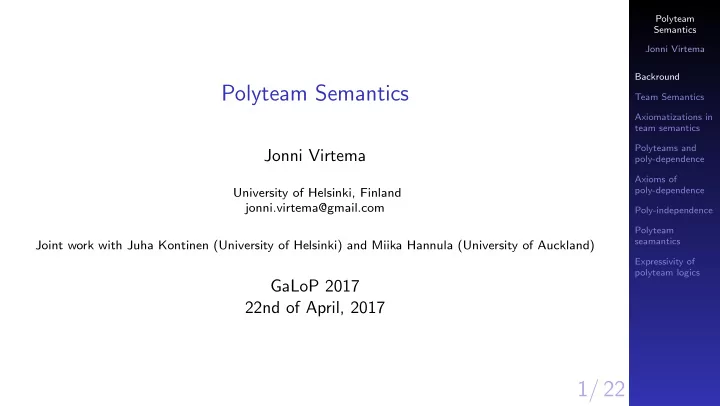
Polyteam Semantics Jonni Virtema Backround Polyteam Semantics Team Semantics Axiomatizations in team semantics Polyteams and Jonni Virtema poly-dependence Axioms of University of Helsinki, Finland poly-dependence


slide-1
SLIDE 1

Polyteam Semantics Jonni Virtema Backround Team Semantics Axiomatizations in team semantics Polyteams and poly-dependence Axioms of poly-dependence Poly-independence Polyteam seamantics Expressivity of polyteam logics

1/ 22 Polyteam Semantics

Jonni Virtema

University of Helsinki, Finland jonni.virtema@gmail.com Joint work with Juha Kontinen (University of Helsinki) and Miika Hannula (University of Auckland)

GaLoP 2017 22nd of April, 2017

slide-2
SLIDE 2

Polyteam Semantics Jonni Virtema Backround Team Semantics Axiomatizations in team semantics Polyteams and poly-dependence Axioms of poly-dependence Poly-independence Polyteam seamantics Expressivity of polyteam logics

2/ 22 Team Semantics: Motivation and History

Logical modelling of uncertainty, imperfect information, and different notions of dependence such as functional dependence and independence. Related to similar concepts in statistics, database theory etc. Historical development:

I First-order logic and Skolem functions. I Branching quantifiers by Henkin 1959. I Independence-friendly logic by Hintikka and Sandu 1989. I Compositional semantics for independence-friendly logic by Hodges 1997.

(Origin of team semantics.)

I Dependence logic 2007 and modal dependence logic 2008 by V¨

a¨ an¨ anen.

I Introduction of other dependency notions to team semantics such as

inclusion, exclusion, and independence. Galliani, Gr¨ adel, V¨ a¨ an¨ anen.

I Approximate dependence by V¨

a¨ an¨ anen 2014 and multiteam semantics by Durand et al. 2016.

slide-3
SLIDE 3

Polyteam Semantics Jonni Virtema Backround Team Semantics Axiomatizations in team semantics Polyteams and poly-dependence Axioms of poly-dependence Poly-independence Polyteam seamantics Expressivity of polyteam logics

2/ 22 Team Semantics: Motivation and History

Logical modelling of uncertainty, imperfect information, and different notions of dependence such as functional dependence and independence. Related to similar concepts in statistics, database theory etc. Historical development:

I First-order logic and Skolem functions. I Branching quantifiers by Henkin 1959. I Independence-friendly logic by Hintikka and Sandu 1989. I Compositional semantics for independence-friendly logic by Hodges 1997.

(Origin of team semantics.)

I Dependence logic 2007 and modal dependence logic 2008 by V¨

a¨ an¨ anen.

I Introduction of other dependency notions to team semantics such as

inclusion, exclusion, and independence. Galliani, Gr¨ adel, V¨ a¨ an¨ anen.

I Approximate dependence by V¨

a¨ an¨ anen 2014 and multiteam semantics by Durand et al. 2016.

slide-4
SLIDE 4

Polyteam Semantics Jonni Virtema Backround Team Semantics Axiomatizations in team semantics Polyteams and poly-dependence Axioms of poly-dependence Poly-independence Polyteam seamantics Expressivity of polyteam logics

3/ 22 First-Order Team Semantics (via database theoretic spectacles)

I A team is a set of assignments that have a common domain of variables. I A team is a database table.

I Variables correspond to attributes. I Assignments correspond to records.

I Dependency notions of database theory give rise to novel atomic formulae.

I Functional dependence gives rise to dependence atoms =(x1, . . . , xn). I Inclusion dependence gives rise to inclusion atoms x ✓ y. I Embedded multivalued dependency gives rise to independence atoms y?x z.

slide-5
SLIDE 5

Polyteam Semantics Jonni Virtema Backround Team Semantics Axiomatizations in team semantics Polyteams and poly-dependence Axioms of poly-dependence Poly-independence Polyteam seamantics Expressivity of polyteam logics

4/ 22 Dependence Logic

In FO, formulas are formed using connectives _, ^, ¬, and quantifiers 9 and 8.

Definition

Dependence logic FO(dep) extends the syntax of FO by dependence atoms =(x1, . . . , xn) . We consider also independence and inclusion atoms (and the corresponding logics) that replace dependence atoms respectively by y?x z and x ✓ y.

slide-6
SLIDE 6

Polyteam Semantics Jonni Virtema Backround Team Semantics Axiomatizations in team semantics Polyteams and poly-dependence Axioms of poly-dependence Poly-independence Polyteam seamantics Expressivity of polyteam logics

5/ 22 Assignments and Teams

The semantics of dependence logic is defined using the notion of a team. Teams: Let A be a set and V = {x1, . . . , xk, . . .} a set of variables. A team X with domain V is a set of assignments s : V ! A. A is called the co-domain of X (the universe of a model).

slide-7
SLIDE 7

Polyteam Semantics Jonni Virtema Backround Team Semantics Axiomatizations in team semantics Polyteams and poly-dependence Axioms of poly-dependence Poly-independence Polyteam seamantics Expressivity of polyteam logics

6/ 22 Interpretation of Dependence Atoms

Let A be a structure and X a team with co-domain Dom(A) and domain V s.t. {x1, ..., xn} ✓ V . A | =X=(x1, ..., xn), if and only if, for all s, s0 2 X: ^

0<i<n

s(xi) = s0(xi) = ) s(xn) = s0(xn).

slide-8
SLIDE 8

Polyteam Semantics Jonni Virtema Backround Team Semantics Axiomatizations in team semantics Polyteams and poly-dependence Axioms of poly-dependence Poly-independence Polyteam seamantics Expressivity of polyteam logics

7/ 22 Interpreting Inclusion and Independence Atoms

Inclusion atoms: A | =X x ✓ y, if and only if, for all s 2 X there exists s0 2 X s.t. s(x) = s0(y). Independence atoms: A | =X y?x z, iff, for all s, s0 2 X: if s(x) = s0(x) then there exists s00 2 X such that

I s00(x) = s(x), I s00(y) = s(y), I s00(z) = s0(z).

slide-9
SLIDE 9

Polyteam Semantics Jonni Virtema Backround Team Semantics Axiomatizations in team semantics Polyteams and poly-dependence Axioms of poly-dependence Poly-independence Polyteam seamantics Expressivity of polyteam logics

8/ 22 Examples of teams

We may think of the variables xi as attributes of a database such as x0 = SALARY and x2 = ID NUMBER. x0 . . . xn s0 a0,m . . . an,m . . . sm a0,m . . . an,m Then dependence atom =(x2, x0) expresses the functional dependence ID NUMBER ! SALARY.

slide-10
SLIDE 10

Polyteam Semantics Jonni Virtema Backround Team Semantics Axiomatizations in team semantics Polyteams and poly-dependence Axioms of poly-dependence Poly-independence Polyteam seamantics Expressivity of polyteam logics

9/ 22 Expressive Power

Dependence logic defines all downward closed ESO properties of teams.

Theorem (Kontinen, V¨ a¨ an¨ anen 2009)

For every sentence ψ 2 ESO[τ [ {R}], in which R appears only negatively, there is φ(y1, . . . , yk) 2 FO(dep)[τ] s.t. for all A and X 6= ; with domain {y1, . . . , yk} A | =X φ ( ) (A, R := X(y)) | = ψ. Independence logic defines all ESO properties of teams.

Theorem (Galliani 2012)

For every sentence ψ 2 ESO[τ [ {R}] there is φ(y1, . . . , yk) 2 FO(?)[τ] s.t. for all A and X 6= ; with domain {y1, . . . , yk}: A | =X φ ( ) (A, R := X(y)) | = ψ.

slide-11
SLIDE 11

Polyteam Semantics Jonni Virtema Backround Team Semantics Axiomatizations in team semantics Polyteams and poly-dependence Axioms of poly-dependence Poly-independence Polyteam seamantics Expressivity of polyteam logics

10/ 22 Amstrong’s Axioms for Functional Dependence

This inference system consists of only three rules which we depict below using the standard notation for functional dependencies, i.e., X ! Y denotes that an attribute set X functionally determines another attribute set Y .

Definition (Armstrong 1974)

I Reflexivity: If Y ✓ X, then X ! Y . I Augmentation: if X ! Y , then XZ ! YZ I Transitivity: if X ! Y and Y ! Z, then X ! Z.

The same axiomatization works for dependence atoms =(x, y) when we add some rules that permutes and adds/removes duplicates to/from x.

slide-12
SLIDE 12

Polyteam Semantics Jonni Virtema Backround Team Semantics Axiomatizations in team semantics Polyteams and poly-dependence Axioms of poly-dependence Poly-independence Polyteam seamantics Expressivity of polyteam logics

10/ 22 Amstrong’s Axioms for Functional Dependence

This inference system consists of only three rules which we depict below using the standard notation for functional dependencies, i.e., X ! Y denotes that an attribute set X functionally determines another attribute set Y .

Definition (Armstrong 1974)

I Reflexivity: If Y ✓ X, then X ! Y . I Augmentation: if X ! Y , then XZ ! YZ I Transitivity: if X ! Y and Y ! Z, then X ! Z.

The same axiomatization works for dependence atoms =(x, y) when we add some rules that permutes and adds/removes duplicates to/from x.

slide-13
SLIDE 13

Polyteam Semantics Jonni Virtema Backround Team Semantics Axiomatizations in team semantics Polyteams and poly-dependence Axioms of poly-dependence Poly-independence Polyteam seamantics Expressivity of polyteam logics

11/ 22 Axioms for Pure (Marginal) Independence

For x?y, where x and y have no variables in common, a complete axiomatization is given by the following Independence Axioms:

  • 1. Permutation and redundancy as before.
  • 2. x?; (Empty Set Rule).
  • 3. If x?y, then y?x (Symmetry Rule).
  • 4. If x?yz, then x?y (Weakening Rule)
  • 5. If x?y and xy?z, then x?yz (Exchange Rule).

This axiomatization due to Geiger, Paz, and Pearl (1991) for marginal independence X ? ? Y between two sets of random variables.

slide-14
SLIDE 14

Polyteam Semantics Jonni Virtema Backround Team Semantics Axiomatizations in team semantics Polyteams and poly-dependence Axioms of poly-dependence Poly-independence Polyteam seamantics Expressivity of polyteam logics

12/ 22 From Teams to Polyteams

I Team semantics is a framework well suited to express different dependency

notions, e.g., studied in database theory, when restricted to the unirelational case.

I However depedencies between different tables cannot be expressed in this

  • framework. This is a real shortcoming.

I We next define a generalisation of team semantics in which we replace

teams by tuples of teams.

slide-15
SLIDE 15

Polyteam Semantics Jonni Virtema Backround Team Semantics Axiomatizations in team semantics Polyteams and poly-dependence Axioms of poly-dependence Poly-independence Polyteam seamantics Expressivity of polyteam logics

13/ 22 Polyteams

For i 2 N, let Var(i) denote a distinct countable set of FO variable symbols.

Definition

Let A be a τ-model and let Di ✓ Var(i) for all i 2 N. A tuple X = (Xi)i2N is a polyteam of A with domain D = (Di)i2N, if Xi is a team with domain Di and co-domain A for each i 2 N. We identify X with (X1, . . . , Xn) if Xi is empty for all i greater than n. We write xi, yi, xi, etc., to denote variables from Var(i).

slide-16
SLIDE 16

Polyteam Semantics Jonni Virtema Backround Team Semantics Axiomatizations in team semantics Polyteams and poly-dependence Axioms of poly-dependence Poly-independence Polyteam seamantics Expressivity of polyteam logics

14/ 22 Polyatoms

Poly-Inclusion atoms: A | =X xi ✓ yj, iff, for all s 2 Xi there exists s0 2 Xj s.t. s(xi) = s0(yj). Poly-Dependence atoms: Let xiyi and ujvj be sequences of variables s.t. |xi| = |uj| and |yi| = |uj|. Assume i 6= j. A | =X=

  • xi, yi/uj, vj

, 8s 2 Xi8s0 2 Xj : s(xi) = s0(uj) implies s(yi) = s0(vj). Note that the atom =(x, y/x, y) corresponds to the dependence atom =(x, y). For empty tuples xi and uj the poly-dependence atom reduces to a“poly-constancy atom” =

  • yi/vj

.

slide-17
SLIDE 17

Polyteam Semantics Jonni Virtema Backround Team Semantics Axiomatizations in team semantics Polyteams and poly-dependence Axioms of poly-dependence Poly-independence Polyteam seamantics Expressivity of polyteam logics

14/ 22 Polyatoms

Poly-Inclusion atoms: A | =X xi ✓ yj, iff, for all s 2 Xi there exists s0 2 Xj s.t. s(xi) = s0(yj). Poly-Dependence atoms: Let xiyi and ujvj be sequences of variables s.t. |xi| = |uj| and |yi| = |uj|. Assume i 6= j. A | =X=

  • xi, yi/uj, vj

, 8s 2 Xi8s0 2 Xj : s(xi) = s0(uj) implies s(yi) = s0(vj). Note that the atom =(x, y/x, y) corresponds to the dependence atom =(x, y). For empty tuples xi and uj the poly-dependence atom reduces to a“poly-constancy atom” =

  • yi/vj

.

slide-18
SLIDE 18

Polyteam Semantics Jonni Virtema Backround Team Semantics Axiomatizations in team semantics Polyteams and poly-dependence Axioms of poly-dependence Poly-independence Polyteam seamantics Expressivity of polyteam logics

14/ 22 Polyatoms

Poly-Inclusion atoms: A | =X xi ✓ yj, iff, for all s 2 Xi there exists s0 2 Xj s.t. s(xi) = s0(yj). Poly-Dependence atoms: Let xiyi and ujvj be sequences of variables s.t. |xi| = |uj| and |yi| = |uj|. Assume i 6= j. A | =X=

  • xi, yi/uj, vj

, 8s 2 Xi8s0 2 Xj : s(xi) = s0(uj) implies s(yi) = s0(vj). Note that the atom =(x, y/x, y) corresponds to the dependence atom =(x, y). For empty tuples xi and uj the poly-dependence atom reduces to a“poly-constancy atom” =

  • yi/vj

.

slide-19
SLIDE 19

Polyteam Semantics Jonni Virtema Backround Team Semantics Axiomatizations in team semantics Polyteams and poly-dependence Axioms of poly-dependence Poly-independence Polyteam seamantics Expressivity of polyteam logics

15/ 22 Axioms of Poly-Dependence

Definition (Axiomatization for poly-dependence atoms)

I Reflexivity: =

  • xi, prk(xi)/yj, prk(yj)
  • , where k = 1, . . . , |xi| and prk takes

the kth projection of a sequence.

I Augmentation: if =

  • xi, yi/uj, vj

, then =

  • xizi, yizi/ujwj, vjwj

I Transitivity: if =

  • xi, yi/uj, vj

and =

  • yi, zi/vj, wj

, then =

  • xi, zi/uj, wj

I Union: if =

  • xi, yi/uj, vj

and =

  • xi, zi/uj, wj

then =

  • xi, yizi/uj, vjwj

I Symmetry: if =

  • xi, yi/uj, vj

, then =

  • uj, vj/xi, yi

I Weak Transitivity: if =

  • xi, yizizi/uj, vjvjwj

, then =

  • xi, yi/uj, wj

This proof system forms a complete characterization of logical implication for poly-dependence atoms.

slide-20
SLIDE 20

Polyteam Semantics Jonni Virtema Backround Team Semantics Axiomatizations in team semantics Polyteams and poly-dependence Axioms of poly-dependence Poly-independence Polyteam seamantics Expressivity of polyteam logics

16/ 22 Poly-Independence Atom

Independence atoms: A | =X y?x z, iff, for all s, s0 2 X: if s(x) = s0(x) then there exists s00 2 X such that

I s00(x) = s(x), I s00(y) = s(y), I s00(z) = s0(z).

slide-21
SLIDE 21

Polyteam Semantics Jonni Virtema Backround Team Semantics Axiomatizations in team semantics Polyteams and poly-dependence Axioms of poly-dependence Poly-independence Polyteam seamantics Expressivity of polyteam logics

16/ 22 Poly-Independence Atom

Poly-Independence atoms: Let xi, yi, aj,b

j, uk, vk, and wk be tuples of variables such that

|xi| = |aj| = |uk|, |yi| = |vk|, |b

j| = |wk|.

A | =X yi/vk ?xi,aj/uk b

j/wk, iff, for all s 2 Xi, s0 2 Xj: if s(xi) = s0(aj) then

there exists s00 2 Xk such that

I s00(uk) = s(xi), I s00(vk) = s(yi), I s00(wk) = s0(b j).

slide-22
SLIDE 22

Polyteam Semantics Jonni Virtema Backround Team Semantics Axiomatizations in team semantics Polyteams and poly-dependence Axioms of poly-dependence Poly-independence Polyteam seamantics Expressivity of polyteam logics

16/ 22 Poly-Independence Atom

Poly-Independence atoms: Let xi, yi, aj,b

j, uk, vk, and wk be tuples of variables such that

|xi| = |aj| = |uk|, |yi| = |vk|, |b

j| = |wk|.

A | =X yi/vk ?xi,aj/uk b

j/wk, iff, for all s 2 Xi, s0 2 Xj: if s(xi) = s0(aj) then

there exists s00 2 Xk such that

I s00(uk) = s(xi), I s00(vk) = s(yi), I s00(wk) = s0(b j).

The atom y/y ?x,x/x z/z is the standard independence atom y ?x z.

slide-23
SLIDE 23

Polyteam Semantics Jonni Virtema Backround Team Semantics Axiomatizations in team semantics Polyteams and poly-dependence Axioms of poly-dependence Poly-independence Polyteam seamantics Expressivity of polyteam logics

17/ 22 Desired Properties of Polyteam Semantics

I Let φ 2 FO.

For every team X it holds that A | =X φ iff A | =s φ, for every s 2 X.

I Let φ 2 FO whose variables are all of sort i 2 N.

For every poly-team X it holds that A | =X φ iff A | =Xi φ.

I Let L be a team-based logic and φ 2 L whose variables are all of sort i 2 N.

For every poly-team X it holds that A | =X φ iff A | =Xi φ.

slide-24
SLIDE 24

Polyteam Semantics Jonni Virtema Backround Team Semantics Axiomatizations in team semantics Polyteams and poly-dependence Axioms of poly-dependence Poly-independence Polyteam seamantics Expressivity of polyteam logics

18/ 22

Definition (Polyteam semantics for poly-first-order logic PFO)

Let A be a τ-structure and X a polyteam of A. The satisfaction relation | =X for first-order logic is defined as follows: A | =X x = y , if x, y 2 Var(i) then 8s 2 Xi : s(x) = s(y) A | =X x 6= y , if x, y 2 Var(i) then 8s 2 Xi : s(x) 6= s(y) A | =X R(x) , if x 2 Var(i)k then 8s 2 Xi : s(x) 2 RA A | =X ¬R(x) , if x 2 Var(i)k then 8s 2 Xi : s(x) 62 RA

slide-25
SLIDE 25

Polyteam Semantics Jonni Virtema Backround Team Semantics Axiomatizations in team semantics Polyteams and poly-dependence Axioms of poly-dependence Poly-independence Polyteam seamantics Expressivity of polyteam logics

18/ 22

Definition (Polyteam semantics for poly-first-order logic PFO)

Let A be a τ-structure and X a polyteam of A. The satisfaction relation | =X for first-order logic is defined as follows: A | =X (ψ ^ θ) , A | =X ψ and A | =X θ A | =X (ψ _ θ) , A | =Y ψ and A | =Z θ for some Y , Z ✓ X s.t. Y [ Z = X A | =X (ψ _j θ) , A | =X[Yj/Xj] ψ and A | =X[Zj/Xj] θ for some Yj, Zj ✓ Xj s.t. Yj [ Zj = Xj

slide-26
SLIDE 26

Polyteam Semantics Jonni Virtema Backround Team Semantics Axiomatizations in team semantics Polyteams and poly-dependence Axioms of poly-dependence Poly-independence Polyteam seamantics Expressivity of polyteam logics

18/ 22

Definition (Polyteam semantics for poly-first-order logic PFO)

Let A be a τ-structure and X a polyteam of A. The satisfaction relation | =X for first-order logic is defined as follows: A | =X 8xψ , A | =X[Xi[A/x]/Xi] ψ, when x 2 Var(i) A | =X 9xψ , A | =X[Xi[F/x]/Xi] ψ holds for some F : Xi ! P(A) \ {;}, when x 2 Var(i).

slide-27
SLIDE 27

Polyteam Semantics Jonni Virtema Backround Team Semantics Axiomatizations in team semantics Polyteams and poly-dependence Axioms of poly-dependence Poly-independence Polyteam seamantics Expressivity of polyteam logics

18/ 22

Definition (Polyteam semantics for poly-first-order logic PFO)

Let A be a τ-structure and X a polyteam of A. The satisfaction relation | =X for first-order logic is defined as follows: A | =X x = y , if x, y 2 Var(i) then 8s 2 Xi : s(x) = s(y) A | =X x 6= y , if x, y 2 Var(i) then 8s 2 Xi : s(x) 6= s(y) A | =X R(x) , if x 2 Var(i)k then 8s 2 Xi : s(x) 2 RA A | =X ¬R(x) , if x 2 Var(i)k then 8s 2 Xi : s(x) 62 RA A | =X (ψ ^ θ) , A | =X ψ and A | =X θ A | =X (ψ _ θ) , A | =Y ψ and A | =Z θ for some Y , Z ✓ X s.t. Y [ Z = X A | =X (ψ _j θ) , A | =X[Yj/Xj] ψ and A | =X[Zj/Xj] θ for some Yj, Zj ✓ Xj s.t. Yj [ Zj = Xj A | =X 8xψ , A | =X[Xi[A/x]/Xi] ψ, when x 2 Var(i) A | =X 9xψ , A | =X[Xi[F/x]/Xi] ψ holds for some F : Xi ! P(A) \ {;}, when x 2 Var(i).

slide-28
SLIDE 28

Polyteam Semantics Jonni Virtema Backround Team Semantics Axiomatizations in team semantics Polyteams and poly-dependence Axioms of poly-dependence Poly-independence Polyteam seamantics Expressivity of polyteam logics

19/ 22 Relationship Between _ and _i

For every formula of PFO there exists an equivalent formula of PFO that only uses disjunctions of type _i. Proof: Guess the splits of _ by using quantifiers and then use _i for splitting each team

  • ne-by-one.
slide-29
SLIDE 29

Polyteam Semantics Jonni Virtema Backround Team Semantics Axiomatizations in team semantics Polyteams and poly-dependence Axioms of poly-dependence Poly-independence Polyteam seamantics Expressivity of polyteam logics

20/ 22 Polydependence Logics

I Add ordinary atoms (dependence, inclusion, etc.) to PFO. I Add poly-atoms (poly-dependence, poly-inclusion, etc.) to PFO. I The latter yields strictly more expressive logics. I The poly-constancy atom =

  • x1/x2

cannot be expressed in PFO(dep).

slide-30
SLIDE 30

Polyteam Semantics Jonni Virtema Backround Team Semantics Axiomatizations in team semantics Polyteams and poly-dependence Axioms of poly-dependence Poly-independence Polyteam seamantics Expressivity of polyteam logics

20/ 22 Polydependence Logics

I Add ordinary atoms (dependence, inclusion, etc.) to PFO. I Add poly-atoms (poly-dependence, poly-inclusion, etc.) to PFO. I The latter yields strictly more expressive logics. I The poly-constancy atom =

  • x1/x2

cannot be expressed in PFO(dep).

slide-31
SLIDE 31

Polyteam Semantics Jonni Virtema Backround Team Semantics Axiomatizations in team semantics Polyteams and poly-dependence Axioms of poly-dependence Poly-independence Polyteam seamantics Expressivity of polyteam logics

21/ 22 Expressive Power of Poly-Dependence Logic

FO(dep) defines all downward closed ESO properties of teams.

Theorem (Kontinen, V¨ a¨ an¨ anen 2009)

For every sentence ψ 2 ESO[τ [ {R}], in which R appears only negatively, there is φ(y1, . . . , yk) 2 FO(dep)[τ] s.t. for all A and X 6= ; with domain {y1, . . . , yk} A | =X φ ( ) (A, R := X(y)) | = ψ. PFO(dep) defines all conjunctions of downward closed ESO properties of teams.

Theorem

For every finite sequence ψi, 1  i  n, of ESO[τ [ {Ri}]-sentences, in which Ri appears only negatively, there is φ(x1, . . . , xn) 2 PFO(dep)[τ] s.t. for all A and for all polyteams X = (X1, . . . , Xn) where Dom(Xi) = xi and Xi 6= ; A | =Xφ(x1, . . . , xn) , (A, R1 := X1(x1) . . . , Xn(xn)) | = ψ1(R1) ^ . . . ^ ψn(Rn).

slide-32
SLIDE 32

Polyteam Semantics Jonni Virtema Backround Team Semantics Axiomatizations in team semantics Polyteams and poly-dependence Axioms of poly-dependence Poly-independence Polyteam seamantics Expressivity of polyteam logics

21/ 22 Expressive Power of Poly-Dependence Logic

PFO(dep) defines all conjunctions of downward closed ESO properties of teams.

Theorem

For every finite sequence ψi, 1  i  n, of ESO[τ [ {Ri}]-sentences, in which Ri appears only negatively, there is φ(x1, . . . , xn) 2 PFO(dep)[τ] s.t. for all A and for all polyteams X = (X1, . . . , Xn) where Dom(Xi) = xi and Xi 6= ; A | =Xφ(x1, . . . , xn) , (A, R1 := X1(x1) . . . , Xn(xn)) | = ψ1(R1) ^ . . . ^ ψn(Rn). PFO(pdep) defines all downward closed ESO properties of polyteams.

Theorem

For every sentence ψ 2 ESO[τ [ {R1, . . . , Rn}] in which Ri:s appear only negatively, there is φ(x1, . . . , xn) 2 PFO(pdep)[τ] s.t. for all A and for all polyteams X = (X1, . . . , Xn) where Dom(Xi) = xi and Xi 6= ; A | =Xφ(x1, . . . , xn) , (A, R1 := X1(x1) . . . , Xn(xn)) | = ψ(R1, . . . , Rn).

slide-33
SLIDE 33

Polyteam Semantics Jonni Virtema Backround Team Semantics Axiomatizations in team semantics Polyteams and poly-dependence Axioms of poly-dependence Poly-independence Polyteam seamantics Expressivity of polyteam logics

22/ 22 Further Results and Details

I Results of the previous page also works for independence logics:

I PFO(ind) defines all conjunctions of ESO properties of teams. I PFO(pind) defines all ESO properties of polyteams.

I For details see the preprint (Polyteam Semantics) in ArXiv.

THANKS!

slide-34
SLIDE 34

Polyteam Semantics Jonni Virtema Backround Team Semantics Axiomatizations in team semantics Polyteams and poly-dependence Axioms of poly-dependence Poly-independence Polyteam seamantics Expressivity of polyteam logics

22/ 22 Further Results and Details

I Results of the previous page also works for independence logics:

I PFO(ind) defines all conjunctions of ESO properties of teams. I PFO(pind) defines all ESO properties of polyteams.

I For details see the preprint (Polyteam Semantics) in ArXiv.

THANKS!