Glue semantics (Slides available at - - PowerPoint PPT Presentation

glue semantics
SMART_READER_LITE
LIVE PREVIEW

Glue semantics (Slides available at - - PowerPoint PPT Presentation

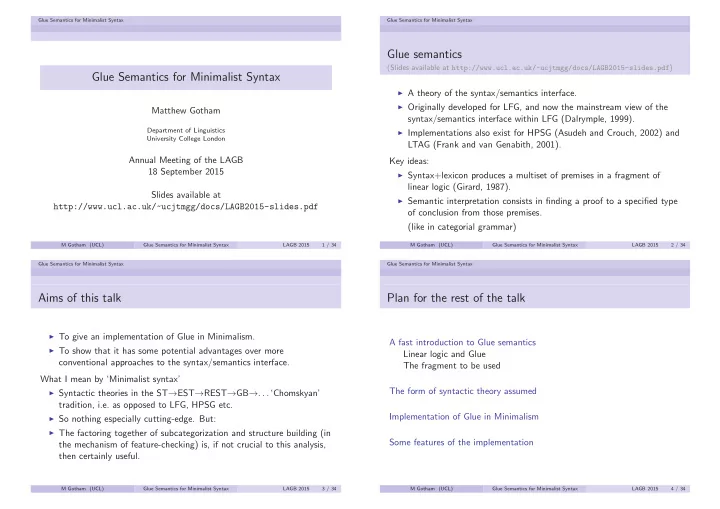
Glue Semantics for Minimalist Syntax Glue Semantics for Minimalist Syntax Glue semantics (Slides available at http://www.ucl.ac.uk/~ucjtmgg/docs/LAGB2015-slides.pdf ) Glue Semantics for Minimalist Syntax A theory of the syntax/semantics


slide-1
SLIDE 1

Glue Semantics for Minimalist Syntax

Glue Semantics for Minimalist Syntax

Matthew Gotham

Department of Linguistics University College London

Annual Meeting of the LAGB 18 September 2015 Slides available at http://www.ucl.ac.uk/~ucjtmgg/docs/LAGB2015-slides.pdf

M Gotham (UCL) Glue Semantics for Minimalist Syntax LAGB 2015 1 / 34 Glue Semantics for Minimalist Syntax

Glue semantics

(Slides available at http://www.ucl.ac.uk/~ucjtmgg/docs/LAGB2015-slides.pdf)

◮ A theory of the syntax/semantics interface. ◮ Originally developed for LFG, and now the mainstream view of the

syntax/semantics interface within LFG (Dalrymple, 1999).

◮ Implementations also exist for HPSG (Asudeh and Crouch, 2002) and

LTAG (Frank and van Genabith, 2001). Key ideas:

◮ Syntax+lexicon produces a multiset of premises in a fragment of

linear logic (Girard, 1987).

◮ Semantic interpretation consists in finding a proof to a specified type

  • f conclusion from those premises.

(like in categorial grammar)

M Gotham (UCL) Glue Semantics for Minimalist Syntax LAGB 2015 2 / 34 Glue Semantics for Minimalist Syntax

Aims of this talk

◮ To give an implementation of Glue in Minimalism. ◮ To show that it has some potential advantages over more

conventional approaches to the syntax/semantics interface. What I mean by ‘Minimalist syntax’

◮ Syntactic theories in the ST→EST→REST→GB→. . . ‘Chomskyan’

tradition, i.e. as opposed to LFG, HPSG etc.

◮ So nothing especially cutting-edge. But: ◮ The factoring together of subcategorization and structure building (in

the mechanism of feature-checking) is, if not crucial to this analysis, then certainly useful.

M Gotham (UCL) Glue Semantics for Minimalist Syntax LAGB 2015 3 / 34 Glue Semantics for Minimalist Syntax

Plan for the rest of the talk

A fast introduction to Glue semantics Linear logic and Glue The fragment to be used The form of syntactic theory assumed Implementation of Glue in Minimalism Some features of the implementation

M Gotham (UCL) Glue Semantics for Minimalist Syntax LAGB 2015 4 / 34

slide-2
SLIDE 2

Glue Semantics for Minimalist Syntax A fast introduction to Glue semantics Linear logic and Glue

Linear logic

(Girard, 1987)

◮ Often called a ‘logic of resources’ (Crouch and van Genabith, 2000, p.

5).

◮ Key difference from classical logic: for

premise1, . . . , premisen ⊢ conclusion to be valid, each premise must be ‘used’ exactly once. So

◮ A ⊢ A

but A, A A

◮ We will only be concerned with a small fragment in this talk:

implication and the universal quantifier only connectives that will be used.

M Gotham (UCL) Glue Semantics for Minimalist Syntax LAGB 2015 5 / 34 Glue Semantics for Minimalist Syntax A fast introduction to Glue semantics Linear logic and Glue

Interpretation as deduction

Linear implication and functional types

Rules of inference for the ⊸ fragment of intuitionistic propositional linear logic and their images under the Curry-Howard correspondence. ⊸ elimination (linear modus ponens) corresponds to application f : A ⊸ B x : A f (x) : B ⊸E ⊸ introduction (linear conditional proof) corresponds to abstraction [x : A]n . . . . Φ : B λx.Φ : A ⊸ B ⊸I n

M Gotham (UCL) Glue Semantics for Minimalist Syntax LAGB 2015 6 / 34 Glue Semantics for Minimalist Syntax A fast introduction to Glue semantics Linear logic and Glue

A simple example

(1) John loves Mary. John loves Mary

  • j′ : B

λy.λx.love′(x, y) : A ⊸ (B ⊸ C) m′ : A λy.λx.love′(x, y) : A ⊸ (B ⊸ C) m′ : A λx.love′(x, m′) : B ⊸ C ⊸E j′ : B love′(j′, m′) : C ⊸E

M Gotham (UCL) Glue Semantics for Minimalist Syntax LAGB 2015 7 / 34 Glue Semantics for Minimalist Syntax A fast introduction to Glue semantics Linear logic and Glue

Quantifier scope ambiguity

(2) Someone loves everyone. someone loves everyone

  • λP.some′(person′, P) :

(B ⊸ C) ⊸ C λy.λx.love′(x, y) : A ⊸ (B ⊸ C) λQ.every′(person′, Q) : (A ⊸ C) ⊸ C

M Gotham (UCL) Glue Semantics for Minimalist Syntax LAGB 2015 8 / 34

slide-3
SLIDE 3

Glue Semantics for Minimalist Syntax A fast introduction to Glue semantics Linear logic and Glue

Surface scope interpretation

λP.some′(person′, P) : (B ⊸ C) ⊸ C λQ.every′(person′, Q) : (A ⊸ C) ⊸ C λz.λv.love′(v, z) : A ⊸ (B ⊸ C) y : A 1 λv.love′(v, y) : B ⊸ C ⊸E x : B 2 love′(x, y) : C ⊸E λy.love′(x, y) : A ⊸ C ⊸I 1 every′(person′, (λy.love′(x, y))) : C ⊸E λx.every′(person′, (λy.love′(x, y))) : B ⊸ C ⊸I 2 some′(person′, λx.every′(person′, λy.love′(x, y))) : C ⊸E

M Gotham (UCL) Glue Semantics for Minimalist Syntax LAGB 2015 9 / 34 Glue Semantics for Minimalist Syntax A fast introduction to Glue semantics Linear logic and Glue

Inverse scope interpretation

λQ.every′(person′, Q) : (A ⊸ C) ⊸ C λP.some′(person′, P) : (B ⊸ C) ⊸ C λz.λv.love′(v, z) : A ⊸ (B ⊸ C) y : A 1 λv.love′(v, y) : B ⊸ C ⊸E some′(person′, λx.love′(x, y)) : C ⊸E λy.some′(person′, λx.love′(x, y)) : A ⊸ C ⊸I 1 every′(person′, λy.some′(person′, λx.love′(x, y))) : C ⊸E

M Gotham (UCL) Glue Semantics for Minimalist Syntax LAGB 2015 10 / 34 Glue Semantics for Minimalist Syntax A fast introduction to Glue semantics The fragment to be used

Meaning constructors

Following Kokkonidis (2008), I’ll use a fragment of (monadic) first-order linear logic as the glue language.

◮ Predicates: e and t ◮ Constants: 1, 2, 3 . . . ◮ Variables: X, Y , Z . . . ◮ Connectives: ⊸ and ∀

I’ll use subscript notation, e.g. e1 ⊸ tX instead of e(1) ⊸ t(X).

M Gotham (UCL) Glue Semantics for Minimalist Syntax LAGB 2015 11 / 34 Glue Semantics for Minimalist Syntax A fast introduction to Glue semantics The fragment to be used

LL λ calculus propositions implicational functional as types proposition type rules as ⊸ elimination application f : A ⊸ B x : A f (x) : B ⊸E

  • perations

⊸ introduction abstraction [x : A]n . . . . Φ : B λx.Φ : A ⊸ B ⊸I n ∀ elimination — Φ : ∀X.A Φ : A[X ←c] ∀E c free for X ∀ introduction — Φ : A Φ : ∀X.A ∀I X not free in any open leaf

M Gotham (UCL) Glue Semantics for Minimalist Syntax LAGB 2015 12 / 34

slide-4
SLIDE 4

Glue Semantics for Minimalist Syntax The form of syntactic theory assumed

Basic ideas

◮ Syntactic objects have features. ◮ The structure-building operation(s) (Merge) is/are based on the

matching of features.

◮ Every feature bears an index, and when two features match their

indices must also match.

◮ Those indices are used to label linear logic formulae paired with

interpretations, thereby providing the syntax/semantics connection.

M Gotham (UCL) Glue Semantics for Minimalist Syntax LAGB 2015 13 / 34 Glue Semantics for Minimalist Syntax The form of syntactic theory assumed

Features

Largely based on Adger (2003) and Adger (2010)

◮ Some features describe what an LI is. ◮ Some features describe what an LI needs (uninterpretable features).

Those can be strong(*) or weak. V T uD, uD uD* | | love

  • s

(I’m going to ignore morphosyntactic features and agreement.)

M Gotham (UCL) Glue Semantics for Minimalist Syntax LAGB 2015 14 / 34 Glue Semantics for Minimalist Syntax The form of syntactic theory assumed

Structure-building operation(s)

Merge.

◮ Hierarchy of Projections-driven. ◮ Selectional features-driven.

◮ External. ◮ Internal. M Gotham (UCL) Glue Semantics for Minimalist Syntax LAGB 2015 15 / 34 Glue Semantics for Minimalist Syntax The form of syntactic theory assumed

Hierarchy of projections

Adger (2003) has: Clausal: C T (Neg) (Perf) (Prog) (Pass) v V Nominal: D (Poss) n N Adjectival: (Deg) A We’ll use: Clausal: C T V Nominal: D N

M Gotham (UCL) Glue Semantics for Minimalist Syntax LAGB 2015 16 / 34

slide-5
SLIDE 5

Glue Semantics for Minimalist Syntax The form of syntactic theory assumed

HoPs merge

A . . . + B ⇒ A . . . B A Where A and B are in the same hierarchy of projections (HoPs) and A is higher on that HoPs than B

M Gotham (UCL) Glue Semantics for Minimalist Syntax LAGB 2015 17 / 34 Glue Semantics for Minimalist Syntax The form of syntactic theory assumed

Select merge

External

A uB, . . . + B ⇒ A . . . B A uB

M Gotham (UCL) Glue Semantics for Minimalist Syntax LAGB 2015 18 / 34 Glue Semantics for Minimalist Syntax The form of syntactic theory assumed

Select merge

Internal

A uB*, . . . . . . B . . . ⇒ A . . . A uB* . . . B . . .

M Gotham (UCL) Glue Semantics for Minimalist Syntax LAGB 2015 19 / 34 Glue Semantics for Minimalist Syntax The form of syntactic theory assumed

External merge

An example

V uD, uD love + D Mary ⇒ V uD D Mary V uD love

M Gotham (UCL) Glue Semantics for Minimalist Syntax LAGB 2015 20 / 34

slide-6
SLIDE 6

Glue Semantics for Minimalist Syntax The form of syntactic theory assumed

External merge

An example

D John + V uD D Mary V uD love ⇒ V V uD D Mary V uD love D John

M Gotham (UCL) Glue Semantics for Minimalist Syntax LAGB 2015 21 / 34 Glue Semantics for Minimalist Syntax The form of syntactic theory assumed

HoPs merge

An example

T uD*

  • s

+ V V uD D Mary V uD love D John ⇒ T uD* V V uD D Mary V uD love D John T

  • s

M Gotham (UCL) Glue Semantics for Minimalist Syntax LAGB 2015 22 / 34 Glue Semantics for Minimalist Syntax The form of syntactic theory assumed

Internal merge

An example

T uD* V V uD D Mary V uD love D John T

  • s

⇒ T1 T uD* V V uD D Mary V uD love D John T

  • s

M Gotham (UCL) Glue Semantics for Minimalist Syntax LAGB 2015 23 / 34 Glue Semantics for Minimalist Syntax Implementation of Glue in Minimalism

Indices

T1 T1 uD*2 V1 V1 uD3 D2 Mary V1 uD2 love D3 John T1

  • s

λz.λv.love′(v, z) : e2 ⊸ (e3 ⊸ t1) m′ : e2 λv.love′(v, m′) : e3 ⊸ t1 ⊸E j′ : e3 love′(j′, m′) : t1 ⊸E V1 uD2, uD3 | love

  • λz.λv.love′(v, z)

: e2 ⊸ (e3 ⊸ t1) D3 △ John

  • j′ : e3

D2 △ Mary

  • m′ : e2

M Gotham (UCL) Glue Semantics for Minimalist Syntax LAGB 2015 24 / 34

slide-7
SLIDE 7

Glue Semantics for Minimalist Syntax Implementation of Glue in Minimalism

T1 T1 uD*2 V1 V1 uD3 D2 someone V1 uD2 love D3 everyone T1

  • s

λP.every′(person′, P) : ∀X.(e3 ⊸ tX) ⊸ tX λP.every′(person′, P) : (e3 ⊸ t1) ⊸ t1 ∀E λP.some′(person′, P) : ∀X.(e2 ⊸ tX) ⊸ tX λP.some′(person′, P) : (e2 ⊸ t1) ⊸ t1 ∀E D3 △ everyone

  • λP.every′(person′, P)

: ∀X.(e3 ⊸ tX) ⊸ tX D2 △ someone

  • λP.some′(person′, P)

: ∀X.(e2 ⊸ tX) ⊸ tX

M Gotham (UCL) Glue Semantics for Minimalist Syntax LAGB 2015 25 / 34 Glue Semantics for Minimalist Syntax Implementation of Glue in Minimalism

Surface scope interpretation

λP.some′(person′, P) : (e3 ⊸ t1) ⊸ t1 λQ.every′(person′, Q) : (e2 ⊸ t1) ⊸ t1 λz.λv.love′(v, z) : e2 ⊸ (e3 ⊸ t1) y : e2 1 λv.love′(v, y) : e3 ⊸ t1 ⊸E x : e3 2 love′(x, y) : t1 ⊸E λy.love′(x, y) : e2 ⊸ t1 ⊸I 1 every′(person′, (λy.love′(x, y))) : t1 ⊸E λx.every′(person′, (λy.love′(x, y))) : e3 ⊸ t1 ⊸I 2 some′(person′, λx.every′(person′, λy.love′(x, y))) : t1 ⊸E

M Gotham (UCL) Glue Semantics for Minimalist Syntax LAGB 2015 26 / 34 Glue Semantics for Minimalist Syntax Implementation of Glue in Minimalism

Inverse scope interpretation

λQ.every′(person′, Q) : (e2 ⊸ t1) ⊸ t1 λP.some′(person′, P) : (e3 ⊸ t1) ⊸ t1 λz.λv.love′(v, z) : e2 ⊸ (e3 ⊸ t1) y : e2 1 λv.love′(v, y) : e3 ⊸ t1 ⊸E some′(person′, λx.love′(x, y)) : t1 ⊸E λy.some′(person′, λx.love′(x, y)) : e2 ⊸ t1 ⊸I 1 every′(person′, λy.some′(person′, λx.love′(x, y))) : t1 ⊸E

M Gotham (UCL) Glue Semantics for Minimalist Syntax LAGB 2015 27 / 34 Glue Semantics for Minimalist Syntax Some features of the implementation

Embedded QPs

(3) No owner of an espresso machine drinks tea. Analysis by (Heim and Kratzer, 1998, p. 229) of the surface scope reading: DP NP NP NP N PP DP t2 P

  • f

N

  • wner

DP t1 DP2 an espresso machine DP1 pro D no

M Gotham (UCL) Glue Semantics for Minimalist Syntax LAGB 2015 28 / 34

slide-8
SLIDE 8

Glue Semantics for Minimalist Syntax Some features of the implementation

N1 PP2 D3 an espresso machine P2 uD3

  • f

N1 uP2

  • wner

N1 uP2 |

  • wner
  • λz.λv.own′(v, z)

: e2 ⊸ (e1 ⊸ t1) P2 uD3 |

  • f
  • λw.w : e3 ⊸ e2

D3 △ an e.m.

  • λP.some′(machine′, P)

: ∀X.(e3 ⊸ tX) ⊸ tX

M Gotham (UCL) Glue Semantics for Minimalist Syntax LAGB 2015 29 / 34 Glue Semantics for Minimalist Syntax Some features of the implementation

λP.some′(machine′, P) : ∀X.(e3 ⊸ tX) ⊸ tX λP.some′(machine′, P) : (e3 ⊸ t1) ⊸ t1 ∀E λz.λv.own′(v, z) : e2 ⊸ (e1 ⊸ t1) y : e2 1 λv.own′(v, y) : e1 ⊸ t1 ⊸E x : e1 2

  • wn′(x, y)

: t1 ⊸E λy.own′(x, y) : e2 ⊸ t1 ⊸I 1 λw.w : e3 ⊸ e2 z : e3 3 z : e2 ⊸E

  • wn′(x, z) : t1

⊸E λz.own′(x, z) : e3 ⊸ t1 ⊸I 3 some′(machine′, λz.own′(x, z)) : t1 ⊸E λx.some′(machine′, λz.own′(x, z)) : e1 ⊸ t1 ⊸I 2

M Gotham (UCL) Glue Semantics for Minimalist Syntax LAGB 2015 30 / 34 Glue Semantics for Minimalist Syntax Some features of the implementation

(Overt) movement

NP CP C TP T VP DP who(m) V love T

  • s

D John C DP who(m) N woman

M Gotham (UCL) Glue Semantics for Minimalist Syntax LAGB 2015 31 / 34 Glue Semantics for Minimalist Syntax Some features of the implementation

Trace theory was abandoned in early minimalism in favor of the so-called copy theory of movement. Indices were deemed incompatible with the principle of Inclusiveness, which restricts the content of tree structures to information originating in the

  • lexicon. Because indices of phrases cannot be traced back to any

lexical entry, they are illegitimate syntactic objects. (Neeleman and van de Koot, 2010, p. 331) If we assume that the computational system of syntax doesn’t use variables, variables are introduced at the point where the LF-structure of a sentence is translated into a semantic representation. (Sauerland, 1998, p. 196)

M Gotham (UCL) Glue Semantics for Minimalist Syntax LAGB 2015 32 / 34

slide-9
SLIDE 9

Glue Semantics for Minimalist Syntax Some features of the implementation

C1[rel] C1[rel] uwh*3 T1 T1 uD*2 V1 V1 uD2 D3[wh] who(m) V1 uD3 love D2 John T1

  • s

C1[rel]

C[rel]1 uwh*3

  • λP.λQ.λx.P(x) ∧ Q(x) :

(e3 ⊸ t1) ⊸ ((e1 ⊸ t1) ⊸ (e1 ⊸ t1))

M Gotham (UCL) Glue Semantics for Minimalist Syntax LAGB 2015 33 / 34 Glue Semantics for Minimalist Syntax Some features of the implementation

λP.λQ.λx.P(x) ∧ Q(x) : (e3 ⊸ t1) ⊸ ((e1 ⊸ t1) ⊸ (e1 ⊸ t1)) λz.λv.love′(v, z) : e3 ⊸ (e2 ⊸ t1) [y : e3]1 λv.love′(v, y) : e2 ⊸ t1 ⊸E j′ : e2 love′(j′, y) : t1 ⊸E λy.love′(j′, y) : e3 ⊸ t1 ⊸I 1 λQ.λx.love′(j′, x) ∧ Q(x) : (e1 ⊸ t1) ⊸ (e1 ⊸ t1) ⊸E

M Gotham (UCL) Glue Semantics for Minimalist Syntax LAGB 2015 34 / 34 Glue Semantics for Minimalist Syntax

References I

Adger, David (2003). Core Syntax: A Minimalist Approach. Core

  • Linguistics. Oxford: Oxford University Press.

– (2010). “A Minimalist theory of feature structure”. In: Features: Perspectives on a Key Notion in Linguistics. Ed. by Anna Kibort and Greville G. Corbett. Oxford: Oxford University Press, pp. 185–218. Asudeh, Ash and Richard Crouch (2002). “Glue Semantics for HPSG”. In: Proceedings of the 8th International HPSG Conference. (Norwegian University of Science and Technology, Trondheim). Ed. by Frank van Eynde, Lars Hellan, and Dorothee Beermann. Stanford, CA: CSLI Publications.

M Gotham (UCL) Glue Semantics for Minimalist Syntax LAGB 2015 35 / 34 Glue Semantics for Minimalist Syntax

References II

Crouch, Richard and Josef van Genabith (2000). “Linear Logic for Linguists”. ESSLLI 2000 course notes. Archived 2006-10-19 in the Internet Archive at http://web.archive.org/web/20061019004949/http: //www2.parc.com/istl/members/crouch/esslli00_notes.pdf. Dalrymple, Mary, ed. (1999). Semantics and Syntax in Lexical Functional Grammar: The Resource Logic Approach. Cambridge, MA: MIT Press. Frank, Anette and Josef van Genabith (2001). “GlueTag: Linear Logic-based Semantics for LTAG—and what it teaches us about LFG and LTAG”. In: Proceedings of the LFG01 Conference. (University of Hong Kong). Ed. by Miriam Butt and Tracy Holloway King. Stanford, CA: CSLI Publications. Girard, Jean-Yves (1987). “Linear Logic”. In: Theoretical Computer Science 50.1, pp. 1–101. issn: 0304-3975.

M Gotham (UCL) Glue Semantics for Minimalist Syntax LAGB 2015 36 / 34

slide-10
SLIDE 10

Glue Semantics for Minimalist Syntax

References III

Heim, Irene and Angelika Kratzer (1998). Semantics in Generative

  • Grammar. Blackwell Textbooks in Linguistics 13. Oxford:

Wiley-Blackwell. Kokkonidis, Miltiadis (2008). “First-Order Glue”. In: Journal of Logic, Language and Information 17.1, pp. 43–68. Neeleman, Ad and Hans van de Koot (2010). “A Local Encoding of Syntactic Dependencies and Its Consequences for the Theory of Movement”. In: Syntax 13.4, pp. 331–372. Sauerland, Uli (1998). “The Meaning of Chains”. PhD thesis. Massachusetts Institute of Technology.

M Gotham (UCL) Glue Semantics for Minimalist Syntax LAGB 2015 37 / 34