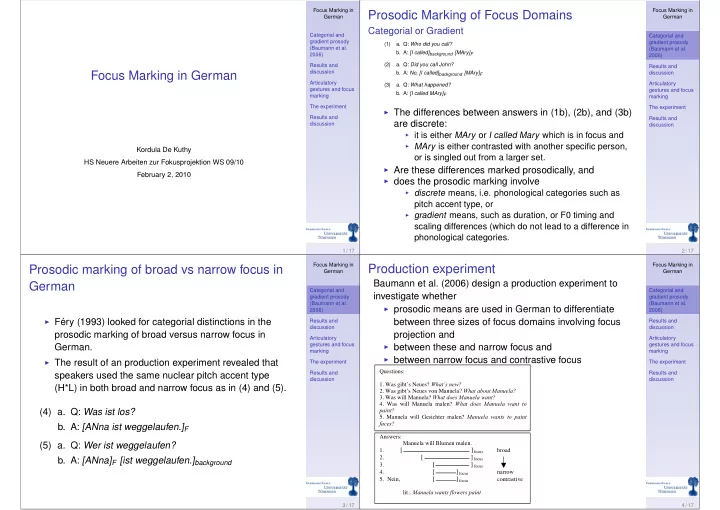

Focus Marking in German Categorial and gradient prosody (Baumann et al. 2006) Results and discussion Articulatory gestures and focus marking The experiment Results and discussion
Focus Marking in German
Kordula De Kuthy HS Neuere Arbeiten zur Fokusprojektion WS 09/10 February 2, 2010
1 / 17 Focus Marking in German Categorial and gradient prosody (Baumann et al. 2006) Results and discussion Articulatory gestures and focus marking The experiment Results and discussion
Prosodic Marking of Focus Domains
Categorial or Gradient
(1)
- a. Q: Who did you call?
- b. A: [I called]background [MAry]F
(2)
- a. Q: Did you call John?
- b. A: No, [I called]background [MAry]F
(3)
- a. Q: What happened?
- b. A: [I called MAry]F
◮ The differences between answers in (1b), (2b), and (3b)
are discrete:
◮ it is either MAry or I called Mary which is in focus and ◮ MAry is either contrasted with another specific person,
- r is singled out from a larger set.
◮ Are these differences marked prosodically, and ◮ does the prosodic marking involve
◮ discrete means, i.e. phonological categories such as
pitch accent type, or
◮ gradient means, such as duration, or F0 timing and
scaling differences (which do not lead to a difference in phonological categories.
2 / 17 Focus Marking in German Categorial and gradient prosody (Baumann et al. 2006) Results and discussion Articulatory gestures and focus marking The experiment Results and discussion
Prosodic marking of broad vs narrow focus in German
◮ F´
ery (1993) looked for categorial distinctions in the prosodic marking of broad versus narrow focus in German.
◮ The result of an production experiment revealed that
speakers used the same nuclear pitch accent type (H*L) in both broad and narrow focus as in (4) and (5). (4) a. Q: Was ist los?
- b. A: [ANna ist weggelaufen.]F
(5) a. Q: Wer ist weggelaufen?
- b. A: [ANna]F [ist weggelaufen.]background
3 / 17 Focus Marking in German Categorial and gradient prosody (Baumann et al. 2006) Results and discussion Articulatory gestures and focus marking The experiment Results and discussion
Production experiment
Baumann et al. (2006) design a production experiment to investigate whether
◮ prosodic means are used in German to differentiate
between three sizes of focus domains involving focus projection and
◮ between these and narrow focus and ◮ between narrow focus and contrastive focus
Questions:
- 1. Was gibt’s Neues? What’s new?
- 2. Was gibt’s Neues von Manuela? What about Manuela?
- 3. Was will Manuela? What does Manuela want?
- 4. Was will Manuela malen? What does Manuela want to
paint?
- 5. Manuela will Gesichter malen? Manuela wants to paint
faces? Answers: Manuela will Blumen malen.
- 1. [
] focus
broad 2.
[ ] focus
3.
[ ] focus
4.
[ ] focus
narrow
- 5. Nein, [ ] focus
contrastive lit.: Manuela wants flowers paint
4 / 17