Cases of Deformity among Newly Detected Leprosy Cases From 2014 to - - PDF document

cases of deformity among newly detected leprosy cases
SMART_READER_LITE
LIVE PREVIEW

Cases of Deformity among Newly Detected Leprosy Cases From 2014 to - - PDF document

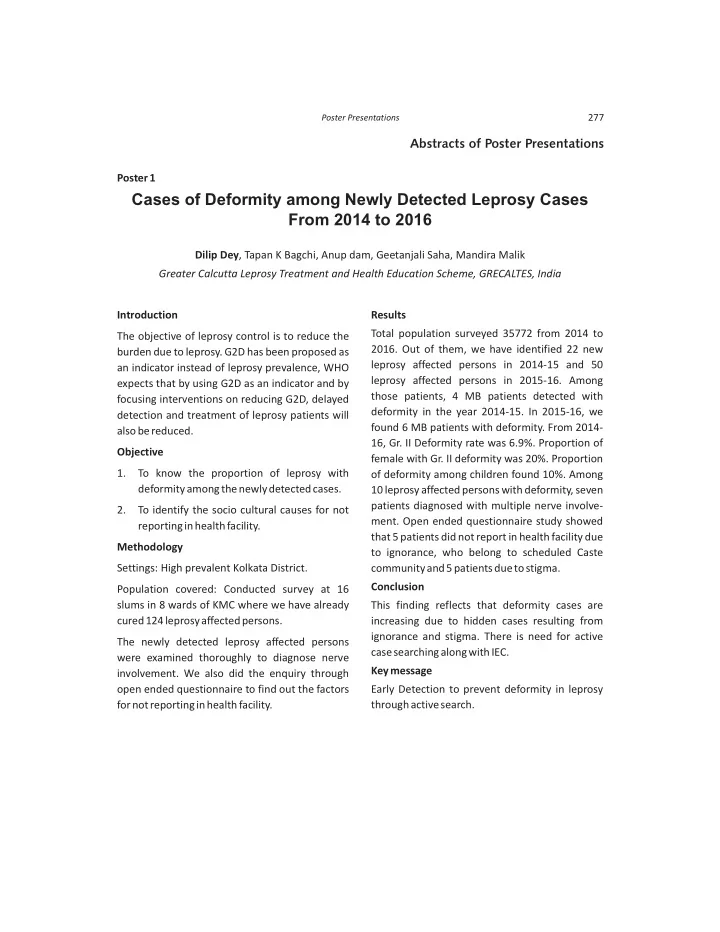
Poster Presentations 277 Abstracts of Poster Presentations Poster 1 Cases of Deformity among Newly Detected Leprosy Cases From 2014 to 2016 Dilip Dey , Tapan K Bagchi, Anup dam, Geetanjali Saha, Mandira Malik Greater Calcutta Leprosy Treatment


slide-1
SLIDE 1

Poster Presentations

277

Introduction The objective of leprosy control is to reduce the burden due to leprosy. G2D has been proposed as an indicator instead of leprosy prevalence, WHO expects that by using G2D as an indicator and by focusing interventions on reducing G2D, delayed detection and treatment of leprosy patients will also be reduced. Objective 1. To know the proportion of leprosy with deformity among the newly detected cases. 2. To identify the socio cultural causes for not reporting in health facility. Methodology Settings: High prevalent Kolkata District. Population covered: Conducted survey at 16 slums in 8 wards of KMC where we have already cured 124 leprosy affected persons. The newly detected leprosy affected persons were examined thoroughly to diagnose nerve

  • involvement. We also did the enquiry through
  • pen ended questionnaire to find out the factors

for not reporting in health facility. Results Total population surveyed 35772 from 2014 to

  • 2016. Out of them, we have identified 22 new

leprosy affected persons in 2014-15 and 50 leprosy affected persons in 2015-16. Among those patients, 4 MB patients detected with deformity in the year 2014-15. In 2015-16, we found 6 MB patients with deformity. From 2014- 16, Gr. II Deformity rate was 6.9%. Proportion of female with Gr. II deformity was 20%. Proportion

  • f deformity among children found 10%. Among

10 leprosy affected persons with deformity, seven patients diagnosed with multiple nerve involve-

  • ment. Open ended questionnaire study showed

that 5 patients did not report in health facility due to ignorance, who belong to scheduled Caste community and 5 patients due to stigma. Conclusion This finding reflects that deformity cases are increasing due to hidden cases resulting from ignorance and stigma. There is need for active case searching along with IEC. Key message Early Detection to prevent deformity in leprosy through active search. Poster 1

Cases of Deformity among Newly Detected Leprosy Cases From 2014 to 2016

Dilip Dey, Tapan K Bagchi, Anup dam, Geetanjali Saha, Mandira Malik Greater Calcutta Leprosy Treatment and Health Education Scheme, GRECALTES, India

Abstracts of Poster Presentations

slide-2
SLIDE 2

Aims and Objectives We share our experience on assessment and impact of provision of disability care services (POD) in leprosy patients with G2D at our Referral center from March 2014 to April 2017. Material and Methods Patients newly diagnosed with G2D or those who developed disabilities while under anti- leprosy treatment or during follow up in the period from 2014 to 2017 were assessed for disability splints, hand exerciser, ulcer care kit, foot drop splint, MCR footwear, POP cast etc. These were provided depending on type of deformity. Besides aids, physiotherapy services like muscle stimulation, wax bath were given to improve upon nerve / muscle function. Clinical impact of services was assessed using simplified proforma. During 2014–2017, 129 patients were registered with grade 2 disabilities of which 69 (53%) were mobile claw hand, 7 (5.4%) fixed claw hand, 23 (18%) abduction deformity, 12 (9%) foot drop, 27 (21%) chronic non healing ulcers and 9 (7%) lagopthalmos. Poster 2

Assessment and Impact of Disability Care Services - Observations from Referral Center

VV Pai, Chandra Kant Dhamale, Tulsiram Kshirsagar, Ashok Kute Bombay Leprosy Project, Mumbai, Maharashtra and Vasudev Rokade Asst Director of Health Services (Leprosy) Govt of Maharashtra, Pune, Maharashtra, India

th

Scientific Highlights of 30 Biennial Conference of IAL - 2017, Digha (West Bengal)

278

Observations/Result On assessment of these 129 patients, we found 20 (30%) patients with mobile claw improved well while 46 (67%) patients remained static and 3 (4%) worsened. Amongst fixed claw hand one (14%) improved and 6 (86%) remained static. Of 23 patients with abduction deformity, 12 (52%) improved, 10 (43%) remained static while one (4%) worsened. In patients with foot drop, 5(41%) improved, 6 (50%) remained static and one (8%)

  • worsened. Amongst 22 patients with foot ulcers,

9(41%) healed, 13 (59%) remained static while

  • ut of 9 patients with lagophthalmos, 8 (89%)

improved and one (11%) remained static. Conclusion It cannot be over emphasized therefore the need to identify G2D early and initiate early medical management with physiotherapy measures are required, not only to correct disabilities y but also to prevent worsening of nerve damage. Key words G2D, POD, Impact

slide-3
SLIDE 3

Poster Presentations

279

Introduction Current practice of treating infected plantar ulcers is based on empirical antimicrobial therapy which not only leads to antimicrobial resistance but also involves more suffering to patient and treatment costs. Aims and Objective The study was carried out to profile the bacteria infecting chronic plantar ulcer in leprosy patients and assess the antibiotic susceptibility pattern of the isolates. Material and methods 38 infected chronic plantar ulcers with grade II disability among people affected by leprosy were enrolled in this cross sectional study during May 2017 to Aug 2017. Wound swabs were obtained and specimens were processed for Gram stain, culture and sensitivity test as per CLSI guidelines. Results The male and female patients distribution was 73.68% and 26.31% respectively with mean age of 51.24+11.81 yrs (SD). More than 50% of ulcers were found over the metatarsal bone with Poster 3

Profile of Bacteria Infecting Chronic Plantar Ulcer in Leprosy Patients And Their Antibiotic Susceptibility Pattern

E Kumar, P. Michael Sukumar and Aparna Srikantam Blue Peter Public Health and Research Centre (BPHRC), LEPRA Society, Near TEC Building, Cherlapally, Hyderabad, Telangana, India granulated tissue and serous discharge (75%). Out of the 38 patients, 37 patients (97.36%) had a positive culture. A total of 40 microorganisms were isolated. Multiple organisms (more than

  • ne) were isolated in 3 (8.10% out of positive

culture) patients. The main isolation was Strepto- coccus species (45.94%), Staphylococcus species (21.62%), Corynebacterium species (18.91%). Vancomycin, Linezolid, Cefazolin and Teicoplanin are found to be 100% sensitive to all the gram positive bacteria. Conclusion The bacteriological study of plantar ulcers of leprosy patients revealed S. aureus and Strepto- coccus species as the main pathogens involved in such infections. Key Message The bacterial profiling and antibiotic suscepti- bility pattern examined in this study may provide the basis for specific antimicrobial therapy for effective control of wound infections. Keywords Leprosy, Plantar ulcer and Bacteria

slide-4
SLIDE 4

th

Scientific Highlights of 30 Biennial Conference of IAL - 2017, Digha (West Bengal)

280

Poster 4

Chronic and Non-Healing Plantar Ulcers Affecting the Quality of Lives

A Kameswara Rao, G. Swamy Reddy, M. Sathi and MS Raju LEPRA Society, Hyderabad, Telangana, India Aims and objectives This paper aims to highlight the role of chronic and non-healing plantar ulcers affecting the quality of lives. Material and methods The study was conducted at one of the referral centers managed by LEPRA Society in Hyderabad, Telangana, India. It is a retrospective data analysis and personal interview of the individuals who attended the center for management of plantar ulcer. Observation/Result A total of 70 individuals cured from Hansen's disease registered for services related to plantar ulcer management for period of 6 months in the year 2017-18. Their age ranged from 28–78 years. Male preponderance is noted with 77% comp- rising males. Of the 70 treated, 16 were of compli- cated category, 13 were new, 52 were old and 5 were recurrent. Scheduled care was provided to all of them as per the standard operating procedure (SOP) of Society. The outcome of the care and challenges will be discussed during the presentation. Conclusion Plantar ulcers are significantly affecting the life of individuals affected with leprosy. Key message Conservative treatment protocols consume much longer time. Therefore marginalized people are not willing to undergo such therapy which is time consuming and does not yield good results. There is a great need to develop early recovery treat- ment protocols by involving the orthopaedic and plastic surgery specialities, in addition to the microbial sensitivity reports from these ulcers. Key words Plantar ulcer, Leprosy, Quality of life Poster 5

Integrated Prevention of Disability Programme for Disabled Person due to Leprosy and Elephantiasis in Bihar, India

  • S. K. Mishra, Rajni Kant Singh, Amar Singh, G C Srivastava, Lalbabu Singh, Santosh Kumar

LEPRA Society, Patliputra colony, Patna, Bihar, India. Introduction India contributes to more than 60% of Leprosy and 40% of Lymphatic Filariasis of world. Bihar is contributing more than 16% of India case load

slide-5
SLIDE 5

Poster Presentations

281

and 89% population lives in rural areas (villages). These diseases produce foot disability among the affected individuals, thus reduces the functional ability of individual, which leads to economic load, stigma, discrimination and separation from community. Why Integration ? Leprosy and Lymphatic Filariasis both produce permanent disability. The strategy on morbidity management and disability prevention primarily focuses on the care of limb such as skin care, wound care, exercises, protective footwear and health education. Lymphatic Filariasis and leprosy are two major neglected tropical diseases with disabling con- ditions attached with chronic manifestations affecting health, social and economic status. Both the diseases share attributes which are cost- effective and common for disability prevention. Aim To improve the functional ability of individual having foot disability to reduce stigma & discrimination from the community. Methods POD camps were organized at the Primary Health Centre with the support of District Health Society in April 2014. Before the camp Information

  • Knowledge. Education Communication (IEC)

campaign were given with the support of IEC mobile Van in in camps. Inter Personal Commu- nication (IPC) was conducted through community health workers. All the affected persons are assessed individually with patients performed the participatory role. IPOD Kit, customized protec- tive Footwear, podiatry appliances, has been given to all those have attended the IPOD camp. In the IPOD camp we adopted "Satisfied customer approach model" whichwais very well taken by the beneficiaries. 3635 feet disabled [Leprosy - 297, Lymphatic Filariasis (Elephantiasis) – 3338] persons were screened with structured format and received the techniques of Self-care practices, IPOD Kit, protective footwear, podiatry appliances, exercise (active & passive). Self-Support Group was formed among beneficiaries and monthly monitoring system were introduced in the community for proper after care and follow-up. Results After completion of one year, data was analysed and found 92% ulcer were healed, only 3% recur- rencies were seen in the form of new ulcer, swelling of elephantiasis was reduced by 65% on the average. Stigma in community, self-stigma also reduced. Their affected persons participation in social cultural, religious, rituals had increased. The acute attack has been reduced in 80% and entry point healedin up to 83%. Of affected individuals. Conclusion We found the techniques of IPOD were well accepted by community, monitored by their own self-support group and sustainable. This model can be replicated at larger scale. The advocacy at policy make level (govt.) will be helpful to reach at larger population.

slide-6
SLIDE 6

Poster 6

Profile of Service Delivery in Leprosy at a Newly Established Secondary Care Centre at Mahaboob Nagar, Telangana

  • S. Srinivasa Rao, D. Babu Rao, A. Kameswara Rao, G. Swamy Reddy, M. Sathi Raju

LEPRA Society, West Marredpally, Secunderabad Telangana, India. Aims and objectives This paper aims to present the significant role

  • f service delivery related to leprosy through a

referral centre model. Materials and Methods The study was conducted at a referral center newly established by LEPRA Society at the Government General Hospital (GGH) premises in collaboration with district health authorities, Mahaboobnagar, Telangana, India. It is a retro- spective data analysis of the individuals affected with leprosy who attended the center for needful management in a period of 18 months from January, 2016 – June, 2017. Results A total of 226 persons with 64% of male pre- ponderance got registered at the centre during the study period. Of them, 77 were new cases who visited the centre for MDT, with 90% MB rate, 36% female ratio and 7.8% of child proportion. Of the 77 diagnosed with the disease, 74 were subjected for skin smear examination with posi- tivity in 19% of cases. Surprisingly, 62% of the cases also presented with some type of disabi- lities (either Gr. I or Gr. II) according to WHO disability grading. The disease related compli- cations (reactions and nerve function deficit) were noticed in 23 persons with 78% in new cases i.e., before start of anti-leprosy treatment, 17.4% during the treatment and the remaining small proportion 4.6% after completion of treatment. Forty seven persons were reported with plantar ulcers (simpe-12 and complicated-35) and 563 pairs of MCR insole footwear was provided to the needy individuals. Conclusion Referral centers are playing significant role in management of leprosy. Key message Disability rate is much higher in newly registered cases.

th

Scientific Highlights of 30 Biennial Conference of IAL - 2017, Digha (West Bengal)

282

slide-7
SLIDE 7

Aims and Objectives This paper aims to analyse the complications reported and managed in the two Referral Centers operated by LEPRA Society in Hyderabad. 1. To study the profile of reaction & neuritis patients reported to referral centres. 2. To assess the time of occurrence and recurrence of the complications. 3. To assess the loss of wages (economic considerations) of the patient at the time of complications. Methodology It is retrospective study of the complications managed at two referral Centers in Hyderabad for a period of five years (2010 to 2014). The data was collected in the pre designed format in excel sheet and analyzed. Observations / Results A total of 385 complications due to leprosy were managed at these centers during the study

  • period. The complications presented were:

Type I – 84 (22%), Type II – 123 (32%) and Neuritis – 178 (46%). Among total reaction cases, Male were 280 (73%), Female-90 (23%) and children-15 (4%) cases. The occurrence of reactions before MDT – 118 (31%), during MDT – 115 (29%) and after MDT- 152 (40%), the finding is that reactions occurrence after MDT is very high in the age group 36 to 65 years old. Conclusion The rate of complication is marginally higher after completion of MDT when compared to two other

  • categories. (before and during MDT).

Recommendations The institutions working for leprosy control should be vigilant to identify and manage the complications even after completion of MDT. Key message The occurrences of reactions were less in female. Poster 7

Retrospective Analysis of Reporting of Complications and Their Management in Leprosy Cases Treated in the Two Leprosy Referral Centers at Hyderabad

  • G. Swamy Reddy, A. Kameswara Rao, M. Sathi Raju

LEPRA Society, West Marredpally, Secunderabad, Telangana, India

Poster Presentations

283

slide-8
SLIDE 8

th

Scientific Highlights of 30 Biennial Conference of IAL - 2017, Digha (West Bengal)

284

Poster 8

Outcome Study of Podiatric Appliances to Heal Planter Ulcer and to Prevent Recurrence

Singh Santosh Kumar, Singh Rajni Kant, Singh Amar, Singh Lalbabu LEPRA Society, Patna, Bihar, India Background The term 'plantar' trophic or perforating ulcer was introduced by Price in 1959. It was defined as a chronic ulceration of the anesthetic sole. The proportion of new cases presenting with WHO grade 2 disability range from 6 to 21%. Plantar ulceration is one of the commonest serious disabilities encountered in leprosy. Podiatric appliances have three roles: First is shift the weight on to the others area. It reduces pressure because it the body weight is spread

  • vera large area. Second is rest to the damaged

part to help ulcer heal more quickly. Third is correct the abnormal foot function. The podiatric appliances help in preventing recurrent ulcer & heal ulcer. Material and Methods 1. Individual record format (patients card) 2. Individual interviewers 3. Patients cards (Biomechanical assessment) 4. Patients attended in IPOD camp during 2011-13 5. Patients attended in referral center in 2011-13 6. Individual recorded biomechanical assess- ment & ulcer format 7. Follow up Results The study group (with podiatric appliances) showed good result with podiatry appliances. Only 13.13%of the patients had developed the recurrent ulcer, and 88.88% ulcer healed. In the non-control group (without podiatric appliances) in 30 % cases there was recurrence of ulcer and wound healing was observed in only 50% of cases. Conclusion Proper footwear with podiatic appliances is very important for Leprosy patients with aesthetic

  • foot. It helps to redistribute the pressure and

reduce the chance of ulcer development. Patients prescribed shoes (custom designed) are the most appropriate, well accepted and were shown to reduce pressure and better wound healing without recurrences. Implications This study shows high level of ulcer healing with regular self-care practices. This can be applied to all at referral centers and secondary level Leprosy care centers. Key words Biomechanical Assessment, Foot Ulcer, Podiatric Appliances, Pressure, Footwear.

slide-9
SLIDE 9

Poster Presentations

285

Poster 9

Cohort Study of Leprosy Patients and their Household Contacts for their Association with Intestinal Parasite Infection in Endemic Region of Purulia (West Bengal) and Champa (Chhattisgarh)

Ravindra P Turankar, Bandana Dubey, Vinay Pathak, MallikaLavania, Itu Singh, Vikram Singh, Madhavi Ahuja, JoydeepaDorlong, Sandeep Kumar and Utpal Sengupta. Stanley Browne Laboratory, The Leprosy Mission Trust India, Nand Nagari, New Delhi, India. Background Leprosy transmission is still continuing and is maintaining a steady, prevalence rate (<1/10,000) in most of the developing countries. India acco- unts for 60% of total leprosy cases reported

  • worldwide. Intestinal parasitic infection is one of

the major health problems in all these developing

  • countries. Helminthic infection has been claimed

to play a role in the development or susceptibility towards leprosy. The present study was con- ducted to find out whether the presence of helminthic parasite contribute towards suscept- iblity to leprosy in an endemic population. Methods A total of 369 stool samples were collected from 96 patients and 273 household contacts from endemic villages of Purulia and Champa. The samples were screened for the presence of intestinal parasites as per standard parasito- logical simple direct saline mount and floatation method. Results Intestinal parasites were detected in 107 (35%) stool samples, out of which 35 (37%) were from leprosy patients and 72(26%) were from house- hold contacts. The presence of intestinal hel- minths was more prevalent among leprosy patients when compared to household contacts. However, the two-tailed p value of 0.1276 was not found to be statistically significant. Further, household contacts were followed up in 6 months' interval for the development of signs and symptoms of leprosy up to 4 years. It was noted that 30 contacts developed leprosy disease but

  • ut of these only three contacts had helminthic

parasite infection earlier. Conclusion Study indicates that intestinal parasite infection has no role to play for the development of leprosy.

slide-10
SLIDE 10

Poster 10

Pure Neural Leprosy with Variations in Presentations and Challenges in Diagnosis – Can Ultra-Sonography of Nerves (USG)/ Nerve Conduction Studies (NCS) Facilitate Diagnosis?

Ashish Khodke, VV Pai, Chandrakant Dhamale and Kalpana Bhatt Dr Bhatt's Ultra Sonography Clinic, Matunga, Mumbai, Maharashtra, India Aims and Objectives It is relatively easy to investigate and diagnose suspects of leprosy with cutaneous manifes- tations but far more challenging to diagnose suspects of leprosy with no skin lesions who report only with neurological presentations. We present below our experience in diagnosing such difficult to diagnose cases seen in Referral Center

  • f Bombay Leprosy Project.

Material and Methods During the period from 2016-17, eight suspects (4 males and 4 females) with neurological pre- sentations but no skin lesions were referred to Referral centre for diagnosis. Mean age was 48 years (range from 25 years to 65 years). Suspects were clinically and bacteriologically assessed and were investigated also for Ultra-sonography (USG) of nerves and nerve conduction studies (NCV). Neurological presentations included non healing painless plantar ulcers in three (2 patients with ulcers on sole and 1 at distal phalinx of finger), one with mobile claw and rest four with symptoms of tingling numbness, burning sensation and loss of sensation along affected

  • nerve. Clinically some patients had nerve thick-

ening and affected area had sensory loss. Results Three patients were subjected to USG of peri- pheral nerves which suggested enlargement of affected nerve compared to normal nerve with anechoic nerve fascicles. There was two to four times increase in cross sectional area (CSA)

  • f nerves. In five patients subjected to NCV

two showed mono-neuritis multiplex affecting multiple nerves, two reported axonal peripheral neuropathy and one demeyelinating axonal poly radiculo neuropathy. Conclusions In all of the above cases leprosy was suspected clinically but confirmation could be facilitated based on clinically doubtful nerve thickening with sensory loss correlating with USG/NCV confirmed enlargement of nerves. The cross sectional area of affected nerves enlargement was almost double in comparison to normal nerves with no clinical symptoms/signs. Key words Ultra Sonography, Nerve conduction studies, Pure Neural Leprosy

th

Scientific Highlights of 30 Biennial Conference of IAL - 2017, Digha (West Bengal)

286

slide-11
SLIDE 11

Poster 11

and Their Association with TNF-á - 238G/A, -308G/A & IFN- in Leprosy and HIV-Peripheral Neuropathy

Sykam A, Prasanna M, Jain S, Ravi GV, Raju R, Suneetha S, Suneetha L Infectious Disease Research Laboratory (IDRL), Institute for Specialised Services in Leprosy (INSSIL), CODEWEL Nireekshana ACET, Narayanaguda, Hyderabad, Telangana, India

Serum Cytokine Levels ã +874 A/T Single Nucleotide Polymorphism

Background Mycobacterium leprae (M. leprae) the causative

  • rganism of leprosy and Human Immuno-

deficiency Virus (HIV) the causative agent of HIV/AIDS are both known to cause neuropathy. Some form of sensory/motor involvement is commonly present in all patients with leprosy and HIV-associated peripheral neuropathy (HIV-PN). It affects up to 67% of individuals with HIV

  • infection. The present study investigates the role
  • f host factors such as cytokine levels of TNF-á

and IFN-ã and their single nucleotide polymor- phisms (SNPs) as common molecules/pathways in causing both HIV-PN, leprosy neuropathy (LN) and other neuropathies. Methods 39 individuals with HIV-PN, 88 with leprosy, 52 with other neuropathies (ON), 101 HIV individuals without neuropathy, and 113 healthy subjects (HS) were evaluated. Serum cytokine levels were measured by sandwich ELISA. One way ANOVA was carried out among the groups to analyze the significance of the levels. SNPs of TNF-á-308 G/A,

  • 238, G/A and IFN- ã+ 874 were investigated

by amplification refractory mutation system poly- merase chain reaction (ARMS-PCR). The allele and genotype frequencies for all the loci investigated for TNF and IFN-ã did not deviate significantly from Hardy-Weinberg equilibrium. These frequencies were compared between groups by Pearson chi squared tests to determine statistical significance. Results Serum TNF-á and IFN-ã was significantly incre- ased in leprosy (p=0.00), HIV-PN (p=0.00) and ON (p=0.00) as compared to HS. SNP studies revealed a statistically significant association between IFN-ã+ 874 A/A in HIV-PN (p<0.00; OR=8.9), leprosy (p<0.00; OR=7.9) and ON (p<0.00; OR= 8.9) as compared to HS. Our study did not find any correlation between SNPs and serum cytokine levels in leprosy, HIV-PN and ON. Conclusion This data suggests a common pathway of involvement of cytokines TNF-á and IFN-ã in

  • neuropathy. Association of IFN-ã A/A genotype

SNP in leprosy, HIV-PN and ON suggests that this could be involved in pathogenesis/susceptibility to peripheral neuropathy. There appears to be no significant regulatory effect of genotypes on the serum cytokine levels as they were not correlated to each other.

  • á

Poster Presentations

287

slide-12
SLIDE 12

Poster 12

A Study of Asteatotic Eczema in Leprosy – The Untold Story

Prasad PVS, Viswanathan P, Kaviarasan PK, Abinaya M Rajah Muthiah Medical College, Annamalai University, Annamalai Nagar, C.Kothangudi, Tamil Nadu 608002, India. Background Leprosy is a slowly progressive disease caused by Mycobacterium leprae. The organisms are usually found in the sub-epidermal zone, inside the nerves, sweat glands, erector pili muscle, macrophages and around the hair follicle. Asteatotic eczema in leprosy occurs due to the destruction of the sweat and sebaceous glands. Definite histological changes are seen even in the normal appearing skin of leprosy patients. There is paucity of studies describing the histo- pathological features of asteatotic eczema in leprosy patients. Histo-pathological findings may help in defining the disease activity of leprosy patients. Aim To study the histo-pathological findings of Asteatotic eczema in leprosy patients. To cor- relate their clinical status and to find out the importance of such correlations in relapse of the disease. Methods Skin biopsy was done from 30 patients from the asteatotic patch and the features were studied

  • histologically. Ridley Jopling classification was
  • followed. Pure neuritic leprosy was also dia-

gnosed appropriately. Results Among the study patients, 33.3% were pure Neuritic, 10% BT, 50% were BL and 6.6% were of Hstoid leprosy. The male to female ratio was 4:1. Histo-pathological picture of asteatotic eczema showed epidermal changes like both hyper- keratosis and atrophy. We also noted acanthosis in 16.6% in contrast to atrophy which is usually seen in leprosy. Dermal changes like infiltrates were noted in 76.6% and granuloma in 23.3%. BL HD and pure neuritic types showed granuloma in 42.8%. and histoid in 14.2%.Though pure Neuritic cases were adequately treated and inactive, the histo-pathological picture from asteatotic eczema showed granuloma. Thickened collagen bundles with kinking was another interesting observation in 56.6% of cases. Conclusion Our study revealed that asteatotic eczema is more commonly noted in lepromatous spectrum. Histo-pathological findings may help in defining the disease activity of leprosy patients. Presence

  • f granuloma in both inactive and adequately

treated cases is an interesting finding which has to be explored further. Hence, asteatotic eczema can be an index of predictor for assessing the resolution of the disease.

th

Scientific Highlights of 30 Biennial Conference of IAL - 2017, Digha (West Bengal)

288

slide-13
SLIDE 13

Poster Presentations

289

Poster 13

Significance of Slit Skin Smears (SSS) in Leprosy Diagnosis

Gopala Rao B, Ashok Babu K, Sanjay Kasetty, Aparna Srikantam LEPRA Society-Blue Peter Public Health and Research Center, Hyderabad, Telangana, India Introduction According to WHO, the classification of leprosy is based on eliciting at least one of the cardinal signs through clinical and bacteriological examination. Most of the cases are confirmed by clinical exami- nation, as there is less scope for bacteriological

  • examination. The present study reports the signi-

ficance of slit skin smear (SSS) examination in the classification of leprosy case. Aim To study the SSS Slit Skin Smear) positivity among clinically diagnosed leprosy patients. Material and Methods A 12-month cohort of 234 new leprosy cases who voluntarily registered with 3 Primary Health Centers (PHC) & 3 Community Health Centre (CHC) of AP & Odisha have been included in this

  • study. Slit skin smears were collected from 92%

(71 PB cases +145 MB cases) of cases following aseptic precautions and using the standard protocol, after obtaining their Informed Consent. The smears were labeled, fixed and stained with Ziehl Neelsen stain for AFB. Light microscopic examination was done. The smear results were reported and recorded according to the Ridley Jopling scale. Results 11 out of 71 PB patients (15%) clinically diagnosed as PB as per WHO classification were AFB positive in slit skin smear microscopy. Eighty six out of 145 MB cases were also bacteriological positive by the same criteria. Conclusion All the 11 patients who were clinically diagnosed as PB case were re-classified as having MB leprosy after their SSS were reported positive. Our study emphasizes the importance of SSS examination for every suspect/new case presen- ting with the signs and symptoms of leprosy to diagnose and treat them with appropriate WHO

  • regimen. These would otherwise have been

wrongly classified and treated with lesser drugs and for a shorter duration following the present guidelines. Key Message It is strongly recommended as an important tool for leprosy diagnosis and classification to aid in appropriate treatment and success of NLEP.

slide-14
SLIDE 14

th

Scientific Highlights of 30 Biennial Conference of IAL - 2017, Digha (West Bengal)

290

Poster 14

Molecular Testing for Drug Resistance in Relapsed Leprosy Cases

Sanjay M. Kasetty, Gopala Rao B, Michael Sukumar, Aparna Srikantam LEPRA Society-Blue Peter Public Health and Research Centre, Cherlapally, Hyderabad, Telangana, India Aims and Objectives To investigate for rifampicin, dapsone and

  • floxacin drug resistance in relapsed leprosy

cases Material and Methods Relapse is defined as re-occurrence of active disease at any time after completion of MDT. Relapse is diagnosed, based on the appearance

  • f new skin lesions and an increase in the

bacteriological index on smear microscopy. There is a mixed theory on relevance of drug resistance and leprosy relapses. A total of 44 Slit-skin samples (SSS) from relapsed leprosy multibacillary (MB) patients visiting LEPRA clinics in AP, Odisha and BPHRC between 2014 and 2016 were investigated. The SSS samples were collected from abnormal (thickened) ear lobe, fore head, edge of active patch and preserved in 70% ethanol. Slit-skin smears were observed microscopically for presence of acid-fast bacilli and DNA from SSS was used as template for PCR based gene amplification using specific primers for detection of mutations in the rpoB, gyrA and folP1genes. Positively amplified genes were further subjected to sequencing for detection of mutations if any. Results The BI of the relapsed MB cases was between 2+ to 6+. Out of 44 relapse cases, 36 (82%) were smear and PCR positive and 8 (18%) were smear and PCR negative. None of the PCR positive samples when sequenced showed any mutation. Conclusions Early detection of drug resistance is essential for effective treatment and preventing the spread of resistant strains. However, relapse cases with no drug resistance indicate possible reactivation and or re-infection. Hence, it is important to monitor recurrent cases for drug resistance and to distinguish between relapse and drug resistance as a means of assessing therapeutic efficacy. Molecular genotyping studies will be able to investigate the above. Key message Molecular tests for differentiating relapse drug resistance are required for effective control of leprosy transmission.