Case Study: UC Nippert Stadium Pressbox Renovation A Sustainable - - PowerPoint PPT Presentation

case study uc nippert stadium pressbox renovation
SMART_READER_LITE
LIVE PREVIEW

Case Study: UC Nippert Stadium Pressbox Renovation A Sustainable - - PowerPoint PPT Presentation

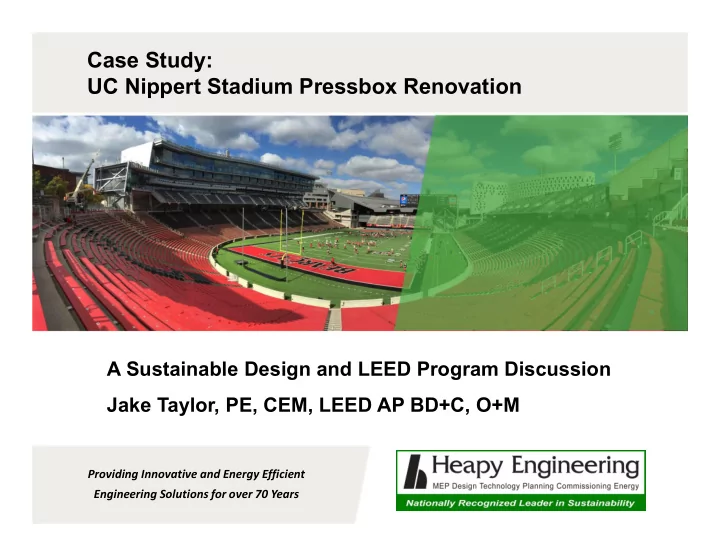
Case Study: UC Nippert Stadium Pressbox Renovation A Sustainable Design and LEED Program Discussion Jake Taylor, PE, CEM, LEED AP BD+C, O+M Providing Innovative and Energy Efficient Engineering Solutions for over 70 Years Learning Objectives

slide-1
SLIDE 1

Case Study: UC Nippert Stadium Pressbox Renovation

A Sustainable Design and LEED Program Discussion Jake Taylor, PE, CEM, LEED AP BD+C, O+M

Providing Innovative and Energy Efficient Engineering Solutions for over 70 Years

slide-2
SLIDE 2

1. The attendees will understand the energy savings

  • pportunities that exist with atypical projects such as a

University Pressbox. 2. Attendees will learn which LEED-NC credits are feasible and more difficult given an atypical project type. 3. Attendees will review the energy efficient design processes used throughout the design of this project and how that affects the LEED process and associated credits. 4. Attendees will gain insight on the LEED difficulties associated with a project with nearly 60% glass on the exterior, operated for only a few days per year, and served by existing central plant systems

Learning Objectives

slide-3
SLIDE 3
  • The Team and Project
  • LEED Introduction and Process
  • LEED and Project Design
  • LEED and Project Construction
  • Conclusions

Agenda

slide-4
SLIDE 4
  • Owner

University of Cincinnati

  • Architect of Record

Heery International

  • Design Architect

Architecture Research Office

  • Civil Engineer

Parsons Brinckerhoff

  • Landscape Architecture

Vivian Llambi & Associates, Inc.

  • Structural Engineer

THP Limited Inc.

  • M/E/P/FP Engineer

Heapy Engineering

  • Commissioning Agent

BC+E Engineering

  • Construction Manager

Turner Construction Company

The Team

slide-5
SLIDE 5
  • Complete demolition of existing pressbox
  • About 65,000 sf of newly constructed pressbox
  • 6 floors

The Project

slide-6
SLIDE 6
  • Intended for full occupancy 6/7 days per year
  • Special events held throughout the year

in various areas

  • Concourse/concession area, club level lounges,

catering areas, suites, and press areas.

The Project

slide-7
SLIDE 7
slide-8
SLIDE 8
slide-9
SLIDE 9

8 Program Prerequisites 100 Potential Credit Points +10 Bonus Credit Points

LEED – Introduction

Certification Levels: Certified: 40 to 49 points Silver: 50 to 59 points Gold: 60 to 69 points Platinum: 80 + points

slide-10
SLIDE 10

LEED Eco-Charrette

slide-11
SLIDE 11

LEED Eco-Charrette

  • EAc1 credits were not counted on due to unknown

HVAC and lighting systems selection as well as

  • verall glass percentage.
  • Urban location made certain SS credits

more easily attainable.

  • Questionable site / LEED Project boundary

didn’t allow some SS credits to be known for sure.

  • Additional Water Use Reduction points were unknown

due to the types and locations of restrooms.

  • Most construction credits were sought after due to the

possibility of limited attainable design credits.

slide-12
SLIDE 12

Project Design

Proposed Baseline Wall 1 U-0.074 U-0.064 Wall 4 U-0.1075 U-0.064 Wall 5,7 U-0.0302 U-0.064 Curtain wall window (2,3,6) U-0.3693 U-0.55 Glass wall window 8 U-1.04 U-0.55 Glass wall window 9 U-1.00 U-0.55 Roof U-0.043 U-0.048

  • Early design Life Cycle Cost Analysis

modeling was completed to evaluate:

  • HVAC Systems
  • (1) VAV with reheat
  • (2) Two Pipe Fan Coils
  • (3) VRF Fan Coils
  • Overall window areas (initial

concept at 65%)

  • LEED DES approach
  • Envelope Insulation Values
slide-13
SLIDE 13

Project Design

  • Other design considerations

that were modeled include:

  • Daylighting
  • Automatic shades

– timer for off season days

  • Occupancy sensors
  • LED exterior/interior
  • Skylights or solar tubes

(better than code min)

  • Better windows where

clarity is not sacrificed

  • Improved flow fixture efficiency
  • VAV type controls on kitchen hoods
  • Demand control ventilation
  • Natural ventilation
  • Radiant floor heat on non fin tube units
  • Exhaust energy recovery
  • Better roof insulation
slide-14
SLIDE 14

Project Design

  • Final Design Included:
  • Natural and Displacement

Ventilation where appropriate

  • 75% LED Lighting
  • Low-flow fixtures and fittings
  • Improved Envelope per tables
  • Enthalpy Economizers
  • Demand Controlled

Ventilation

INITIAL Proposed Baseline Wall 1 U-0.074 U-0.064 Wall 4 U-0.1075 U-0.064 Wall 5,7 U-0.0302 U-0.064 Curtain wall window (2,3,6) U-0.3693 U-0.55 Glass wall window 8 U-1.04 U-0.55 Glass wall window 9 U-1.00 U-0.55 Roof U-0.043 U-0.048 FINAL Proposed Baseline Wall 1 U-0.064 U-0.064 Wall 4 U-0.064 U-0.064 Wall 5,7 U-0.0302 U-0.064 Curtain wall window (2,3,6) U-0.3693 U-0.55 Glass wall window 8 U-1.04 U-0.55 Glass wall window 9 U-0.3693 U-0.55 Roof U-0.035 U-0.048

slide-15
SLIDE 15

Project Design and LEED

  • LEED Project Boundary
slide-16
SLIDE 16

Project Design and LEED

  • LEED Occupant and Usage Data

(2,050 gameday visitors * 7 gamedays per year + 50 non-gameday visitors * 40 non-gamedays per year) / 47 total days in operation = 348 average visitors per day (200 gameday FTE * 7 gamedays per year + 4 non-gameday FTE * 40 non-gamedays per year) / 47 total days in operation = 33 average FTE per day Average building users per day = 348 average visitors per day + 33 average FTE per day = 381 average users per day

slide-17
SLIDE 17

Project Design and LEED

  • SSc2 Development Density and Community Connectivity
slide-18
SLIDE 18

Project Design and LEED

  • SSc1 Site Selection
  • SSc3 Brownfield Redevelopment
  • Lead and Asbestos were present in the existing building and

was remediated everywhere as part of this project

slide-19
SLIDE 19

Project Design and LEED

  • SSc5.2 Site Development, Maximize Open Space
slide-20
SLIDE 20

Project Design and LEED

  • SSc7.1 Heat Island Effect, Non-Roof
slide-21
SLIDE 21

Project Design and LEED

  • SSc7.2 Heat Island Effect, Roof
slide-22
SLIDE 22

Project Design and LEED

  • WEp1/c3 Water Use Reduction
  • The project contained 1.28 gpf water closets, a combination of 0.5 gpm manual

and automatic lavatories, and a mix of 0.5 gpf and waterless urinals.

  • The project also contained mixes of public, private, and out-of-building restrooms.
slide-23
SLIDE 23

Project Design and LEED

  • EAp3/c4 Fundamental and Enhanced Refrigerant Management
slide-24
SLIDE 24

Project Design and LEED

  • IEQp1 Minimum IAQ Performance
  • Naturally ventilated areas as well as those served by a displacement ventilation

system allowed for less needed mechanically cooled outdoor air and thus offered energy savings.

slide-25
SLIDE 25

Project Design and LEED

  • IEQc1 Outdoor Air Delivery Monitoring
  • CO2 sensors
  • IDc1.2 Low-Mercury Lighting
  • Large quantities of LED lighting on interior and exterior made this credit feasible.
slide-26
SLIDE 26

Project Design and LEED

  • IEQc6.1 Controllability of Systems, Lighting and Thermal Comfort
slide-27
SLIDE 27

Project Design and LEED

  • IEQc8 Daylight and Views
  • IEQc8.2 was able to be earned at 91%
  • IEQc8.1 was unable to be earned due to too large of windows

without any type of view preserving automated shades.

slide-28
SLIDE 28

Project Design and LEED

  • IEQc8 Daylight and Views
slide-29
SLIDE 29

Project Design and LEED

37 points earned after the design submittal

slide-30
SLIDE 30

Project Construction and LEED

  • A LEED Construction Kickoff Meeting was held where all

construction requirements were discussed.

  • All product submittals were reviewed and documented for

LEED throughout construction.

  • Bi-weekly LEED Construction Status discussions were had

by the team to maintain progress.

slide-31
SLIDE 31

Project Construction and LEED

  • MRc2 Construction Waste Management
  • Large amounts of diverted demolition waste made the earning of this credit more likely.
  • EAc3 Enhanced Commissioning
  • This credit was not able to be earned after a clarifying comment from GBCI noted that

Enhanced Commissioning must include all DES equipment when the building is greater than 50,000 sf and more than 20% of the building energy comes from the district energy system.

slide-32
SLIDE 32

Project Construction and LEED

  • MRc7 Certified Wood
  • This credit was re-evaluated during construction and removed as a requirement

since additional points weren’t needed for Silver and the cost premium was significant.

  • IEQc3.1 Construction IAQ Management, During Construction
  • This credit was removed from the project scope as the project completion date was later than

anticipated and the point wasn’t needed for a new credit threshold or necessary for a buffer.

  • IDc1.4 Innovative Elevator Technology
  • The elevators selected eliminate the need for an elevator machine room within the building,

thereby reducing building materials/resources. Save process energy associated with the elevator systems. Eliminate the use of hydraulic fluid within the elevator systems to reduce the associated environmental impact.

slide-33
SLIDE 33

Project Construction and LEED

  • MRc4/5 Recycled Content and Regional Materials
slide-34
SLIDE 34

Project Construction and LEED

slide-35
SLIDE 35

Providing Innovative and Energy Efficient Engineering Solutions for over 70 Years

Thank you!

Case Study: UC Nippert Stadium Pressbox Renovation