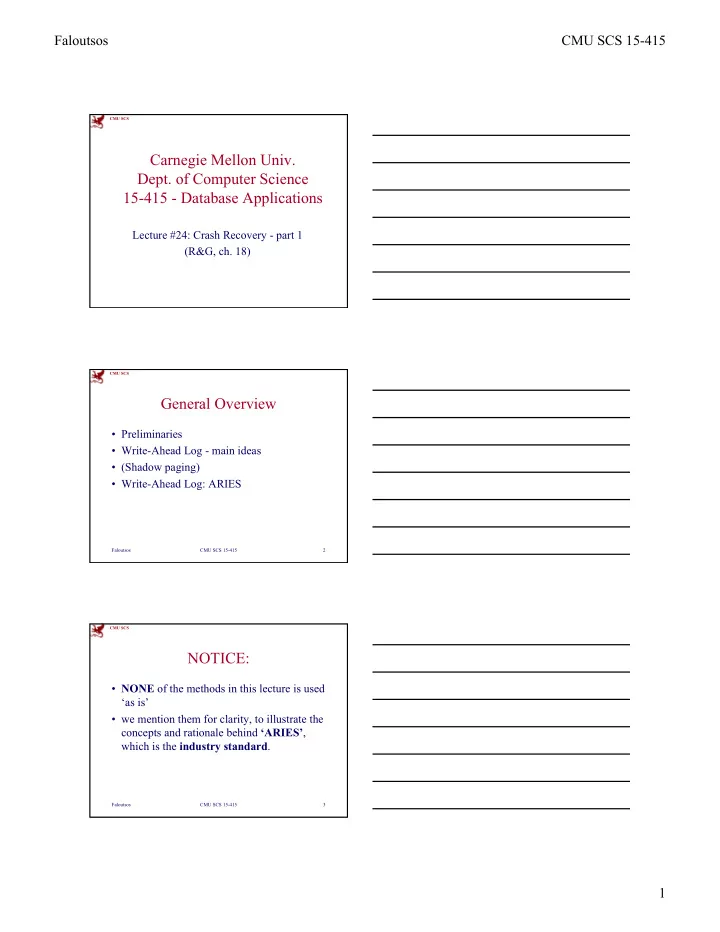
Carnegie Mellon Univ. Dept. of Computer Science 15-415 - Database - - PDF document

carnegie mellon univ dept of computer science 15 415
SMART_READER_LITE
LIVE PREVIEW

Carnegie Mellon Univ. Dept. of Computer Science 15-415 - Database - - PDF document

Faloutsos CMU SCS 15-415 CMU SCS Carnegie Mellon Univ. Dept. of Computer Science 15-415 - Database Applications Lecture #24: Crash Recovery - part 1 (R&G, ch. 18) CMU SCS General Overview Preliminaries Write-Ahead Log - main ideas


slide-1
SLIDE 1

Faloutsos CMU SCS 15-415 1

CMU SCS

Carnegie Mellon Univ.

  • Dept. of Computer Science

15-415 - Database Applications

Lecture #24: Crash Recovery - part 1 (R&G, ch. 18)

CMU SCS

Faloutsos CMU SCS 15-415 2

General Overview

  • Preliminaries
  • Write-Ahead Log - main ideas
  • (Shadow paging)
  • Write-Ahead Log: ARIES

CMU SCS

Faloutsos CMU SCS 15-415 3

NOTICE:

  • NONE of the methods in this lecture is used

‘as is’

  • we mention them for clarity, to illustrate the

concepts and rationale behind ‘ARIES’, which is the industry standard.

slide-2
SLIDE 2

Faloutsos CMU SCS 15-415 2

CMU SCS

Faloutsos CMU SCS 15-415 4

Transactions - dfn

= unit of work, eg.

move $10 from savings to checking

Atomicity (all or none) Consistency Isolation (as if alone) Durability

recovery concurrency control

CMU SCS

Faloutsos CMU SCS 15-415 5

Overview - recovery

  • problem definition

– types of failures – types of storage

  • solution#1: Write-ahead log - main ideas

– deferred updates – incremental updates – checkpoints

  • (solution #2: shadow paging)

CMU SCS

Faloutsos CMU SCS 15-415 6

Recovery

  • Durability - types of failures?
slide-3
SLIDE 3

Faloutsos CMU SCS 15-415 3

CMU SCS

Faloutsos CMU SCS 15-415 7

Recovery

  • Durability - types of failures?
  • disk crash (ouch!)
  • power failure
  • software errors (deadlock, division by zero)

CMU SCS

Faloutsos CMU SCS 15-415 8

Reminder: types of storage

  • volatile (eg., main memory)
  • non-volatile (eg., disk, tape)
  • “stable” (“never” fails - how to implement

it?)

CMU SCS

Faloutsos CMU SCS 15-415 9

Classification of failures:

  • logical errors (eg., div. by 0)
  • system errors (eg. deadlock - pgm can run

later)

  • system crash (eg., power failure - volatile

storage is lost)

  • disk failure

frequent; ‘cheap’ rare; expensive

slide-4
SLIDE 4

Faloutsos CMU SCS 15-415 4

CMU SCS

Faloutsos CMU SCS 15-415 10

Problem definition

  • Records are on disk
  • for updates, they are copied in memory
  • and flushed back on disk, at the discretion
  • f the O.S.! (unless forced-output: ‘output

(B)’ = fflush())

CMU SCS

Faloutsos CMU SCS 15-415 11

Problem definition - eg.:

read(X) X=X+1 write(X)

disk main memory

5

}page buffer{

5

reminder

CMU SCS

Faloutsos CMU SCS 15-415 12

Problem definition - eg.:

read(X) X=X+1 write(X)

disk main memory

6 5

reminder

slide-5
SLIDE 5

Faloutsos CMU SCS 15-415 5

CMU SCS

Faloutsos CMU SCS 15-415 13

Problem definition - eg.:

read(X) X=X+1 write(X)

disk

6 5

buffer joins an ouput queue, but it is NOT flushed immediately! Q1: why not? Q2: so what?

reminder

CMU SCS

Faloutsos CMU SCS 15-415 14

Problem definition - eg.:

read(X) read(Y) X=X+1 Y=Y-1 write(X) write(Y)

disk

6

Q2: so what? X

3 5

Y

3

reminder

CMU SCS

Faloutsos CMU SCS 15-415 15

Problem definition - eg.:

read(X) read(Y) X=X+1 Y=Y-1 write(X) write(Y)

disk

6 3

Q2: so what? Q3: how to guard against it? X

3 5

Y

reminder

slide-6
SLIDE 6

Faloutsos CMU SCS 15-415 6

CMU SCS

Faloutsos CMU SCS 15-415 16

Overview - recovery

  • problem definition

– types of failures – types of storage

  • solution#1: Write-ahead log - main ideas

– deferred updates – incremental updates – checkpoints

  • (solution #2: shadow paging)

CMU SCS

Faloutsos CMU SCS 15-415 17

Solution #1: W.A.L.

  • redundancy, namely
  • write-ahead log, on ‘stable’ storage
  • Q: what to replicate? (not the full page!!)
  • A:
  • Q: how exactly?

CMU SCS

Faloutsos CMU SCS 15-415 18

W.A.L. - intro

  • replicate intentions: eg:

<T1 start> <T1, X, 5, 6> <T1, Y, 4, 3> <T1 commit> (or <T1 abort>)

slide-7
SLIDE 7

Faloutsos CMU SCS 15-415 7

CMU SCS

Faloutsos CMU SCS 15-415 19

W.A.L. - intro

  • in general: transaction-id, data-item-id, old-

value, new-value

  • (assumption: each log record is

immediately flushed on stable store)

  • each transaction writes a log record first,

before doing the change

  • when done, write a <commit> record & exit

CMU SCS

Faloutsos CMU SCS 15-415 20

W.A.L. - deferred updates

  • idea: prevent OS from flushing buffers,

until (partial) ‘commit’.

  • After a failure, “replay” the log

CMU SCS

Faloutsos CMU SCS 15-415 21

W.A.L. - deferred updates

  • Q: how, exactly?

– value of W on disk? – value of W after recov.? – value of Z on disk? – value of Z after recov.?

<T1 start> <T1, W, 1000, 2000> <T1, Z, 5, 10> <T1 commit> before crash

slide-8
SLIDE 8

Faloutsos CMU SCS 15-415 8

CMU SCS

Faloutsos CMU SCS 15-415 22

W.A.L. - deferred updates

  • Q: how, exactly?

– value of W on disk? – value of W after recov.? – value of Z on disk? – value of Z after recov.?

<T1 start> <T1, W, 1000, 2000> <T1, Z, 5, 10> before crash

CMU SCS

Faloutsos CMU SCS 15-415 23

W.A.L. - deferred updates

  • Thus, the recovery algo:

– redo committed transactions – ignore uncommited ones

<T1 start> <T1, W, 1000, 2000> <T1, Z, 5, 10> before crash

CMU SCS

Faloutsos CMU SCS 15-415 24

W.A.L. - deferred updates

Observations:

  • no need to keep ‘old’ values
  • Disadvantages?

<T1 start> <T1, W, 1000, 2000> <T1, Z, 5, 10> before crash

slide-9
SLIDE 9

Faloutsos CMU SCS 15-415 9

CMU SCS

Faloutsos CMU SCS 15-415 25

W.A.L. - deferred updates

  • Disadvantages?

(e.g., “increase all balances by 5%”) May run out of buffer space! Hence:

CMU SCS

Faloutsos CMU SCS 15-415 26

Overview - recovery

  • problem definition

– types of failures – types of storage

  • solution#1: Write-ahead log

– deferred updates – incremental updates – checkpoints

  • (solution #2: shadow paging)

CMU SCS

Faloutsos CMU SCS 15-415 27

W.A.L. - incremental updates

  • log records have ‘old’ and ‘new’ values.
  • modified buffers can be flushed at any time

Each transaction:

  • writes a log record first, before doing the

change

  • writes a ‘commit’ record (if all is well)
  • exits
slide-10
SLIDE 10

Faloutsos CMU SCS 15-415 10

CMU SCS

Faloutsos CMU SCS 15-415 28

W.A.L. - incremental updates

  • Q: how, exactly?

– value of W on disk? – value of W after recov.? – value of Z on disk? – value of Z after recov.?

<T1 start> <T1, W, 1000, 2000> <T1, Z, 5, 10> <T1 commit> before crash

CMU SCS

Faloutsos CMU SCS 15-415 29

W.A.L. - incremental updates

  • Q: how, exactly?

– value of W on disk? – value of W after recov.? – value of Z on disk? – value of Z after recov.?

<T1 start> <T1, W, 1000, 2000> <T1, Z, 5, 10> before crash

CMU SCS

Faloutsos CMU SCS 15-415 30

W.A.L. - incremental updates

  • Q: recovery algo?
  • A:

– redo committed xacts – undo uncommitted ones

  • (more details: soon)

<T1 start> <T1, W, 1000, 2000> <T1, Z, 5, 10> before crash

slide-11
SLIDE 11

Faloutsos CMU SCS 15-415 11

CMU SCS

Faloutsos CMU SCS 15-415 31

High level conclusion:

  • Buffer management plays a key role
  • FORCE policy: DBMS immediately forces

dirty pages on the disk (easier recovery; poor performance)

  • STEAL policy == ‘incremental updates’:

the O.S. is allowed to flush dirty pages on the disk

CMU SCS

Faloutsos CMU SCS 15-415 32

Buffer Management summary

Force No Force No Steal Steal

UNDO REDO

Force No Force No Steal Steal

Slowest Fastest

Performance Implications Logging/Recovery Implications

No UNDO No REDO

CMU SCS

Faloutsos CMU SCS 15-415 33

W.A.L. - incremental updates

Observations

  • “increase all balances by

5%” - problems?

  • what if the log is huge?

<T1 start> <T1, W, 1000, 2000> <T1, Z, 5, 10> before crash

slide-12
SLIDE 12

Faloutsos CMU SCS 15-415 12

CMU SCS

Faloutsos CMU SCS 15-415 34

Overview - recovery

  • problem definition

– types of failures – types of storage

  • solution#1: Write-ahead log

– deferred updates – incremental updates – checkpoints

  • (solution #2: shadow paging)

CMU SCS

Faloutsos CMU SCS 15-415 35

W.A.L. - check-points

Idea: periodically, flush buffers Q: should we write anything on the log?

<T1 start> <T1, W, 1000, 2000> <T1, Z, 5, 10> ... <T500, B, 10, 12> before crash

CMU SCS

Faloutsos CMU SCS 15-415 36

W.A.L. - check-points

Q: should we write anything on the log? A: yes! Q: how does it help us?

<T1 start> <T1, W, 1000, 2000> <T1, Z, 5, 10> <checkpoint> ... <checkpoint> <T500, B, 10, 12> before crash

slide-13
SLIDE 13

Faloutsos CMU SCS 15-415 13

CMU SCS

Faloutsos CMU SCS 15-415 37

W.A.L. - check-points

Q: how does it help us?

A=? on disk? A=? after recovery? B=? on disk? B=? after recovery? C=? on disk? C=? after recovery?

<T1 start> ... <T1 commit> ... <T499, C, 1000, 1200> <checkpoint> <T499 commit> <T500 start> <T500, A, 200, 400> <checkpoint> <T500, B, 10, 12> before

crash

CMU SCS

Faloutsos CMU SCS 15-415 38

W.A.L. - check-points

Q: how does it help us? I.e., how is the recovery algorithm?

<T1 start> ... <T1 commit> ... <T499, C, 1000, 1200> <checkpoint> <T499 commit> <T500 start> <T500, A, 200, 400> <checkpoint> <T500, B, 10, 12> before

crash

CMU SCS

Faloutsos CMU SCS 15-415 39

W.A.L. - check-points

Q: how is the recovery algorithm? A:

  • undo uncommitted

xacts (eg., T500)

  • redo the ones

committed after the last checkpoint (eg., none)

<T1 start> ... <T1 commit> ... <T499, C, 1000, 1200> <checkpoint> <T499 commit> <T500 start> <T500, A, 200, 400> <checkpoint> <T500, B, 10, 12> before

crash

slide-14
SLIDE 14

Faloutsos CMU SCS 15-415 14

CMU SCS

Faloutsos CMU SCS 15-415 40

W.A.L. - w/ concurrent xacts

Assume: strict 2PL

CMU SCS

Faloutsos CMU SCS 15-415 41

W.A.L. - w/ concurrent xacts

Log helps to rollback transactions (eg., after a deadlock + victim selection) Eg., rollback(T500): go backwards on log; restore old values

<T1 start> <checkpoint> <T499 commit> <T500 start> <T500, A, 200, 400> <T300 commit> <checkpoint> <T500, B, 10, 12> <T500 abort> before

CMU SCS

Faloutsos CMU SCS 15-415 42

W.A.L. - w/ concurrent xacts

  • recovery algo?
  • undo uncommitted ones
  • redo ones committed

after the last checkpoint

<T1 start> ... <T300 start> ... <checkpoint> <T499 commit> <T500 start> <T500, A, 200, 400> <T300 commit> <checkpoint> <T500, B, 10, 12> before

slide-15
SLIDE 15

Faloutsos CMU SCS 15-415 15

CMU SCS

Faloutsos CMU SCS 15-415 43

W.A.L. - w/ concurrent xacts

  • recovery algo?
  • undo uncommitted
  • nes
  • redo ones

committed after the last checkpoint

  • Eg.?

time

T1 T2 T3 T4 ck ck crash

CMU SCS

Faloutsos CMU SCS 15-415 44

W.A.L. - w/ concurrent xacts

  • recovery algo?

specifically:

  • find latest

checkpoint

  • create the ‘undo’

and ‘redo’ lists

time

T1 T2 T3 T4 ck ck crash

CMU SCS

Faloutsos CMU SCS 15-415 45

W.A.L. - w/ concurrent xacts

time

T1 T2 T3 T4 ck ck crash <T1 start> <T2 start> <T4 start> <T1 commit> <checkpoint > <T3 start> <T2 commit> <checkpoint > <T3 commit>

slide-16
SLIDE 16

Faloutsos CMU SCS 15-415 16

CMU SCS

Faloutsos CMU SCS 15-415 46

W.A.L. - w/ concurrent xacts

<T1 start> <T2 start> <T4 start> <T1 commit> <checkpoint > <T3 start> <T2 commit> <checkpoint > <T3 commit>

<checkpoint> should also contain a list of ‘active’ transactions (= not commited yet)

CMU SCS

Faloutsos CMU SCS 15-415 47

W.A.L. - w/ concurrent xacts

<T1 start> <T2 start> <T4 start> <T1 commit> <checkpoint {T4, T2}> <T3 start> <T2 commit> <checkpoint {T4,T3} > <T3 commit>

<checkpoint> should also contain a list of ‘active’ transactions

CMU SCS

Faloutsos CMU SCS 15-415 48

W.A.L. - w/ concurrent xacts

<T1 start> <T2 start> <T4 start> <T1 commit> <checkpoint {T4, T2}> <T3 start> <T2 commit> <checkpoint {T4,T3} > <T3 commit>

Recovery algo:

  • build ‘undo’ and ‘redo’ lists
  • scan backwards, undoing ops

by the ‘undo’-list transactions

  • go to most recent checkpoint
  • scan forward, re-doing ops by

the ‘redo’-list xacts

slide-17
SLIDE 17

Faloutsos CMU SCS 15-415 17

CMU SCS

Faloutsos CMU SCS 15-415 49

W.A.L. - w/ concurrent xacts

<T1 start> <T2 start> <T4 start> <T1 commit> <checkpoint {T4, T2}> <T3 start> <T2 commit> <checkpoint {T4,T3} > <T3 commit>

Recovery algo:

  • build ‘undo’ and ‘redo’ lists
  • scan backwards, undoing ops

by the ‘undo’-list transactions

  • go to most recent checkpoint
  • scan forward, re-doing ops by

the ‘redo’-list xacts Actual ARIES algorithm: more clever (and more complicated) than that swap?

CMU SCS

Faloutsos CMU SCS 15-415 50

W.A.L. - w/ concurrent xacts

<T1 start> <T2 start> <T4 start> <T1 commit> <checkpoint {T4, T2}> <T3 start> <T2 commit> <checkpoint {T4,T3} > <T3 commit> Observations/Questions 1) what is the right order to undo/redo? 2) during checkpoints: assume that no changes are allowed by xacts (otherwise, ‘fuzzy checkpoints’) 3) recovery algo: must be idempotent (ie., can work, even if there is a failure during recovery! 4) how to handle buffers of stable storage?

CMU SCS

Faloutsos CMU SCS 15-415 51

Observations

ARIES (coming up soon) handles all issues: 1) redo everything; undo after that 2) ‘fuzzy checkpoints’ 3) idempotent recovery 4) buffer log records;

– flush all necessary log records before a page is written – flush all necessary log records before a x-act commits

slide-18
SLIDE 18

Faloutsos CMU SCS 15-415 18

CMU SCS

Faloutsos CMU SCS 15-415 52

Overview - recovery

  • problem definition

– types of failures – types of storage

  • solution#1: Write-ahead log

– deferred updates – incremental updates – checkpoints

  • (solution #2: shadow paging)

CMU SCS

Faloutsos CMU SCS 15-415 53

Shadow paging

  • keep old pages on disk
  • write updated records on new pages on disk
  • if successful, release old pages; else release

‘new’ pages

  • tried in early IBM prototype systems, but
  • not used in practice - why not?

NOT USED

CMU SCS

Faloutsos CMU SCS 15-415 54

Shadow paging

  • not used in practice - why not?
  • may need too much disk space (“increase all

by 5%”)

  • may destroy clustering/contiguity of pages.
slide-19
SLIDE 19

Faloutsos CMU SCS 15-415 19

CMU SCS

Faloutsos CMU SCS 15-415 55

Other topics

  • against loss of non-volatile storage: dumps
  • f the whole database on stable storage.

CMU SCS

Faloutsos CMU SCS 15-415 56

Conclusions

  • Write-Ahead Log, for loss of volatile

storage,

  • with incremental updates (STEAL, NO

FORCE)

  • and checkpoints
  • On recovery: undo uncommitted; redo

committed transactions.

CMU SCS

Faloutsos CMU SCS 15-415 57

Next time:

ARIES, with full details on

– fuzzy checkpoints – recovery algorithm