
SLIDE 1
Card recognition
Justin Pinkul
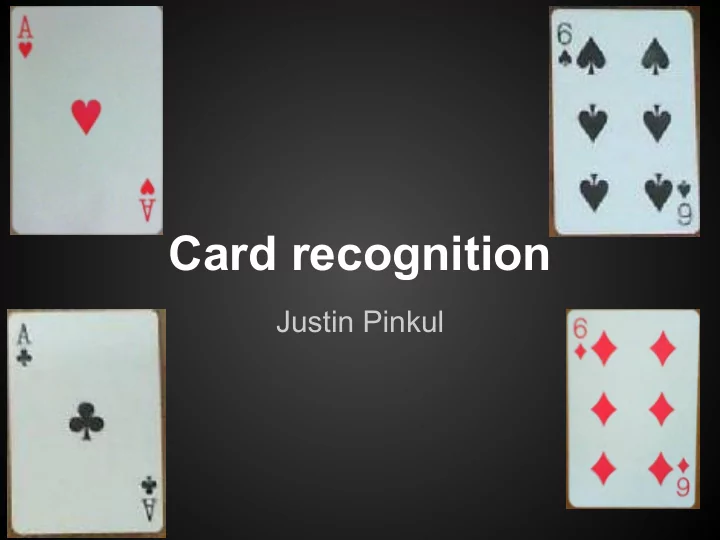
Card recognition Justin Pinkul Blackjack Needed information - - PowerPoint PPT Presentation
Card recognition Justin Pinkul Blackjack Needed information Position Value Orientation Scale Assumptions Same deck of cards Fixed viewing angle Comparable lighting The algorithm Grayscale template-matching
Justin Pinkul
Needed information
Grayscale template-matching invariant to rotation scale, translation, brightness and contrast Three step filtering process
Step 1: circular sampling
Circular sampling
Circular sampling
Circular sampling
Step 2: radial sampling
Radial sampling
Radial sampling
Radial sampling
Radial sampling
Radial sampling
Step 3: normal template matching
sampling
main
I = image G = template scales = 0.5, 0.55, 0.6, 0.65, 0.7, 0.75, 0.8, 0.85 radius = 0, 8, 16, 24, 32, 45 pass1, probScales = circularTest(I, G, scales, radius) pass2, probAngles = radialTest(I, G, scales, radius, pass1, probScales) templateMatch(I, G, pass2, probScales, probAngles)
circularTest(I, G, scales, radius) for scale = all scales resizedQ = resize Q to the scale for len = all radius (xcen, ycen) = center of resizedQ qScore[scale, length] = getCircleAverage(resizedQ xcen, ycen ,len) end end for all (x,y) in I for len = all radius iScore[x, y, length] = getCircleAverage(I, x, y, len) end end
for all (x,y) in I for scale = all scales iRadiusAvgs = iScore(x,y, ...) qRadiusAvgs = qScores(scale, ...) cor = correlate(iRadiusAvgs, qRadiusAvgs) add cor to correlations end pass1(x,y) = max(correlations) > threshold1 probableScale(x,y) = scales(index of max(correlations)) end end
radiusTest(I, G, scales, radius, pass1, probScales) r = largest radius for theta = all test angels (cenx, ceny) = the center of Q qScores[theta] = getRadiusAverage(Q, theta, cenx, ceny, r) end for all (x,y) in I if pass1(x,y) iR = r * probScales(x,y) iScores[x,y,theta] = getRadiusAverage(Q, theta, x, y, iR) end end
for all (x,y) in I if pass1(x,y) for theta = all angels iAngAvgs = iScores(x,y,...) for all orientations shifted = shift qScores to the new orientation cor = correlate(iAngAvgs, shifted) add cor to correlations end pass2(x,y) = max(correlations) > threshold2 probRadius = radius(index of max(correlations)) end end end end
radius samples
De Araújo, Sidnei. "Grayscale Template-Matching Invariant to Rotation, Scale, Translation, Brightness and Contrast." Advances in Image and Video Technology. By Hae Kim. Heidelberg: Springer Berlin, 2007. 100-13. Print.