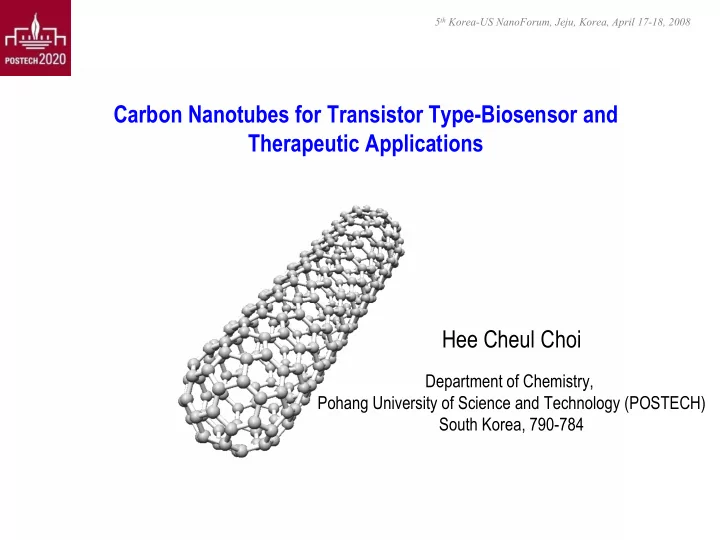
SLIDE 1 Hee Cheul Choi
Department of Chemistry, Pohang University of Science and Technology (POSTECH) South Korea, 790-784
Carbon Nanotubes for Transistor Type-Biosensor and Therapeutic Applications
5th Korea-US NanoForum, Jeju, Korea, April 17-18, 2008
SLIDE 2 Surface Chemistry of Carbon nanotubes: Hybrid structures
Choi, et al., JACS 2002, 124, 9059. Lee and Choi, et al., Small 2005, 1, 975.
Noble metal-SWNT composites Transition metal-SWNT
Shin and Choi, et al., Adv. Mater. 2007, 19, 2873.
TiO2-SWNT composites
Facile and spontaneous synthetic approaches Mechanism
SLIDE 3
Intercalation of Li ions in pyrene-functionalized SWNT Modulation of band energy Schottky diode behavior Lithium intensity distribution (SPEM, Li 1s)
Lim and Choi, et al., JACS 2008, 130, 2160.
Surface Chemistry of Carbon nanotubes: Schottky diodes
SLIDE 4 O2 H2 CH4 C2H4 SiO CO
SiO2 Si
Byon and Choi, Nature Nanotech 2007, 2, 162. Byon and Choi, Nano Lett. 2008, 8, 178.
Carbothermal Reduction
Surface Chemistry of Carbon nanotubes: Carbothermal Reduction – Etching SiO2
SLIDE 5
Sub-10 nm scale Lithography using Nanotrenches
Byon and Choi, Nature Nanotech 2007, 2, 162.
SLIDE 6 Negative Differential Resistance (NDR) device
- Ferritin captured in metallic SWNT nanogap electrodes
- Electrically cut m-SWNT (gap = ca. 20 nm)
- Electrostatically captured Ferritins
- Peak current density: 4.0 x 10⁶ A cm-2 (record)
- Peak-to-Valley Ratio (PVR): ~ 40 (@ scan rate of 26 mV/s)
- NDR is 1.2 µohm cm2
Apoferrtin Apoferrtin + Fe(III) Tang and Choi, et al., JACS 2007, 129, 11018.
Carbon nanotube electronics: Carbon nanotube/protein-based memory device
SLIDE 7
▪ Nonspecific Binding ▪ Specific Binding (using CDI-Tween20)
Robert J. Chen et al,. PNAS. 2003, 100, 4984
Electronic sensing of biomolecular recognitions using SWNTs-FETs
SLIDE 8 Sensitivity
- At least ~ pM, grateful if it can go lower.
- Protein detection limit of SWNT-FET: >10 nM
(c.f. Lieber group: ~ 10 fM detection limit of proteins using SiNW devices-Nat. Biotechol. 2005, 23, 1294.)
Feasibility
- Prompt use: currently too long stabilization time
- Nonspecific binding: perfect protection of devices with efficient
chemical blocking is mandatory. Hurdles to overcome
SLIDE 9
Nanotube aspect: Direct charge communication between proteins and nanotubes Metal-nanotube contact aspect: Schottky barrier modulation by protein adsorptions on metal surfaces
SiO2/Si
Au/Cr
Buffer Sol’n
Au/Cr
The two regions effecting to a biosensor sensitivity
SLIDE 10
Nanotube aspects: Charge injection from biomolecules Electric double layer field modulation caused by biomolecules Metal-nanotube contact aspect: Adsorbed chemical species may modulate work function level of contact metals, which consequently change the Schottky barrier height resulting in the conductance change. Strongly depending on the pI (isoelectric point) values of proteins +
Metal
Energy
Semiconducting SWNT VB CB Fermi level matching (EFM = EFS) & Band bending of VB, CB EFS EFM buffer
The origin of conductance changes: Schottky Barrier
SLIDE 11 Pd/Au evaporation mPEG-SH SAM SiO2/Si PMMA SWNT s SiO2/Si SiO2/Si s s sssssssss s SiO2/Si ss s s Lift off SiO2/Si Lift off Device I
S O OMe n S O OMe n
Device II Chen, Choi, Dai et al, J. Am. Chem. Soc. 2004, 126, 1563
.50x10
1.48 1.46 1.44 Ids (µΑ) 1200 800 400 Time (s) .50x10
3.45 3.40 3.35 3.30 Ids (µΑ) 1000 800 600 400 200 Time (s)
HIgG
Device I Device II 100 nM 100 nM
Experimental evidence for the detection mechanism
SLIDE 12
SiO2/Si
▪ Synthesis of network SWNTs ▪ Usage of the thin shadow mask ▪ Thermal evaporator with tilted angle stages
Au/Cr Au/Cr
Increased Schottky contact area for high performance
SLIDE 13 V
10 mV
2000 μm
200 µm
Teflon electrochemical cell
Protein Injection
1 μM
CVD (900℃ 10 min)
SiO2/Si Substrate with Catalyst CH4 H2 C2H4
Growth SWNTs ( R ~ 1 kΩ ) In wire
S D
(Cu)
S D
SiO2/Si
S D Choi and Dai et al. Nano Lett. 2003, 3, 157. Yang and Choi et al. Langmuir 2005, 21, 9198.
Fabrication of SWNT-FET having increased Schottky contact area
SLIDE 14
(a) SWNT FET device fabricated by a photolithography
SWNTs Photo Resist
(1) Metal Evaporation (2) Lift Off
SiO2/Si Au/Cr
(b) SWNT-FET device fabricated by a shadow mask at tilted angle
SWNTs Shadow Mask angle evaporation SiO2/Si Au/Cr Byon and Choi. J. Am. Chem. Soc. 2006, 128, 2188.
Fabrication of SWNT-FET having increased Schottky contact area
SLIDE 15 ▪ SA ▪ SpA
A u / C r S i O2 / S i
1 pM sensitivity
a SWNT-FET fabricated by a shadow mask at tilted angle
Buffer sol’n Byon and Choi. J. Am. Chem. Soc. 2006, 128, 2188.
Highly sensitive SWNT-FET devices: Nonspecific bindings of proteins
SLIDE 16
1 pM sensitivity
a SWNT-FET fabricated by a shadow mask at tilted angle a SWNT-FET fabricated by a shadow mask <Protein : SpA>
(unit : pM) 10 nM sensitivity
Highly sensitive SWNT-FET devices: Nonspecific bindings of proteins
SLIDE 17
Treatment of 0.05% Tween20 after immobilizing probe proteins
▪ Probe protein: Protein A ▪ Target protein: rabbit IgG ▪ Probe protein: hCG ▪ Target protein: anti β-hCG
1 pM sensitivity
Highly sensitive SWNT-FET devices: Specific bindings of proteins
SLIDE 18 Acknowledgement
Collaborators
- Prof. Joon Won Park (POSTECH)
- Prof. Jillian M. Buriak (Univ. Alberta, Canada)
- Prof. Insung S. Choi (KAIST)
- Prof. Seunghun Hong (SNU)
- Prof. Jin Yong Lee (SKKU)
- Prof. Young Kyun Kwon (U. Mass)
Post Doctors
- Dr. Hyeon Suk Shin
- Dr. Hye Ryung Byon
Graduate Students
Seok Min Yoon Yoonmi Lee Hyun Jae Song Hyunseob Lim Hye Kyung Moon Suphil Kim Kyoung Ok Kim Ji Eun Park Kwangho Chu
UnderGraduate Students
Chee Bum Park
Fundings MOST, KOSEF, KRF, POSTECH
January 8, 2008