Carbon in ecosystems of Central Siberia: the effect of forest - - PowerPoint PPT Presentation

carbon in ecosystems of central siberia the effect of
SMART_READER_LITE
LIVE PREVIEW

Carbon in ecosystems of Central Siberia: the effect of forest - - PowerPoint PPT Presentation

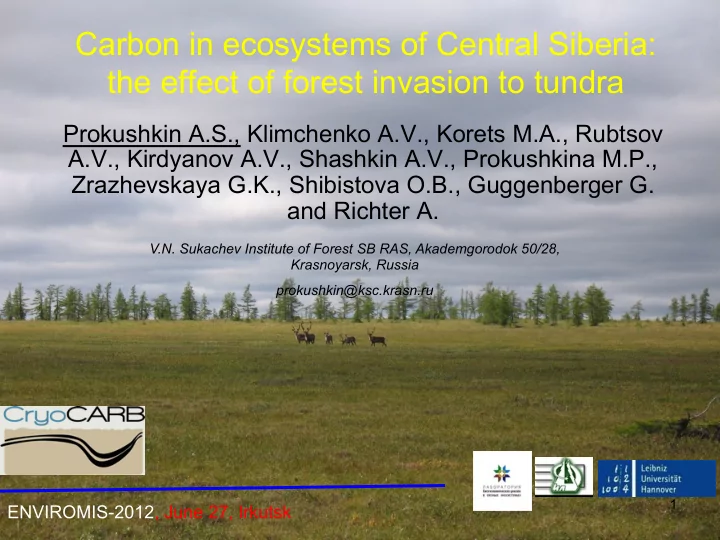
Carbon in ecosystems of Central Siberia: the effect of forest invasion to tundra Prokushkin A.S., Klimchenko A.V., Korets M.A., Rubtsov A.V., Kirdyanov A.V., Shashkin A.V., Prokushkina M.P., Zrazhevskaya G.K., Shibistova O.B., Guggenberger G.


slide-1
SLIDE 1

Carbon in ecosystems of Central Siberia: the effect of forest invasion to tundra

Prokushkin A.S., Klimchenko A.V., Korets M.A., Rubtsov A.V., Kirdyanov A.V., Shashkin A.V., Prokushkina M.P., Zrazhevskaya G.K., Shibistova O.B., Guggenberger G. and Richter A.

ENVIROMIS-2012, June 27, Irkutsk

V.N. Sukachev Institute of Forest SB RAS, Akademgorodok 50/28, Krasnoyarsk, Russia prokushkin@ksc.krasn.ru 1

slide-2
SLIDE 2

How forest vegetation freezes the soil

ENVIROMIS-2012, June 27, Irkutsk

2

slide-3
SLIDE 3

ESF JRP: Long-term Carbon Storage in Cryoturbated Arctic Soils

Cryocarb

  • The overarching goal of CryoCARB is to advance organic carbon estimates for

cryoturbated soils, focusing on the Eurasian Arctic and to understand the vulnerability of these carbon stocks in a future climate.

  • The constraints to our understanding of carbon dynamics in cryogenic soils are

currently manifold:

First, due to cryoturbation, organic matter is unevenly distributed within the soil, making SOC estimation very difficult. There is evidence that the North American arctic carbon stock is bigger than previously thought, also because of underestimation of carbon stored in distorted, broken and warped horizons [4]. Second, most studies dealing with SOC in arctic soils fail to account for carbon stored in the upper permafrost, although the latter is directly under threat in a rapidly warming Arctic [1]. Thawing of the upper permafrost will also mobilize old, geogenic C [8], which is rarely addressed. Third, the mechanisms of carbon stabilization are largely unknown thus hampering the prediction of climate-CO2 feedbacks [3,5]. Knowledge of the chemical composition of organic matter and the processes on how carbon is stabilized is necessary to predict the magnitude and the time-scale at which SOC will get remobilized from thawing permafrost under climate change [9].

3

slide-4
SLIDE 4

Cryosols are reservoir of 747 Gt C in the upper 3 m, excluding peatlands and carbon in deep loess sediment

4

slide-5
SLIDE 5

Problem Accelerated decomposition and release of ancient soil carbon in extensive Tundra biome (12 million km2) upon global warming may cause significant increase of net C fluxes to atmosphere in Northern Hemisphere

McGuire et al. (2010) Shaver et al. (2006) J. of Ecology Corradi et al. (2005) Global Change Biol. Etc.

Climatic response of permafrost soils will vary significantly with (i) location (e.g. tundra subzone), (ii) SOM quality, (iii) involved stabilization mechanisms and (iv) invasion of woody vegetation. Key goal of “Cryocarb” Project is to obtain the explicit information on factors from i to iii, which are specifically important with regard to cryoturbation processes

Gundelwein et al. (2007) Eur. J. SoilSci.

Associated project (RFBR #10-04-01003) “Stabilization of organic matter in cryoturbated soils of Siberia” aimed to estimate the role of forest invasion to tundra in carbon budget

5

slide-6
SLIDE 6

Examples of Cryoturbation processes and OC distribution within the soil

6

slide-7
SLIDE 7

Research objectives: go into forest- tundra ecotone and…

  • Determine OC storage in vegetation and

soil

  • Assess ecosystem-scale variability in OC

stocks between tundra, sparse and closed forests

  • Study transformation of soil organic matter

by isotopic and biomarker fingerprints

7

slide-8
SLIDE 8

Study sites

  • Taymyr (Ary-Mas)
  • 3 transects
  • Anabar (Kyndyn)
  • 1 transect
  • Putorana (Tembenchi)
  • 2 transects
  • Tura
  • 3 transects
  • Baykit
  • survey is planned in near future

Ary-Mas Kyndyn Tura Baykit Tembenchi

MAT = -13oC MAT = -10oC MAT = -6oC MAT = -9oC

No tundra sites

8

slide-9
SLIDE 9

9

Table 1. Characteristics of altitudinal transects (upland landforms) within Central Siberia. Transect, number of plots Coordinates Altitude, m a.s.l. MAAT,

  • C

Vegetation Soil properties Patterned ground, % stone content, % Ary-Mas n=11 72o30’ N 102o30 E 20-90

  • 13.8

southern tundra-larch forests 0-35 0-10 Kyndyn n=4 70o52’ N 102o56’E 70-370

  • 13.1

mountain tundra-larch forests 0-40 5-25 Tembenchi n=25 65o25’ N 97o35’ E 200-900

  • 10.8

mountain tundra-larch forests 0-50 5-90

slide-10
SLIDE 10

Structure of presentation

  • Some words about forest research in high latitudes of

Northern Eurasia and Northern America

  • Tree-line advances and retreats in past
  • Present forests: tree generations and TRW (Ary-Mas case

study)

  • Vegetation biomass, soil organic carbon, soil temperatures

and permafrost on altitudinal transects of Taimyr, Anabar and Putorana Plateaus

10

slide-11
SLIDE 11

Current knowledge about forest-tundra terrains

  • Taimyr forest research history: Middendorf 1867, Tolmachev 1920s,

Tyulina 1930s, Lovelius 1970s-80s, Naurzbaev 1990s-2000s

  • Numerous dendroclimatic studies in Circum-arctic Eurasia

(publications of McDonald, Briffa, Vaganov, Naurzbaev etc.)

  • Forest invasion to the tundra:
  • Polar Ural (Shiyatov et al. numerous publications)
  • Taymyr Peninsula (e.g. Kharuk et al., 2004, Ranson et al., 2004)
  • Alaska (e.g. Suarez et al., 1999)
  • Vegetation change (e.g. Sturm et al., 2001, Tchebakova et al., 2009

etc.)

  • Effects of woody species invasion to tundra on soil C stock are

controversial:

  • Positive (e.g. Steltzer 2004)
  • Negative (e.g. Wilmking et al. 2006)

11

slide-12
SLIDE 12

Global temperatures for last 150,000 years

12

slide-13
SLIDE 13

Taimyr tree-line advances and retreats: 50,000 years

  • Dating based on Larix wood macrofossils distribution in Taimyr Peninsula during the last 50,000 years

(Naurzbaev, Vaganov, 2000; Briffa et al., 2000, Naurzbaev et al., 2002, 2003 http://www.cru.uea.ac.uk/ cru/people/briffa/qsr1999).

годы до нашей эры и годы нашей эры Северная широта 71 72 73 74

  • 52000
  • 50000
  • 48000
  • 46000
  • 44000
  • 42000
  • 40000
  • 38000
  • 36000
  • 34000
  • 32000
  • 30000
  • 28000
  • 26000
  • 24000
  • 22000
  • 20000
  • 18000
  • 16000
  • 14000
  • 12000
  • 10000
  • 8000
  • 6000
  • 4000
  • 2000

2000

Каргинское время Сартанское время Голоцен

Latitude Year Karginskoe inter-glacial Sartanskoe glacial Holocene Pleistocene

NO fossil wood

Ary-Mas

Present Larix tree-line 13

slide-14
SLIDE 14

Fossil wood

Fossil wood on the lake bank in 3 km from Novaya River (ca 60 m a.s.l.) Fossil wood in eroded river bank of Khatanga River – large peat deposit

14

slide-15
SLIDE 15

Tree-line advances and retreats: Holocene optimum (10,000-3,500 years BP)

  • forest-tundra ecotone shifted ca. 300

km north 10,000 years BP and retreated ca. 3,500 years BP.

  • NB: SOC older 3,500 years has been

formed in forested terrain.

MacDonald G et al. Phil. Trans. R. Soc. B 2008; 363:2283-2299

15

slide-16
SLIDE 16

Northern Hemisphere (Mann et al. 1999), Arctic (Overpeck et al. 1997) and northern Eurasian (Briffa & Osborn 1999; Briffa 2000) summer surface-temperature trends over the past 1000 years (adapted from Overpeck et al. 1997; Briffa & Osborn 1999; Mann et al. ...

  • Tree establishment generally

coincides with temperature peaks

  • Large frequency of trees

established in 20th century

Frequency

5 10 15 20 25 30 35 40 1530 1570 1610 1650 1690 1730 1770 1810 1850 1890 1930 1970 2010 1 2 3

Frequency

5 10 15 20 25 30 35 40 1530 1570 1610 1650 1690 1730 1770 1810 1850 1890 1930 1970 2010 1 2 3

Naurzbaev 2005 Cit.: MacDonald G et al. Phil. Trans. R. Soc. B 2008; 363:2283-2299

16

slide-17
SLIDE 17

Approaches

  • Stand
  • Measurements of DBH and H (tree census):
  • S = 200-10,000 m2
  • >150 trees/plot
  • All seedlings
  • Tree cores (n=15-25) and discs (n=5) for TRW measurements
  • 5-10 seedlings for age and biomass measurements
  • Biomass through allometric equation (Bondarev et al. 1970)

17

slide-18
SLIDE 18

C stock estimate: sampling and measurements of ground vegetation and soil

  • Shrubs (Salix spp., B. nana, D. fruticosa)
  • Cross transect (10×1 m)
  • Stem counting and measurement of total weight of samples (n=3-5)
  • Ground vegetation: 5-7 subplots (25×20 cm)
  • Dwarf shrubs (wet weight, subsamples to dry)
  • Grasses (wet weight, subsamples to dry)
  • Moss/lichen layer (wet weight, subsamples to dry)
  • Topsoil: 5-7 subplots
  • O horizon: (20×20 cm, wet weight, subsamples to dry)
  • Upper 0-5 cm: 5-7 subplots (1-3 cylinders)
  • Subsoil: 1 soil pit across mound and trough
  • Sampling at 0-5, 5-10, 10-20,… and upper 10 cm of permafrost

(1-3 cylinders)

  • Soil temperature (every 5 cm)

18

slide-19
SLIDE 19

Taimyr Peninsula: Ary-Mas site

  • 3 altitudinal transects:
  • 2 north-facing slopes
  • 1 south-facing slope
  • N-facing:
  • tree-line - 60 m a.s.l.
  • sparse forests - 40 m a.s.l.
  • “dense” forests – 10-20 m a.s.l.
  • S-facing slope
  • species-line (krumholz) - 90 m a.s.l.
  • sparse forests – 60-20 m a.s.l.

Total number of plots: 11

19

slide-20
SLIDE 20

Plot views

Species-line (Krumholz): 90 m a.s.l. Tree-line (biogroups): 60 m a.s.l. Sparse forests (individual trees and biogroups): 40 m a.s.l. “Dense” forests (individual trees): 10-20 m a.s.l.

20

slide-21
SLIDE 21

Tree-­‑line Sparse ¡forest Sparse ¡forest Closed ¡forest Altitude, ¡m ¡a.s.l. 60 40 20 10 DBH, ¡cm 5,69 8,73 10,77 9,55 H, ¡m 5,72 7,47 8,51 7,90 Tree ¡density, ¡ha-­‑1 155 430 400 1860 "closinest" 0,04 0,11 0,14 0,35 Basal ¡area, ¡m2/ha 0,77 2,53 3,57 8,71 Wood ¡stock, ¡m3/ha 2,65 10,45 16,27 37,56 Wood ¡stock, ¡kg/m2 0,14 0,55 0,85 1,97 Altitude, ¡m ¡a.s.l. 60 40 20 DBH, ¡cm 6,82 5,32 7,09 H, ¡m 6,41 5,49 6,56 Tree ¡density, ¡ha-­‑1 195 720 1950 "closinest" 0,03 0,08 0,33 Basal ¡area, ¡m2/ha 0,70 1,57 7,54 Wood ¡stock, ¡m3/ha 2,59 5,23 28,43 Wood ¡stock, ¡kg/m2 0,14 0,27 1,49 Altitude, ¡m ¡a.s.l. 60 40 20 DBH, ¡cm 5,60 5,94 4,38 H, ¡m 5,67 5,88 4,86 Tree ¡density, ¡ha-­‑1 125 195 415 "closinest" 0,01 0,02 0,03 Basal ¡area, ¡m2/ha 0,30 0,53 0,61 Wood ¡stock, ¡m3/ha 1,03 1,85 1,89 Wood ¡stock, ¡kg/m2 0,05 0,10 0,10 Transect ¡1 Transect ¡2 Transect ¡3

Northern aspect Southern aspect *

* Logged in the past

*

21
slide-22
SLIDE 22

Tree growth

0.0 0.2 0.4 0.6 0.8 1.0 1.2 1650 1680 1710 1740 1770 1800 1830 1860 1890 1920 1950 1980 2010 Year AD Tree ring width, mm tree-line sparse stand sparse stand closed forest 0.0 0.2 0.4 0.6 0.8 1.0 1.2 1650 1680 1710 1740 1770 1800 1830 1860 1890 1920 1950 1980 2010 Year AD Treee ring width, mm tree-line sparse stand closed forest 0.0 0.5 1.0 1.5 2.0 2.5 1650 1680 1710 1740 1770 1800 1830 1860 1890 1920 1950 1980 2010 Year AD Tree ring width, mm

Transect 1 Transect 2

Uneven age structure: forests consist of 4-7 generations

  • f larch trees (the oldest dated by1530)

No fire effect: no one tree with fire scare Periods of larger TRW correspond to new larch generation establishment 20th century showed 4 periods with good growth of stands and new tree generation establishment Better radial growth of tree generations established after 1940’s The latter generation (mid-1990’s) does not reach 1.3 m height yet

2 4 6 8 10 12 1650 1680 1710 1740 1770 1800 1830 1860 1890 1920 1950 1980 2010 Year AD Diameter (DBH), cm

22

slide-23
SLIDE 23

0,00 0,10 0,20 0,30 0,40 0,50 0,60 0,70 0,80 0,90 1,00 AM11-­‑1 AM11-­‑2 AM11-­‑3 AM11-­‑4 dwarf ¡shrubs grasses moss-­‑lichen

Ground vegetation

0% 10% 20% 30% 40% 50% 60% 70% 80% 90% 100% AM11-­‑1 AM11-­‑2 AM11-­‑3 AM11-­‑4 dwarf ¡shrubs grasses moss-­‑lichen

0,0 0,2 0,4 0,6 0,8 1,0 AM11-­‑1 AM11-­‑2 AM11-­‑3 AM11-­‑4 S t

  • c

k , ¡ k g / m 2 moss-­‑lichen grasses dwarf ¡shrubs

Tree-line Sparse forests Dense forest 23

slide-24
SLIDE 24

Carbon pools in ecosystems

0% 10% 20% 30% 40% 50% 60% 70% 80% 90% 100% Mineral ¡0.5 ¡m O ¡horison moss-­‑lichen grasses dwarf ¡shrubs shrubs Trees

5 10 15 20 25 30 60 ¡m 40 ¡m 20 ¡m 10 ¡m Carbon ¡stock, ¡kgC/m2 Altitude, ¡m ¡a.s.l. Trees shrubs dwarf ¡shrubs grasses moss-­‑lichen O ¡horison Mineral ¡0.5 ¡m 24

slide-25
SLIDE 25

Soil organic matter

  • Invasion of forest has little effect on the C stock in 0.5 m layer of soil
  • Invasion of forest leads to the accumulation of C in O layer
  • Forest SOM is less thermoresistant: in short-term perspective to

analyze biodegradability in incubation experiment

5 10 15 20 25 20 40 60 80 100 Altitude, m a.s.l. Mineral layer (0,5 m), kgC/m2 0,0 0,4 0,8 1,2 1,6 2,0 O layer, kgC/m

2

mineral 0.5 m O layer

Closed forest Sparse forest Tree-line Krummholz

  • 20

20 40 60 80 100 20 40 60 80 100 Ratio (LOI250:LOI550) Soil depth, cm

tree-line Sparse forest Dense forest

cryoturbated?

%

25

slide-26
SLIDE 26

Forest invasion (moss and O layer development) affects soil temperature

20 40 60 80 100 5 10 15 20 Temperature, oC Soil depth, cm

tree-line sparse forest closed forest

20 40 60 80 100 5 10 15 20 Temperature,

  • C

Soil depth, cm

tree-line sparse forest closed forest

Transect #1 Transect #2

26

slide-27
SLIDE 27

…and permafrost depth

y = -53.633x + 97.767 R2 = 0.908

10 20 30 40 50 60 70 80 90 100 0.0 0.5 1.0 1.5 O layer, kg/m2 Permafrost depth, cm 27

slide-28
SLIDE 28

Tundra, tree-line and forests in Anabar plateau

369 m a.s.l. 71 a.s.l.

28

slide-29
SLIDE 29

Soil C stocks

б)

5 10 15 20 25 30 100 200 300 400 Высота н.у.м., м Запасы С, кг/м2

29

slide-30
SLIDE 30

Soil Temperature

55 см 43 см 28 см 71 см 20 40 60 80 100 2 4 6 8 10 12 Температура почвы, оС Глубина, см АМ-1 АМ-4 АМ-2 АМ-3

  • 30
  • 25
  • 20
  • 15
  • 10
  • 5

5 10 15 25.7.09 25.9.09 25.11.09 25.1.10 25.3.10 25.5.10 25.7.10 Т е м п е р а т у р а п о ч в ы , о С Дата

Forest Tundra

30

slide-31
SLIDE 31

Tree-line and forests in Putorana Plateau

800 m 700 m 900 m 500 m 350 m

31

slide-32
SLIDE 32

Ecosystem C stocks

y = -0,0128x + 18,107 R? = 0,4754

5 10 15 20 25 200 400 600 800 1000 E c

  • s

y s t e m c a r b

  • n

d e n s i t y , k g C / m

2

Altitude, m a.s.l.

"Tembenchi"

2 4 6 8 10 12 14 16 18 20 900 800 700 600 500 300 200 300 500 600 N-facing slope, m a.s.l. Valley, m a.s.l. S-fasing slope, m a.s.l. larch tall shrub dw shrub grass moss-lichen O layer Mineral soil

32

slide-33
SLIDE 33

Soil Temperature

20 40 60 80 100 2 4 6 8 10 12 Soil T, oC Soil depth, cm

Tree-line at 900 m Forests at 300 m Forests at 700 m

33

slide-34
SLIDE 34

Organic layer stock vs. active layer thickness

20 40 60 80 100 2 4 6 8 10 ALT, cm O layer, kgC/m2

34

slide-35
SLIDE 35

“Forest” effects

  • Changed plant species composition in ground

vegetation (i.e. mosses replace grasses)

  • Increased ground vegetation coverage

(no or little frost boils);

  • Enhanced O layer thickness

Causes:

  • Canopy effect?
  • Snow accumulation?
  • Litterfall biochemistry?

35

slide-36
SLIDE 36

Tundra soils: Carbon stock comparison

Author(s) ¡ Region ¡ Number ¡of ¡ profiles ¡ Organic ¡carbon ¡ kg ¡OC ¡m-­‑2 ¡

Tarnokai& ¡Smith ¡ (1992) ¡ Canada ¡ 14 ¡ 4 ¡–63 ¡ Matsumura& ¡ Yefremov(1995) ¡ Russia ¡ 7 ¡ 11 ¡–20 ¡ Batjes(1996) ¡ Worldwide ¡ 5 ¡ 16 ¡–125 ¡ Ping ¡et ¡al. ¡(1997, ¡ 2002) ¡ Alaska ¡ 42 ¡ 10 ¡–94 ¡ Stolbovoi(2000, ¡ 2002) ¡ Russia ¡ <163 ¡ 17 ¡ Post ¡(2006) ¡ Worldwide ¡ – ¡ 14 ¡ Gundelweinet ¡al. ¡ (2007) ¡ Sibiria ¡ 10 ¡ 31 ¡

¡

This study Central Siberia 7 4–16 Tundra (tree-line) This study Central Siberia 27 6-27 Forests

within top 100 cm (modified after Gundelweinet al., 2007 Eur. J. Soil Sci.) within top 50 cm (depth estimate limited by shallow forest soils)

36

slide-37
SLIDE 37

CONCLUSIVE REMARKS:

  • 1. Soil organic matter of present tundra ecosystems

could be formed in forested terrain of past warm period in HOLOCENE;

  • 2. Larch invasion to tundra and stand development

patterns such as closed canopy, complete moss cover of ground surface and accumulation of O layer all induce the raise of permafrost and decrease of soil temperature, both resulting in conservation of C (including previously cryoturbated horizons) in frozen subsoil for “LONG” period of time.

  • 3. Warming as predicted for 2oC (for 2060) may

convert tundra and forest-tundra ecotone areas to northern Larix taiga, but still underlain by continuous permafrost.

37

slide-38
SLIDE 38
  • 1. Carbon age, biomarker analysis, isotopic composition (C, N)
  • f SOM and vegetation at latitudinal transect (Central

Siberia: Ary-Mas … Baykit) and altitudinal transects at all 5 sites;

  • 2. Biodegradability of SOM in incubation experiments;
  • 3. Retrospective analysis of satellite data (NDVI) for 10 km belt

near 102oE from 71 to 73oN to estimate “greening” of the area.

Perspectives:

38

slide-39
SLIDE 39

Acknowledgements

  • RFBR and ESF for financial

support

  • Special thanks to all people

assisted with field works and lab analyses

39

slide-40
SLIDE 40

Thank you for attention!

40