Car-Like Robot: e.g., lie in free space How to Park a Car? - - PDF document

car like robot
SMART_READER_LITE
LIVE PREVIEW

Car-Like Robot: e.g., lie in free space How to Park a Car? - - PDF document

2/14/2012 Types of Path Constraints Local constraints: Car-Like Robot: e.g., lie in free space How to Park a Car? Differential constraints: ff e.g., have bounded curvature (Nonholonomic Planning) Global constraints: e.g., have


slide-1
SLIDE 1

2/14/2012 1

Car-Like Robot: How to Park a Car?

(Nonholonomic Planning)

1

Types of Path Constraints

Local constraints:

e.g., lie in free space

Differential constraints:

ff e.g., have bounded curvature

Global constraints:

e.g., have minimal length

2

Types of Path Constraints

Local constraints:

e.g., lie in free space

Differential constraints:

ff e.g., have bounded curvature

Global constraints:

e.g., have minimal length

3

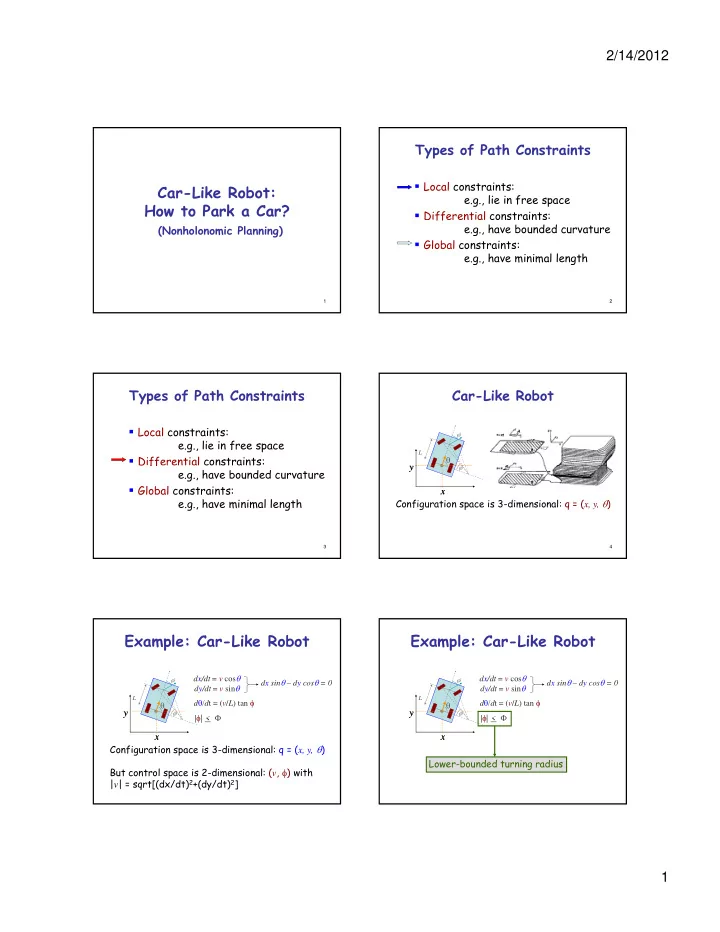
Car-Like Robot

L

θ

Configuration space is 3-dimensional: q = (x, y, θ)

4

y x

Example: Car-Like Robot

L

θ dx/dt = v cosθ dy/dt = v sinθ dθ/dt = (v/L) tan φ dx sinθ – dy cosθ = 0

y x Configuration space is 3-dimensional: q = (x, y, θ) But control space is 2-dimensional: (v, φ) with |v| = sqrt[(dx/dt)2+(dy/dt)2]

| |φ| < Φ

Example: Car-Like Robot

dx/dt = v cosθ dy/dt = v sinθ dθ/dt = (v/L) tan φ dx sinθ – dy cosθ = 0

L

θ | |φ| < Φ

y x Lower-bounded turning radius

slide-2
SLIDE 2

2/14/2012 2

How Can This Work? Tangent Space/Velocity Space

θ

(x,y,θ)

(dx,dy,dθ) L

θ x y

θ (dx,dy)

y x

dx/dt = v cosθ dy/dt = v sinθ dθ/dt = (v/L) tan φ | |φ| < Φ dx sinθ – dy cosθ = 0 θ

(x,y,θ)

(dx,dy,dθ) L

θ

How Can This Work? Tangent Space/Velocity Space

x y

θ (dx,dy)

dx/dt = v cosθ dy/dt = v sinθ dθ/dt = (v/L) tan φ | |φ| < Φ

y x

Type 1 Maneuver

(x1, y1, θ0+δθ) d η

q

CYL(x,y,δθ,η)

(x y θ ) δθ η

ρ

Allows sidewise motion

dq dq (x3, y3, θ0) (x2, y2, θ0+δθ) (x0, y0, θ0)

δθ δθ ρ (x,y)

η= 2ρ tanδθ d = 2ρ(1/cosδθ − 1) > 0

(x,y,θ0) When δθ 0, so does d and the cylinder becomes arbitrarily small

Type 2 Maneuver

Allows pure rotation

10

Combination

dq dq (x1, y1, θ0+δθ) (x3, y3, θ0) (x2, y2, θ0+δθ) (x0, y0, θ0) d

11

Combination

12

slide-3
SLIDE 3

2/14/2012 3 Coverage of a Path by Cylinders

θ +

q q’

x y Path created ignoring the car constraints

13

Path Examples

14

Drawbacks

Final path can be far from optimal Not applicable to car that can only move

forward (e.g., think of an airplane)

15

Reeds and Shepp Paths Reeds and Shepp Paths

CC|C0 CC|C C|CS0C|C

Given any two configurations, the shortest RS paths between them is also the shortest path

Example of Generated Path

Holonomic Nonholonomic

slide-4
SLIDE 4

2/14/2012 4 Other Technique: Control-Based Sampling

dx/dt = v cos θ dy/dt = v sin θ dθ/dt = (v/L) tan φ dx sinθ – dy cosθ = 0 dθ/dt = (v/L) tan φ | |φ| < Φ

  • 1. Select a node m
  • 2. Pick v, φ, and dt
  • 3. Integrate motion from m

new configuration

19

Indexing array: A 3-D grid is placed over the configuration space Each milestone

Other Technique: Control-Based Sampling

configuration space. Each milestone falls into one cell of the grid. A maximum number of milestones is allowed in each cell (e.g., 2 or 3). Asymptotic completeness: If a path exists, the planner is guaranteed to find one if the resolution of the grid is fine enough.

Computed Paths

Car That Can Only Turn Left Tractor-trailer

ϕm ax= 45 o, ϕm in= 22.5 o ϕm ax= 45 o

21

Application

22

Architectural Design: Verification of Building Code

  • C. Han

23

Other “Similar” Robots/Moving Objects (Nonholonomic)

  • Rolling-with-no-sliding

contact (friction), e.g.: car, bicycle, roller skate S b i i l

  • Submarine, airplane
  • Conservation of angular

momentum: satellite robot, under-actuated robot, cat Why is it useful?

  • Fewer actuators: design simplicity, less weight
  • Convenience (think about driving a car with 3 controls!)

24