Capstone Experience Biology Department Largest major on campus - - PowerPoint PPT Presentation
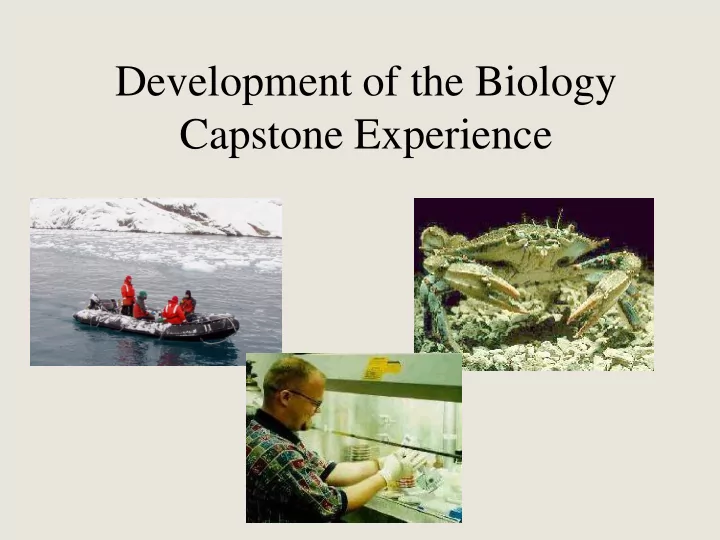
Development of the Biology Capstone Experience Biology Department Largest major on campus Graduate 130-150 students a year 16 faculty members with active research program that offer undergraduate students research opportunities.
Biology Department
- Largest major on campus
- Graduate 130-150 students a year
- 16 faculty members with active research program that
- ffer undergraduate students research opportunities.
- Teach a large number of major and non-major
experiences.
- Very diverse student body
- Departmental Honors Program
- 5TH Year Biology Master’s Degree program
- 5th year program in Computational Biology (with
Computer Information Sciences)
Biology Undergraduate Program
- General Biology - is the most common major within the Department
- f Biology) and is perfect for students in the pre-health professions
fields.
- Biology with a concentration in Molecular Biology - great for
students considering Masters, PhD, or MD/PhD research programs.
- Biology with a concentration in Marine Sciences - students
complete most of the General Biology requirements and study at Dauphin Island for two summers.
- Biology with a concentration in Environmental Sciences - great for
students who want to work with environmental issues.
- Individually Designed Major - this option allows students to develop
their own major of interest with approval from the Dean of the School
- f Natural Sciences and Mathematics…some of our students have
created majors in Reproductive Biology and Women’s Health as well as Biopsychology.
Creating and Designing a Capstone Experience:
- 1. Determine the specific broad learning objectives for the academic
program;
- 2. Determine the kind of student work that should be expected during
the capstone experience (the content and performance standards);
- 3. Design the capstone experience to enable students to produce that
work;
- 4. Inform students in the syllabus or related handouts how the
- bjectives of the experience are designed to reflect a culmination of
their abilities, knowledge, and/or values.
- 5. Determine how and when the faculty will assess the work that
students produce;
- 6. Provide information in department assessment plans and other
documents to be reviewed by various constituents regarding how the experience relates to the standards for the program and how they are evaluated.
Student Outcomes in Biology Degree
- The bachelor of science degree is designed to help the students:
– Obtain a firm foundation and advanced study in all important sub-fields of biology. – To master scientific concepts – Critically evaluate new scientific results and incorporate key findings into their base of knowledge. – Conceive and perform biological experiments that include data collection, data analysis and interpretation, and synthesis of findings. – develop critical thinking and problem-solving skills applicable to scientific and public issues. – Learn effective oral and written scientific communication skills.
It is the first professional degree in the discipline and prepares students for careers in biological sciences and/or further training, including master of science and doctoral programs, as well as professional schools.
Creating and Designing a Capstone Experience:
- 1. Determine the specific broad learning objectives for the academic
program;
- 2. Determine the kinds of student work that should be expected during
the capstone experience (the content and performance standards);
- 3. Design the capstone experience to enable students to produce that
work;
- 4. Inform students in the syllabus or related handouts how the
- bjectives of the experience are designed to reflect a culmination of
their abilities, knowledge, and/or values.
- 5. Determine how and when the faculty will assess the work that
students produce;
- 6. Provide information in department assessment plans and other
documents to be reviewed by various constituents regarding how the experience relates to the standards for the program and how they are evaluated.
Capstone Experience
Writing Ethics and Civic Responsibility Quantitative literacy A capstone experience is a experience designed to be offered in the final year
- f a student’s major, a experience that ties together the key learning objectives
that faculty expect the student to have learned during the major, interdisciplinary program, or interdepartmental major.
- Develop ideas
- Organize
- Support evidence
- Style
- Mechanics
- Cite literature
- Data analysis
- Read and interpret graphs
- Understand logical arguments
- Data representation
- Examine/identify ethical Dilemma
- Problem solving /critical thinking
- Investigate. Compare and evaluate
arguments
- Comprehend possible alternatives
Student Work
- Writing - honors thesis, research paper, laboratory report,
research proposals, scientific review, case study response, poster presentation, reflective essays.
- Quantitative Literacy – research experiences (all
components), problem sets, critical analysis papers, exams, statistical analysis.
- Ethics and Civil Responsibility – case students,
position papers, essays, oral presentations, letters to groups.
Problems
- Facilitating the number of classes needed to have a
student teacher ratio of 30:1 (940 majors/16 Faculty)
- Increase in number of capstone classes offered;
– Reduce the diversity of classes the department can offer – Reduce time for mentorship opportunities – Reduce research productivity
- What do we do with students who take a capstone
experience prior to their last 30 hours of class work.
- Can experiences only be handled by faculty in the
Biology Department
CAPSTONE EXPERIENCE OPTIONS FOR STUDENTS
BY429 Evolution BY 409 Principles of Human Physiology BY 398/498 Undergraduate/Honors Research Common Ethics Component
- develop online module
- get other area to lecture on topic
- purchase or find a free bio ethics tutorial
Common Option Outcomes:
1) All culminating learning experience 2) All based on and reflect the specific approaches, methods and practices in the discipline 3) All choices have well defined learning outcomes and assessments 4) All reinforce and asses student competencies in writing, quantitative literacy and ethics
Creating and Designing a Capstone experience:
- 1. Determine the specific broad learning objectives for the academic
program;
- 2. Determine the kinds of student work that should be expected during the
capstone experience (the content and performance standards);
- 3. Design the capstone experience to enable students to produce that work;
- 4. Inform students in the syllabus or related handouts how the objectives of
the experience are designed to reflect a culmination of their abilities, knowledge, and/or values.
- 5. Determine how and when the faculty will assess the work that students
produce;
- 6. Provide information in department assessment plans and other
documents to be reviewed by various constituents regarding how the experience relates to the standards for the program and how they are evaluated.
Capstone Assessment Methods
- Try to use direct methods of
assessment as opposed to indirect assessment.
- Direct assessments can be
more easily facilitated in capstone experiences because they can be implemented in a specific forum with specific students—the capstone experiences.
- Here are some examples…
Evaluation
Performance Area Rating = 4 Rating = 3 Rating = 2 Rating = 1 Score Structure Written work has clear and appropriate beginning, development and conclusion. Paragraphing and transitions are also clear and appropriate. Written work has adequate beginning, development and conclusion. Paragraphing and transitions are also adequate. Written work has weak beginning, development and conclusion. Paragraphing and transitions are also deficient. Organizational structure and paragraphing have serious and persistent errors. Content The length of the written work provides in-depth coverage of the topic, and assertions are clearly supported by evidence. The length of the written work is sufficient to cover the topic, and assertions are supported by evidence. Written work does not do an adequate job of covering the assigned topic, and assertions are weakly supported by evidence. Written work does not cover the assigned topic, and assertions are not supported by evidence. Mechanics Written work has no major errors in word selection and use, sentence structure, spelling, punctuation, and capitalization. Written work is relatively free of errors in word selection and use, sentence structure, spelling, punctuation, and capitalization. Written work has several major errors in word selection and use, sentence structure, spelling, punctuation, and capitalization. Written work has serious and persistent errors in word selection and use, sentence structure, spelling, punctuation, and capitalization. Total Overall Score = Total/3
Student ____________________ Experience __________ Date __________
Intended Outcome: the student will use clear and concise communication in the written form.
Experience – Specific Rubrics:
Standardized Examinations Major Fields Test
- Nationally-normed.
Percentiles can be used to compare with students
- utside a department or
university.
- Informative. Sub-scores (if
available) can be used to assess different skills or content areas in the curriculum
- Adaptable. Some test
products (i.e., ETS subject tests) allow departments to submit their own questions.
Using Capstone Assessment Results
- Summary measures should be ―elegant‖—they should be
easily organized, easily described, and should be informative
- Should lead to discussion of the program, not the value of
the capstone experience only
- Good idea: If it is possible to use the same assessment for
students entering a program (such as freshmen), then the value added by the program might be demonstrated
- It is important to implement capstone assessment