Capsis A software platform to host various kinds of growth and yield - - PowerPoint PPT Presentation

capsis
SMART_READER_LITE
LIVE PREVIEW

Capsis A software platform to host various kinds of growth and yield - - PowerPoint PPT Presentation

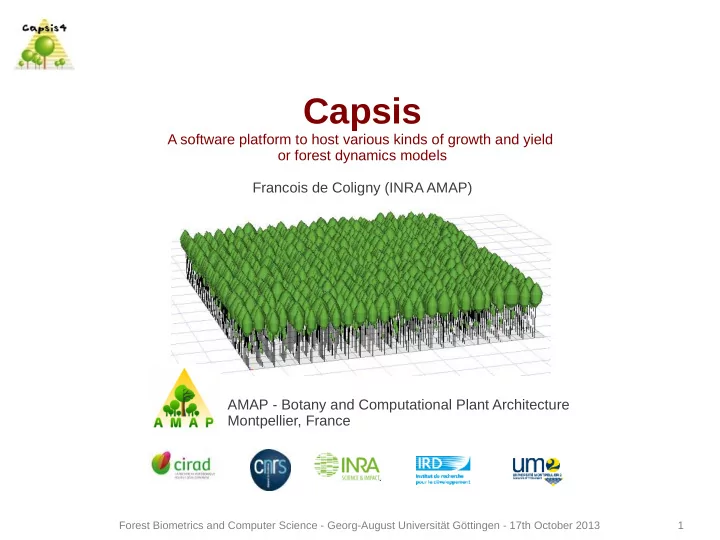
Capsis A software platform to host various kinds of growth and yield or forest dynamics models Francois de Coligny (INRA AMAP) AMAP - Botany and Computational Plant Architecture Montpellier, France Forest Biometrics and Computer Science -


slide-1
SLIDE 1

Forest Biometrics and Computer Science - Georg-August Universität Göttingen - 17th October 2013 1

Capsis

A software platform to host various kinds of growth and yield

  • r forest dynamics models

Francois de Coligny (INRA AMAP) AMAP - Botany and Computational Plant Architecture Montpellier, France

slide-2
SLIDE 2

Forest Biometrics and Computer Science - Georg-August Universität Göttingen - 17th October 2013 2

Modelling plants and forests: modelling what, why and how ?

slide-3
SLIDE 3

Forest Biometrics and Computer Science - Georg-August Universität Göttingen - 17th October 2013 3

Forestry growth models

A variety of stand-level growth model exists, each approach has key advantages & disadvantages

  • A. Weiskittel - MeMoWood conference - Nancy - 2013
slide-4
SLIDE 4

Forest Biometrics and Computer Science - Georg-August Universität Göttingen - 17th October 2013 4

Capsis: modelling forests growth / dynamics

INRA – EFPA division : Forest, Grassland and Freshwater Ecology 1994 : Capsis is created in Avignon by a scientist: Philippe Dreyfus (INRA URFM Avignon) mutualisation of models development knowledge transfer to the forest managers 12 stand level and tree distance independent models a lot of partnerships 1999 : Capsis now managed in Montpellier by a developer: Francois de Coligny (INRA AMAP Montpellier) specifications are widened to spatialized models a supporting methodology for modellers collaborative development 2013 : Capsis contains more than 60 growth or dynamics models

slide-5
SLIDE 5

Forest Biometrics and Computer Science - Georg-August Universität Göttingen - 17th October 2013 5

Capsis: how does it look ?

project model : initialisation + time loop intervention integrated viewers and charts export

Capsis - Linux - Graphical user interface - English

slide-6
SLIDE 6

Forest Biometrics and Computer Science - Georg-August Universität Göttingen - 17th October 2013 6

Capsis: a standard usage

Simulations are always run the same way:

  • choice of a growth model
  • configuration and initial situation
  • evolution stages (by the growth model)
  • interventions (with dedicated plugins)
  • > different scenarios

the model area scenario a scenario b interventions project manager initial step

slide-7
SLIDE 7

Forest Biometrics and Computer Science - Georg-August Universität Göttingen - 17th October 2013 7

Capsis: Software design

script pilot gui pilot kernel Library 1 library 2 module 1 library 1 module 2 module 3 ext 2 ext 3

Modules

ext 1

Tools Pilots Libraries

the growth and yield / forest dynamics models the common graphical user interface the intervention tools, viewers, charts and export methods (...)

slide-8
SLIDE 8

Forest Biometrics and Computer Science - Georg-August Universität Göttingen - 17th October 2013 8

Capsis: Actors and roles D M U

developers modellers end-users the Capsis community: developers + modellers co-develop together Developer Francois de Coligny INRA AMAP Montpellier Modeller Céline Meredieu INRA Biogeco Bordeaux PP3, Lemoine, Fompine Modeller Teresa Fidalgo Fonseca UTAD Vila Real Portugal ModisPinaster Modeller Gauthier Ligot ULG Gembloux Belgium Gymnos, Quergus End-user Thierry Sardin ONF Silvicultural guides End-user Students, forestry associations

slide-9
SLIDE 9

Forest Biometrics and Computer Science - Georg-August Universität Göttingen - 17th October 2013 9

Capsis: the Charter

Clear participation rules all the common parts are free software (LGPL), they are reusable by everyone

  • > all except the red parts
  • free kernel: the Capsis kernel is a free software (LGPL licence) : kernel + generic pilots

+ extensions + libraries (all the capsis.* packages)

  • development: the modellers are in charge of the development of their models in Capsis
  • support: They can have support from the developers : training sessions, design, starting

help, further assistance

  • free access in the community: All the source codes are freely accessible by all

members in the Capsis community, modules may become the base for new modules, code can be shared…

  • respect of intellectual property: all members respect the intellectual property of the
  • ther members
  • validations: developers deal with technical validation, modellers deal with functionnal

validation

  • distribution: the stabilized / validated modules may be distributed when the author

decides and chooses a licence (LGPL free license suggested), possible download from a ftp site

  • decentralization: modellers manage directly the relations with their end-users: financing,

training, assistance, models documentation, contracts…

slide-10
SLIDE 10

Forest Biometrics and Computer Science - Georg-August Universität Göttingen - 17th October 2013 10

  • use an accessible language

+ Java is powerful and strict → accessible to scientists

  • Java is rich → also a drawback
  • a short training course

scientists become beginer developers

  • backing is essential

after the initial training course... ...a customized starting session

  • support must be effective

reactivity, availability

Help the modellers develop by themselves

a simple editor, a file manager, and a terminal are enough portable: Windows, Linux, Mac

slide-11
SLIDE 11

Forest Biometrics and Computer Science - Georg-August Universität Göttingen - 17th October 2013 11

interactive (french / english) not interactive: with scripts

  • long simulations
  • runs on clusters
  • sensitivity analyses...

Capsis: several ways of use

slide-12
SLIDE 12

Forest Biometrics and Computer Science - Georg-August Universität Göttingen - 17th October 2013 12

Models for maritime pine in the Landes de Gascogne

Capsis illustrations

Céline Meredieu, Thierry Labbé (INRA Biogeco, Bordeaux)

Lemoine model (stand level, plantation):

  • age
  • number of trees
  • girth (dominant, mean)
  • basal area
  • height (dominant, mean)
  • volume (mean)

PP3 model (distribution model, plantation): a list of trees

  • age
  • diameter, Height, volume of each tree
  • number of trees in each category
  • crown (Height, diameter)
  • other information (biomass, carbon, etc.)

Applications, further works:

  • a permanent resource analysis system (with IFN - National Forest Inventory)
  • dead wood modelling and biodiversity
  • models transfer to the silviculture prescribers
slide-13
SLIDE 13

Forest Biometrics and Computer Science - Georg-August Universität Göttingen - 17th October 2013 13

Fagacées: an invidual-based model for oak and beech

Capsis illustrations

Jean-Francois Dhôte (ONF R&D), Patrick Vallet (Irstea), Mathieu Fortin (AgroParisTech Lerfob), Gilles Le Moguedec (INRA AMAP)

Fagacées relies on 5 fundamental relations at 2 levels

  • 1. stand level
  • a growth model for dominant height (H0)
  • a self thinning model giving the relative density index (RDI)
  • a basal area (G) productivity model (Eichhorn)
  • 2. tree level
  • a model for distributing the increases at the tree scale
  • a height / diameter model

Work under progress on the model to help revise the ONF Chênaie Atlantique silvicultural guide (Pascal Jarret, 2004) Changing context, climatic change, productivity change...

Le Moguédec G., Dhôte J.-F., 2012. Fagacées: a tree-centered growth and yield model for sessile oak (Quercus petraea L.) and common beech (Fagus sylvatica L.). Annals of Forest Science (2012) 69:257–269.

slide-14
SLIDE 14

Forest Biometrics and Computer Science - Georg-August Universität Göttingen - 17th October 2013 14

Jackpine

Capsis illustrations The Crobas - PipeQual model by Annikki Makela (University of Helsinki, Finland), a reusable library for Crobas was added in Capsis

Robert Schneider (UQAR, Québec)

Predict the effect of different scenarios on the growth and wood quality of Jack pine, Black and White spruce in Québec.

slide-15
SLIDE 15

Forest Biometrics and Computer Science - Georg-August Universität Göttingen - 17th October 2013 15

Oakpine: oak and pine growing at the same time

Capsis illustrations

Ngo Bieng M.-A., Perot T., de Coligny F., Goreaud F., 2013. Spatial pattern of trees influences species productivity in a mature oak– pine mixed forest. Eur J Forest Res, in press, DOI: 10.1007/s10342-013-0716-z

Quantify the impact of the spatial structure type on the productivity of oak-pine forests

  • simulate several types of realistic spatial structure (same list of trees)
  • simulate growth for each structure type
  • compare the obtained productivities

Spatial structure analysis on 34 plots: typology for the canopy: 4 types / for the understorey: 3 types Spatial structures simulation: a combination of point processes

  • specific structure: aggregation, random, regularity
  • intertype structure: attraction, independence, repulsion

Simulation examples:

Marie-Ange Ngo Bieng (Cirad System, Montpellier), Thomas Perot (Irstea Ecosystèmes Forestiers, Nogent sur Vernisson)

Script mode, repetitions, example of results:

T 1.4 1.5 1.6 1.7 1.8 1.9

P

TypeA TypeB 2.6 2.8 3.0 3.2 3.4

Productivité Chêne

TypeA TypeB 4.0 4.2 4.4 4.6 4.8 5.0 5.2

Productivité Chêne et pin

Accroissement en surface terrière sur 6 ans (m²/ha)

Canopée Type 1, modèle C7 Ss étage Type 2, modèle SE6 Canopée Type 3, modèle C4 Ss étage Type 2, modèle SE6
slide-16
SLIDE 16

Forest Biometrics and Computer Science - Georg-August Universität Göttingen - 17th October 2013 16

Artemis-2009

Capsis illustrations

Mathieu Fortin, Luc Langevin (MRNF Québec), Jean-Francois Lavoie (Arcane Technologies)

Other Capsis models by the Québec MRNF since 2002: Présage (Daniel Mailly, Sylvain Turbis): a model of production and evaluation of scenarios to help management of forests in Québec SaMARE (Sadi Aid, Sylvain Turbis): a distance-independent tree model for sugar maple- dominated stands (sugar maple, yellow birch, American beech and other broadleaved species) Natura (Sadi Aid, Isabelle Auger): a whole-stand model for the province of Québec Succès (Mathieu Fortin, Luc Langevin): a succession model for the main forest types in Québec A distance-independent tree model for the main potential vegetations in the province of Québec Objectives, at the provincial level:

  • develop silvicultural strategies
  • update sample plots
  • calculate the allowable cut

Six sub-models to forecast (i) the temporal change of mortality, (ii) diameter growth at breast height (dbh) of surviving stems, (iii) the number of recruits, (iv) their diameters, (v) height and (vi) volume using dbh.

http://www.mrn.gouv.qc.ca/publications/forets/connaissances/recherche/Fortin-Mathieu/Memoire156.pdf The permanent plots of the MRNF-DIF in Québec: 12001 plots, from 1970

slide-17
SLIDE 17

Forest Biometrics and Computer Science - Georg-August Universität Göttingen - 17th October 2013 17

twoe: tropical forests

Capsis illustrations twoe (2e) is a software that can be used for modelling and simulating multispecies tropical forest dynamics from permanent plot data Two packages:

  • an R package to estimate the demographic parameters of tropical tree species from

permanent forest plot data

  • a Capsis module to simulate forest dynamics

Ghislain Vieilledent (Cirad BSEF, Montpellier)

More details on http://twoe.org/

slide-18
SLIDE 18

Forest Biometrics and Computer Science - Georg-August Universität Göttingen - 17th October 2013 18

OptimiSt

Sergio de Miguel (University of Eastern Finland, Joensuu, Finland)

  • simulates forest stand dynamics for Pinus brutia
  • can be adapted to different target forest species and ecosystems
  • possible integration of different forest management oriented models

... and optimize stand-level multi-objective forest management

Capsis illustrations

slide-19
SLIDE 19

Forest Biometrics and Computer Science - Georg-August Universität Göttingen - 17th October 2013 19

Ventoux: modelling a forested massif (1)

Capsis illustrations

Philippe Dreyfus (INRA URFM, Avignon)

Initial stand: + 15 years :

2nd regeneration cutting Seed cutting Precommercial thinning Removal of the last seed trees

+ 40 years :

Thinning

+ 55 years :

Thinning

+ 65 years :

Thinning

+ 80 years : + 100 years : Realistic sylvicultural scenario and evolution over 100 years

slide-20
SLIDE 20

Forest Biometrics and Computer Science - Georg-August Universität Göttingen - 17th October 2013 20

The stronger the proportion (trees taller than 3 m height), the darker the species color Two management scenarios: (a) without silvicultural treatments ; or (b) management favouring the fir and the beech Simulating over 100 years the colonisation of fir (blue) and beech (red) in stands of pine (scots pine or mountain pine, green) on the north part of the Mont-Ventoux (north-west, between altitudes 900 and 1600 m)

Ventoux: modelling a forested massif (2)

Philippe Dreyfus (INRA URFM, Avignon)

year 2000 year 2100 (a) (b) Capsis illustrations

slide-21
SLIDE 21

Forest Biometrics and Computer Science - Georg-August Universität Göttingen - 17th October 2013 21

PhysioDemoGenetics

Capsis illustrations

Sylvie Oddou-Muratorio, Hendrik Davi (INRA URFM, Avignon)

PhysioDemoGenetics aims at studying the genetic adaptation through natural selection driven by climatic variables in a continuous tree population

  • > accounts for complex interactions among genes, functional traits and climate when

environment or demography are unstable. It relies on (1) explicit modelling of the genetic determinism of ecophysiology-related traits and (2) the coupling of ecophysiological processes at tree level (implemented in the Castanea library in Capsis) with dynamical processes (dispersal, growth, mortality) and genetic processes (implemented in the Genetics library in Capsis)

slide-22
SLIDE 22

Forest Biometrics and Computer Science - Georg-August Universität Göttingen - 17th October 2013 22

Simmem: modelling several forests

Capsis illustrations

Patrick Vallet, Véronique Cucchi (Irstea, Nogent sur Vernisson)

Simmem is a model simulating the management of several forests at the same time Each forest grows with a specific Capsis model according to its species and forest structure Connections to Fasy, Fagacées, FTChene, Gymnos, Lemoine, Melies, Laricio and Sylvestris Forgeco ANR project, three teams:

  • Irstea, Nogent sur V. (P. Vallet, T. Cordonnier, T. Bronner)
  • > Forêt d'Orleans
  • > Massif du Vercors
  • ULG, Gembloux, Belgium (P. Lejeune, G. Ligot, L. Dedry,
  • O. De Thier)
  • > Ardennes belges
  • EFI Atlantic, Bordeaux (C. Orazio)
  • > Aquitaine

the management rules are configured for the whole site

slide-23
SLIDE 23

Forest Biometrics and Computer Science - Georg-August Universität Göttingen - 17th October 2013 23

Capitalisation: thinning plugins

NHA (G. Ligot, ULG) RDI (F. Mothe, G. Le Moguedec, INRA Lerfob) Stocking + Kg (P. Dreyfus, INRA URFM) Uneven thinner (B. Courbaud, IRSTEA, T. Sardin, ONF) NV (B. Courbaud, IRSTEA) Complex (F. de Coligny, INRA AMAP) Tree list (P. Dreyfus, INRA URFM)

Shared tools and libraries

slide-24
SLIDE 24

Forest Biometrics and Computer Science - Georg-August Universität Göttingen - 17th October 2013 24

SamsaraLight: a reusable library for radiative balance

Shared tools and libraries

Benoit Courbaud (Irstea, Grenoble) Quergus (G. Ligot, ULG, Belgium) Heterofor (M. Jonard, UCL, Belgium) Samsara (B. Courbaud, IRSTEA)

  • adaptable to spatialized individual based models
  • the crown is a kind of ellipsoid or a cone
  • two modes: turbid medium volume or porous envelop
  • irradiance (MJ) for each tree and each cell on the ground
  • the irradiance can be considered for tree growth

A library implementing the radiative balance of the Samsara model, to make it possible to reuse it in other models (Quergus, Heterofor, RReShar, Samsara and Samsara2, Mountain).

slide-25
SLIDE 25

Forest Biometrics and Computer Science - Georg-August Universität Göttingen - 17th October 2013 25

Foreole: individual-based wind risk

Philippe Ancelin, Benoit Courbaud (Irstea, Grenoble), Thierry Fourcaud (Cirad AMAP)

Tree 43 Tree 113 Mountain growth model (Spruce) Foreole Zoom An integrated library

  • assess the risk
  • simulate trees removal

Shared tools and libraries

slide-26
SLIDE 26

Forest Biometrics and Computer Science - Georg-August Universität Göttingen - 17th October 2013 26

Coupled to a growth model (Radiata pine, Maritime pine, Oak), logging algorithms, sawing is possible

Wood Quality Workshop

Dave Pont (Scion, New Zeland), Frédéric Mothe, Patrick Vallet (INRA Lerfob, Nancy), Céline Meredieu, Thierry Labbé (INRA Biogeco, Bordeaux)

Shared tools and libraries

slide-27
SLIDE 27

Forest Biometrics and Computer Science - Georg-August Universität Göttingen - 17th October 2013 27

Capsis in Annals of Forest Science

slide-28
SLIDE 28

Forest Biometrics and Computer Science - Georg-August Universität Göttingen - 17th October 2013 28

Models 1/2

Dufour-Kowalski S., Courbaud B., Dreyfus P., Meredieu C., de Coligny F., 2012. Capsis: an open software framework and community for forest growth modelling. Annals of Forest Science (2012) 69:221–233

Capsis

slide-29
SLIDE 29

Forest Biometrics and Computer Science - Georg-August Universität Göttingen - 17th October 2013 29

Models 2/2

Dufour-Kowalski S., Courbaud B., Dreyfus P., Meredieu C., de Coligny F., 2012. Capsis: an open software framework and community for forest growth modelling. Annals of Forest Science (2012) 69:221–233

Capsis

slide-30
SLIDE 30

Forest Biometrics and Computer Science - Georg-August Universität Göttingen - 17th October 2013 30

Distribution

  • possible to download an evaluation version with few free models
  • the modellers may distribute partial copies

"To comply with the charter, the modellers may distribute the Capsis platform with their own modules but NOT with the modules of the other modellers. The modules (i.e. the growth models) are indeed not free and belong to their authors who may decide to distribute them with the license they choose. The section 4 of the charter grants access on all the modules to the modellers of the Capsis community but only to them, resulting in this distribution restriction"

  • > the modellers can build installers to distribute only their models

script pilot gui pilot kernel Library 1 library 2 mountain library 1 ext 2 ext 3 ext 1

ant clean installer -Dmodules="mountain/**,lerfob/fagacees/**,lerfob/commons/**"

fagacees

slide-31
SLIDE 31

Forest Biometrics and Computer Science - Georg-August Universität Göttingen - 17th October 2013 31

  • a Capsis installer on an ONF server for internal distribution
  • upgraded each year (december) by ONF
  • with the Capsis developers and modellers
  • a single Capsis with 18 modules:

Oakpine1 et 2 (Irstea) PiceaAbies (FCBA) PNN2 (INRA) Pp3 (INRA) Pseudotsugamenziesii (FCBA) Regix (FCBA) Samsara (Irstea) Sylvestris (Irstea) Abial (INRA) Artemis (MRNF, Québec) CA1 (INRA) Fagacées (INRA) Gymnos (Gembloux, Belgique) Laricio (Irstea, INRA) Lemoine (INRA) Melies (Irstea) NRG (INRA) Capsis helps write/update ONF silvicultural guides (about 17 since 2004)

Capsis-ONF-2012 - 21 dec 2012

Christine Deleuze et al. (ONF, R&D)

slide-32
SLIDE 32

Forest Biometrics and Computer Science - Georg-August Universität Göttingen - 17th October 2013 32

Communication

  • reference paper in Annals of Forest Science
  • last conference: MemoWood 2013, 1-4 oct in Nancy (France)
  • next annual meeting of the Capsis users: 7-9 April 2014, Gembloux (Belgium)
  • since 2011: coupled to the CAQ annual meeting, of the french-speaking

forest-wood modellers network

  • a web site
  • documentation for the modellers: http://www.inra.fr/capsis
  • up to date projects list
slide-33
SLIDE 33

Forest Biometrics and Computer Science - Georg-August Universität Göttingen - 17th October 2013 33

Thank you for your attention