
SLIDE 1
Taking Risks in the New Frontier: Rigor, Reasoning and Relevance
ATMIM Spring Conference Worcester State University Friday, March 24, 2017
SHAPE NUMBERS GAMES HISTORY
- Dr. Mary M. Sullivan
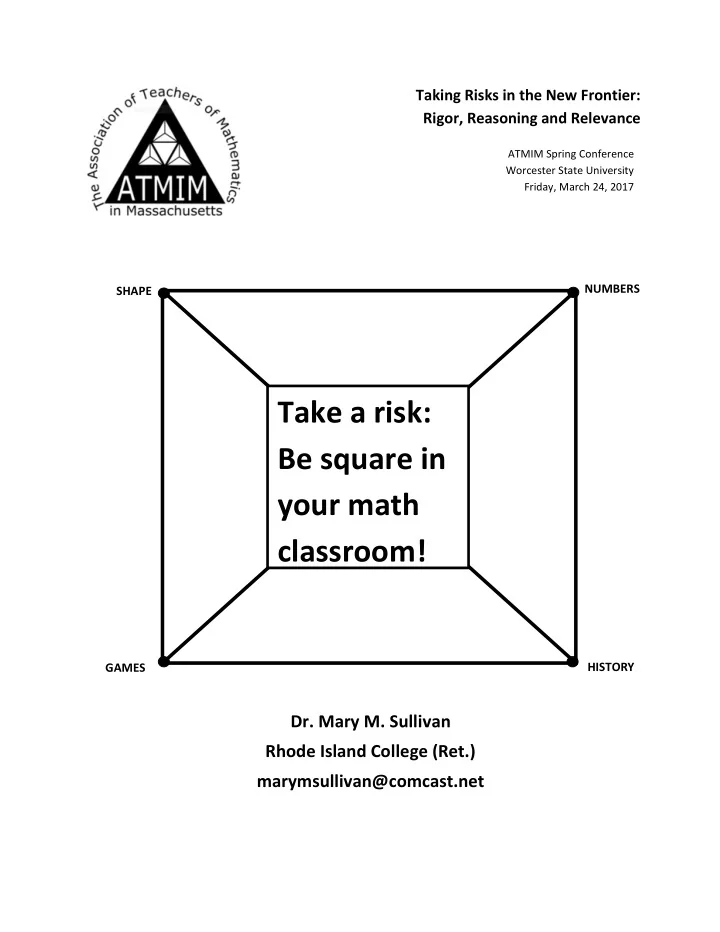
Take a risk: Be square in your math classroom! GAMES HISTORY - - PDF document
Taking Risks in the New Frontier: Rigor, Reasoning and Relevance ATMIM Spring Conference Worcester State University Friday, March 24, 2017 NUMBERS SHAPE Take a risk: Be square in your math classroom! GAMES HISTORY Dr. Mary M. Sullivan
ATMIM Spring Conference Worcester State University Friday, March 24, 2017
SHAPE NUMBERS GAMES HISTORY
1 Dividing square regions Separate the square region into a congruent pair by drawing a path connecting vertices from the 16
2 Latin Squares Ken-Ken provides arithmetic clues as hints to the numbers to go in each square. Solve this puzzle. Copy the values of your solution into the second grid. In the third grid, create a different set of Ken-Ken
Grade level determines size of square and operations used. Create a 4 x 4 Latin Square or solve this Ken- Ken puzzle to have one. Using the same values, create a different set of clues. Sudoku Mini
3 Screenshots from iPad app 100! (Also iPhone version, 1010!) Goal is to complete rows and columns on the 10 x 10 grid, using pieces given
4 Checkerboard Paper
5 Checkerboard
6 Dissecting Squares: Demonstrate how you can cut each square into 4, 5, 6, … squares. Describe your thinking process.
7 The area of Square A is 64 square units; the area of square B is 81 square units. Determine the dimensions of FIND. Dissecting Squares
8 Magic Squares: sum of each row, column, and diagonal is the same “magic constant.” 2 7 6 4 14 12 b g f 9 5 1 18 10 2 i e a 4 3 8 8 6 16 d c h a b c d e f g h i b + g + f = d + c + h = b + i + d = f + a + h = b + e + h = f + e + d = i + e + a = g + e + c = A prime number has exactly two factors: itself and 1. See if you can construct magic squares that contain from 1 to 8 prime numbers.
10
11 References and Resources Complex Instruction (Smarter Together) Boaler, Jo. (2016). Mathematical mindsets: Unleashing students' potential through creative math, inspiring messages and innovative teaching. San Francisco, CA: Jossey-Bass Publishers. Cohen, E. G., & Lotan, R.A. (Eds.) (1997). Working for equity in hetereogeneous classrooms: Sociological theory in practice. New York: Teachers College Press. Cohen, E. G., & Lotan, R.A. (2014). Designing groupwork: Strategies for the heterogeneous classroom, Third Edition. New York: Teachers College Press. Featherstone, H., et al. (2011). Smarter Together! Collaboration and Equity in the Elementary Math
https://ww2.kqed.org/mindshift/2016/05/23/how-a-strengths-based-approach-to-math-redefines-who- is-smart/ http://cimath.org/ Mathematics Kenney, M. J., Bezuszka, S.J., & Martin, J. (1992). Informal geometry explorations. Palo Alto, CA: Dale Seymour Publications. Kenney, M. J., & Bezuszka, S.J. (2015). Number Treasury3. Singapore: World Scientific Publishing Co. Article on dissecting squares into squares of different sizes http://celebrationofmind.org/archive/miller-squares.html Constructing Latin Squares of order 4 https://en.wikipedia.org/wiki/Small_Latin_squares_and_quasigroups#Order_4 Tasks sources https://www.youcubed.org/tasks/ http://www.celebrationofmind.org/ http://cimath.org/more-information/ Tricks for squaring numbers Compare Pankaj Rattan’s https://www.youtube.com/watch?v=aiwLSm9KHUI with this one https://www.youtube.com/watch?v=mdsqHAIHlyA