CAPS Career, Academic and Personal Success A Multidimensional - - PowerPoint PPT Presentation

caps career academic and personal success
SMART_READER_LITE
LIVE PREVIEW

CAPS Career, Academic and Personal Success A Multidimensional - - PowerPoint PPT Presentation

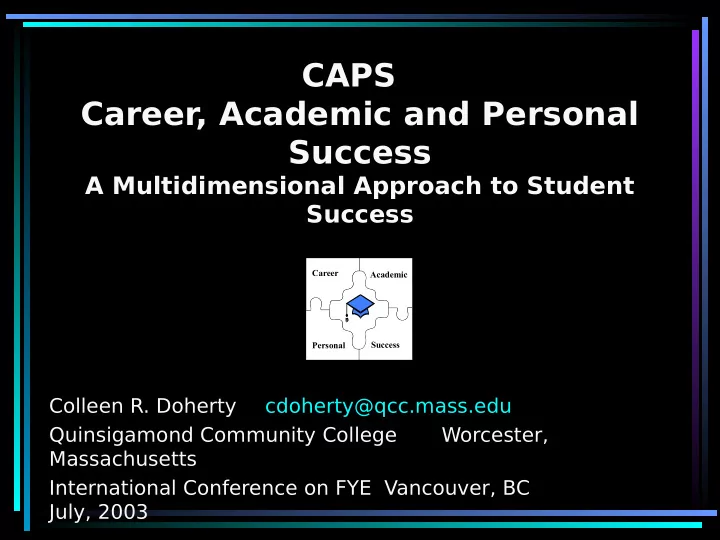
CAPS Career, Academic and Personal Success A Multidimensional Approach to Student Success Career Academic Success Personal Colleen R. Doherty cdoherty@qcc.mass.edu Quinsigamond Community College Worcester, Massachusetts


slide-1
SLIDE 1

CAPS Career, Academic and Personal Success

A Multidimensional Approach to Student Success

Colleen R. Doherty cdoherty@qcc.mass.edu Quinsigamond Community College Worcester, Massachusetts International Conference on FYE Vancouver, BC July, 2003

Career Academic Personal Success

slide-2
SLIDE 2

Title III

“The purpose of the Strengthening Institutions Program is to provide grants to eligible institutions of higher education to improve their academic programs, institutional management, and fjscal stability in order to increase their self- suffjciency and strengthen their capacity to make a substantial contribution to the higher education resources of the Nation. Funds may be used for faculty development, funds and administrative management, development and improvement of academic programs, joint use of facilities, and student services.” (US Dept. of Ed. Web site) Additional information may be found at http://www.ed.gov/offjces/OPE/HEP/idues/tit le3a.html

slide-3
SLIDE 3

Title III Team

  • Cathy Livingston, Vice President of Academic Afgairs; Project

Manager of Title III Grant

  • Pat T
  • ney, Dean of Instruction for Humanities and Social Sciences
  • Jim Rice, Professor of English/Coordinator of Communication
  • Felix Rizvanov, Director of Instructional Design
  • Colleen Doherty, Director of Career Development
  • Anne Shull, Instructor of English as a Second Language
  • Sheila Booth, Assistant Professor of English
  • Steve Rayshick, Assistant Professor of English
  • Betsy Zuegg, Assistant Professor of Developmental English
  • Elaine Previte, Coordinator of Learning Resources
  • Virginia Asadoorian, Professor of Mathematics
  • Steve Zona, Professor of Mathematics
slide-4
SLIDE 4

QCC Identifjed Needs

  • limited success of developmental

students

  • large % of undeclared majors who do not

persist to graduation

  • clear need to improve academic advising
  • course content and delivery methods for

developmental courses

slide-5
SLIDE 5

5 Major Target Areas

  • College Orientation Course
  • Curriculum Redesign
  • Research Success of Pilot Courses
  • Developmental Advising Model
  • Professional Development Program

for Faculty

slide-6
SLIDE 6

Successes Challenges Suggestions

slide-7
SLIDE 7
  • 1. College Orientation Course

3 Major Themes – Career Development – College Connection and Knowledge – Learning and Study Skills Final Project – CAPS Plan Active Instructional Methodologies Nearly 90 % of students returned the second semester

slide-8
SLIDE 8

Community College Focus

  • Commuter Campus
  • Busy, Competing Agendas
  • Minimal Connection to College
  • Large Immigrant Population (Worcester)
  • High Percentage of Students beginning

in Developmental Courses

  • Age Difgerence
slide-9
SLIDE 9

CAPS PLAN: Career, Academic and Personal Success

Career Academic Personal Success

slide-10
SLIDE 10

QCC CAPS PLAN

Career, Academic, and Personal Success ORT 110 & PSY 115

LEARNING PROFILE

(complete 2) Index of Learning Styles Results _____________________ Modality Questionnaire Results _____________________ MBTI (Meyers-Briggs) Results _____________________ GEFT (Embedded Figures) Results______________________ Summarizing Comments: ____________________________________ __________________________________________________________

slide-11
SLIDE 11

CAREER PLANNING (complete 3)

*Self-Assessment Self-Directed Search Results _____________________ Strong-Campbell Results _____________________ Kuder Results _____________________ Career Link Inventory Results _____________________ MBTI (Meyers-Briggs) Results _____________________ Career Key Results _____________________ *Values (complete 1) Your Values Test Results ____________________ COPES Results ____________________ *Careers Researched (research 2 to 5 careers) ________________________ ________________________ *Career Options Exploring further Short-term Options Long -term Options coursework/Other Summarizing Comments:______________________________________

slide-12
SLIDE 12

QCC Course Selection Planning Chart

Co u r se # O fg e r e d P l a n t

  • T

a k e G r a d e C r e d i t s P r e r e q u isit e s Fa ll _____ Sp rin g _____ Su m m e r/In t e rse ssio n _____ Fa ll _____ Sp rin g _____

QCC Course Selection Planning Chart

slide-13
SLIDE 13

Institutional Benefjts of CAPS Plan

  • Advising
  • Comprehensive view of student,

including career plan and course selection

  • Transfer
  • Plan, contact schools
  • General Studies- Administrative

Mechanism

  • Provide direction to large % of undecided

students

slide-14
SLIDE 14

Challenges & Suggestions

  • Faculty Selection Critical
  • Start up of New Course,

Registering Appropriate Students

  • Faculty Training and Compensation
  • Technology Usage
slide-15
SLIDE 15
  • 2. Curriculum Re-Design
  • Faculty Release Time
  • Valuable Dialogue Across

Disciplines

  • Uniformity within course sections
  • Improved Sequences from course to

course

  • Customized Texts
  • Course Matrix
slide-16
SLIDE 16

Matrix Categories

Week Topics/ Descriptio n Instructional Strategies Learning Outcomes Faculty Resources/ Materials Assessme nt

slide-17
SLIDE 17

Challenges & Suggestions

  • Academic Freedom
  • Pilot /Field Test Sections
  • Faculty Use of Technology
  • Adjuncts and Late Notifjcation of

Teaching

  • Support for Faculty
  • Changing

Instructional Methodologies

slide-18
SLIDE 18
  • 3. Research

Attrition and Persistence

  • Fall, 2001 baseline cohort shows

that within one semester QCC lost 30% of all students enrolled in developmental courses.

  • Within One year QCC lost 48.2% of

the above students.

slide-19
SLIDE 19

Retention and Grades from Fall 2002 to Spring 2003 Title III Pilot Results

  • 78.6% for ENG (10.5% increase over Fall, 01).
  • 80.5% for MATH (13.2% increase over Fall, 01).
  • 89.7% for ORT (College Orientation)

(26% increase over Fall, 01).

  • GRADES- % of students with C+ or higher
  • 9.8% higher in Title III Pilot Sections of

Math and English than in Non-pilot Sections.

slide-20
SLIDE 20

ORT 110 College Orientation Course

  • Developmental Pilots with ORT 110=

75.4% of students in Dev. Pilots received grades of C+ or higher in Pilots.

  • Dev. Pilots without ORT 110= 60.7% of

students in Dev. Pilots received grades of C+ or higher in Pilots.

  • ORT 110 infmuence resulted in 24.4%

increase in student success.   

slide-21
SLIDE 21

Challenges & Suggestions

  • Integrating Data from Various

Sources

  • Community College Enrollment

Patterns difger from 4-year colleges

  • Defjne and Measure “Student

Success” from both Quantitative and Qualitative Approaches

slide-22
SLIDE 22
  • 4. Developmental Advising
  • Goal-

Design a Campus-wide, Comprehensive, Developmental Advising Program that addresses all Offjces or Departments Involved in Advising.

slide-23
SLIDE 23

External Resources and Models

  • Valencia Community College- Life

Map

  • NACADA
  • Work of Virginia Gordon (Undecided

Students)

  • Work of Joe Cuseo (Advising,

Retention and First- Year Initiatives)

  • Work of Terry O’Banion
slide-24
SLIDE 24

O’Banion “Academic Advising is much larger than

assisting someone in course selection. One has to go through difgerent stages of development in order to ultimately select which courses are most appropriate. Stages include – (1) exploration of life goals; (2) exploration of career goals; (3) selection of a program major; (4) identifjcation of course choices; and (5) creation of course schedule.”

slide-25
SLIDE 25

Developmental Advising Task Force

  • Stage Model -0-15 credits- Stage One
  • 15-30 credits- Stage T

wo

  • 30-45 credits- Stage Three
  • 45-60+- Stage Four
  • gradual shift of responsibilities to student as

they move through the stages

  • Specifjc Performance Indicators at

Each Stage

  • Existing Campus Resources and

Solutions

slide-26
SLIDE 26

Challenges & Suggestions

  • Difgering Perspectives and

Approaches of Student Afgairs and Academic Afgairs

  • New Campus-wide Initiatives need

Presidential Endorsement

  • Allow Ample TIME for Process and

Results

slide-27
SLIDE 27
  • 5. Faculty Professional

Development

  • Developmental Course Content

Revised

  • Improving Instructional

Methodologies – Inclusive Strategies Reaching ALL Students – Use/Integration of T echnology

  • On-going Improvement and

Updating of Course Content  

slide-28
SLIDE 28

Develop and Sustain Faculty Professional Development

  • Expand to All Faculty
  • Those teaching Title III courses and others
  • Include existing training initiatives at college
  • Train-the-Trainer Model
  • Resources
  • Refmective Practice
  • Universal Design
  • Accelerated Learning
slide-29
SLIDE 29

Teaching Every Student in the Digital Age,

  • D. Rose & A.

Meyer Creating Signifjcant Learning Experiences, Dee Fink The Courage to Teach, Parker Palmer

slide-30
SLIDE 30

Challenges & Suggestions

  • Resources
  • Technology Availability & Comfort

Level

  • Measuring Change and Improvement
  • Sustaining Momentum