
SLIDE 1
Century Associates / Eco Housing Corporation / Keystar Real Estate
Capitol Hill Cohousing
at the Eastern Branch Boys & Girls Club
A proposal for contextually sensitive, community supporting, adaptive reuse
Capitol Hill Cohousing A proposal for contextually sensitive, - - PowerPoint PPT Presentation
Century Associates / Eco Housing Corporation / Keystar Real Estate Capitol Hill Cohousing A proposal for contextually sensitive, community supporting, adaptive reuse at the Eastern Branch Boys & Girls Club Who we are The Project Team
Century Associates / Eco Housing Corporation / Keystar Real Estate
at the Eastern Branch Boys & Girls Club
A proposal for contextually sensitive, community supporting, adaptive reuse
Century Associates acquires, develops and operates single family, multifamily mixed use and neighborhood commercial properties. In addition to developing property for its own account, Century Associates provides expertise to other developers in areas
project management, financial and technical feasibility, value engineering, claims analysis, architectural design and building performance. Unique among development firms, Century Associates maintains in house architectural capabilities that provide essential perspective throughout the development process. Century Associates is owned by Joel Kelty, a Capitol Hill Resident since 2000.
Eco Housing Corporation (www.ecohousing.net) is a Maryland corporation formed in 1999 and has been responsible for the development
projects: Takoma Village, located in Takoma ,DC and Eastern Village, located in Silver Spring, MD. In addition, Eco has recently provided development services for Metro Village, a 150 unit mixed income apartment community in Takoma, DC. The principal owners of EcoHousing are Donald Tucker, President and Michael Tucker, Executive VP.
Keystar is a real estate investment and development company formed in 2004 to invest in and develop real in the Washington metropolitan area. Keystar and its affiliates holdings include:
❖
Metro Village Apartments: a 150 unit mixed income community located in Takoma Park, DC that includes 123 (80%) income- restricted units. The project was completed in June 2016.
❖
Ravenwood Apartments: 23 units located in Riverdale, Maryland
❖
Peabody Street Apartments: 30 units located in the Brightwood neighborhood of Washington, DC
❖
7001 Carroll Avenue: 22,000 square foot historic mixed use building located in Takoma Park, Maryland Keystar is owned by Bruce Levin.
Who we are
EDG Architects has been responsible for the design and production of more than 150 projects ranging from single family residences to large commercial and multi-family
residential rehabilitation projects ranging from cosmetic repairs to historic restoration and adaptive reuse with replacement of all major building systems. EDG prides itself on its ability to deliver high quality, “green” and affordable buildings within challenging time and budget constraints.
Capitol Hill Village (CHV) is a neighborhood nonprofit
enriches the lives of Capitol Hill residents as they grow
vendor and staff services and provides social, cultural and educational programs designed to enhance the ability of Capitol Hill area residents to remain in their homes and their community over time. The Village provides a range of services and programs such as transportation to medical appointments and events, help with errands and small home maintenance issues, snow shoveling and leaf raking, as well as programs designed enhance social engagement. For members with more complex issues, CHV's social services team provides care coordination and navigation support to members and their families or care partners, including assistance with medical, insurance, social service, housing, legal and other issues. Membership is open to residents of Capitol Hill of all ages and subsidies and emergency assistance is available to qualifying lower income members.
Who we are
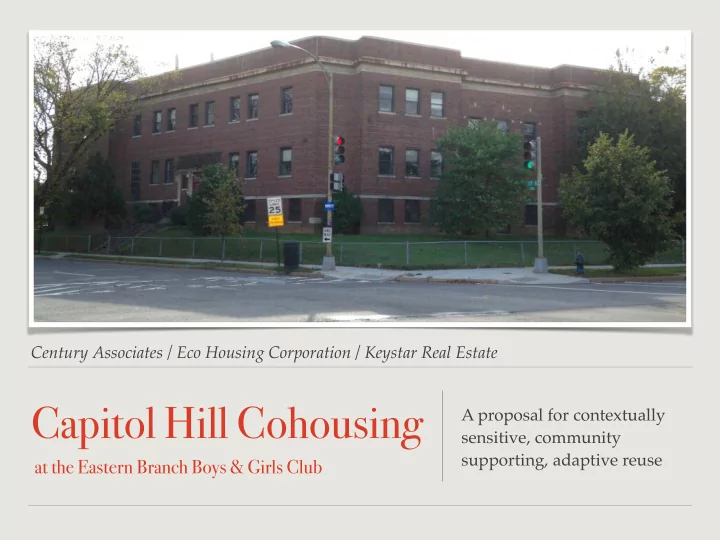
The Eastern Branch building will be converted to an innovative, mixed-use multi-family facility with two primary neighborhood-serving functions:
❖ Senior cohousing residences ❖ Community activity space
The project envisions primarily interior renovation work and will not add floors to the structure or otherwise substantially modify the exterior massing and character of the building.
Project Concept
❖ 29 age-restricted independent living
residences
❖ 2 caregiver apartments ❖ A range of unit sizes, including
larger units marketed toward seniors living in Capitol Hill row houses
❖ Senior oriented services and
programing on site
❖ Fully accessible (universal) design ❖ Walkable - proximity to urban
amenities and transportation
Project Concept
A type of housing community that features both private dwellings and shared common facilities. Design fosters social interaction among residents.
What is cohousing?
Takoma Village Cohousing, Washington, DC
What is cohousing?
❖ Individual dwelling units ❖ A “common house” & other shared
facilities
❖ Physical configuration designed to
reinforce & encourage resident interaction
❖ Residents participation in development &
management
❖ Consensus-based decision making
Eastern Village, Silver Spring, MD
What is cohousing?
❖ Originated in Scandinavia in the 1970s ❖ More than 100 operating communities
today
❖ At least 100 more in planning stages ❖ Urban, suburban and rural contexts ❖ Intergenerational & Senior-centric
❖ Participatory design process ❖ Site & building design fosters
social interaction
❖ Shared common facilities &
grounds
❖ Resident management &
❖ Intergenerational & Inclusive ❖ Environmentally sensitive &
sustainable design
What is cohousing?
❖ Amenities ❖ Site Design ❖ Common House ❖ Individual Units
❖ Organized around a common
pedestrian street, courtyard or area within a building
❖ Parking aggregated & located
at perimeter
❖ Centrally located common
house
❖ Well defined public & private
realms…
❖ But with transitional spaces
that encourage interaction
What does cohousing look like?
Takoma Village Cohousing, Washington, DC
What does cohousing look like?
What does cohousing look like?
❖ Cooking & dining ❖ Lounge, television ❖ Grouped mailboxes ❖ Shop, bike storage ❖ Guest suites ❖ Music room ❖ Game, play room
❖
Units face onto & are accessed from a common (typically exterior) space
❖
Patios, porches & stoops create a transitional zone between public & private
❖
Kitchen windows oriented towards common green space
What does cohousing look like?
What does cohousing look like?
❖ Self Contained ❖ Variety of unit sizes encourages
resident diversity
❖ Flexibility to adapt units as
households change improves community stability
❖ Downsizing - typically smaller units
800-900 SF, but not necessarily
❖ Emphasis on Universal Design ❖ Guest apartments for family visits ❖ Some have apartments for live-in caregivers ❖ Defined policies & practices related to aging
(“co-care” policies)
❖ Cohousing can accomplish many of the
to aging in place.
❖ Centralized nature of cohousing can result
in more efficient service delivery.
❖ Self management means residents have a
say in how things are done.
❖ Cohousing may be less expensive due to
volunteer management.
❖ Neither cohousing nor villages adequately
address important issues regarding transition to long term and end of life care.
Eco Housing Corporation, has developed the first two cohousing communities in Washington:
❖
Takoma Village Cohousing
❖
Eastern Village Cohousing Joel Kelty wrote a thesis on cohousing and was involved with Takoma Village. Joel has given two presentations on cohousing to members of Capitol Hill Village that generated substantial interest. Maintains a list of interested purchasers.
Cohousing in DC
DC’s first cohousing community
❖ 43 units ❖ 1.43 acres (30 du/ac) ❖ Affordable: 70% below 80% AMI ❖ US DOE PATH demonstration site ❖ Developer: EcoHousing Corp ❖ Architect: EDG Architects
Cohousing in DC
Adaptive reuse of a 1950s office building
❖ 56 cohousing units & 11 live/work
units
❖ Affordable: 50% at 80% AMI ❖ LEED Silver, multiple awards ❖ Developer: EcoHousing Corp &
Poretsky Builders
❖ Architect: EDG Architects
Sustainable, adaptive Reuse of an existing building
Cohousing in DC
Sustainable, adaptive reuse of an existing building
Cohousing in DC
❖ Reuse existing exterior masonry
skin and concrete frame
❖ New stairs and elevator to provide
full accessibility for those with a range of physical abilities
❖ Exterior landscaping/ramping to
achieve an accessible main entrance
❖ Sustainable design including green
roof & solar panels
❖ Compatibility in design and use
with neighborhood context
❖ Space available for community use
Capitol Hill Cohousing
Project Benefits
❖ Health benefits of social interaction ❖ Having “work” to do keeps people
mentally & physically healthy & active
❖ Unusual behavior or absence likely to
be noticed by neighbors
❖ Neighbors assist each other ❖ Shared resources & maintenance
Project Benefits
❖ 1,850 square feet of
community space on lower level
❖ Use to be determined in
collaboration with neighborhood
Project Benefits
❖ Adaptive reuse of existing building ❖ Energy efficient mechanical,
electrical and plumbing systems and equipment
❖ Solar photovoltaics & hot water ❖ Green roof
Project Benefits
❖ Building architecture,
massing and scale retained.
❖ Both design and proposed
use are compatible with surrounding neighborhood
Project Benefits
❖ Remove a liability from District’s
real estate portfolio
❖ Contribute over $136,000 annually
in new property tax revenue
❖ Retain Capitol Hill residents that
would otherwise leave the City
Process
Our team has completed many development projects with multiple stakeholders:
❖ Immediate Neighbors ❖ ANC ❖ Hill East Task Force ❖ Future residents
Following project award, we will host a community kick-off meeting, hopefully in the building, to introduce our team, walk the building and grounds and share our initial concepts. We expect this to be a highly iterative process with multiple meetings with planning staff, neighbors, civic groups and others.
The need for senior cohousing
“A major trend in the metro area last year was the number of non-family buyers…” “[Empty nesters and] never nesters…look for a new type of home, typically with less maintenance, the option of one-level living with a first-floor bedroom or rambler-style home on
“A common theme among mature couples and younger people without kids is to live within walking distance to shops and restaurants or public transportation…” —The Washington Post, January 3, 2015
Changing demographics require planning
“There are many communities that aren’t doing enough to prepare for the demographic shifts that are underway… Some are barely even aware of them. There are a lot of localities that are not thinking about this yet — to a surprising degree, actually.”
AARP Home & Community Program
“I am at a loss for an explanation for why none of the new construction
addition to the influx of young families, there are many residents who are thinking about moving to one floor units (apartments or condos) to avoid the two or three flights of stairs in their current homes. As everyone knows space for new construction or renovation is at a premium on the Hill and it appears that seniors will have no choice but to leave the Hill despite the fact that they do not want to.”
Websites:
Literature:
Ourselves, Kathryn McCamant & Charles Durrett
Living & Other New Forms of Housing, Dorit Fromm Nearby Completed Cohousing Communities:
www.takomavillage.org
www.easternvillage.org
www.blueberryhill.org
www.libertyvillage.com Completed Senior Cohousing Communities:
silversagevillage.com
www.wolfcreeklodge.org