
SLIDE 1
CapiTainS Guidelines
From digital edition to machine actionable edition
Thibault Clérice, PhD at Humboldt Chair of Digital Humanities, Leipzig University @ponteineptique
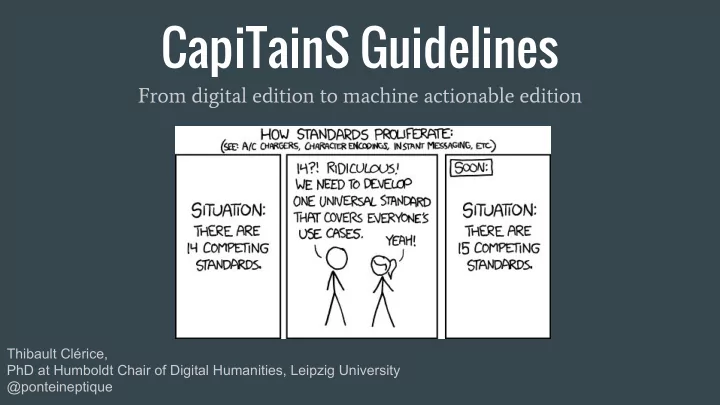
CapiTainS Guidelines From digital edition to machine actionable - - PowerPoint PPT Presentation
CapiTainS Guidelines From digital edition to machine actionable edition Thibault Clrice, PhD at Humboldt Chair of Digital Humanities, Leipzig University @ponteineptique A problem (1) In France alone : 1575 PhD for lettres classiques
From digital edition to machine actionable edition
Thibault Clérice, PhD at Humboldt Chair of Digital Humanities, Leipzig University @ponteineptique
In France alone :
"Hasta sub exsertam donec perlata papillam, haesit uirgineumque alte bibit acta cruo" Aeneid. 11, 803 « Déjà la javeline, pénétrant au dessous de son sein découvert, s’est fixée immobile : profondément enfoncée, elle a bu son sang virginal. »
désigne à proprement parler le bout du sein de la femme et renforce l’image du sang virginal qui s’écoule, faisant du meurtre de Camille un acte proche du viol”
LE CORPS FEMININ ET SES REPRESENTATIONS POETIQUES DANS LA LATINITE TARDIVE, Sophie MALICK-PRUNIER, 2008, Paris 4, dir. Zarini
○ Canonical Text Service and Canonical Text Service URN by C. Blackwell and N. Smith
“Clearly, there are many such trees that might be drawn to describe the structure of this or other anthologies. Some of them might be representable as further subdivisions of this tree: for example, we might subdivide the lines into individual words, since in our simple example no word crosses a line
what text is (memorably termed an ordered hierarchy of content objects (OHCO) view of text by Renear et al.20) turns out to be very effective for a large number of purposes.” http://www.tei-c.org/release/doc/tei-p5-doc/en/html/SG.html
○ ἔνθ᾽ αὖ Τυδεΐδῃ Διομήδεϊ Παλλὰς Ἀθήνη
○ Arma virumque cano, Troiae qui primus ab oris
○ Leaked password ? ○ A French Bank institution ?
The Canonical Text Services Protocol is a specification that "defines a network service for identifying texts and for retrieving fragments of texts by canonical reference expressed as CTS-URNs." CTS and CTS-URN provides an interoperable, open and persistent system for sharing text resources and parts of them on the web. At the core of the CTS URN is the idea of representing texts as part of a graph, where nodes resolve to texts, objects or images, and the edges provide navigation between them. Text nodes themselves consist of citable nodes, with each node having the following properties:
Neel Smith and Chris Blackwell, Canonical Text Services , http://cite-architecture.github.io
urn: cts: greekLit: tlg0012. tlg001. perseus-grc1: 1. 1
URN namespace CTS namespace Textgroup eg Author Work Identifier Version Identifier Reference Subreference Ancient Greek Literature Homeric Texts Illiad First version edited on Perseus Book 1 Line 1
urn:cts:latinLit:phi1294.phi002.perseus-lat2
Martial, Epigrammata urn:cts:froLit:jns915.jns1856.ciham-fro1 -> Wauchier de Denain, Vie de Saint Martin urn:cts:pdlpsci:bodin.livrep.perseus-fre1 -> Bodin, Six Books of a Commonweale urn:cts:latinLit:phi0690.phi003.perseus-lat1:1.1 -> (Virgile,Virg. Uirg. Verg...), (Aeneid, Énéide, Éné.) 1.1
http://capitains.github.io - http://github.com/Capitains Bridget Almas (Perseids), Frederik Baumgardt (Perseids), Thibault Clérice (Humboldt Chair of DH)
○ More people to work on your software ○ What happens after the project funds run out ?
○ More people to work with your software ○ Organization, Project and Funder should be known so that you continue getting funded
○ Thanks GITHUB, Travis and others !
○ People can check what you stated
http://capitains.github.io/pages/tools.html
http://www.gliffy.com/go/publish/7879353 http://cts.perseids.org http://ci.perseids.org http://www.perseids.org/sites/joth/
○ Texts ○ Metadata
○ Browsing catalog ○ Browsing text content
http://capitains.github.io/pages/guidelines.html
data/ |- textgroup |-__cts__.xml |- work |-__cts__.xml |- part-of-the-urn.xml (phi1294.phi001.perseus-lat2.xml)
TEI/teiHeader/encodingDesc <refsDecl n="CTS"> <cRefPattern n="line" matchPattern="(.+).(.+)" replacementPattern="#xpath(/tei:TEI/tei:text/tei:body/tei:div[@n=’$1’]//tei:l[@n=’$2’])"> <p>This pointer pattern extracts book and line</p> </cRefPattern> <cRefPattern n="book" matchPattern="(.+)" replacementPattern="#xpath(/tei:TEI/tei:text/tei:body/tei:div[@n=’$1’])"> <p>This pointer pattern extracts book.</p> </cRefPattern> </refsDecl> TEI/text/body <div type=”edition|translation” n=”urn:cts:latinLit:phi1294.phi002.perseus-lat2”> … </div>
Group level
<ti:textgroup xmlns:ti="http://chs.harvard.edu/xmlns/cts" urn="urn:cts:latinLit:phi1294"> <ti:groupname xml:lang="eng">Martial</ti:groupname> </ti:textgroup>
Work level
<ti:work xmlns:ti="http://chs.harvard.edu/xmlns/cts" groupUrn="urn:cts:latinLit:phi1294" urn="urn:cts:latinLit:phi1294.phi002"> <ti:title xml:lang="eng">Epigrammata</ti:title> <!-- For each "text", either edition or translation, there should be a ti:edition or ti:translation node --> <ti:edition workUrn="urn:cts:latinLit:phi1294.phi002" urn="urn:cts:latinLit:phi1294.phi002.perseus-lat2"> <ti:label xml:lang="eng">Epigrammata</ti:label> <ti:description xml:lang="eng">
</ti:description> </ti:edition> </ti:work>
○ Run your own website locally in less than 10 minutes ( https://youtu.be/_Vmwz_761GM ) ○ Make API following standards easily ○ Profit (and participate) in a coding comunity ?
○ Create interfaces using CTS data easily ○ Parse texts locally for Natural Language Processing ○ Parse texts from different APIs https://www.youtube. com/watch? v=L5rVH1KGBCY
Current Data Providers :
Sources (Dictionaries, Lexicons…)
○ Perseids Hackathon (May 9th - 14th) ○ OAI-PMH Layer ○ New Inventory Maker for Python ○ More documentation ○ More training (DH2016; Lyon HiSoMA Lab; CHS) ○ PhP Abstraction is welcome if you do PhP ○ Java Abstraction is as welcome if you do Java (And I want CapiTainS Javara to become a thing)
Special thanks to the team at Perseids and DH Chair as well as R. Lopes for the logos ! Useful links :
See you at the training ! Contact : thibault.clerice@uni-leipzig.de / @ponteineptique (GitHub and twitter)