CAPCOA Greenhouse Gas Reduction Exchange Workshop February 18, 2014 - - PowerPoint PPT Presentation

capcoa greenhouse gas
SMART_READER_LITE
LIVE PREVIEW

CAPCOA Greenhouse Gas Reduction Exchange Workshop February 18, 2014 - - PowerPoint PPT Presentation

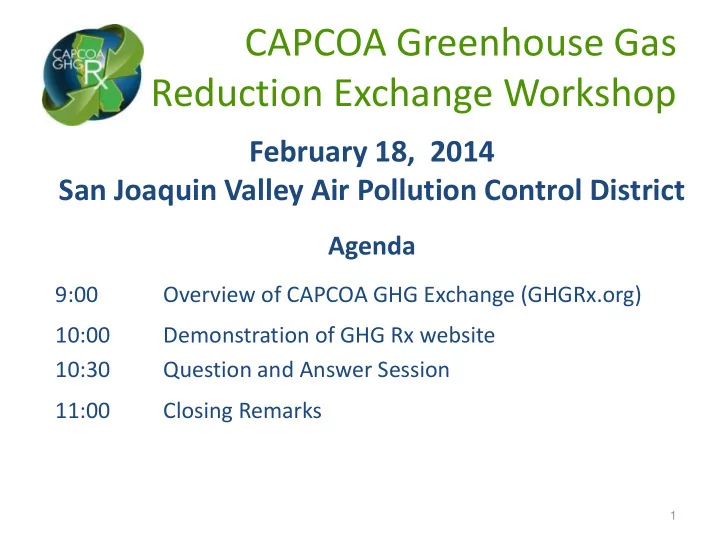
CAPCOA Greenhouse Gas Reduction Exchange Workshop February 18, 2014 San Joaquin Valley Air Pollution Control District Agenda 9:00 Overview of CAPCOA GHG Exchange (GHGRx.org) 10:00 Demonstration of GHG Rx website 10:30 Question and Answer


slide-1
SLIDE 1

CAPCOA Greenhouse Gas Reduction Exchange Workshop

February 18, 2014 San Joaquin Valley Air Pollution Control District

Agenda

9:00 Overview of CAPCOA GHG Exchange (GHGRx.org) 10:00 Demonstration of GHG Rx website 10:30 Question and Answer Session 11:00 Closing Remarks

1

slide-2
SLIDE 2

CAPCOA Greenhouse Gas Reduction Exchange

For webcast participants, email questions to: webcast@valleyair.org Subject: GHG Rx

2

slide-3
SLIDE 3

What is CAPCOA?

  • California Air Pollution Control Officers

Association (CAPCOA.org)

  • Non-profit association of California’s 35 local

air pollution control officers – including the San Joaquin Valley Air District

  • Forum for local air districts to work together
  • n statewide issues

3

slide-4
SLIDE 4

CAPCOA’s Work on GHGs and Land Use

4

slide-5
SLIDE 5

CAPCOA Greenhouse Gas Reduction Exchange (GHG Rx)

  • nline at www.ghgrx.org

5

slide-6
SLIDE 6

The CAPCOA GHG Rx

Mission Statement: Our mission is to provide a trusted

source of high quality California-based greenhouse gas credits to keep investments, jobs, and benefits in-state, through an Exchange with integrity, transparency, low transaction costs, and exceptional customer service.

Objectives: To provide a secure, low-cost, high quality,

greenhouse gas exchange for credits created in California. Financial resources invested in-state will help create local jobs and realize needed air pollution co-benefits from projects in California.

6

slide-7
SLIDE 7

Background & Purpose

  • Developed to respond to requests from local governments

and others in order to:

  • Encourage local generation and exchange of high quality GHG emission

reduction credits

  • Facilitate mitigation of GHGs for CEQA, climate action plan

commitments, and other voluntary purposes

  • Credits are derived from voluntary projects in CA
  • Program operates on two levels:
  • Decentralized project review by Participating Districts
  • Centralized platform provides common rules, tracking, and public access

to information

7

slide-8
SLIDE 8

CAPCOA’s Objectives

  • Ensure high quality credits
  • Make it easy for buyers and sellers to find

each other

  • Keep transaction costs low
  • Keep financial investments, air quality and
  • ther co-benefits in the local community

8

slide-9
SLIDE 9

Additional Benefits

  • Accelerate local GHG reduction
  • Stimulate local economy
  • Create a “feasible” mitigation option for

CEQA

9

slide-10
SLIDE 10

GHG Rx Platform Elements

  • Credit Project Database
  • Credit projects are shown in summary form with contacts and

links to complete information

  • Searchable by district, project type, etc.
  • Districts validate (verify) credit projects prior to listing, track

credit transactions, and update listings

  • Districts are not involved in financial transactions
  • Bulletin Board listings
  • Buyers seeking credits
  • Parties seeking funds to develop projects
  • Funding Opportunities listings

10

slide-11
SLIDE 11

Anticipated Users

  • Lead agencies
  • CEQA project developers
  • Land use consultants
  • GHG reduction project implementers
  • Individuals
  • Private companies

11

slide-12
SLIDE 12

GHG Rx Key Features

  • Credits are derived from voluntary projects

in California

  • No membership required
  • Costs are kept low
  • Builds on decades of CA Air District

expertise with criteria pollutant emission reduction credits

12

slide-13
SLIDE 13

Participating Air Districts (PDs)

  • Bay Area AQMD
  • Placer County APCD
  • Sacramento Metropolitan AQMD
  • South Coast AQMD
  • San Joaquin Valley APCD
  • Northern Sonoma APCD

Contact CAPCOA to list projects in other districts (916-441-5700)

13

slide-14
SLIDE 14

GHG Rx “Rules of the Road”

  • Participation Agreement
  • Follow the Administrative Guidelines for the GHG Rx
  • Use CAPCOA-approved quality criteria and protocols to evaluate

credits

  • Issue legally binding instrument and terms for credits approved
  • Administrative Guidelines approved by CAPCOA Board
  • Establish roles & responsibilities
  • Identify credit tracking requirements
  • Set quality assurance procedures for data and projects
  • Provide common forms
  • Include Users’ Guides

14

slide-15
SLIDE 15

GHG Rx Quality Criteria

  • GHG Rx Quality Criteria Guidance
  • Establish criteria for approval of protocols for projects
  • Include protocol for making case-by-case approvals of projects
  • Overarching criteria: emission reductions must:
  • Be real, additional/surplus, quantifiable, validated (verified),

enforceable, permanent

  • Occur in California
  • Be after date specified in protocol

15

slide-16
SLIDE 16

GHG Funding Opportunities

  • GHG Rx provides information on funding available for

climate change and air pollution reduction projects

  • To submit information, please contact staff from your

district or CAPCOA

16

slide-17
SLIDE 17

GHG Bulletin Board

  • Listing for:
  • Buyers seeking to purchase credits
  • Parties seeking funding to develop projects
  • Can request post on website
  • Approved by System Administrator before posted

17

slide-18
SLIDE 18

Resource Links

18

  • Administrative Guidelines

(link on ghgrx.org)

  • Background, purpose
  • Functionality
  • Users, roles
  • Quality control
  • Rules for participation
  • Standardized forms
slide-19
SLIDE 19

Resource Links

19

  • Protocols (link on ghgrx.org)
  • Biomass-to-energy
  • Boiler Efficiency
  • Organic Waste (Livestock)*
  • Forest Management – I
  • Forest Management – II*
  • Forest Management – III*
  • Case-by-case*

*Provisionally approved by CAPCOA Board

slide-20
SLIDE 20

Resource Links

20

  • User Guide (link on ghgrx.org)
  • Use of GHG Rx website
  • Detailed instruction with screenshots
slide-21
SLIDE 21

How the GHG Rx Works

  • A “project” is an activity that reduces GHG

emissions and can thus generate GHG reduction “credits” for listing on the Rx

  • Project developers = individuals, businesses,
  • rganizations, traders, brokers, etc.
  • Projects follow CAPCOA-approved protocols
  • Applications are submitted to the local air district

21

Step 1: Submitting a Project

slide-22
SLIDE 22

How the GHG Rx Works

Credit listing information:

  • Listing entity information (name, address, etc.)
  • Credit project information (project description, location, protocol

followed, implementation and expiration dates, etc.)

  • Quantity of credits (minimum listing = 10 metric tons; minimum sale = 1

metric ton)

  • History of credits (have they been listed elsewhere?)

Supporting Information:

  • Maps, photographs
  • Calculations
  • Demonstration of how project complies with a CAPCOA protocol
  • Monitoring and/or validation (a.k.a. verification) schedule
  • Other information, such as location in environmental justice areas

22

Step 1: Submitting a Project, cont.

slide-23
SLIDE 23

How the GHG Rx Works

  • Review application for completeness
  • Determine if project meets basic Rx criteria (real,

additional/surplus, quantifiable, verifiable, enforceable and permanent)

  • Verify protocol requirements are met
  • Evaluate baseline and reduction calculations
  • Conduct field visit
  • Prepare validation report

Compliance with GHG banking rules at participating air districts satisfy these requirements.

23

Step 2: Air District Review

slide-24
SLIDE 24

How the GHG Rx Works

Air District issues credit certificate with terms:

  • Attests that the credits described in the application have

been reviewed and meet all CAPCOA criteria

  • Requires the applicant notify the Air District of any sale,

transfer or retirement of the credits

  • Renders the credits invalid if the terms of the approval are

not met

24

Step 3: Issue Legally Binding Instrument

slide-25
SLIDE 25

How the GHG Rx Works

  • Air District posts credits and all documentation on

the Rx

  • Unique project number and serial numbers

assigned

  • Seller notifies Air District of any credits sold,

transferred or retired

  • Sold, transferred, retired credits recorded by the

Air District and shown as transactions

  • Controls in place to eliminate any fraudulent or

inappropriate listings

25

Step 4: Listing Credits

slide-26
SLIDE 26

How the GHG Rx Works

  • Issuing District tracks credits throughout their life
  • Initial validation and issuance, periodic reviews, changes in status
  • Updates information on GHG Rx
  • Each credit has a unique serial number: 100-BA-SC-BM-11-1-250

Proj # -Air District – County – protocol – year – qty credits

  • Periodic audit of projects by
  • Participating Districts & CAPCOA

26

Step 5: Tracking Credits

slide-27
SLIDE 27

Quality Control

  • Participating air districts sign MOU with

CAPCOA, requiring them to:

  • Follow the administrative rules of the GHG Rx
  • Use CAPCOA-approved criteria and protocols to

evaluate credits

  • Issue binding terms for credits approved

27

slide-28
SLIDE 28

Quality Control

  • Administrative Guidelines govern the function of

the GHG Rx

  • Establish roles & responsibilities
  • Identify credit tracking requirements
  • Set quality assurance procedures for data and

projects

  • Provide common forms
  • Include Users’ Guides

28

slide-29
SLIDE 29

Quality Control

  • GHG Rx Quality Criteria Guidance
  • Establish criteria for approval of protocols for projects
  • Include protocol for making case-by-case approvals of projects
  • Overarching criteria - emission reductions must:
  • Be real, additional/surplus, quantifiable, validated (verified),

enforceable, permanent

  • Occur in California
  • Protocols reviewed by CAPCOA Engineering

Managers, approved by CAPCOA Board

29

slide-30
SLIDE 30

CAPCOA Greenhouse Gas Reduction Exchange

Questions?

30

slide-31
SLIDE 31

GHG Rx Platform Demonstration

31

slide-32
SLIDE 32

CAPCOA’s Greenhouse Gas Reduction Exchange

Question and Answer Session For webcast participants, email: webcast@valleyair.org

Subject: GHG Rx

32

slide-33
SLIDE 33

Questions After Today?

33

San Joaquin Valley APCD Leonard Scandura leonard.scandura@valleyair.org 661-392-5601

Check Appendix C of Administrative Guidelines for list of district contacts