Tajiguas Resource Recovery Project 2018 CAPCOA Engineering - - PowerPoint PPT Presentation

tajiguas resource recovery project
SMART_READER_LITE
LIVE PREVIEW

Tajiguas Resource Recovery Project 2018 CAPCOA Engineering - - PowerPoint PPT Presentation

Tajiguas Resource Recovery Project 2018 CAPCOA Engineering Symposium Kevin Brown Air Quality Engineer III Santa Barbara County Air Pollution Control District October 30, 2018 1 Presentation Overview Background Process Description

slide-1
SLIDE 1

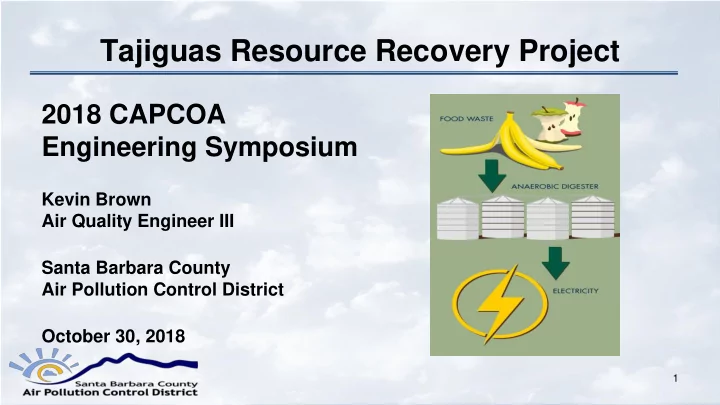
Tajiguas Resource Recovery Project

2018 CAPCOA Engineering Symposium

Kevin Brown Air Quality Engineer III Santa Barbara County Air Pollution Control District October 30, 2018

1

slide-2
SLIDE 2

Presentation Overview

  • Background
  • Process Description
  • Emission Controls
  • Permit Highlights
  • Project Challenges
  • Summary

2

slide-3
SLIDE 3

3

slide-4
SLIDE 4

Landfill Background

4

  • On the coast
  • Reaching

capacity in the near future

  • Replacement

landfill not finalized

slide-5
SLIDE 5

Regulatory Background

5

slide-6
SLIDE 6

Process Description

6

slide-7
SLIDE 7

Process Streams

7

slide-8
SLIDE 8

8

slide-9
SLIDE 9

Materials Recovery Facility (MRF)

  • Tipping Area

– Accepts 290,000 TPY combined waste

  • Materials Sorting Area

– Recyclables – Organics – Residual waste

  • Paper Dryer

9

slide-10
SLIDE 10

What is the Anaerobic Digestion Process?

  • Decomposition of waste in an oxygen-free environmental
  • Naturally occurs in the landfill
  • Process is sped up using percolate and creating an ideal

environment

  • Byproduct is digester gas

10

slide-11
SLIDE 11

Anaerobic Digestion Facility (ADF)

11

  • 16 heated, enclosed digesters
  • Dimensions: 100’ L x 22’ W x 16’ H
  • 710 ton capacity
  • 28 day digestion cycle
  • Video of Digester Operations
slide-12
SLIDE 12

12

slide-13
SLIDE 13

Combined Heat and Power Engines

13

  • Digester Gas CHP Engines:

– Two GE/Jenbacher JMS 416 B82 engines – 1,573 bhp/1,141 kWe each

  • Landfill Gas CHP Engines:

– Two GE/Jenbacher JMG 420 B82 engines – 1,966 bhp/1,429 kWe each

  • Electricity used for onsite needs
  • r sold to the grid
  • Heat used for digesters or paper

recycling

slide-14
SLIDE 14

Compost Management Unit

14

  • Twenty-six 230’ L x 16’ W

x 12’ H windrows

  • Cured six to eight weeks
  • Sold as commodity
slide-15
SLIDE 15

15

slide-16
SLIDE 16

Emission Controls

16

slide-17
SLIDE 17

Baghouses

  • Used to control

PM emissions from:

– MRF tipping area – MRF sorting area – Paper dryer

17

slide-18
SLIDE 18

Ammonia Scrubbers

18

  • MRF

– Two crossflow scrubbers – Reduce odor

  • ADF

– Crossflow scrubber – Reduce ammonia

slide-19
SLIDE 19

Biofilters

19

  • Used to control VOC, PM,

ammonia and odors from:

– MRF tipping area – MRF sorting area – ADF

  • Size: 80’ L x 80’ W x 8’ H
  • Capacity: 50,000 cubic feet
slide-20
SLIDE 20

Activated Carbon Filters

20

  • Used to reduce H2S

concentration in biogas prior to combustion in the digester gas fired CHP engines

slide-21
SLIDE 21

SCR/Oxidation Catalyst

  • Combined SCR and

Oxidation Catalyst

  • Urea Injection
  • NOx and CO control
  • Equipped on the four

combined heating and power engines

21

slide-22
SLIDE 22

Enclosed Flares

22

  • Digester Gas Flare

– John Zink ZTOF enclosed flare – 15.805 MMBtu/hr heat input rating – Downstream from Venturi scrubber to reduce ammonia concentration

  • Landfill Gas Flare

– John Zink ZTOF enclosed flare – 39.000 MMBtu/hr heat input rating

slide-23
SLIDE 23

Compost Best Management Practices

  • 20% dry woodchip blending
  • Turning every 2 weeks
  • 20 minute irrigation after

turning

  • 50% to 60% moisture content
  • Video of Windrow Turner
  • Emission Factor Assumption

for Digestate Compost

23

slide-24
SLIDE 24

Permit Highlights

24

slide-25
SLIDE 25

BACT/CEMS

  • BACT triggered for NOx, VOC, SOx, PM, PM10 and PM2.5
  • Equipment subject to BACT: ADF, baghouses, CHP

engines, enclosed flares, composting operations, and emergency electrical generators

  • Continuous Emissions Monitoring System (CEMS) and

Data Acquisition System (DAS) for CHP engines

25

slide-26
SLIDE 26

Offset Exemption

  • California Health & Safety Code §42314

– Produces 50 megawatts or less of electricity – Applies BACT – Emissions reductions from shutdown of existing equipment to be provided as emissions offsets – Provide reasonable available offsets from facilities it owns or operates – Made a good faith effort to secured reasonably available offsets

26

slide-27
SLIDE 27

Permitted Emission Limits

  • Annual Potential to Emit for Project (TPY):

27

NOx VOC CO SOx PM PM10 PM2.5 10.81 10.68 23.03 1.79 6.77 6.66 6.66

slide-28
SLIDE 28

Project Challenges

28

slide-29
SLIDE 29

HRA Modeling

29

  • Update model for District permit
  • Toxic emission factors lacking

for digester gas

  • Will require toxic emission

source testing at startup

slide-30
SLIDE 30

Odors

  • Other waste conversion

and composting projects have caused significant

  • dor issues
  • This project has been

designed with odor controls/mitigations

30

slide-31
SLIDE 31

California Coastal Boundary

  • Original project within

coastal zone boundary

  • Forced redesign of facility

and supplemental EIR

  • Resulted in lawsuit and

2 year delay

31

slide-32
SLIDE 32

Summary

32

slide-33
SLIDE 33

Questions?

33