Canadian Dry Bean Growing Regions 49 O N Saskatoon Guelph - - PowerPoint PPT Presentation

canadian dry bean growing regions
SMART_READER_LITE
LIVE PREVIEW

Canadian Dry Bean Growing Regions 49 O N Saskatoon Guelph - - PowerPoint PPT Presentation

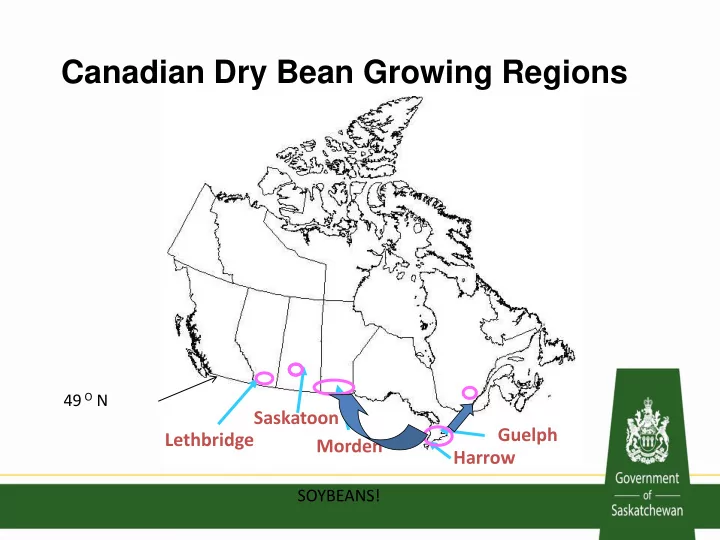
Canadian Dry Bean Growing Regions 49 O N Saskatoon Guelph Lethbridge Morden Harrow SOYBEANS! The climate North of the 49 th parallel Long days in summer Warm days but cool nights Frost in any month except July The Challenge


slide-1
SLIDE 1

Morden Guelph Harrow Lethbridge

Canadian Dry Bean Growing Regions

49 O N

Saskatoon

SOYBEANS!
slide-2
SLIDE 2

The climate

  • North of the 49th parallel
  • Long days in summer
  • Warm days but cool nights
  • Frost in any month except July
slide-3
SLIDE 3

The Challenge

  • Produce a high value crop in <100days
  • Compete with alternative pulse crops
  • Experience
  • Soil type – medium textured loam in thin black soil

zone of SK (= higher rainfall)

  • Yield
  • Price

Need for premium quality

slide-4
SLIDE 4

Premium Quality

  • The customer is always right!
slide-5
SLIDE 5

Premium Quality

Slow darkening Regular darkening

fresh aged

slide-6
SLIDE 6

Small red (e.g. Redbond) Pinto (e.g. Winchester) Pink (e.g. Viva) Navy (e.g. Envoy) Black (e.g. CDC Jet) Great Northern (e.g. Polaris)

slide-7
SLIDE 7

Newer Varieties bred for SK from CDC

CDC Sol CDC Marmot CDC 3458-7 navy CDC WM-2

slide-8
SLIDE 8

Environmental effects

CDC Pintium @ Redvers 2002- stained CDC Pintium @ Saskatoon 2002- not stained

Pre-disposition to staining likely due to cool wet weather during harvest

slide-9
SLIDE 9

Maturity problems

Too late More mature

slide-10
SLIDE 10

Early Maturity

  • Early maturity in one environment does not =

early maturity in another

  • Watch out for effect of long days
  • Delayed DTF
  • Watch out for effect of cool nights
  • Lengthens DTM
  • Early maturity = shorter season for biomass

accumulation and yield

slide-11
SLIDE 11

Cold Tolerant Beans?

 Cold tolerant beans would lengthen the

season

Germinate in cool soil

 Survive the odd light late spring frost or

early fall frost

 Originated in sub-tropical regions  Warm-season legume

 Hate cold temperatures

slide-12
SLIDE 12

Tepary Bean

  • Wild & cultivated species
  • riginating in dry areas of

Mexico and SW USA

  • Looks like small common

bean

  • Reputation for tolerance

to drought, heat and cold

  • Crossing with common bean is difficult but possible
  • testing hybrids for stress tolerance
slide-13
SLIDE 13

Breeding for tolerance

  • White mould
  • plant architecture
  • Screening for tolerance
  • f material in disease

nurseries under irrigation

http://info.ag.uidaho.edu/pdf/PNW/PNW0568.pdf

slide-14
SLIDE 14

Common Bacterial Blight

  • Marker-assisted

selection

  • Followed by

field confirmation

Now have early maturing, CBB tolerant blacks, navies & pintos

slide-15
SLIDE 15

Halo Blight

  • Crossing to exotic

material resulted in introduction of susceptibility

  • single gene control

appears possible

  • I-gene marker for

BCMV may also work as marker for tolerance to HB

slide-16
SLIDE 16

Anthracnose

  • Becoming a problem in

SK with wetter years

  • Genetic resistance

available for prevalent race 73

  • Markers available and

being used in breeding programs to ensure newer lines are tolerant

slide-17
SLIDE 17

Issues affecting quality

  • Genetics of colour, size, shape
  • Maturity
  • Disease
  • Agronomics
  • Maximize yield for particular production system
  • Decrease disease incidence
  • Take advantage of irrigation to keep seeds plump & to

maintain yield potential

slide-18
SLIDE 18

Future

  • Niche marketing of new/improved types of beans
  • Smaller production of more types
  • De-commodification
  • new combinations of colours, shapes, sizes
  • specific profiles of nutrients

Is the consumer willing to pay a premium???

slide-19
SLIDE 19

Dry Bean

Main Characteristics of Varieties

CDC Pintium pinto 12 100 100 100 50 E 85 350 I Island pinto 6 117 111 100 55 M 79 355 II Mariah ^ pinto 4 112 113 94 55 L 82 293 II Winchester pinto 5 116 111 109 52 M 82 352 II Winmor pinto 6 118 104 100 55 M 72 350 II CDC Marmot pinto 4 109 120 115 50 E 80 367 I CDC WM-2 ~ pinto 7 114 108 104 52 E 79 365 II Envoy navy 12 80 90 84 53 M 77 184 I Lightning navy 7 109 95 90 60 L 85 175 II Skyline ^ navy 5 74 95 92 57 L 80 163 I OAC Spark navy 5 86 100 101 55 L 81 163 I AC Polaris great northern 7 97 102 95 52 L 70 310 III AC Redbond small red 8 98 103 99 51 M 65 290 II CDC Blackcomb black 6 113 99 94 56 M 85 167 II Carman Black black 5 125 115 112 59 M 88 180 II CDC Jet black 12 94 96 92 58 L 85 170 II AC Black Diamond shiny black 7 102 94 94 54 M 70 250 II CDC Sol ~ yellow 6 102 93 85 55 L 78 399 I * Co-op and regional trials grown in narrow rows. Direct comparisons to CDC Pintium since 2002. ** Maturity ratings based on E = 100 days L = 110 days for May 20 planting to swathing maturity. See page 2 for more information. Pod clearance: percentage of pods that completely clear the cutterbar at time of swathing (~4 cm). ‡ Growth habit: I = Determinate bush; II = Indeterminate bush; III = Indeterminate vine.

Growth Habit‡ Irrigation

  • --- Yield % of CDC Pintium ----

Area 2 Area 3 Maturity Rating** Days to Flower Years Tested* Variety Type % Pod Clearance Seed Weight (g/1000)

Varieties of Grain Crops 2014

slide-20
SLIDE 20

Canada-Saskatchewan Irrigation Diversification Centre

slide-21
SLIDE 21

Canada-Saskatchewan Irrigation Diversification Centre

slide-22
SLIDE 22
  • 500.0

1000.0 1500.0 2000.0 2500.0 3000.0 WINCHESTER 1533 CDC WHITE MOUNTAIN ISLAND WM-2 CDC MEDICINE HAT SOL CDC

Dry Bean Acres by Crop Type and Variety 2013 (irrigated) Courtesy SCIC

ACRES

slide-23
SLIDE 23
  • 100.0

200.0 300.0 400.0 500.0 600.0 700.0 1533 CDC WHITE MOUNTAIN ENVOY

Dry Bean Acres by Crop Type and Variety 2013 (dryland) Courtesy SCIC

ACRES

slide-24
SLIDE 24

20 40 60 80 100 120 140 160 180 All Provinces Manitoba Alberta Ontario Quebec Saskatchewan British Columbia New Brunswick Nova Scotia Millions

Canadian Export to World Via Province: Beans Nesoi (Black, Lima, Pinto, Cowpeas, Etc.)

Canada Dollars 2011 Canada Dollars 2012 Canada Dollars 2013

slide-25
SLIDE 25

5 10 15 20 25 Millions

Canadian Export to World: Beans Nesoi (Black, Lima, Pinto, Cowpeas, Etc..)

Canada Dollars 2011 Canada Dollars 2012 Canada Dollars 2013

slide-26
SLIDE 26
slide-27
SLIDE 27
slide-28
SLIDE 28
slide-29
SLIDE 29
slide-30
SLIDE 30
slide-31
SLIDE 31
slide-32
SLIDE 32
slide-33
SLIDE 33
slide-34
SLIDE 34
slide-35
SLIDE 35
slide-36
SLIDE 36
slide-37
SLIDE 37

Statpub collects from a variety of sources. Todays prices for Saskatchewan.

  • BEANS SPOT MARKET AVERAGE 2014 CROP
  • (CDN cents per pound farmers dressed quality delivered plant)
  • No 1 Navy/Pea Beans 37.00 to 37.00 37.00 28.50 to 30.00
  • No 1 Great Northern 60.00 to 60.00 60.00 33.30 to 35.00
  • No 1 Cranberry Beans 64.00 to 64.00 64.00 42.80 to 45.00
  • No 1 Light Red Kidney55.00 to 55.00 55.00 42.80 to 45.00
  • No 1 Dark Red Kidney 60.00 to 60.00 60.00 42.80 to 45.00
  • No 1 Black Beans 35.00 to 35.00 35.00
  • No 1 Pinto Beans 32.00 to 32.00 32.00 25.70 to 27.00
  • No 1 Small Red
  • No 1 Pink 40.00 to 40.00 40.00
slide-38
SLIDE 38

Todays Prices: (Source Saskcan)

New crop pricing:

  • Pintos

Navies Black

  • ~30

Mid 30’s Low 30’s Old Crop pricing

  • ~32

36-37 33-35 CourtesySaskcanPulse

Alvin Klassen cellular: 204 312 0888 aklassen@Saskcan.com

slide-39
SLIDE 39

Saskatchewan processor

  • Saskcan Actively looking at navy beans

being developed at CDC

  • Market looking for new sources of dry

bean

  • Will be actively promoting dry beans and

faba beans in coming years under irrigation.

  • Fb 9-4 faba under irrigation in Alberta

yielded 110 bu. / acre.

slide-40
SLIDE 40