Can We Use Dormant Almond Orchards for Groundwater Recharge? Ken - - PowerPoint PPT Presentation

can we use dormant almond orchards for groundwater
SMART_READER_LITE
LIVE PREVIEW

Can We Use Dormant Almond Orchards for Groundwater Recharge? Ken - - PowerPoint PPT Presentation

Can We Use Dormant Almond Orchards for Groundwater Recharge? Ken Shackel, Helen Dahlke, Astrid Volder, Bruce Lampinen, Roger Duncan, David Doll. Nick Blom, Modesto Irrigation District Almond Board of CA Using Orchards for Winter Recharge Many


slide-1
SLIDE 1

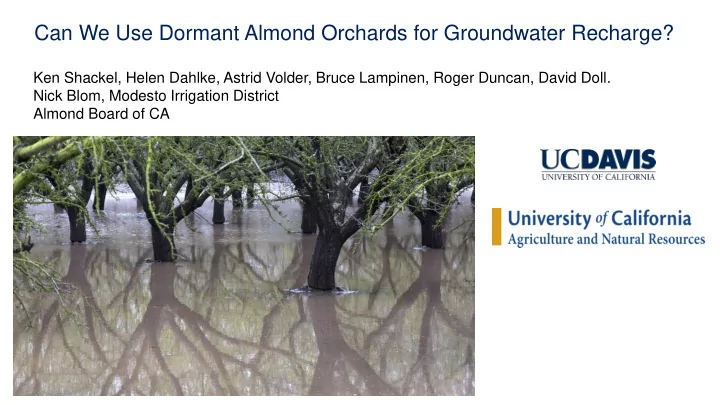
Can We Use Dormant Almond Orchards for Groundwater Recharge?

Ken Shackel, Helen Dahlke, Astrid Volder, Bruce Lampinen, Roger Duncan, David Doll. Nick Blom, Modesto Irrigation District Almond Board of CA
slide-2
SLIDE 2

Many ducks need to be in a row for winter recharge flooding to be a sustainable strategy in almonds Duck #1 (deal breaker): trees don’t die.

Monitor: 1) Yield 2) Root & tree health 3) Tree water stress 4) Soil water 5) Etc….

Using Orchards for Winter Recharge

slide-3
SLIDE 3

Saturated Soils: Generally BAD for Almonds

slide-4
SLIDE 4

Saturated Soils: Generally BAD for Almonds

Questions:

  • 1. Is it OK for Almonds if the trees

are dormant (Dec/Jan)?

  • 2. What happens to root and tree

health over the long run?

  • 3. What about leaching of N,

pesticides, salts, etc.?

slide-5
SLIDE 5

Two commercial orchard sites. Started trials in fall 2015 2015: Pre-treatment yields, install monitoring equipment Winter 2015/16 & 2016/17: apply a total of 24” water during January 2016 & 2017: monitor tree health and yield

Modesto Delhi “Excellent” SAGBI “Moderately Good” SAGBI

slide-6
SLIDE 6

Modesto Recharge Site – Paradise Road – 15+ year old Flood-irrigated Nonpareil / Sonora / Monterey

slide-7
SLIDE 7

Modesto Irrigation District Captured Storm Water Runoff

slide-8
SLIDE 8
slide-9
SLIDE 9

Six inches of water applied for four consecutive weeks in January

slide-10
SLIDE 10

Compared against adjacent section with no winter irrigation

slide-11
SLIDE 11

A suite of measurements:

  • water infiltration
  • Leaching of NO3, salts, etc.
  • Root growth, tree “stress”,

bloom, growth, yield, etc.

slide-12
SLIDE 12

Root zone hydrology – quickly drained in Delhi sand but root zone saturated for 48 hours in Modesto Site

Fine sandy loam Sand ~ 6 hrs ~ 48 hrs

slide-13
SLIDE 13

‘Mini-rhizotron’ method to observe root growth and ‘health’

slide-14
SLIDE 14
slide-15
SLIDE 15
slide-16
SLIDE 16

Root growth

  • Trees in Recharge treatment showed

higher standing root length:

  • Standing root length: rate of root

production minus rate of root death

  • Greater standing root length = longer

root lifespan

  • Median lifespan of roots was about

30-70% longer in the Recharge treatment than in the Control

  • Lifespan increased with depth except for

18-24” depth

  • Greatest difference between Control and

Recharge treatment at 6-12” depth

Standing Root Length

Delhi 6” 6” – 12” 12” – 18” 18” –24”

Depth

slide-17
SLIDE 17

Checking root health by testing for tree water stress: Are roots able to supply the water that the tree needs?

slide-18
SLIDE 18

Date, 2016

JAN FEB MAR APR MAY JUN JUL AUG SEP

SWP (bar)

  • 20
  • 15
  • 10
  • 5
  • 20
  • 15
  • 10
  • 5

(RECHARGE) (RECHARGE)

Delhi (Sand) Modesto (FSL)

Fully Irrigated Baseline Control Recharge Fully Irrigated Baseline Control Recharge

Testing for water stress during the growing season

No evidence of water stress resulting from impairment of root water uptake. Some evidence of an improved tree water condition with winter recharge irrigations.

slide-19
SLIDE 19

GgPrR camera

LIDAR

slide-20
SLIDE 20

Measuring PAR

(Photosynthetically Active Radiation) = shade

slide-21
SLIDE 21

2016 2017 Change Control 72.0 a 65.3 a

  • 6.7

Recharge 75.8 a 65.4 a

  • 10.4

Delhi

2016 2017 Change Control 88.8 a 75.1 a

  • 13.7

Recharge 85.2 a 77.2 a

  • 8.0

Stanislaus

Impact on Canopy Growth

No difference in canopy growth in recharge areas

  • vs. control
slide-22
SLIDE 22

Yield Data

Year Treatment 2015 2016 2017 (pre-treatment) Modesto No Recharge 3360 3290 2980 Recharge 3430 3130 2990 Delhi No Recharge 1190 1140 2640 Recharge 1410 1200 3110

*Bottom line: no apparent negative effect on yield from winter flooding

slide-23
SLIDE 23

Root zone hydrology

slide-24
SLIDE 24

How much of applied water went to recharge?

Summary of water inputs (rain & applied water) for October-March.

AWC = available water content

Rain Applied Water Total deep percolation Deep Percolation from rainfall Deep Percolation

  • f applied water

Applied water stored in rootzone inches inches inches inches inches % inches %

2015/16

Delhi 12.94 26.15 29.09 4.79 24.30 93% 1.84 7% Modesto 9.91 24.00 21.90 2.55 19.35 81% 4.65 19%

2016/17

Delhi 17.44 25.80 33.03 7.43 25.60 99% 0.20 1% Modesto 12.46 24.00 27.94 4.78 23.16 96% 0.84 4%

  • >80% of applied water went to deep percolation..
slide-25
SLIDE 25

Soil Nitrate

How much residual soil nitrate is leached during groundwater recharge events?

  • Soil cores (12 ft) were taken

before November) and after(February) recharge events

  • Soil analysis: texture, pH, EC, soil

nitrate, DOC

  • Nitrate and salts pushed deeper

into soil profile

Delhi - Flood

slide-26
SLIDE 26

ROOT ZONE 12 ft PROFILE

Soil Nitrate: 1 kg/ha = 0.89 lb/acre

Soil Nitrate – Nov. vs Feb.

  • Modesto
  • Root zone (upper 3 ft):
  • 56% increase in Flood treatment
  • 220% increase in Control
  • Entire profile (12 ft):
  • 107% increase in Flood treatment
  • 20% increase in Control
  • Most of the increase in soil nitrate in the

root zone occurred is the result of nitrification

  • Most of the increase of nitrate deeper in

soil profile is a result of leaching

Modesto Modesto

slide-27
SLIDE 27

Conclusions

  • No obvious warning signs that winter irrigation (Dec/Jan)

for groundwater recharge negatively affects trees

  • What about February / March??
  • Trees on sandy sites might benefit from winter flooding
  • Sandy soils (Delhi) – clear nitrate loss from recharge
  • What about other leaching of other pollutants /

pesticides? Regulations??