Tree Stewardship and Planting Tips Case Western Green Bag Lunch, - - PowerPoint PPT Presentation

tree stewardship and planting tips
SMART_READER_LITE
LIVE PREVIEW

Tree Stewardship and Planting Tips Case Western Green Bag Lunch, - - PowerPoint PPT Presentation

Tree Stewardship and Planting Tips Case Western Green Bag Lunch, September 21, 2017 The Cleveland Tree Plan Summary The Cleveland Tree Plan Why Trees? Over 100 years trees appreciate Other infrastructure depreciates The Cleveland Tree


slide-1
SLIDE 1

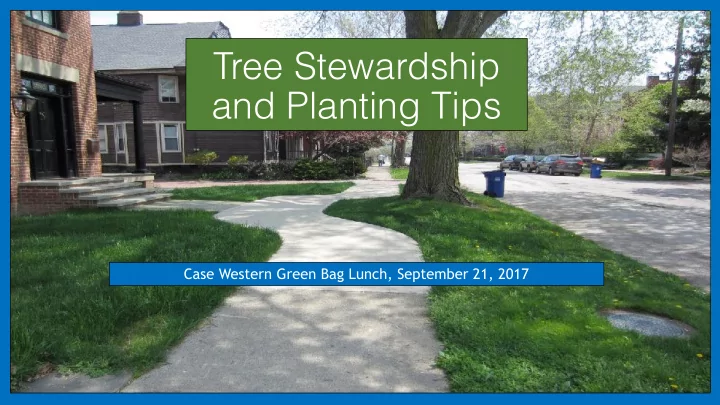
Tree Stewardship and Planting Tips

Case Western Green Bag Lunch, September 21, 2017
slide-2
SLIDE 2

The Cleveland Tree Plan

Summary

slide-3
SLIDE 3

The Cleveland Tree Plan

Why Trees?

Over 100 years trees appreciate Other infrastructure depreciates

slide-4
SLIDE 4

The Cleveland Tree Plan

Why Trees?

In Cleveland that means $28 million in annual benefits

❖ 1.8 billion gallons of rainwater every year (value: $11 million). ❖ Saves residents and business owners $3.5 million in energy costs each year.

slide-5
SLIDE 5

The Cleveland Tree Plan

Why Trees?

In Cleveland that means $28 million in annual benefits

❖ 1.8 billion gallons of rainwater every year (value: $11 million). ❖ Saves residents and business owners $3.5 million in energy costs each year.

slide-6
SLIDE 6

The Cleveland Tree Plan

The Way Forward: Action Steps

❖ Action #8: Institute policy changes supportive of urban forestry

slide-7
SLIDE 7

The Cleveland Tree Plan

The Way Forward: Action Steps

❖ Action #9: Plant with a purpose: trees for neighborhood equity

slide-8
SLIDE 8

The Cleveland Tree Plan

How Can You Make a Difference?

❖ Select Qualified Arborists

slide-9
SLIDE 9

Tree Steward Training

slide-10
SLIDE 10

Tree Steward Program

Curriculum focused on:

  • Urban Forestry
  • Tree Biology
  • Tree Identification
  • Tree Stress
  • Root and Soil Management
  • Planting, Pruning and Care
  • Community Forestry
slide-11
SLIDE 11

Tree Steward Program

Process (four parts) Classroom Parts I&II (curriculum) Outdoor Parts III&IV (planting/care)

slide-12
SLIDE 12

Tree Steward Program

Learning Objectives

  • 1. Increased awareness of trees

and the benefits they provided

  • 2. Basic ability to plant and care

for trees in the community

  • 3. Willingness to organize and

participate in community forestry events

slide-13
SLIDE 13

Regional Initiatives and Partnerships

Cleveland Tree Plan Cleveland Tree Coalition Public/Private Grants and Partnerships

slide-14
SLIDE 14

Planting

  • Inspect your trees

before planting!

  • Tree planting is short
  • Tree lives are long
  • Do it right the first

time – tag your trees!

slide-15
SLIDE 15
slide-16
SLIDE 16

Plant Selection

  • Match the tree to the

site

  • Select healthy/quality

trees

  • Inspect the root ball
slide-17
SLIDE 17

Plant Selection

  • Inspect branches, trunk,

and roots

  • Look for circling roots
  • These can lead to

girdling roots

slide-18
SLIDE 18

Plant Selection

  • Inspect branches, trunk,

and roots

  • Look for circling roots
  • These can lead to

girdling roots

slide-19
SLIDE 19

Plant Selection

  • Inspect branches, trunk,

and roots

  • Look for circling roots
  • These can lead to

girdling roots

slide-20
SLIDE 20

Plant Selection

  • Inspect structure

(central leader)

  • Look for pests/diseases
  • No injuries to trunk or

root collar

slide-21
SLIDE 21
slide-22
SLIDE 22

Stock Type

  • Bare root
  • Pro: small/light/

see all roots

  • Con: dry out

easily/dormant planting season

slide-23
SLIDE 23

Stock Type

  • Containerized/container

grown

  • Pro: easy to move/

relatively light

  • Con: Substrate grown/

circling or girdling roots

slide-24
SLIDE 24

Stock Type

  • Containerized/container

grown

  • Often have excessive or

defective roots

  • Substrate grown
slide-25
SLIDE 25

Stock Type

  • Balled and Burlapped

(B&B)

  • Pro: soil-based root ball
  • Con: heavy/lose 90% of

roots/deep roots/ hidden issues

slide-26
SLIDE 26

Stock Type

  • Balled and Burlapped

(B&B)

  • Pro: soil-based root ball
  • Con: heavy/lose 90% of

roots/deep roots/hidden issues

Wire basket

slide-27
SLIDE 27

Stock Type

  • Balled and Burlapped

(B&B)

  • Pro: soil-based root ball
  • Con: heavy/lose 90% of

roots/deep roots/hidden issues

Deep roots

slide-28
SLIDE 28

Stock Type

  • Balled and Burlapped

(B&B)

  • Pro: soil-based root ball
  • Con: heavy/lose 90% of

roots/deep roots/hidden issues

Deep roots

slide-29
SLIDE 29
slide-30
SLIDE 30

Planting Techniques

  • Locate utilities
  • Above and below ground
  • Practice ‘Right Tree Right Place’
slide-31
SLIDE 31

Planting Techniques

  • Shallow/Wide planting

hole

slide-32
SLIDE 32

Planting Techniques

  • Too deep!
slide-33
SLIDE 33

Planting Techniques

  • Too deep!
slide-34
SLIDE 34

Planting Techniques

  • Root flare near grade
slide-35
SLIDE 35

Planting Techniques

  • Root flare near grade
slide-36
SLIDE 36

Planting Techniques

  • Do not over-dig!
slide-37
SLIDE 37

Planting Techniques

  • Remove planting

materials

slide-38
SLIDE 38

Planting Techniques

  • Correct root defects
slide-39
SLIDE 39

Planting Techniques

  • Correct root defects
slide-40
SLIDE 40

Planting Techniques

  • Check drainage/no

gravel (perched water table)

slide-41
SLIDE 41

Planting Techniques

  • Fill in with site soil
  • 2-3x root ball
slide-42
SLIDE 42

Planting Techniques

  • Top-dress with

compost/woodchips

slide-43
SLIDE 43

Planting Techniques

  • Top-dress with

compost/woodchips

slide-44
SLIDE 44
slide-45
SLIDE 45

Transplanting

  • Root pruning
  • Trees can be hardened
  • ff to help acclimation
  • Drum lace large root

balls

Photos courtesy GardenWeb and Tree PGH

slide-46
SLIDE 46

Transplanting

  • Root pruning
  • Trees can be hardened
  • ff to help acclimation
  • Drum lace large root

balls

Photos courtesy GardenWeb and Tree PGH

slide-47
SLIDE 47

Transplanting

  • Tree spade used for digging
  • Take care when

transporting

  • Protect your investment
slide-48
SLIDE 48

Transplanting

  • Tree spade used for

digging

  • Take care after planting
slide-49
SLIDE 49
slide-50
SLIDE 50

Early Care

  • Planting is just the start!
  • Transplant shock can

cause increased mortality

  • Just add water!

Be sure to repeat

slide-51
SLIDE 51

Early Care

  • Fertilization
  • Mulching
  • Staking or Guying
slide-52
SLIDE 52

Early Care

  • Fertilization
  • Mulching
  • Staking or Guying
slide-53
SLIDE 53

Early Care

  • Fertilization
  • Mulching
  • Staking or Guying
slide-54
SLIDE 54

Early Care

  • Tree wrap
  • Root collar guards

Photos of wraps/guards courtesy A.M. Leonard

slide-55
SLIDE 55

Early Care

  • Tree wrap
  • Root collar guards

Photos of wraps/guards courtesy A.M. Leonard

slide-56
SLIDE 56

Early Care

  • Pruning
  • Yes, just a small

amount at planting

  • Include dead or broken

branches too

Photos courtesy Dr. Ed Gilman

slide-57
SLIDE 57

Early Care

  • Pruning
  • Yes, just a small

amount at planting

  • Include dead or broken

branches too

slide-58
SLIDE 58

Early Care

  • Use ANSI A300 for planning

specifications

  • Tree planting best

management practices too!

  • Include detailed drawings

too

slide-59
SLIDE 59

Early Care

  • Use ANSI A300 for planning

specifications

  • Tree planting best

management practices too!

  • Include detailed drawings

too

slide-60
SLIDE 60
slide-61
SLIDE 61

Tree Planting & Establishment


January 31, 2017
 The Ohio Tree Care Conference

slide-62
SLIDE 62

Tree Planting & Establishment


January 31, 2017
 The Ohio Tree Care Conference

slide-63
SLIDE 63

Tree Planting & Establishment


January 31, 2017
 The Ohio Tree Care Conference

slide-64
SLIDE 64

Tree Planting & Establishment


January 31, 2017
 The Ohio Tree Care Conference

slide-65
SLIDE 65

Tree Planting & Establishment


January 31, 2017
 The Ohio Tree Care Conference

slide-66
SLIDE 66

Tree Planting & Establishment


January 31, 2017
 The Ohio Tree Care Conference

slide-67
SLIDE 67

Happy Planting! Diana Sette Arborist Educator The Holden Arboretum 9500 Sperry Road Kirtland, Ohio 44094
 p: 267-423-0340
 f: 440.256.5836

http://www.holdenarb.org/resources/communityforestry.asp