Call Semantics Finding Remote Objects Method Call Semantics what - - PDF document

call semantics finding remote objects
SMART_READER_LITE
LIVE PREVIEW

Call Semantics Finding Remote Objects Method Call Semantics what - - PDF document

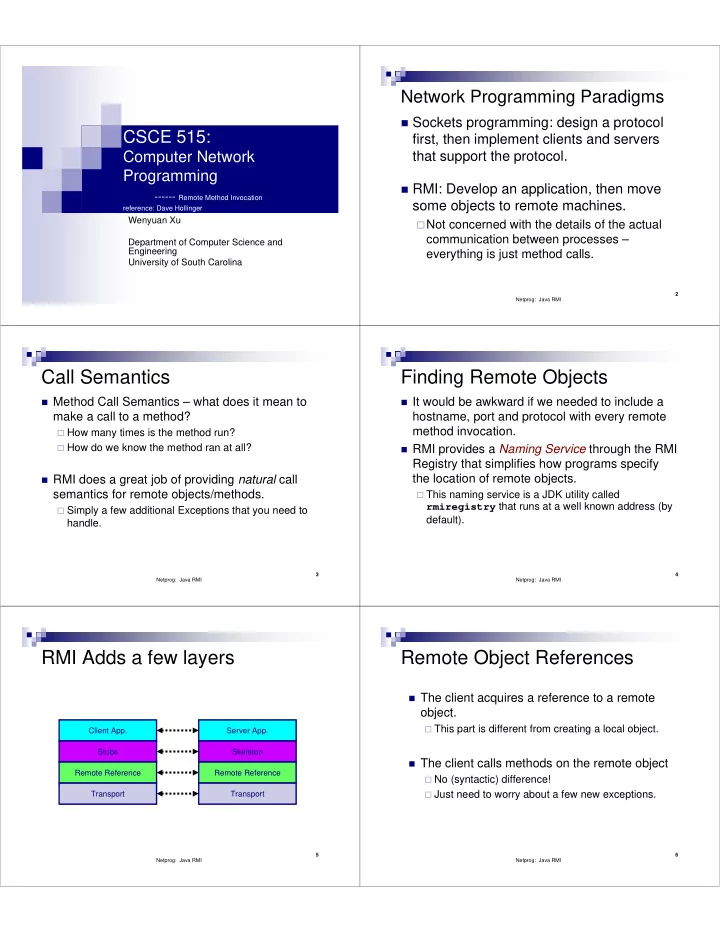
Network Programming Paradigms Sockets programming: design a protocol CSCE 515: first, then implement clients and servers Computer Network that support the protocol. Programming RMI: Develop an application, then move ------ Remote Method


slide-1
SLIDE 1

CSCE 515:

Computer Network Programming

  • ----- Remote Method Invocation

reference: Dave Hollinger

Wenyuan Xu Department of Computer Science and Engineering University of South Carolina

Netprog: Java RMI 2

Network Programming Paradigms

Sockets programming: design a protocol

first, then implement clients and servers that support the protocol.

RMI: Develop an application, then move

some objects to remote machines.

Not concerned with the details of the actual

communication between processes – everything is just method calls.

Netprog: Java RMI 3

Call Semantics

Method Call Semantics – what does it mean to

make a call to a method?

How many times is the method run? How do we know the method ran at all?

RMI does a great job of providing natural call

semantics for remote objects/methods.

Simply a few additional Exceptions that you need to

handle.

Netprog: Java RMI 4

Finding Remote Objects

It would be awkward if we needed to include a

hostname, port and protocol with every remote method invocation.

RMI provides a Naming Service through the RMI

Registry that simplifies how programs specify the location of remote objects.

This naming service is a JDK utility called

rmiregistry that runs at a well known address (by default).

Netprog: Java RMI 5

RMI Adds a few layers

Server App. Skeleton Remote Reference Transport Client App. Stubs Remote Reference Transport

Netprog: Java RMI 6

Remote Object References

The client acquires a reference to a remote

  • bject.

This part is different from creating a local object.

The client calls methods on the remote object

No (syntactic) difference! Just need to worry about a few new exceptions.

slide-2
SLIDE 2

Netprog: Java RMI 7

Overview of RMI Programming

Define an interface that declares the methods that

will be available remotely.

The server program must include a class that

implements this interface.

The server program must create a remote object and

register it with the naming service.

The client program creates a remote object by asking

the naming service for an object reference.

Netprog: Java RMI 8

Java Interfaces

Similar to Class No implementation! All methods are

abstract (virtual for C++ folks).

Everything is public. No fields defined, just Methods. No constructor an Interface is an API that can be

implemented by a Class.

Netprog: Java RMI 9

Interfaces and Inheritence

In Java a class can only extend a single

superclass (single inheritence).

A class can implement any number of

interfaces.

end result is very similar to multiple

inheritence.

Netprog: Java RMI 10

Sample Interface

public interface Shape { public getArea(); public draw(); public fill(Color c); }

Netprog: Java RMI 11

Implementing an Interface

public class Circle implements Shape { private double radius; private Point center; // define a constructor and other // methods // MUST define the methods: // getArea(); // draw(); // public fill(Color c); }

Netprog: Java RMI 12

Server Details – extending Remote

Create an interface the extends the

java.rmi.Remote interface.

This new interface includes all the public methods

that will be available as remote methods.

import java.rmi.*; public interface MyRemote extends Remote { public int foo(int x) throws RemoteException; public String blah(int y) throws RemoteException; . . . }

slide-3
SLIDE 3

Netprog: Java RMI 13

How the interface will be used

Class for your Remote Object Your Interface UnicastRemoteObject Remote Interface Class RemoteServer extends implements extends extends

provides methods needed by

Netprog: Java RMI 14

Server Details – Implementation Class

Create a class that implements the

interface.

The class should also extend

UnicastRemoteObject*

This class needs a constructor that throws

RemoteException !

This class is now used by rmic to create

the stub and skeleton code.

*It doesn’t have to extend UnicastRemoteObject, there is another way…

Netprog: Java RMI 15

Remote Object Implementation Class

public class MyRemoteImpl extends UnicastRemoteObject implements MyRemote { public MyRemoteImpl() throws RemoteException {} public int foo(int x) { return(x+1); } public String blah(int y) { return(“Your number is “ + y); } }

Netprog: Java RMI 16

Generating stubs and skeleton

Compile the remote interface and

implementation:

> javac MyRemote.java MyRemoteImpl.java Use rmic to generate MyRemoteImpl_stub.class, MyRemoteImpl_skel.class > rmic MyRemoteImpl

Netprog: Java RMI 17

Server Detail – main()

The server main() needs to:

create a remote object. register the object with the Naming service.

public static void main(String args[]) { try { MyRemoteImpl r = new MyRemoteImpl(); Naming.bind(“joe”,r); } catch (RemoteException e) { . . .

Netprog: Java RMI 18

Client Details

The client needs to ask the naming service for a

reference to a remote object.

The client needs to know the hostname or IP address

  • f the machine running the server.

The client needs to know the name of the remote

  • bject.

The naming service uses URLs to identify

remote objects.

slide-4
SLIDE 4

Netprog: Java RMI 19

Using The Naming service

Naming.lookup() method takes a string

parameter that holds a URL indicating the remote object to lookup. rmi://hostname/objectname

Naming.lookup() returns an Object! Naming.lookup() can throw RemoteException MalformedURLException

Netprog: Java RMI 20

Getting a Remote Object

try { Object o = Naming.lookup(“rmi://localhost/ReMath”); MyRemote r = (MyRemote) o; // . . . Use r like any other Java object! } catch (RemoteException re) { . . . } catch (MalformedURLException up) { throw up; }

Netprog: Java RMI 21

Starting the Server

First you need to run the Naming service

server: rmiregistry &

Now run the server:

java ServerMain

Netprog: Java RMI 22

Sample Code

There is sample RMI code on the course

homepage:

RemoteMathImpl: remote integer arithmetic