1 LinkedList: doubly-linked list (cont.) Removing an element from a - - PowerPoint PPT Presentation

1
SMART_READER_LITE
LIVE PREVIEW

1 LinkedList: doubly-linked list (cont.) Removing an element from a - - PowerPoint PPT Presentation

Concrete collections in Java library ArrayList: indexed sequence that grows/shrinks dynamically LinkedList: ordered sequence that allows efficient insertions and removal at any location HashSet: unordered collection that rejects


slide-1
SLIDE 1

1

1

Java Collection framework: On concrete collections and their implementation

2

Concrete collections in Java library

  • ArrayList: indexed sequence that grows/shrinks dynamically
  • LinkedList: ordered sequence that allows efficient insertions

and removal at any location

  • HashSet: unordered collection that rejects duplicates
  • TreeSet: sorted set
  • EnumSet: set of enumerated type values (implements Set)
  • LinkedHashSet: set that remembers the order in which elements

were inserted

  • PriorityQueue: allows efficient removal of the smallest element
  • HashMap: stores key/value associations
  • TreeMap: map in which the keys are sorted
  • EnumMap: keys belong to an enumerated type (impl. Map)
  • LinkedHashMap: remembers the order in which added
  • WeakHashMap: keys and entries that can be reclaimed by the

garbage collector if the keys are not used elsewhere

  • IdentityHashMap: keys that are compared by ==, not equals

3

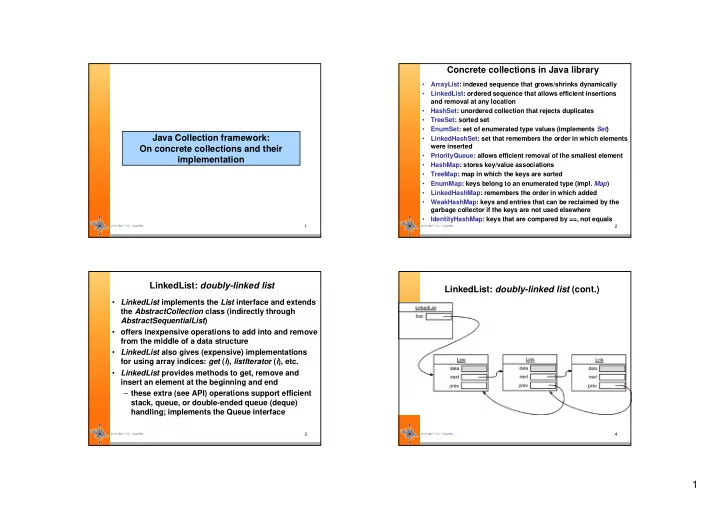
LinkedList: doubly-linked list

  • LinkedList implements the List interface and extends

the AbstractCollection class (indirectly through AbstractSequentialList)

  • offers inexpensive operations to add into and remove

from the middle of a data structure

  • LinkedList also gives (expensive) implementations

for using array indices: get (i), listIterator (i), etc.

  • LinkedList provides methods to get, remove and

insert an element at the beginning and end – these extra (see API) operations support efficient stack, queue, or double-ended queue (deque) handling; implements the Queue interface

4

LinkedList: doubly-linked list (cont.)

slide-2
SLIDE 2

2

5

LinkedList: doubly-linked list (cont.)

List <E> list = new LinkedList <E> (aCollection) list.addFirst (obj) list.addLast (obj)

  • bj = list.getFirst ()
  • bj = list.getLast ()
  • bj = list.removeFirst ()
  • bj = list.removeLast ()
  • list traversal is done by an implementation of

ListIterator

  • a recursive list having itself as an element is not

permitted (but not checked)

6

Removing an element from a linked list

7

Adding an element to a linked list

8

ArrayList: sequentially allocated list

  • the class ArrayList implements List
  • internally, contains an Object [ ] array that is

automatically reallocated when needed

  • methods to manipulate the array that stores the

elements: ensureCapacity (minCapacity), and trimToSize ()

  • gives efficient (O(1)) implementations for methods

with index positions, such as get (i), set (i, obj), etc.

  • implements the marker interface RandomAccess
  • note that ArrayList does not provide operations for

stack and queue handling (not a Queue)

  • element traversals are made by an implementation of

ListIterator

slide-3
SLIDE 3

3

9

Removing an element from an array

10

Implementation of Java Collections

  • uses object-oriented mechanisms and patterns to
  • rganize the services and the classes:
  • encapsulation, inheritance, polymorphism;

– Template Method, Factory Method, Iterator, Strategy, Proxy, etc.

  • however, data structures are not organized into a

single-root class library – some libraries handle maps uniformly as collections of pair elements

  • to support code reuse, the framework provides

abstract classes, e.g., AbstractCollection

  • AbstractCollection implements Collection, leaving
  • perations, such as iterator () and size (), abstract

11

Relationships between framework classes

12

Implementation of Java Collections (cont.)

  • the skeleton class either gives a method some

default definition, say, throwing an exception, or implements it in terms of more basic operations

  • e.g., utility routines, such as toString () and

addAll (aCollection), can be defined in terms of other

  • perations:

public class AbstractCollection <E> implements Collection <E> { . . . public abstract Iterator<E> iterator ();

slide-4
SLIDE 4

4

13

Implementation of Java Collections (cont.)

. . . public boolean add (E obj) { // illegal by default throw new UnsupportedOperationException (); } // hypothetical implementation: public boolean contains (Object obj) { for (E element : this) // calls iterator () if (element.equals (obj)) return true; return false; } } // AbstractCollection <E>

14

Implementation of Java Collections (cont.)

  • the abstract classes are meant to be used by

programmers wanting to extend the framework with new implementations of data structures

  • of course, must implement the missing abstract

methods to make default ones to work

  • additionally, an implementation may override a

ready-made skeleton method to make it legitimate,

  • r to give it a more efficient implementation for a

specific concrete data structure

15

Error Handling

  • very thorough checks; uses unchecked exceptions
  • denied ops throw UnsupportedOperationException
  • unacceptable type throws ClassCastException
  • element constraint (e.g. range) violation throws

IllegalArgumentException

  • an accessed empty collection or exhausted iterator

throws NoSuchElementException

  • a null parameter (unless null is accepted as an

element) throws NullPointerException

  • invalid element index (< 0 or >= size ()) throws

IndexOutOfBoundsException

  • especially, constant views may throw

UnsupportedOperationException

16

Iterator error handling

  • Iterator.remove () removes the last element visited

by next ()

  • removal depends on the state of the iterator

– throws UnsupportedOperationException if the remove operation is not supported, and – throws IllegalStateException if the next method has not yet been called

  • generally, the behavior of an Iterator is unspecified

if the underlying collection is modified while the iteration is in progress in any way other than by calling the method remove

slide-5
SLIDE 5

5

17

Iterator error handling (cont.)

  • however, ListIterator.remove is guaranteed to throw

IllegalStateException if the list was structurally modified (i.e., remove or add have been called) since the last next or previous

  • ListIterator.add (anObject) throws

– UnsupportedOperationException if the add method is not supported by this list iterator – ClassCastException (IllegalArgumentException) if the class (or some other aspect) of the specified element prevents it from being added to this list

  • note that adding does not depend on the state of the

iterator (whether next or previous has been called)

18

Iterator error handling (cont.)

  • the method set (newElement) replaces the last

element returned by last next or previous

  • the update is done "in place", i.e., without

structurally modifying the data structure

  • however, the method set () itself throws

IllegalStateException – if neither next nor previous have been called, or – if the list was structurally modified (remove or add have been called) since the last next or previous

19

Fail-Fast Feature

  • iterators generally support the so-called fail-fast

feature

  • this means that if the collection is modified after an

iterator is created, in any way except through the iterator's own remove or add methods, an exception is thrown

  • only one iterator may be both reading and changing a

list, and multiple readers are allowed if they don't do any structural modifications (so, set (obj) is OK)

  • thus, in case of concurrent modification, the iterator

fails quickly, rather than risking arbitrary behaviour at an undetermined time in the future

20

Fail-Fast Feature (cont.)

For example, consider the following code: List<String> list = . . .; ListIterator<String> iter1 = list.listIterator (); ListIterator<String> iter2 = list.listIterator(list.size()); iter1.next (); iter1.remove (); iter2.next (); // throws exception

  • last call throws a ConcurrentModificationException

since iter2 detects that the list was modified externally

slide-6
SLIDE 6

6

21

Fail-Fast Feature: Summary

  • an iterator throws ConcurrentModificationException,

if it founds that the data structure has been structurally modified by other iterators or by collection operations

  • simple rule: attach as many reader iterators to a

collection as you like; alternatively, you can attach a single iterator that can both read and write – modification detection is achieved by a mutation count values per each iterator and the collection

  • bject
  • note that here "ConcurrentModificationException"

doesn't mean to involve any multithreading