C10.1 Projections and Pattern and for Rubiks cube (Korf, 1997). - - PowerPoint PPT Presentation

c10 1 projections and pattern
SMART_READER_LITE
LIVE PREVIEW

C10.1 Projections and Pattern and for Rubiks cube (Korf, 1997). - - PowerPoint PPT Presentation

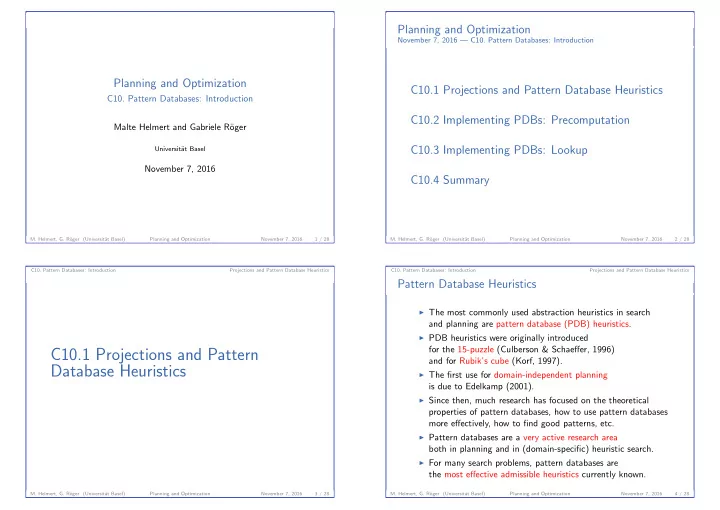
Planning and Optimization November 7, 2016 C10. Pattern Databases: Introduction Planning and Optimization C10.1 Projections and Pattern Database Heuristics C10. Pattern Databases: Introduction C10.2 Implementing PDBs: Precomputation Malte


slide-1
SLIDE 1

Planning and Optimization

  • C10. Pattern Databases: Introduction

Malte Helmert and Gabriele R¨

  • ger

Universit¨ at Basel

November 7, 2016

  • M. Helmert, G. R¨
  • ger (Universit¨

at Basel) Planning and Optimization November 7, 2016 1 / 28

Planning and Optimization

November 7, 2016 — C10. Pattern Databases: Introduction

C10.1 Projections and Pattern Database Heuristics C10.2 Implementing PDBs: Precomputation C10.3 Implementing PDBs: Lookup C10.4 Summary

  • M. Helmert, G. R¨
  • ger (Universit¨

at Basel) Planning and Optimization November 7, 2016 2 / 28

  • C10. Pattern Databases: Introduction

Projections and Pattern Database Heuristics

C10.1 Projections and Pattern Database Heuristics

  • M. Helmert, G. R¨
  • ger (Universit¨

at Basel) Planning and Optimization November 7, 2016 3 / 28

  • C10. Pattern Databases: Introduction

Projections and Pattern Database Heuristics

Pattern Database Heuristics

◮ The most commonly used abstraction heuristics in search

and planning are pattern database (PDB) heuristics.

◮ PDB heuristics were originally introduced

for the 15-puzzle (Culberson & Schaeffer, 1996) and for Rubik’s cube (Korf, 1997).

◮ The first use for domain-independent planning

is due to Edelkamp (2001).

◮ Since then, much research has focused on the theoretical

properties of pattern databases, how to use pattern databases more effectively, how to find good patterns, etc.

◮ Pattern databases are a very active research area

both in planning and in (domain-specific) heuristic search.

◮ For many search problems, pattern databases are

the most effective admissible heuristics currently known.

  • M. Helmert, G. R¨
  • ger (Universit¨

at Basel) Planning and Optimization November 7, 2016 4 / 28

slide-2
SLIDE 2
  • C10. Pattern Databases: Introduction

Projections and Pattern Database Heuristics

Pattern Database Heuristics Informally

Pattern Databases: Informally A pattern database heuristic for a planning task is an abstraction heuristic where

◮ some aspects of the task are represented in the abstraction

with perfect precision, while

◮ all other aspects of the task are not represented at all.

Example (15-Puzzle)

◮ Choose a subset T of tiles (the pattern). ◮ Faithfully represent the locations of T in the abstraction. ◮ Assume that all other tiles and the blank can be anywhere

in the abstraction.

  • M. Helmert, G. R¨
  • ger (Universit¨

at Basel) Planning and Optimization November 7, 2016 5 / 28

  • C10. Pattern Databases: Introduction

Projections and Pattern Database Heuristics

Projections

Formally, pattern database heuristics are abstraction heuristics induced by a particular class of abstractions called projections. Definition (Projection) Let Π be an FDR planning task with variables V and states S. Let P ⊆ V , and let S′ be the set of states over P. The projection πP : S → S′ is defined as πP(s) := s|P (with s|P(v) := s(v) for all v ∈ P). We call P the pattern of the projection πP. In other words, πP maps two states s1 and s2 to the same abstract state iff they agree on all variables in P.

  • M. Helmert, G. R¨
  • ger (Universit¨

at Basel) Planning and Optimization November 7, 2016 6 / 28

  • C10. Pattern Databases: Introduction

Projections and Pattern Database Heuristics

Pattern Database Heuristics

Abstraction heuristics for projections are called pattern database (PDB) heuristics. Definition (Pattern Database Heuristic) The abstraction heuristic induced by πP is called a pattern database heuristic or PDB heuristic. We write hP as a shorthand for hπP. Why are they called pattern database heuristics?

◮ Heuristic values for PDB heuristics are traditionally stored in a

1-dimensional table (array) called a pattern database (PDB). Hence the name “PDB heuristic”.

  • M. Helmert, G. R¨
  • ger (Universit¨

at Basel) Planning and Optimization November 7, 2016 7 / 28

  • C10. Pattern Databases: Introduction

Projections and Pattern Database Heuristics

Example: Transition System

LRR LLL LLR LRL ALR ALL BLL BRL ARL ARR BRR BLR RRR RRL RLR RLL

Logistics problem with one package, two trucks, two locations:

◮ state variable package: {L, R, A, B} ◮ state variable truck A: {L, R} ◮ state variable truck B: {L, R}

  • M. Helmert, G. R¨
  • ger (Universit¨

at Basel) Planning and Optimization November 7, 2016 8 / 28

slide-3
SLIDE 3
  • C10. Pattern Databases: Introduction

Projections and Pattern Database Heuristics

Example: Projection (1)

Abstraction induced by π{package}:

LRR LLL LLR LRL

LRR LLR LRL LLL

ALR ARL ALL ARR

ALR ARL ARR ALL

BLL BRL BRR BLR

BLL BRR BLR BRL

RRR RRL RLR RLL

RLL RRL RLR RRR h{package}(LRR) = 2

  • M. Helmert, G. R¨
  • ger (Universit¨

at Basel) Planning and Optimization November 7, 2016 9 / 28

  • C10. Pattern Databases: Introduction

Projections and Pattern Database Heuristics

Example: Projection (2)

Abstraction induced by π{package,truck A}:

LRR LRL

LRR LRL

LLL LLR

LLR LLL

ALR ALL

ALR ALL

ARL ARR

ARL ARR

BRR BLL BLR BRL

BLL BLR BRL BRR

RRR RRL

RRL RRR

RLR RLL

RLL RLR h{package,truck A}(LRR) = 2

  • M. Helmert, G. R¨
  • ger (Universit¨

at Basel) Planning and Optimization November 7, 2016 10 / 28

  • C10. Pattern Databases: Introduction

Projections and Pattern Database Heuristics

Pattern Databases: Chapter Overview

In the following, we will discuss:

◮ how to implement PDB heuristics

this chapter

◮ how to effectively make use of multiple PDB heuristics

Chapter C11

◮ how to find good patterns for PDB heuristics

Chapter C12

  • M. Helmert, G. R¨
  • ger (Universit¨

at Basel) Planning and Optimization November 7, 2016 11 / 28

  • C10. Pattern Databases: Introduction

Implementing PDBs: Precomputation

C10.2 Implementing PDBs: Precomputation

  • M. Helmert, G. R¨
  • ger (Universit¨

at Basel) Planning and Optimization November 7, 2016 12 / 28

slide-4
SLIDE 4
  • C10. Pattern Databases: Introduction

Implementing PDBs: Precomputation

Pattern Database Implementation

Assume we are given a pattern P for a planning task Π. How do we implement hP?

1 In a precomputation step, we compute a graph representation

for the abstraction T (Π)πP and compute the abstract goal distance for each abstract state.

2 During search, we use the precomputed abstract goal

distances in a lookup step.

  • M. Helmert, G. R¨
  • ger (Universit¨

at Basel) Planning and Optimization November 7, 2016 13 / 28

  • C10. Pattern Databases: Introduction

Implementing PDBs: Precomputation

Precomputation Step

Let Π be a planning task and P a pattern. Let T = T (Π) and T ′ = T πP.

◮ We want to compute a graph representation of T ′. ◮ T ′ is defined through an abstraction of T .

◮ For example, each concrete transition induces

an abstract transition.

◮ However, we cannot compute T ′ by iterating

  • ver all transitions of T .

◮ This would take time Ω(T ). ◮ This is prohibitively long (or else we could solve the task

using uniform-cost search or similar techniques).

◮ Hence, we need a way of computing T ′ in time

which is polynomial only in Π and T ′.

  • M. Helmert, G. R¨
  • ger (Universit¨

at Basel) Planning and Optimization November 7, 2016 14 / 28

  • C10. Pattern Databases: Introduction

Implementing PDBs: Precomputation

Syntactic Projections

Definition (Syntactic Projection) Let Π = V , I, O, γ be an FDR planning task, and let P ⊆ V be a subset of its variables. The syntactic projection Π|P of Π to P is the FDR planning task P, I|P, {o|P | o ∈ O}, γ|P, where

◮ ϕ|P for formula ϕ is defined as the formula obtained from ϕ

by replacing all atoms (v = d) with v / ∈ P by ⊤, and

◮ o|P for operator o is defined by replacing all formulas ϕ

  • ccurring in the precondition or effect conditions of o with

ϕ|P and all atomic effects (v := d) with v / ∈ P with the empty effect ⊤. Put simply, Π|P throws away all information not pertaining to variables in P.

  • M. Helmert, G. R¨
  • ger (Universit¨

at Basel) Planning and Optimization November 7, 2016 15 / 28

  • C10. Pattern Databases: Introduction

Implementing PDBs: Precomputation

Trivially Inapplicable Operators

Definition (Trivially Inapplicable Operator) An operator o of a SAS+ task is called trivially inapplicable if

◮ pre(o) contains the atoms (v = d) and (v = d′)

for some variable v and values d = d′, or

◮ eff(o) contains the effects (v := d) and (v := d′)

for some variable v and values d = d′. Notes:

◮ Trivially inapplicable operators are never applicable

and can thus be safely omitted from the task.

◮ Trivially inapplicable operators can be detected in linear time.

  • M. Helmert, G. R¨
  • ger (Universit¨

at Basel) Planning and Optimization November 7, 2016 16 / 28

slide-5
SLIDE 5
  • C10. Pattern Databases: Introduction

Implementing PDBs: Precomputation

Trivially Unsolvable SAS+ Tasks

Definition (Trivially Unsolvable) A SAS+ task Π = V , I, O, γ is called trivially unsolvable if γ contains the atoms (v = d) and (v = d′) for some variable v and values d = d′. Notes:

◮ Trivially unsolvable SAS+ tasks have no goal states

and are hence unsolvable.

◮ Trivially unsolvable SAS+ tasks can be detected in linear time.

  • M. Helmert, G. R¨
  • ger (Universit¨

at Basel) Planning and Optimization November 7, 2016 17 / 28

  • C10. Pattern Databases: Introduction

Implementing PDBs: Precomputation

Equivalence Theorem for Syntactic Projections

Theorem (Syntactic Projections vs. Projections) Let Π be a SAS+ task that is not trivially unsolvable and has no trivially inapplicable operators, and let P be a pattern for Π. Then T (Π|P) G ∼ T (Π)πP. Proof. exercises

  • M. Helmert, G. R¨
  • ger (Universit¨

at Basel) Planning and Optimization November 7, 2016 18 / 28

  • C10. Pattern Databases: Introduction

Implementing PDBs: Precomputation

PDB Computation

Using the equivalence theorem, we can compute pattern databases for (not trivially unsolvable) SAS+ tasks Π and patterns P: Computing Pattern Databases def compute-PDB(Π, P): Remove trivially inapplicable operators from Π. Compute Π′ := Π|P. Compute T ′ := T (Π′). Perform a backward uniform-cost search from the goal states of T ′ to compute all abstract goal distances. PDB := a table containing all goal distances in T ′ return PDB The algorithm runs in polynomial time and space in terms of Π + |PDB|.

  • M. Helmert, G. R¨
  • ger (Universit¨

at Basel) Planning and Optimization November 7, 2016 19 / 28

  • C10. Pattern Databases: Introduction

Implementing PDBs: Precomputation

Generalizations of the Equivalence Theorem

◮ The restrictions to SAS+ tasks and to tasks

without trivially inapplicable operators are necessary.

◮ We can slightly generalize the result if we allow general

negation-free formulas, but still forbid conditional effects.

◮ In that case, the weighted graph of T (Π)πP is isomorphic

to a subgraph of the weighted graph of T (Π|P).

◮ This means that we can use T (Π|P) to derive

an admissible estimate of hP.

◮ With conditional effects, not even this weaker result holds.

  • M. Helmert, G. R¨
  • ger (Universit¨

at Basel) Planning and Optimization November 7, 2016 20 / 28

slide-6
SLIDE 6
  • C10. Pattern Databases: Introduction

Implementing PDBs: Precomputation

Going Beyond SAS+ Tasks

◮ Most practical implementations of PDB heuristics

are limited to SAS+ tasks (or modest generalizations).

◮ One way to avoid the issues with general FDR tasks

is to convert them to equivalent SAS+ tasks.

◮ However, most direct conversions can exponentially increase

the task size in the worst case. We will only consider SAS+ tasks in the chapters dealing with pattern databases.

  • M. Helmert, G. R¨
  • ger (Universit¨

at Basel) Planning and Optimization November 7, 2016 21 / 28

  • C10. Pattern Databases: Introduction

Implementing PDBs: Lookup

C10.3 Implementing PDBs: Lookup

  • M. Helmert, G. R¨
  • ger (Universit¨

at Basel) Planning and Optimization November 7, 2016 22 / 28

  • C10. Pattern Databases: Introduction

Implementing PDBs: Lookup

Lookup Step: Overview

◮ During search, the PDB is the only piece of information

necessary to represent hP. (It is not necessary to store the abstract transition system itself at this point.)

◮ Hence, the space requirements for PDBs during search

are linear in the number of abstract states S′: there is one table entry for each abstract state.

◮ During search, hP(s) is computed by mapping

πP(s) to a natural number in the range {0, . . . , |S′| − 1} using a perfect hash function, then looking up the table entry for this number.

  • M. Helmert, G. R¨
  • ger (Universit¨

at Basel) Planning and Optimization November 7, 2016 23 / 28

  • C10. Pattern Databases: Introduction

Implementing PDBs: Lookup

Lookup Step: Algorithm

Let P = {v1, . . . , vk} be the pattern.

◮ We assume that all variable domains are natural numbers

counted from 0, i.e., dom(v) = {0, 1, . . . , |dom(v)| − 1}.

◮ For all i ∈ {1, . . . , k}, we precompute Ni := i−1 j=1 |dom(vj)|.

Then we can look up heuristic values as follows: Computing Pattern Database Heuristics def PDB-heuristic(s): index := k

i=1 Nis(vi)

return PDB[index]

◮ This is a very fast operation: it can be performed in O(k). ◮ For comparison, most relaxation heuristics need time O(Π)

per state.

  • M. Helmert, G. R¨
  • ger (Universit¨

at Basel) Planning and Optimization November 7, 2016 24 / 28

slide-7
SLIDE 7
  • C10. Pattern Databases: Introduction

Implementing PDBs: Lookup

Lookup Step: Example (1)

Abstraction induced by π{package,truck A}:

LRR LRL

LRR LRL

LLL LLR

LLR LLL

ALR ALL

ALR ALL

ARL ARR

ARL ARR

BRR BLL BLR BRL

BLL BLR BRL BRR

RRR RRL

RRL RRR

RLR RLL

RLL RLR

  • M. Helmert, G. R¨
  • ger (Universit¨

at Basel) Planning and Optimization November 7, 2016 25 / 28

  • C10. Pattern Databases: Introduction

Implementing PDBs: Lookup

Lookup Step: Example (2)

◮ P = {v1, v2} with v1 = package, v2 = truck A. ◮ dom(v1) = {L, R, A, B} ≈ {0, 1, 2, 3} ◮ dom(v2) = {L, R} ≈ {0, 1}

N1 = 0

j=1 |dom(vj)| = 1, N2 = 1 j=1 |dom(vj)| = 4

index(s) = 1 · s(package) + 4 · s(truck A) Pattern database: abstract state LL RL AL BL LR RR AR BR index 1 2 3 4 5 6 7 value 2 2 1 2 1 1

  • M. Helmert, G. R¨
  • ger (Universit¨

at Basel) Planning and Optimization November 7, 2016 26 / 28

  • C10. Pattern Databases: Introduction

Summary

C10.4 Summary

  • M. Helmert, G. R¨
  • ger (Universit¨

at Basel) Planning and Optimization November 7, 2016 27 / 28

  • C10. Pattern Databases: Introduction

Summary

Summary

◮ Pattern database (PDB) heuristics are abstraction heuristics

based on projection to a subset of variables.

◮ For SAS+ tasks, they can easily be implemented

via syntactic projections of the task representation.

◮ PDBs are lookup tables that store heuristic values,

indexed by perfect hash values for projected states.

◮ PDB values can be looked up very fast,

in time O(k) for a projection to k variables.

  • M. Helmert, G. R¨
  • ger (Universit¨

at Basel) Planning and Optimization November 7, 2016 28 / 28