Future changes of nutrient dynamics and biological productivity in - - PowerPoint PPT Presentation

future changes of nutrient dynamics and biological
SMART_READER_LITE
LIVE PREVIEW

Future changes of nutrient dynamics and biological productivity in - - PowerPoint PPT Presentation

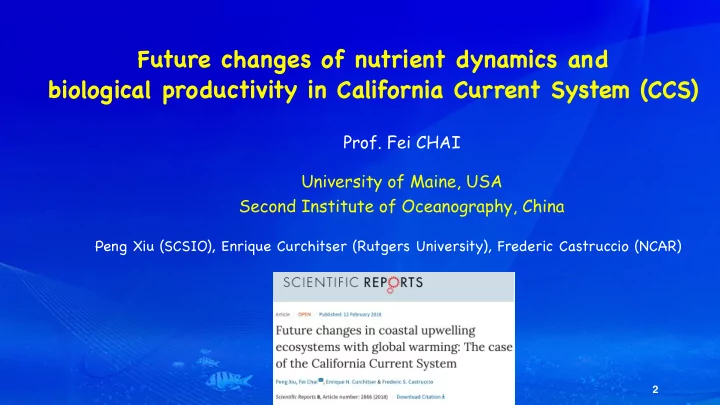
Future changes of nutrient dynamics and biological productivity in California Current System (CCS) Prof. Fei CHAI University of Maine, USA Second Institute of Oceanography, China Peng Xiu (SCSIO), Enrique Curchitser (Rutgers University),


slide-1
SLIDE 1

Future changes of nutrient dynamics and biological productivity in California Current System (CCS)

  • Prof. Fei CHAI

University of Maine, USA Second Institute of Oceanography, China

Peng Xiu (SCSIO), Enrique Curchitser (Rutgers University), Frederic Castruccio (NCAR)

2

slide-2
SLIDE 2

Outline

3

Motivation - global vs. regional approach for understanding the ocean Physical-biological modeling for the Pacific Ocean (ROMS-CoSiNE) Future projections for CCS based on GFDL/ESM connecting with ROMS-CoSiNE Controlling factors for increasing nutrients and biological productivity in CCS Summary

slide-3
SLIDE 3

4

slide-4
SLIDE 4

4

slide-5
SLIDE 5

5

IPCC Reports and Earth System Models

slide-6
SLIDE 6

5

IPCC Reports and Earth System Models

slide-7
SLIDE 7

5

IPCC Reports and Earth System Models

slide-8
SLIDE 8

www.gfdl.noaa.gov

slide-9
SLIDE 9

Outline

8

Motivation - global vs. regional approach for understanding the ocean Physical-biological modeling for the Pacific Ocean (ROMS-CoSiNE) Future projections for CCS based on GFDL/ESM connecting with ROMS-CoSiNE Controlling factors for increasing nutrients and biological productivity in CCS Summary

slide-10
SLIDE 10

Regional Ocean Model System (ROMS) (7-12km)

(Chai et al., 2002, 2003, 2007, 2009; Fujii and Chai, 2007; Liu and Chai, 2009; Xiu and Chai, 2011, Palacz et al., 2011, Xu et al., 2013, Xiu and Chai, 2013, 2014, Guo et al., 2014 and 2015; Hsu et al., 2016; Zhang et al, 2017; Xiu and Chai et al., 2018) Carbon, Silicate, Nitrogen Ecosystem Model (CoSiNE)

9

Sear Surface Temperature (SST) (color) Sea Surface Height (SSH) (elevation)

slide-11
SLIDE 11

➢ The dominant factors controlling the temporal variability of carbon cycle? (seasonal, interannual, decadel)

Global Carbon Cycle

pCO2sea

2.6±0.8 GtC/yr (25% of the total anothropogenic CO2 emissions)

4.3±0.1 GtC/yr (45% of the total anothropogenic CO2 emissions)

slide-12
SLIDE 12

Year

Sea Surface pCO2

1970 2010

Anthropogenic trend is 1-2 ppm/year

Seasonal cycle is largest

Xiu & Chai, JGR-Oceans, 2014

slide-13
SLIDE 13

Sea-to-Air CO2 flux

SEATS: -0.14 g C m-2 yr-1 MB: 4.6 g C m-2 yr-1 HOT: -5 g C m-2 yr-1 Integrated North PACIFIC (ocean sink):

  • 0.57 Pg C yr-1

R=0.72 SEATS HOT

Observed

Modeled

Xiu & Chai, JGR-Oceans, 2014

slide-14
SLIDE 14

PDO

Sea-to-Air CO2 flux

Normal Run

57% 17.5% 1st 2nd

PDO, MEI, NGPO

1st

Correlation/Lags PC1 normal run (57% variance) PC2 normal run (18% variance) P (3

PDO 0.77/0 0.62/12 0. MEI 0.53/0 0.59/15 0. NPGO

  • 0.51/15

Interannual and decadal variability

Xiu & Chai, JGR-Oceans, 2014

slide-15
SLIDE 15

Model resolution matters!

Fiechter, Chai, Curchister, et al., GBC, 2014

Sea-to-Air CO2 flux ROMS-Biogeochemistry modeling for CCS

slide-16
SLIDE 16

SST and Chlorophyll Comparison

Guo & Chai et al. Ocean Dynamics, 2014 Line 67

15

ROMS- CoSiNE Model SST Observed SST ROMS- CoSiNE Model Chl-a SeaWiFS Chl-a

slide-17
SLIDE 17

Temperature, NO3, SiO4, and Chla (along Line 67)

Taylor diagrams of simulated seasonal cycle of temperature (Temp), nitrate (NO ), silicate (SiO ) and chlorophyll (Chla) from station 67-55 to station 67-70 (a)

0-150km near M2 Off-Shore 150-1000km

Guo & Chai et al. Ocean Dynamics, 2014 Temp Chla NO3 SiO4

16

slide-18
SLIDE 18

Seasonal cycles of variables in the 0-150 km domain

Surface Si(OH)4 Si(OH)4 at 60 m

Surface Chla

Integrated PP

17

Guo & Chai et al., 2014 Ocean Dynamics, 2014

slide-19
SLIDE 19

18

Interannual variation (1993-2016) in the 0-150 km domain

Along shore wind (equatorward +) Vertical velocity at 60m depth

Modeled sea surface temperature

weaker stronger

Guo & Chai et al., in prep. Ocean Dynamics, 2014

slide-20
SLIDE 20

19

Interannual variation (1993-2016) in the 0-150 km domain

NO3 at 60m depth

Vertical NO3 flux at 60m depth

Depth integrated Chla

higher concentration lower concentration less chla more chla

Guo & Chai et al., in prep. Ocean Dynamics, 2014

slide-21
SLIDE 21

Outline

20

Motivation - global vs. regional approach for understanding the ocean Physical-biological modeling for the Pacific Ocean (ROMS-CoSiNE) Future projections for CCS based on GFDL/ESM connecting with ROMS-CoSiNE Controlling factors for increasing nutrients and biological productivity in CCS Summary

slide-22
SLIDE 22

1860 - 1900 2081 - 2120

Difference = (2081/2120) - (1860/1900) Temperature (0-200m) NO3 (0-200m) Primary Production

Rykaczewski and Dunne GRL, 2010

Based on GFDL Global ESM

slide-23
SLIDE 23

1860 - 1900 2081 - 2120

Difference = (2081/2120) - (1860/1900) Temperature (0-200m) NO3 (0-200m) Primary Production

Rykaczewski and Dunne GRL, 2010

Based on GFDL Global ESM

slide-24
SLIDE 24

GFDL-ESM ROMS-CoSiNE One-way downscaling

Downscaling from Global to Regional Models

100km 7km resolution resolution

slide-25
SLIDE 25

Comparing two periods (20 years)

Forced with RCP 8.5 from GFDL-ESM2M

1990-2009 vs. 2030-2049

Difference = AVG(2030-2049) – AVG(1990-2009)

Temperature Comparison in CCS

1990-2009 2030-2049

Xiu, Chai et al., 2018

slide-26
SLIDE 26

Modeled and Satellite Chlorophyll Comparison

Modeled

MODIS

Xiu, Chai et al., 2018

slide-27
SLIDE 27

Comparison of Temperature and Stratification Difference = (2030-2049) - (1990-2009)

SST Increase

Stratification (N2) Enhanced

Xiu, Chai et al., 2018

slide-28
SLIDE 28

Comparison of Nutrients and Primary Production Difference = (2030-2049) - (1990-2009)

NO3 Increase warm colors SiO4 Increase more warm colors Decrease Decrease warming more SST Increase Primary Production Increase Decrease

Xiu, Chai et al., 2018

slide-29
SLIDE 29

Comparison of Nutricline Depth (NO3 and SiO4) Difference = (2030-2049) - (1990-2009)

NO3 Nutricline SiO4 Nutricline

Nutricline become shallower in most areas, more so for silicate than nitrate. Offshore region in the north, nutricline deepens.

Xiu, Chai et al., 2018

slide-30
SLIDE 30

Nitrate Changes

slide-31
SLIDE 31

More Si than N

Open Ocean and Coastal Upwelling - Nutrients Connections

Courtesy of Ryan Rykaczewski USC California California Our study indicates there will be more silicate upwelled than nitrate in CCS due to difference

  • f Si and N cycling

in the open ocean.

Silicate pump model, Dugdale and Wilkerson, 1998

slide-32
SLIDE 32

Plankton Biomass Comparions: (2030-49) - (1990-09)

Small Phyto. Diatoms

Microzoo Mesozoo

Mesozoo increase more near-shore

Change in

  • pposite direction

Microzoo increase more

  • ff-shore

Integrated (0-200m)

slide-33
SLIDE 33

Modeled Plankton at surface (based 3km ROMS-CoSiNE) Small Phyto Diatom Micro-Zoo Meso-Zoo

1 October 2013

slide-34
SLIDE 34

Coastal upwelling favorable wind and wind stress curl offshore

Land-ocean thermal contrast generarte wind stress curl offshore

slide-35
SLIDE 35

positive

Along shore wind

1990-09

Wind stress curl

1990-09

DIFF = (2039-49)- (1990-09) DIFF = (2039-49)- (1990-09) Increase near coast more upwelling Decrease

  • ffshore

less upwelling Increase in the north

  • f CCS

more upwelling

slide-36
SLIDE 36

Future climate change impact on upwelling systems

Bakun Hypothesis Poleward migration

  • f pressure systems

Enhancement of land-ocean thermal contrast along the coast Bakun et al., 2015

slide-37
SLIDE 37

% = [AVG(2030-49) – AVG(1990-09)] /AVG(1990-09)

Vertical Nutrient Flux Calculations

change (%) W NO3 SIO4 100 m 5.6% 9.9% 24% 200 m 21.3% 5.7% 18.8% 300 m

  • 4.0%

2.9% 14.8%

Changes of Vertical Velocity (W) and NO3 and SiO4 in region 2 and 3, during April-July

2 3

slide-38
SLIDE 38

Annual Mean NO3 Flux (0-200m) (kmol/s)

2.95 2.33 1.47 2.00 1.36 0.92

1990-2009

  • 0.01 0.30

Upwelling

0.25 0.26

Mixing

Net NO3 to Region 2 & 3: Difference = 1 (4.14 - 3.13)

Rykaczewski and Dunne GRL, 2010

2030-2049

slide-39
SLIDE 39

Increasing EKE in the central

  • ffshore potentially enhancing

upper water nutrients

Eddy Kinetic Energy (EKE) Difference = (2030-49) - (1990-09)

slide-40
SLIDE 40
  • Higher resolution coastal model yield

more regional difference

  • Increasing along-shore wind lead to

stronger upwelling; upwelled nutrient (Si/N) concentration increase

  • New and primary production increase

because more nutrients (Si/N) to CCS

  • Diatoms and meso-zooplankton

increase more near shore, due to more Si

  • EKE also increased in offshore

region, enhance nutrient supply

slide-41
SLIDE 41

Summary

39

Motivation - global vs. regional approach for understanding the ocean

Physical-biological modeling for the Pacific Ocean (ROMS-CoSiNE)

Future projections for CCS based on GFDL/ESM connecting with ROMS-CoSiNE

Controlling factors for increasing nutrients and biological productivity in CCS

Model resolution matters! Global models are improving, but still need regional modeling Studying physical-biological coupling in coastal regions and eddy dynamics Downscaling and upscaling are needed to connect open ocean and coastal seas