Slide 1 / 68
C Townsend D Plank E Compton Slide 2 / 68 2 The electron - - PowerPoint PPT Presentation
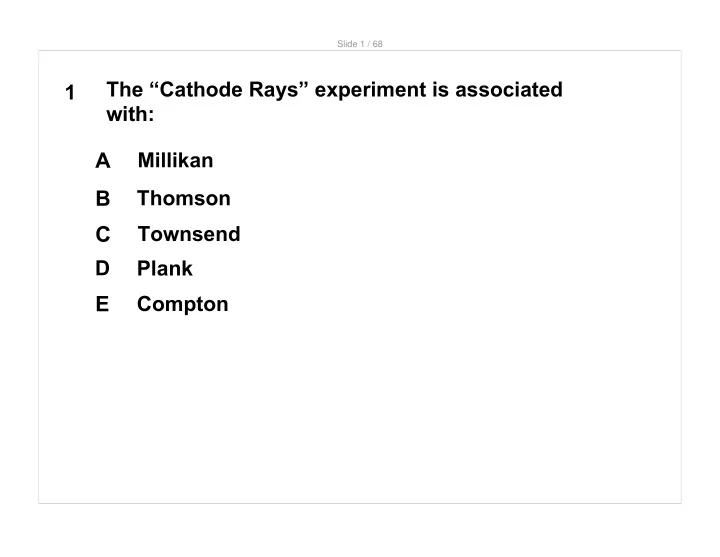
Slide 1 / 68 The Cathode Rays experiment is associated 1 with: A Millikan B Thomson C Townsend D Plank E Compton Slide 2 / 68 2 The electron charge was measured the first time in: A Cathode ray experiment B Photoelectric
Slide 2 / 68
2 The electron charge was measured the first time in: A Cathode ray experiment B Photoelectric effect experiment C Oil drop experiment D Diffraction electrons from aluminum foil E Compton effect experiment
Slide 3 / 68
3 Which of the following colors associated with the lowest temperature? A Violet B Blue C Green D Yellow E Red
Slide 4 / 68
4 Which of the following photons has the greatest energy? A Infrared B Blue C X-Ray D γ- photon E UV – photon
Slide 5 / 68
5 The energy of a photon depends on: A Amplitude B Speed C Temperature D Pressure E Frequency
Slide 6 / 68
6 How does the energy of a photon change if the wavelength is doubled? A Doubles B Quadruples C Stays the same D Is cut to one-half E Is cut to one-fourth
Slide 7 / 68
7 How does the momentum of a photon change if the wavelength is halved? A Doubles B Quadruples C Stays the same D Is cut to one-half E Is cut to one-fourth
Slide 8 / 68
8 The photoelectric effect explains : A The wave nature of light B The particle nature of light C The wave properties of an electron D The particle properties of an electron E The atomic structure
Slide 9 / 68
9 The kinetic energy of photo-electrons depends on: A Speed of light B Angle of illumination C Intensity of light D Wavelength E None of the above
Slide 10 / 68
10 Which of the following is the formula of the photon mass? A m = h/cλ B m = cλ/h C m = h/f D m = f/h E m = Ec2
Slide 11 / 68
11 The maximum kinetic energy of photo-electrons depends on which of the following:
- I. The light intensity
- II. The frequency of the light
- III. The nature of the photo-cell
A Only I B Only II C Only III D Only I and II E Only II and III
Slide 12 / 68
12 Which of the following formulas explains the photo-electric effect? A hλ = W0 + KE B hf = W0 - KE C hf = W0 + KE D hλ = -W0 + KE E hc/λ = W0 - KE
Slide 13 / 68
13 Which of the following graphs is a correct relationship between the maximum kinetic energy
- f photo-electrons and the frequency of the
incident light? A B C D E
Slide 14 / 68
14 Which of the following graphs is a correct relationship between the maximum kinetic energy
- f photo-electrons and the intensity of the
incident light? A B C D E I
I I I I
Slide 15 / 68
15 Which of the following graphs is a correct relationship between the de Broglie wavelength and the linear momentum of a particle? A B C D E
Slide 16 / 68
16 All of the following are properties of γ rays EXCEPT: A They discharge electrified objects B They ionize gases C They are deflected by magnetic fields D They penetrate light objects E They are diffracted by crystals
Slide 17 / 68
17 Which of the following phenomena provides the best evidence that light can have particle properties? A Diffraction of light B Electromagnetic radiation C Compton effect D Electron diffraction E γ-ray diffraction
Slide 18 / 68
18 Which of the following phenomena provides the best evidence that particles can have wave properties? A The absorption of photons by electrons in an atom B The alpha-decay of radioactive nuclei C The interference pattern produced by neutrons incident on a crystal D The production of x-rays by electrons striking a metal target E The scattering of photons by electrons at rest
Slide 19 / 68
19 Which of the following formulas can be used to determine the de Broglie wavelength? A λ = hmv B λ = h/mv C λ = mv/h D λ = hm/c E λ = mc/h
Slide 20 / 68
20 A photon can disappear producing an electron and positron, this phenomenon is called? A Interference of light B Diffraction of X-Rays C Pair production D Scattering of electrons E Annihilation
Slide 21 / 68
21 When a positron collides with an electron they disappear producing photons, this phenomenon is called? A Interference of light B Diffraction of X-Rays C Pair production D Scattering of electrons E Annihilation
Slide 22 / 68
22 The following statement: “In order to understand a given experiment, we must use either the wave or the photon theory, but not both” is called? A Wave theory of light B Particle theory of light C Planetary theory of an atom D Principle of complementarity E Wave theory of matter
Slide 23 / 68
23 Electrons are accelerated to a maximum speed of v in an X-Ray tube by an applied voltage V0. What is the maximum speed of the electrons if the voltage is quadrupled? A 4v B 2v C D E v/4
Slide 24 / 68
24 In a Compton Effect experiment a photon scattered from an electron at rest increases its wavelength from λi to λf. Which of the following deflecting angles ϴ gives the greatest raise in the wavelength
- f the scattered?
A 0 ̊ B 30 ̊ C 60 ̊ D 90 ̊ E 180 ̊
Slide 25 / 68
25 Which one of the following objects moving at the same speed is associated with a greatest wavelength? A Neutron B Electron C Tennis ball D Bowling ball E α- Particle
Slide 26 / 68
26 According to the Bohr model of the atom, the angular momentum of an electron is: A Linearly increases with increasing electron’s velocity B Linearly increases with increasing orbital radius C Quantized D Inversely proportional to the electron’s velocity E Inversely proportional to the orbital radius
Slide 27 / 68
27 Rutherford’s experiment “Scattering α–particles by a gold foil” was conducted to prove which of the following: A Plum-pudding model of the atom B Planetary model of the atom C De Broglie hypothesis D Wave nature of light E Quantum theory of light
Slide 28 / 68
28 In Rutherford’s Experiment “Scattering α – particles by a gold foil” the biggest part of α – particles could pass through the foil undeflected. Which of the following properties of the atom can be explained from this observation? A The positive charge is concentrated in the nucleus B The nucleus has electrons and protons C The atomic mass is concentrated in the nucleus D The α – particles couldn’t be deflected by electrons E The size of the nucleus is much less than the size of the atom
Slide 29 / 68
29 Which of the following statement(s) can be associated with Bohr’s theory of the atom?
- I. An electron orbiting the nucleus can change its energy
continuously
- II. An electron orbiting the nucleus emits energy and falls
- n the nucleus
- III. An electron orbits the nucleus without radiating energy
and can change its energy only by a certain portion when it jumps between the orbits
- IV. The angular momentum of an electron around the
nucleus is equal an integer times h/2π
A I and II B II and IV C II and III D III and IV E I, II, III and IV
Slide 30 / 68
30 When an electron falls from an orbit where n = 2 to n = 1: A A photon is emitted B A photon is absorbed C No change in atomic energy D Atomic energy decreases to zero E Atomic energy increases
Slide 31 / 68
31 When an electron jumps from an orbit where n = 1 to n = 3 its orbital radius in terms of the smallest radius r1 is: A
r1/9 B r1/3
C
2 r1
D
3 r1 E 9 r1
Slide 32 / 68
32 When an electron jumps from an orbit where n = 1 to n = 4 its energy in terms of the energy on the ground level is: A E1/9 B E1/16 C 2 E1 D 4 E1 E 16 E1
Slide 33 / 68
33 An electron is moving around a single proton in an
- rbit characterized by n = 5. How many of the
electron's de Broglie wavelengths fit into the circumference of this orbit? A 3 B 4 C 5 D 16 E 25
Slide 34 / 68
34 In a cathode ray tube an electron is accelerated by an electric field. When the applied voltage is 600 V the electron’s De Broglie wavelength is λ. What is the De Broglie wavelength of the accelerated electron through a potential difference of 150 V? A λ B 2 λ C λ /2 D λ /4 E 4 λ
Slide 35 / 68
35 According to Maxwell’s theory of electro- magnetism an electron orbiting the atomic nucleus: A Changes its energy by certain portions B Conserves its angular momentum C Conserves its energy D Radiates its energy and falls on the nucleus E Changes its angular momentum by certain portions
Slide 36 / 68
36 A hypothetical atom has the energy levels presented by the graph. An electron is excited from the ground state to the energy level -1 eV. The following are the energies of the emitted photons EXCEPT: A 9 eV B 4 eV C 6 eV D 2 eV E 10 eV
Slide 37 / 68
37 A hypothetical atom has energy levels presents by the graph. A container with the hypothetical gas is irradiated with electro-magnetic radiation with the energy range from 4 eV to 9 eV. The following sequence of the photons can be found in the emission spectrum. A 1 eV, 2 eV, and 6 eV only B 2 eV, 3 eV, and 4 eV only C 1 eV, 3 eV, and 5 eV only D 7 eV and 2 eV only E None from the above
Slide 38 / 68
38 A hypothetical atom has energy levels presents by the graph. A container with the hypothetical gas is irradiated with electro-magnetic radiation with the energy range from 4 eV to 9 eV. Which of the following transitions will produce a photon with the longest wavelength? A From n = 4 to n = 1 B From n = 4 to n = 2 C From n = 2 to n = 1 D From n = 3 to n = 1 E From n = 4 to n = 3
Slide 39 / 68
39 According to the Bohr’s theory of the hydrogen atom, electrons starting in the 4th energy level and eventually ending in the ground state could produce a total of how many lines in the hydrogen spectra? A 6 B 5 C 7 D 4 E 3
Slide 40 / 68
40 Which of the following transitions is related to the energy absorption? A α1 B α2 C α3 D α4 E α5
Slide 41 / 68
- 1. In an experiment conducted to investigate a photo-electric effect
physics students use an apparatus show on the diagram. Photo- electrons emitted as a result of incident light can be accelerated or stopped by an applied voltage. When the incident light has a wavelength
- f 3 nm the stopping voltage required to stop them is 1 V. If the incident
light has a wavelength of 2 nm the stopping voltage is 3 V. a) Calculate the Plank’s constant from the data collected in the experiment.
Slide 42 / 68
- 1. In an experiment conducted to investigate a photo-electric effect
physics students use an apparatus show on the diagram. Photo- electrons emitted as a result of incident light can be accelerated or stopped by an applied voltage. When the incident light has a wavelength
- f 3 nm the stopping voltage required to stop them is 1 V. If the incident
light has a wavelength of 2 nm the stopping voltage is 3 V. b) Calculate the work function for the photo-cell use in the experiment.
Slide 43 / 68
- 1. In an experiment conducted to investigate a photo-electric effect
physics students use an apparatus show on the diagram. Photo- electrons emitted as a result of incident light can be accelerated or stopped by an applied voltage. When the incident light has a wavelength
- f 3 nm the stopping voltage required to stop them is 1 V. If the incident
light has a wavelength of 2 nm the stopping voltage is 3 V. c) Determine the threshold frequency for this type of photo-cell.
Slide 44 / 68
- 1. In an experiment conducted to investigate a photo-electric effect
physics students use an apparatus show on the diagram. Photo- electrons emitted as a result of incident light can be accelerated or stopped by an applied voltage. When the incident light has a wavelength
- f 3 nm the stopping voltage required to stop them is 1 V. If the incident
light has a wavelength of 2 nm the stopping voltage is 3 V. d) Calculate the stopping voltage required to stop photo-electrons emitted by the cell when the incident light has a wavelength of 100 nm.
Slide 45 / 68
- 2. A group of physics students
conducts an experiment to investigate a photo-electric effect. They graphed the kinetic energy as a function of frequency of the incident light. a) Determine the Plank’s constant from the given graph.
Slide 46 / 68
- 2. A group of physics students
conducts an experiment to investigate a photo-electric effect. They graphed the kinetic energy as a function of frequency of the incident light. b) Determine the work function of the photo-cell.
Slide 47 / 68
- 2. A group of physics students
conducts an experiment to investigate a photo-electric effect. They graphed the kinetic energy as a function of frequency of the incident light. c) Determine the threshold frequency.
Slide 48 / 68
- 2. A group of physics students conducts
an experiment to investigate a photo- electric effect. They graphed the kinetic energy as a function of frequency of the incident light. In the second trial students use a photo- cell with greater work function. d) How does it change the graph? Explain.
Slide 49 / 68
- 3. An electromagnetic radiation is incident
- n a metallic surface and electrons are
emitted by the plate when the wavelength is 450 nm or less.
- a. What is the work function of the metal?
Slide 50 / 68
- 3. An electromagnetic radiation is incident
- n a metallic surface and electrons are
emitted by the plate when the wavelength is 450 nm or less.
- b. What is the maximum kinetic energy of
photo-electrons if the incident light has a wavelength of 400 nm?
Slide 51 / 68
- 3. An electromagnetic radiation is incident
- n a metallic surface and electrons are
emitted by the plate when the wavelength is 450 nm or less.
- c. What is the stopping voltage required to
stop photo-electrons ejected by the plate when the incident light has a wavelength of 300 nm?
Slide 52 / 68
- 3. An electromagnetic radiation is incident
- n a metallic surface and electrons are
emitted by the plate when the wavelength is 450 nm or less.
- d. If the stopping voltage is 5 V, what is the
wavelength of the incident light?
Slide 53 / 68
- 4. An X-Ray photon with a wavelength of λi =
0.14 nm collides with a electron at rest and bounces back.
- a. What is the wavelength of the scattered
photon?
Slide 54 / 68
- 4. An X-Ray photon with a wavelength of λi =
0.14 nm collides with a electron at rest and bounces back.
- b. What is the momentum of the recoil
electron?
Slide 55 / 68
- 4. An X-Ray photon with a wavelength of λi =
0.14 nm collides with a electron at rest and bounces back.
- c. What is the energy of the recoil electron?
Slide 56 / 68
- 4. An X-Ray photon with a wavelength of λi =
0.14 nm collides with a electron at rest and bounces back.
- d. Is the energy conserved during the
collision?
Slide 57 / 68
- 4. An X-Ray photon with a wavelength of λi =
0.14 nm collides with a electron at rest and bounces back.
- e. What is the De Broglie wave length of the
scattered electron?
Slide 58 / 68
- 5. An X-Ray tube accelerates an
electron beam between two
- electrodes. A 70,000 V potential
difference is applied across the tube.
- a. What is the speed of the
accelerated electrons?
Slide 59 / 68
- 5. An X-Ray tube accelerates an
electron beam between two
- electrodes. A 70,000 V potential
difference is applied across the tube.
- b. What is the energy of the emitted
photons?
Slide 60 / 68
- 5. An X-Ray tube accelerates an
electron beam between two
- electrodes. A 70,000 V potential
difference is applied across the tube.
- c. What is the wavelength of the
emitted photons?
Slide 61 / 68
- 5. An X-Ray tube accelerates an
electron beam between two
- electrodes. A 70,000 V potential
difference is applied across the tube.
- d. What is the mass of the emitted
photons?
Slide 62 / 68
- 5. An X-Ray tube accelerates an
electron beam between two
- electrodes. A 70,000 V potential
difference is applied across the tube.
- e. What is the momentum of the
emitted photons?
Slide 63 / 68
- 6. A free electron is captured by a proton. As a result of this process
two photons are emitted. The energy of the first photon is E1 = 3.4 eV.
- a. Calculate the wavelength of the photon with energy E1.
Slide 64 / 68
- 6. A free electron is captured by a proton. As a result of this process
two photons are emitted. The energy of the first photon is E1 = 3.4 eV.
- b. Calculate the energy of the second photon E2.
Slide 65 / 68
- 6. A free electron is captured by a proton. As a result of this process
two photons are emitted. The energy of the first photon is E1 = 3.4 eV.
- c. Calculate the wavelength of the second photon?
Slide 66 / 68
- 6. A free electron is captured by a proton. As a result of this process
two photons are emitted. The energy of the first photon is E1 = 3.4 eV.
- d. On the diagram below show arrows associated with these
transitions of the electron.
Slide 67 / 68
- 6. A free electron is captured by a proton. As a result of this process
two photons are emitted. The energy of the first photon is E1 = 3.4 eV. The electron stays on the ground level for a long limit of time and then absorbs an energy of 15 eV from an incident photon.
- e. What is the energy of the emitted electron?
Slide 68 / 68
- 6. A free electron is captured by a proton. As a result of this process
two photons are emitted. The energy of the first photon is E1 = 3.4 eV.
- f. What is the De Broglie wavelength of the emitted electron?