C-Mod via TEM Turbulence EX/2-3 by D.R. Ernst 1 with K.H. Burrell 2 - - PowerPoint PPT Presentation

c mod via tem turbulence
SMART_READER_LITE
LIVE PREVIEW

C-Mod via TEM Turbulence EX/2-3 by D.R. Ernst 1 with K.H. Burrell 2 - - PowerPoint PPT Presentation

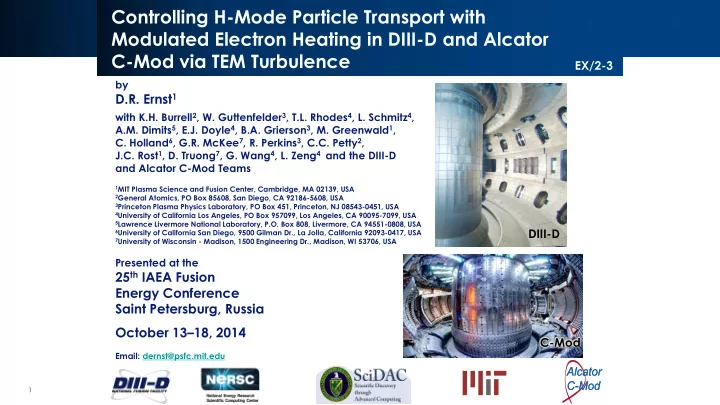
Controlling H-Mode Particle Transport with Modulated Electron Heating in DIII-D and Alcator C-Mod via TEM Turbulence EX/2-3 by D.R. Ernst 1 with K.H. Burrell 2 , W. Guttenfelder 3 , T.L. Rhodes 4 , L. Schmitz 4 , A.M. Dimits 5 , E.J. Doyle 4 ,


slide-1
SLIDE 1

1

Ernst/IAEA EX/2-3/Oct. 2014

Controlling H-Mode Particle Transport with Modulated Electron Heating in DIII-D and Alcator C-Mod via TEM Turbulence

by

D.R. Ernst1

with K.H. Burrell2, W. Guttenfelder3, T.L. Rhodes4, L. Schmitz4, A.M. Dimits5, E.J. Doyle4, B.A. Grierson3, M. Greenwald1,

  • C. Holland6, G.R. McKee7, R. Perkins3, C.C. Petty2,

J.C. Rost1, D. Truong7, G. Wang4, L. Zeng4 and the DIII-D and Alcator C-Mod Teams

1MIT Plasma Science and Fusion Center, Cambridge, MA 02139, USA 2General Atomics, PO Box 85608, San Diego, CA 92186-5608, USA 3Princeton Plasma Physics Laboratory, PO Box 451, Princeton, NJ 08543-0451, USA 4University of California Los Angeles, PO Box 957099, Los Angeles, CA 90095-7099, USA 5Lawrence Livermore National Laboratory, P.O. Box 808, Livermore, CA 94551-0808, USA 6University of California San Diego, 9500 Gilman Dr., La Jolla, California 92093-0417, USA 7University of Wisconsin - Madison, 1500 Engineering Dr., Madison, WI 53706, USA

Presented at the

25th IAEA Fusion Energy Conference Saint Petersburg, Russia October 13–18, 2014

Email: dernst@psfc.mit.edu

EX/2-3 DIII-D C-Mod

slide-2
SLIDE 2

2

Ernst/IAEA EX/2-3/Oct. 2014

Density Gradient Driven Trapped Electron Mode Turbulence Regulates H-Mode Inner Core as TeTi and at Low Torque

  • Dedicated H-Mode experiments on Alcator C-Mod and DIII-D demonstrate local

control of density peaking with strong electron heating

  • TEM is only unstable mode in H-Mode inner core with moderately peaked density

– When TeTi at low torque & collisionality (similar to burning plasmas) – Long wavelength; drives strong particle and electron heat fluxes

  • Discovered and confirmed a new nonlinear TEM threshold that increases strongly

with collisionality

  • New coherent TEMs observed and reproduced by GYRO with new synthetic

Doppler Backscattering diagnostic

  • TEM provides new mechanism for burn self-regulation:

– α-heating would flatten density profile, reducing fusion power

slide-3
SLIDE 3

3

Ernst/IAEA EX/2-3/Oct. 2014

New Nonlinear TEM Critical Density Gradient Increases Strongly with Collisionality

  • 220 nonlinear GS2 simulations find

effective nonlinear TEM critical density gradient.

[Ernst PoP (2004), IAEA (2006), APS Inv. (2012)]

  • Low collisionality limits density

gradient

  • ~2x upshift with realistic ion

temperature gradients

  • Dedicated H-Mode TEM experiments in C-Mod and DIII-D test the TEM

nonlinear upshift over an order of magnitude variation in collisionality

slide-4
SLIDE 4

4

Ernst/IAEA EX/2-3/Oct. 2014

Density Gradient Driven TEMs Produce Strong Ion-scale Density Fluctuations

  • Density gradient driven TEM is

long wavelength – Strong particle transport – Strong electron thermal transport

  • Transport and density

fluctuation spectra closely match gyrokinetic simulations with synthetic diagnostics

  • TEM is sole instability for ρ<0.5 in

all cases shown

slide-5
SLIDE 5

5

Ernst/IAEA EX/2-3/Oct. 2014

Local Core Density Fluctuations Increase Strongly with Electron Heating in Both C-Mod and DIII-D

  • New coherent modes observed on Doppler

Backscattering in DIII-D at TEM wavelengths

  • Phase contrast imaging on C-Mod

shows density fluctuations track temperature

slide-6
SLIDE 6

6

Ernst/IAEA EX/2-3/Oct. 2014

Density Profile Locally Flattened by Modulated ECH in DIII-D

  • Density is modulated by ECH
  • nly for r < 0.5, where GYRO

analysis shows TEM dominant

  • Profile reflectometer has

2-4 mm, 0.4 ms resolution

slide-7
SLIDE 7

7

Ernst/IAEA EX/2-3/Oct. 2014

Electron Heating Raises Te by ~50% in Both C-Mod and DIII-D Experiments

C-Mod EDA H-Mode DIII-D QH-Mode

slide-8
SLIDE 8

8

Ernst/IAEA EX/2-3/Oct. 2014

Increased Transport in C-Mod ITB During On-axis Heating Pulses is Consistent with GS2 Nonlinear Simulations of TEM

  • Density gradient limited by effective nonlinear TEM critical density gradient
  • Energy flux increases 5x during heating, dominated by electron energy flux
  • GS2 matches TRANSP heat flux when density gradient matches

nonlinear TEM critical density gradient

slide-9
SLIDE 9

9

Ernst/IAEA EX/2-3/Oct. 2014

In DIII-D, ECH Raises Te/Ti from 0.5 to 1.0, Destabilizing TEM; Provides Mechanism for Density Flattening with ECH

  • ECH increases TEM growth rate by

doubling Te/Ti , which halves a/Ln

crit

  • Rotation slows in pedestal with ECH,

hence in core, reducing E×B shear – Prior to ECH, shear in parallel flow doubles growth rate – Not important during ECH

Density gradient driven TEM is sole instability in inner core during ECH

slide-10
SLIDE 10

10

Ernst/IAEA EX/2-3/Oct. 2014

Nonlinear GYRO TEM Simulations Closely Match Fluxes Inferred from Transport Analysis at r=0.30 with ECH

  • Nonlinear simulations show strong

increase of transport with density gradient, consistent with TEM

  • TEM nonlinear upshift apparent

– Reduced at lower collisionality and higher q in DIII-D – GYRO shows 35%

  • Zonal flows are dominant in the

upshift regime, close to the linear threshold

slide-11
SLIDE 11

11

Ernst/IAEA EX/2-3/Oct. 2014

Shape of DBS Frequency Spectrum During ECH Reproduced by GYRO TEM Simulation with New DBS Synthetic Diagnostic

  • New synthetic DBS diagnostic reproduces DBS frequency spectrum for first time

in DIII-D

  • Uses Gaussian spread in DBS wavenumbers based on 2D full wave simulations

[J. Hillesheim et al., RSI (2010)]

  • Accurate calculation of ky

DBS = n q(ρ,θ) / rcyl(ρ,θ) in shaped geometry

slide-12
SLIDE 12

12

Ernst/IAEA EX/2-3/Oct. 2014

Local DBS Measurement Reveals Coherent Fluctuations at TEM Wavelengths, which Intensify During ECH

  • Separated in frequency by constant interval, corresponding to adjacent toroidal

mode numbers n:

  • DBS PSD response for this case: R(n) = exp [ - (n-19)2/182 ]

2πflab = ky

DBS vE = nΩtor n = …, 18, 19, 20,

slide-13
SLIDE 13

13

Ernst/IAEA EX/2-3/Oct. 2014

Nonlinear GYRO Simulations Reproduce Coherent TEM Fluctuations Seen on DBS, as Well as Spectral Decay

  • Coherent modes in GYRO correspond to resolution used, Δn = 2

– Match every second coherent mode seen on DBS (for which Δn = 1)

  • High resolution GYRO simulations in progress with Δn = 1
  • Doppler shift in GYRO increased by 20% over CER measurement, based on

interval between coherent modes (within uncertainties)

slide-14
SLIDE 14

14

Ernst/IAEA EX/2-3/Oct. 2014

Density Gradient Driven TEM Turbulence Shown to Regulate Particle and Thermal Transport in H-Mode Inner Core

  • Strong sensitivity to electron temperature allows central electron heating

to locally control density peaking.

  • New core localized, coherent fluctuations observed in DIII-D at TEM

wavelengths, when TEM is found to be sole instability – Intensify during ECH, while the density profile is locally flattened – Reproduced in GYRO nonlinear TEM simulations

  • Collisionality dependence of TEM nonlinear upshift experimentally

confirmed

  • TEM relevant when density moderately peaked, Ti ~ Te, low collisionality

– α-heating would flatten density profile, reducing fusion power (self-regulating)