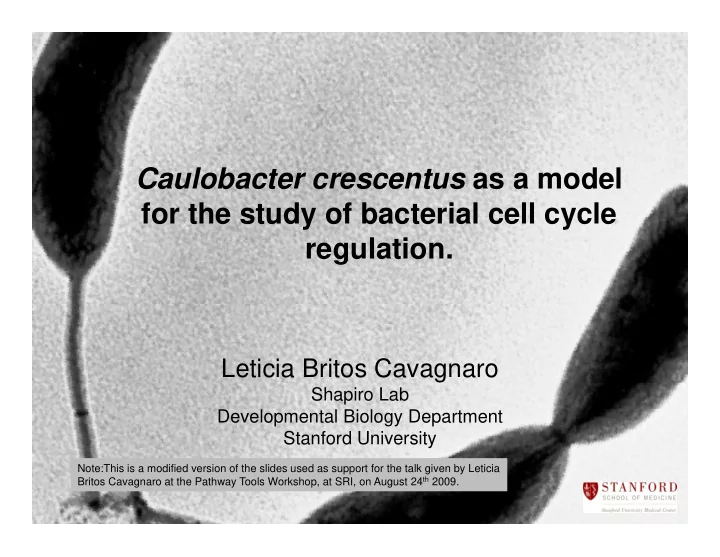
SLIDE 1 C l b t t d l Caulobacter crescentus as a model for the study of bacterial cell cycle l ti regulation.
Leticia Britos Cavagnaro
Shapiro Lab Developmental Biology Department Stanford University
Note:This is a modified version of the slides used as support for the talk given by Leticia Britos Cavagnaro at the Pathway Tools Workshop, at SRI, on August 24th 2009.
SLIDE 2
Act I
It th b t f ti it th t f ti It was the best of times, it was the worst of times…
SLIDE 3 Strategies for survival: Sporulation p
Bacillus subtilis
SLIDE 4 Strategies for survival: Fruiting bodies g
Myxococcus xanthus
SLIDE 5
Caulobacter’s strategy
swarmer cell
Caulobacter s strategy
flagellum
differentiation
stalk ~45 min
stalked cell
SLIDE 6 Advantages of Caulobacter i t l d l as experimental model
- Distinct polar structures
Distinct polar structures
SLIDE 7 mRNA levels of 14% of Caulobacter genes vary as a function of the cell cycle vary as a function of the cell cycle
Temporal variations in mRNA levels Temporal regulation
Replication Initiation
dnaA
Flagellar Biogenesis Laub et al. (2000)
SLIDE 8 Cell cycle-regulated genes can be d i f ti l d l grouped in functional modules
Pili Biogenesis Cell Division DNA methylation Flagellar Ejection Replication Initiation Stalk Synthesis Chromosome Segregation Flagellar Biogenesis Replication Inhibition
G1 S G2
SLIDE 9
Caulobacter’s cell cycle is driven by a i it f t l t circuit of master regulators
SLIDE 10
Possible arrest points upon stress or t i t d i ti nutrient deprivation
Cell division Differentiation DNA replication ep cat o and segregation
SLIDE 11
How do cells rely information about the environment to the regulatory circuit that drives the cell cycle? circuit that drives the cell cycle?
SLIDE 12
Visualization and analysis of analysis of microarrays and t i proteomics experiments
SLIDE 14
Cellular Overview
SLIDE 15
R l t Regulatory Overview
SLIDE 16
Act II
E l i C l b t ’ t i ti l l d Exploring Caulobacter’s transcriptional landscape
SLIDE 17
Caulobacter relies heavily on transcriptional p regulation
SLIDE 18 Caulobacter relies heavily on transcriptional p regulation
Cases et al. (2003)
SLIDE 19
High density transcriptional mapping of l b ’ Caulobacter’s genome
SLIDE 20 Application: Identification of transcriptional start sites transcriptional start sites
McGrath et al. (2007)
SLIDE 21 Application: Identification of small RNAs
One example
sRNA
CC3510 CC3511
Found and verified 27 novel small RNA
- Activated by starvation
- Stops the cell‐cycle
Landt et al. (2008)
RNAs
SLIDE 22 Application: operon mapping
RNA expression
(1) (2) (3)
Probes
A
expression ORFs 250bp
(1) (2) (3)
A
Probe‐probe signal cross‐correlation 3000 nt
Predicted transcript
~3000 bp 3000 bp
Eduardo Abeliuk (unpublished)
SLIDE 23 Genome Expression Browser Genome Expression Browser
- Web-based browser that shows the probe expression correlations, multiple
ORF annotations, mRNA cell cycle expression profiles, and other genomic features together on one display.
- The Genome Expression Browser can be used to visually scan an arbitrary
region of the genome, and inspect interesting correlations present among different microarray experiments or genomic features.
- Well suited for integrating data from Affy high-density tiling arrays in the
backend
- Currently contains Caulohi1 (Caulobacter) affy chip data. Other species
coming soon.
- The Genome Expression Browser is in closed beta.
- Contact: Eduardo Abeliuk (eabeliuk@stanford edu) McAdams/Shapiro Lab
- Contact: Eduardo Abeliuk (eabeliuk@stanford.edu). McAdams/Shapiro Lab.
SLIDE 24 Differential expression Absolute expression Interesting sites Gene annotation Probe‐level signal Cross‐correlation Info and profiles Eduardo Abeliuk
SLIDE 25
Act III
L ti l ti l ti Location, location, location.
SLIDE 26 Caulobacter’s cell cycle is driven by a i it f t l t circuit of master regulators
Collier et al. (2007)
SLIDE 27 The activity of the CtrA master regulator is y g controlled by proteolysis
CtrA CtrA CpdR ClpXP Cell pole Cell pole Ryan et al. (2004) Iniesta et al. (2006) Iniesta et al. (2008)
SLIDE 28 Werner et al (2009)
SLIDE 29 Werner et al (2009)
SLIDE 30 High-throughput screen for t i l li ti d t i t protein localization determinants
Beat Christen & Mike Fero (in preparation)
SLIDE 31 High-throughput screen for t i l li ti d t i t protein localization determinants
Cell Finding C ll Sh P Cell Shape Parameters Localized Fluor Signal Locations g Localized Fluor Signal Amplitudes Delocalized Fluor Signal amplitude S D t St t ( i ) Summary Data Structure (no images)
Beat Christen & Mike Fero (in preparation)
SLIDE 32 High-throughput screen for t i l li ti d t i t
PleC
protein localization determinants
PleC DivJ
Non-mutagenized reporter strain
CpaE
Mutant showing Beat Christen & Mike Fero (in preparation) Mutant showing DivJ delocalization
SLIDE 33 Dynamic sub-cellular localization of prokaryotic signaling proteins prokaryotic signaling proteins
Compartmental Bipolar Unipolar
SLIDE 34
Rethinking the Rethinking the Cellular Component Component Ontology
SLIDE 35
SLIDE 36 Lucy Shapiro
Antonio Iniesta B t Ch i t
Harley McAdams
Sun-Hae Hong Mik F Beat Christen Bo Zhou Brandon Williams Erin Goley Mike Fero Eduardo Abeliuk Mohammed AlQuraishi Jimmy Blair Erin Goley Esteban Toro Grant Bowman Jay Lesley Jimmy Blair Jean Yeh Jennifer Boyd-Kozdon Ling Xie Jerod Ptacin Monica Schwartz Natalie Dye St L dt Steve Landt Virginia Kalogeraki
Special thanks to:
Alex Shearer, Suzanne Paley, Tomer Altman & Peter Karp (SRI) Tomer Altman & Peter Karp (SRI) Sam Purvine, Tom Taverner & Mary Lipton (PNNL)
Funding: Stanford Graduate Fellowship
SLIDE 37 “It was the best of times, it was the worst of times; it was the age of wisdom it was the age of foolishness; it was the age of wisdom, it was the age of foolishness; it was the epoch of belief, it was the epoch of incredulity; it was the season of light, it was the season of darkness; it was the spring of hope it was the winter of despair; it was the spring of hope, it was the winter of despair; we had everything before us, we had nothing before us; we were all going directly to Heaven, we were all going the
Excerpt from “A Tale of Two Cities”, by Charles Dickens