
SLIDE 1
Business Response
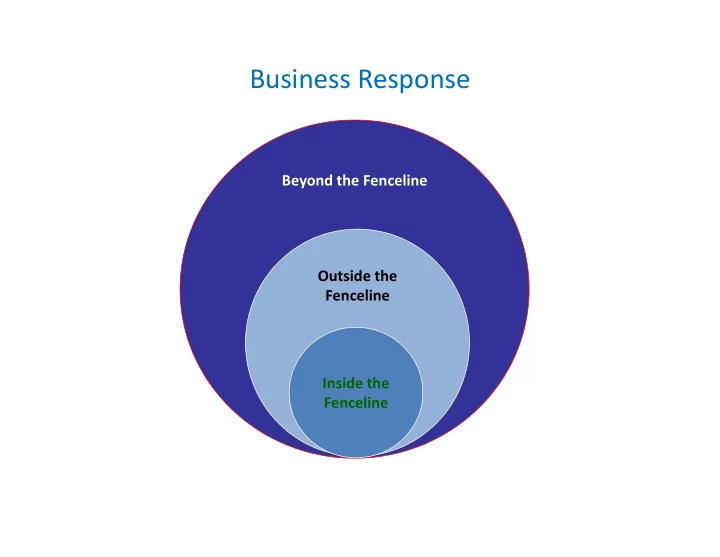
Beyond the Fenceline Outside the Fenceline Inside the Fenceline
Business Response Beyond the Fenceline Outside the Fenceline - - PowerPoint PPT Presentation
Business Response Beyond the Fenceline Outside the Fenceline Inside the Fenceline Corporate Social Responsibility Refers to a business principle that requires companies to look at the impact of their products and practices on society,
Beyond the Fenceline Outside the Fenceline Inside the Fenceline
requires companies to look at the impact of their products and practices
development; and on their relationship with their stakeholders
– Social investments – Corporate – Community Partnerships – Managing Workplace Conditions – Environmental Stewardship
CSR Initiatives:
Support to River Councils such as the Save Silang Sta Rosa River Program for the Silang – Sta Rosa – Binan corridor and the SACRED / San Cristobal River Enhancement Defenders
Projects
management programs of Petron Phils in Batangas Bay and of Pilipinas Shell in Oriental Mindoro
ecological waste disposal and recycling
projects in Samar, Ragay and Samal in collaboration with communities and local governments
conservation programs (e.g for the Phil. Eagle, the Pawikan, the Irawady dolphin of Northern Palawan and the Dugong)
targeting the social concerns of consumers) using the strength of its marketing, distribution and sales networks to build brand loyalty, while at the same time increasing women’s access to health care and basic education
detection screening services, at little or no cost to them. Serves as gateway into the health care system.
NGOs in designing programs, identifying needs for services, training Avon employees and sales reps, and contextualizing educational materials
Source: CORPORATE SOCIAL RESPONSIBILITY IN PRACTICE CASEBOOK Catalyst Consortium, 2002
counselors (PEC) in the workplace to provide timely and accurate information and provision of assistance to formulate company HIV/AIDS policies.
regions, reaching more than 25,000 employees
educators and counselors (PEC) and PEC trainers training; information dissemination, counseling, and referral for services in partnership with NGOs for training, HIV testing, counseling, hotline, and other services.; executive briefings; and HIV/AIDS policy formulation workshops.
awarded the Pro-active Program Achievement Hall of Fame Award in 2010 by DTI for setting industry standards on labor quality, productivity and community relations in the Philippines.
households to water lines and retaining the connection for the long haul; provides continuous, reliable access to safe and affordable water. Water connection costs have dropped by almost compared to costly vended water
quality and safety standards of the International Organization for Standardization’s (ISO) ISO/IEC 17025:2005, ISO 14001:2004 and OHSAS 18001:2007, DOH and DENR.
in the East Zone by commissioning two new sewage treatment facilities
53 percent - technical skills development to ensure steady supply of talent for
and stay updated on international best practices 34 percent - in leadership development and getting results through others 13 percent : exposing our key talents to local and international forums to enable them to network and benchmark with other practitioners in the field.
with similar handicaps.
courses to the hearing-impaired. Upon graduation, some students are sent to college as scholars, while others are hired by the company
. “More and more companies in the world espouse CSR.
In our company, it’s a way of life, not just a marketing ploy… It is the responsibility of every Filipino company who can afford, to help.”
Meeting the needs of the present without compromising the ability of future generations to meet their own needs Growth with Equity Empowerment
Institutions Ecological Integrity
World Business Council for Sustainable Development
Jaime Ayala, CEO, Ayala Land 2007 Sustainability Report
Ian Thackwray Former COO, Holcim Cement Phils “ We place environmental management high on our priorities as a company. We recognize the public's high expectations for responsible management in this area and strive to meet and exceed those expectations"
Holcim Philippines, Inc. Chief Operating Officer Ian Thackwray receives the Kapatiran sa Industriya (KAPATID) Award from Her Excellency President Gloria Macapagal-Arroyo during the 30th National Conference of Employers, organized by the Employers Confederation
recognition of the outstanding productivity and quality achievements
has consistently achieved excellent manufacturing efficiencies and quality ratings while meeting environmental standards and regulations.
Survey cites RP firms for ‘green’ efforts (http://business.inquirer.net/money/topstories/view
By Michelle Remo, Philippine Daily Inquirer, 06/02/2009
MANILA, Philippines—The business sector emerged as the most perceivably environment-friendly in a recently released international survey, which observers said was a result of efforts of firms in the country to actively pursue projects that promote cleaner and greener surroundings. According to the 2009 Grant Thornton International Business Report, the business sector in the Philippines got a score of +78 percent in terms of friendliness to the environment. The score is determined by subtracting the number of respondent-firms that described their country’s business sector to be either “unfriendly” or “very unfriendly” to the environment from those that considered it to be “friendly” or “very friendly.” The respondents based their answers on environment care-related projects they know that were implemented by many businesses in the country. According to Punongbayan & Araullo, a tax and business advisory firm in the country that has a tie-up with Grant Thornton, the
Philippines outperformed 35 other countries included in the survey. Others that landed in the Top 5 most
environmentally friendly were the business sectors of India, Thailand, Denmark and Finland, which recorded scores of between +60 and +70 percent. Those that landed in the Bottom 5 were the business sectors of Turkey, Greece, Argentina, Spain and Russia, which recorded scores of between -15 to -45 percent. “This is a very encouraging sign. The Philippine business community is taking the ‘green movement’
seriously as opposed to just treating it as a fad or a trend,” said Greg Navarro, managing partner and chief
executive officer of P&A. “I think that more and more business leaders are embracing the idea that
environment-friendly practices do not have to be in opposition to their business strategies. They can actually incorporate these practices into their mission and build a sustainable business,” he said.
Results of the IBR survey also showed that firms in the Philippines would not mind establishing or pursuing environmental care-related projects if these would adversely affect profitability. The survey said 64 percent of Filipino firms were willing to undertake such projects despite their impact
P&A said many of the companies belonging to the Top 1,000 corporations in the Philippines spent for projects that promoted a clean and green
“Despite the [economic] downturn, profit is clearly not the only factor driving PHBs [privately held businesses], which makes sense,” Navarro pointed out. “At this point, adopting ‘green’ practices is becoming a self-rewarding decision.
imagined
largely derive from consumer choices and a rising demand for a specific standard of living
alters the natural environment, we need to learn to live with our environmental problems and find cost – effective solutions for them
real
respond to a competitive marketplace, but also shapes consumer choices and behavior patterns
minimizing costs and maximizing and sustaining resources
investment.
1960s Indifference / Passiveness 1970s 1990s 21st Century 1980s
1960s Indifference / Passiveness 1970s Environmental Awareness / Pollution Control/End - of - Pipe Approach (Reactive) Pollution/Waste reduction (Proactive) / Improving compliance 1990s 21st Century 1980s
1960s Indifference / Passiveness 1970s Environmental Awareness / Pollution Control/End - of - Pipe Approach (Reactive) Pollution/Waste reduction (Proactive) / Improving compliance 1990s Environmental Mgt. Systems 21st Century CSR & Sustainability Reporting/ Greener Business 1980s
1960s Indifference / Passiveness 1970s Environmental Awareness / Pollution Control/End - of - Pipe Approach (Reactive) Pollution/Waste reduction (Proactive) / Improving compliance 1990s Environmental Mgt. Systems 21st Century CSR & Sustainability Reporting/ Greener Business 1980s
53.6% Predicted growth rate of the global market for
drink through 2012. 2296% growth rate of global hybrid- car sales since 2000, with sales forecast to rise 286% through 2012 in the US alone 12.3% Projected annual growth rate of global biofuels market through 2017; production of ethanol alone expected to hit 27 billion gallons per year by 2014 100B - worldwide investment in clean energy in 2009 (New Energy Finance) up from 71B in 2006 and 27B in 2004 * Renewables projected to supply 20% of global power by 2020. 18.6 – 23.1B – estimated solar revenues in 2010 (Solar Buzz) 40 M – estimates by the American Solar Energy Society of the number of green jobs in the US by 2030 500B – value of low – carbon energy markets by 2050 (Stern)
Five components:
cars by 4%/yr and investing in new battery technology for plug –in hybrids
efficient and provide homeowners tax breaks to do the same
energy conservation products like fiberglass insulation
generated by wind, solar and geothermal plants in rural areas to the major population centers (with the savings in energy efficiency paying for the grid in three yrs)
projects
SustainableBusiness.com
Bendigo and Adelaide Bank Ltd. (BEN.ASX) Australian community bank which offers green personal and home loans at discounted interest rates when people renovate or build with green features, such as solar hot water or grey water systems. Chipotle Mexican Grill, Inc. (NYSE: CMG) A US restaurant chain of 860 restaurants that serves 100% free-range chicken and pork, about 60% beef, rBGH-free dairy products, and organic produce and beans with a goal to offer a completely sustainable menu as soon as they can build the supply chain to meet their demand. First Solar, Inc. (Nasdaq: FSLR) The largest thin film solar producer by far of the highest efficiency and lowest cost modules in the industry, now able to manufacture modules at $0.98 per watt, edging closer to its 2012 goal of $0.70 per watt when solar PV will be competitive with conventional electricity sources.
Philips Electronics world leader in lighting technology which created the compact fluorescent bulb in 1980; innovative green products account for 23% of total revenues,
Vestas Wind Systems largest wind turbine manufacturer in the world with a 19.8% market Share; currently working to push down the cost per kilowatt hour of electricity from wind power and setting the industry standard for efficiency and durability
“(For Indonesia, Philippines, Thailand, and Viet Nam) the potential economic cost of inaction is huge—if the world continues the “business-as-usual” emission trends—considering market and non- market impacts and catastrophic risks of rising temperatures— the cost to these countries each year could be equivalent to a loss of 6.7% of their combined GDP by 2100, more than twice the world average”.
Economics of Climate Change in Southeast Asia, April 2009
UK Government Economic Service, Nov 2006
We aim … to assist Philippine business to address its environmental issues and concerns….