Building Quality Early Learning Systems and Kindergarten Readiness - - PowerPoint PPT Presentation

building quality early learning systems and kindergarten
SMART_READER_LITE
LIVE PREVIEW

Building Quality Early Learning Systems and Kindergarten Readiness - - PowerPoint PPT Presentation

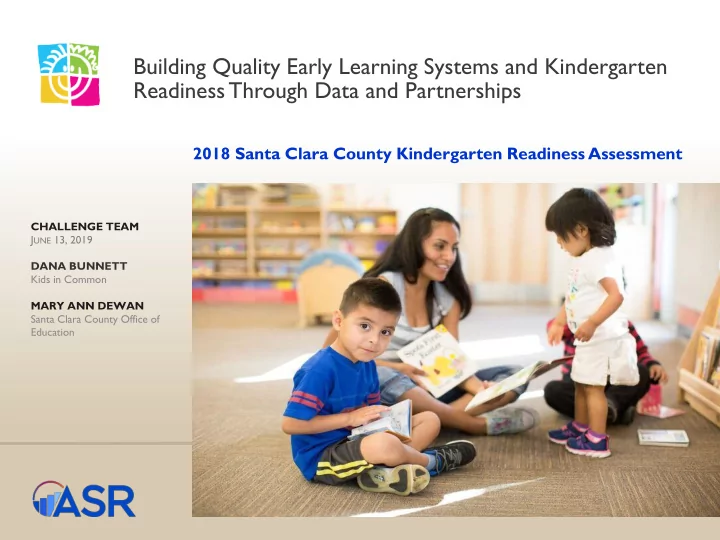
Building Quality Early Learning Systems and Kindergarten Readiness Through Data and Partnerships 2018 Santa Clara County Kindergarten Readiness Assessment CHALLENGE TEAM J UNE 13, 2019 DANA BUNNETT Kids in Common MARY ANN DEWAN Santa Clara


slide-1
SLIDE 1

2018 Santa Clara County Kindergarten Readiness Assessment

Building Quality Early Learning Systems and Kindergarten Readiness Through Data and Partnerships

CHALLENGE TEAM JUNE 13, 2019 DANA BUNNETT Kids in Common MARY ANN DEWAN Santa Clara County Office of Education

slide-2
SLIDE 2

2

Agenda

  • Background: Why assess readiness?
  • Findings from the 2018 Santa Clara County assessment

» How many children in Santa Clara County were Fully Ready for school? » What factors predicted higher readiness in the county? » How is readiness related to family engagement and community services and supports?

  • How do we use the data to turn the curve on readiness in the

county?

slide-3
SLIDE 3

3

Background

  • Why is kindergarten readiness important?

» Linked to long-term education, health, and social outcomes » Creates a portrait of readiness for a community » Informs interventions to support readiness » Builds bridges between 0-5 and K-12 communities

  • Why measure readiness in Santa Clara County?

» Last countywide readiness assessment was over 10 years ago » Can be used to shape local strategies for readiness in the county » Can bring together partners in the county pursuing a common goal –

Every child comes to school ready to learn!

slide-4
SLIDE 4

SRA Model & Measures

4

KINDERGARTEN OBSERVATION FORM (KOF)

  • 20 research-based items administered by teacher
  • 6 direct test items
  • 14 observational items

FIRST 5 SERVICE DATA

  • Family Resource Center services
  • Home visiting services
  • Developmental screening and referrals

PARENT INFORMATION FORM (PIF)

  • Take-home confidential survey for parents
  • PIF measures:
  • Child health
  • Early learning
  • Family protective factors
  • Family risk markers
  • Participation in programs/services
slide-5
SLIDE 5

5

2018 Santa Clara County Sample

14 DISTRICTS 42 SCHOOLS 66 CLASSROOMS 1,253 K ASSESSMENTS (KOF) 983 PARENT SURVEYS (PIF)

slide-6
SLIDE 6

6

School Readiness in 2018

19%

Not Ready

50%

Fully Ready Average readiness score that predicts third grade reading:

3.25

60%

3rd Graders are Proficient Readers

31%

Partially Ready

N=1,159. Note: Data were weighted to approximate race/ethnicity, SES, and EL representation, and adjusted for school and district enrollment. Fully Ready: Mean score of 3.25 or higher in all three domains: Self-Regulation, Social Expression and K. Academics. Partially Ready: Mean score of 3.25 or higher in one or two domains. Not Ready: Mean score below 3.25 in all three domains.

slide-7
SLIDE 7

7

ECE

Special Needs

Age

Maternal Education

Health & Well-being (Not tired)

Gender

Race/ ethnicity

Single parent- hood

Bedtime

Child Resilience Family Income Home- lessness

SCHOOL READINESS

English Learner

Predictors of Readiness in 2018

N=729. Estimates are adjusted for districts and schools nested in districts.

slide-8
SLIDE 8

8

“Recipe” of Assets for Readiness

  • Quality services and supports foster conditions for optimal growth

and development, so that each child enters school ready to learn

SCHOOL READINESS

EARLY CHILDHOOD EXPERIENCES Early health services Early learning programs Parent support and family engagement

slide-9
SLIDE 9

9

QUALITY MATTERS and Readiness

  • Children attending QUALITY MATTERS (QRIS) rated early learning

programs in Santa Clara County have higher readiness scores

Early Learning Programs

Scale of 1= Not proficient to 4 = Proficient. N=610-649. * p <.05; **p < .01. Estimates are adjusted for age, sex, race/ethnicity (Hispanic or not), special needs, English Learner status, maternal education, family income, and single parenthood.

3.08 3.13 3.05 2.97 3.20 3.23 3.07 3.20 Overall* Self-Regulation Social Expression Kindergarten Academics** No ECE QUALITY MATTERS ECE

slide-10
SLIDE 10

10

Family Engagement

  • Children in highly engaged families had higher Kindergarten

Academics scores

Parent Support and Family Engagement 3.40 3.39 3.34 3.37 3.45 3.42 3.41 3.46 Overall Self-Regulation Social Expression K Academics* Low Engagement High Engagement

Scale of 1= Not proficient to 4 = Proficient. N=707-741. *Difference statistically significant, p<.05.

slide-11
SLIDE 11

11

FIRST 5 and Kinder Prep

  • FIRST 5 families were more likely to have screenings and carry out

activities to prepare their children for kindergarten^

4.12 4.69 Preparation for K+

Prep for K: Number of activities. N=248. +p <.10; *p < .05. ^ Among sample attending schools near FRC sites.

74% 63% 66% 39% 86% 64% 73% 52% Any screen* Hearing Vision Dev+ No FIRST 5 FIRST 5 Parent Support and Family Engagement Early Health Services

slide-12
SLIDE 12

12

FRCs and Readiness

  • Among students attending schools near Family Resource Center

sites, FRC services associated with higher Self-Regulation & Social Expression skills

Scale of 1= Not proficient to 4 = Proficient. N=235-252. +p <.10; *p < .05. Estimates are adjusted for race/ethnicity (Hispanic or not), special needs, English Learner status, age, sex, maternal education, family income, and single parenthood.

3.02 2.99 2.88 3.03 3.18 3.27 3.19 3.04 Overall+ Self-Regulation* Social Expression* Kindergarten Academics No FIRST 5 FRC FIRST 5 FRC Parent Support and Family Engagement
slide-13
SLIDE 13

13

Cumulative Effect of Assets for Latino Boys

10% 19% 52% 45% 37% 19% 0 to 4 5 to 6 7 to 9 Fully Ready Not Ready

Well-being (not tired) ECE experience Securely housed Visited library Read with caregiver Resilient Less screen time K prep activities Early bedtime

ASSETS PERCENT READY BY NUMBER OF ASSETS

N=107. ***p < .001.

Parent Support and Family Engagement Early Health Services Early Learning Programs

slide-14
SLIDE 14

14

Assets and Readiness by ZIP Code

  • ZIP Codes where children/families have more assets, readiness

scores are higher

ASSETS READINESS

Parent Support and Family Engagement Early Health Services Early Learning Programs

slide-15
SLIDE 15

15

How Do We Turn the Curve?

  • Partners in all sectors have a role to play in improving the quality
  • f each child’s early experience
  • Universal Access Pilot received over $2M in funding from

Board of Supervisors to change how business is done in East San Jose

» Increase connection to early education, health, parent support services » Increase school readiness » Increase third grade reading

Healthy Pregnancies & Births Optimal Child Development Supported & Engaged Families High Quality Early Care & Education (ECE) High Quality K- 3rd Grade Education Children succeeding by 3rd Grade

slide-16
SLIDE 16

16

Building a Call to Action

1. Where else should we present the data? With whom should we connect to share the findings? 2. What are two things you want to see happen in the county to improve school readiness? 3. What other questions would you like answered with the data?

slide-17
SLIDE 17

17

Thank you to the sponsors who made this study possible!

slide-18
SLIDE 18

18

Contact ASR if you have other questions!

  • Christina Branom

Branom@appliedsurveyresearch.org

  • Lisa Colvig-Niclai

Lisa@appliedsurveyresearch.org