
SLIDE 1
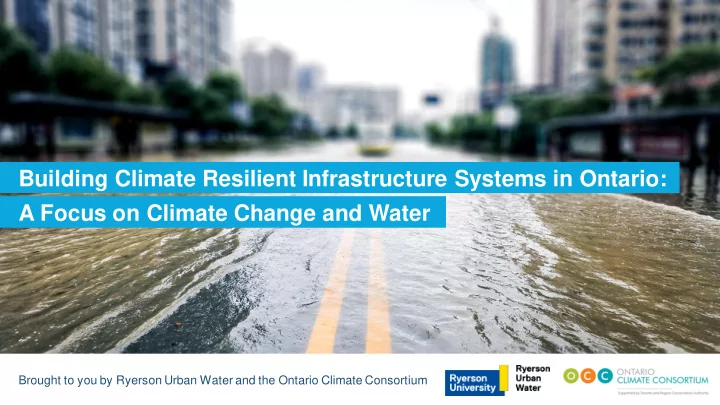
Building Climate Resilient Infrastructure Systems in Ontario: A Focus on Climate Change and Water
Brought to you by Ryerson Urban Water and the Ontario Climate Consortium
Building Climate Resilient Infrastructure Systems in Ontario: A - - PowerPoint PPT Presentation
Building Climate Resilient Infrastructure Systems in Ontario: A Focus on Climate Change and Water Brought to you by Ryerson Urban Water and the Ontario Climate Consortium Agenda for the Day Morning Afternoon Welcoming Remarks, Traditional
Brought to you by Ryerson Urban Water and the Ontario Climate Consortium
We will be tweeting about the workshop @RyUrbanWater!
Land Acknowledgement and Workshop Objectives
Research, Education, Policy: Healthy Water. Healthy Cities.
water.ryerson.ca
Ryerson Urban Water (RUW) is an interdisciplinary consortium
the complexities of managing an urban water system through dynamic integration of research, education, and policy implementation.
4
5
6
7
OUTCOME
RUW will advance the transformation of communities to healthy urban environments by enhanced interdisciplinary research and integration with external partners. Establish RUW as the pre-eminent collaborative hub for excellence in Applied Research in solving urban water challenges.
8
OUTCOME
An informed water-literate citizenry that supports decisions leading to sustainable urban watersheds. Establish RUW as a leader in delivering water Education through traditional and innovative approaches.
9
OUTCOME
Fact based policy and regulation decisions that encourage and support sustainable urban water actions. Establish RUW as the urban water advisor on Policy strategies for all levels of government.
Glenn Milner,
Climate Change Specialist, Savanta – GEI Consultants
Alice Dixon,
Energy Specialist, Infrastructure Ontario
Quentin Chiotti,
Senior Advisor, Metrolinx
Chris Gore,
Associate Professor & Chair, Ryerson University
Table Facilitator Note-Taker Theme 1 Frances Delaney Anum Khan Train Station 2 Quentin Chiotti Nishal Shah Train Station 3 Alice Dixon Nayel Halim Residential High-Rise 4 Victoria Kramkowski Kristina Dokoska Residential High-Rise 5 Glenn Milner Caroline John Hospital 6 Sharon Lam Golnoosh Siavas-Moakhar Hospital
Lisa Prime,
Principal, PRIME Strategy & Planning
Clara Blakelock,
Interim Program Manager, Green Infrastructure Ontario Coalition
Christine Zimmer,
Senior Manager, Credit Valley Conservation
Kevin Beaulieu,
Municipal Program Director, Friends of the Greenbelt Foundation
Table Facilitator Note-Taker 1 Glenn Milner Joanna Tucci 2 Victoria Kramkowski Nishal Shah 3 Sharon Lam Poorna Haque 4 Clara Blakelock Kristina Dokoska 5 Frances Delaney Anum Khan 6 Lisa Prime Nayel Halim