
SLIDE 1
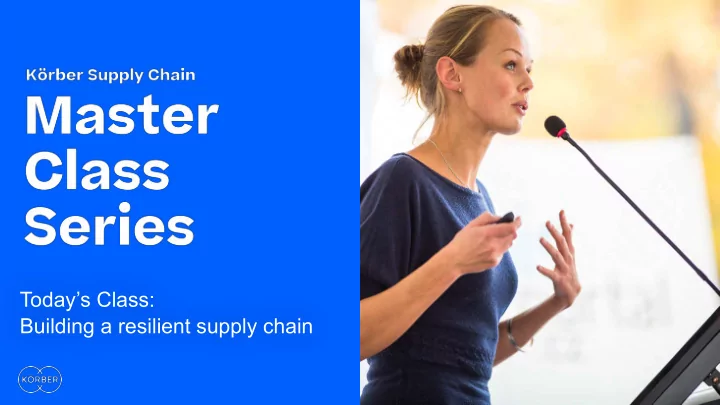
Building a resilient supply chain Speakers Thomas Goldsby Zubair - - PowerPoint PPT Presentation
Todays Class: Building a resilient supply chain Speakers Thomas Goldsby Zubair Amla Professor Senior Sales Engineer James A. Haslam, II Chair of Logistics Krber Supply Chain The University of Tennessee Knoxville 2 Supply Chain Master
2
Thomas Goldsby Professor James A. Haslam, II Chair of Logistics The University of Tennessee Knoxville
Zubair Amla Senior Sales Engineer Körber Supply Chain
3
Why are we here? What are we trying to accomplish? Class Schedule:
Master Class Series – On-Demand
4
All phone lines are muted Recording of today’s class and slides will be emailed to you within 48 hours Questions:
after class Handout: Flexibility in WMS Poll Question: How prepared is your supply chain to handle disruptions?
When straight-line speed won’t get the job done!
7
Post-COVID-19 Crisis Supply Chain (March 2020)
8
In today’s globalized and interconnected world, any major disruption – from a disease to a fire – has the potential to cascade through supply chains and permeate other systems. Todays supply chain are:
Many organizations focus on how to make our supply chains more efficient by:
Many supply chains are not equipped to manage, mitigate and respond to disruptions…
9
Natural Disasters
Accidents
Intentional Disruptions
Other
10
11
Minimize Risk Barriers to Entry Prepare for unexpected Consumer Expectations Manage Compliance Drive Greater Efficiency
12
13
Supply chain resilience
Multisourcing Nearshoring Platform, product or plant harmonization Ecosystem partnerships Inventory and capacity buffers Manufacturing network diversification
Source: Gartner, Six Strategies for a More Resilient Supply Chain
14
walls by including suppliers, partners, manufacturers, distributers and retailers
and respond quickly
geographies and/or regions
data and information sharing
COVID-19 has presented an unprecedented challenge to supply chains around the world with rapidly evolving customer demand and expectations meeting strained resources and lack of automation. Join Derek Curtis on Tuesday, October 20th to hear about some of the most valuable lessons learned from supply chain industry experts in this Masterclass; and explore how COVID has reshaped our thinking around disaster mitigation.
Contributor:
Derek Curtis Territory Manager Körber Supply Chain
16