Brown Act Presentation September 15, 2016 Catherine Groves (415) - - PDF document

brown act presentation
SMART_READER_LITE
LIVE PREVIEW

Brown Act Presentation September 15, 2016 Catherine Groves (415) - - PDF document

Bicycle Advisory Committee Peninsula Corridor Joint Powers Board Brown Act Presentation September 15, 2016 Catherine Groves (415) 995-5171 cgroves@hansonbridgett.com 1 Government Ethics Laws Minimum standard Not always common


slide-1
SLIDE 1

1

1

Bicycle Advisory Committee

Peninsula Corridor Joint Powers Board

Brown Act Presentation

September 15, 2016

Catherine Groves

(415) 995-5171 cgroves@hansonbridgett.com 2

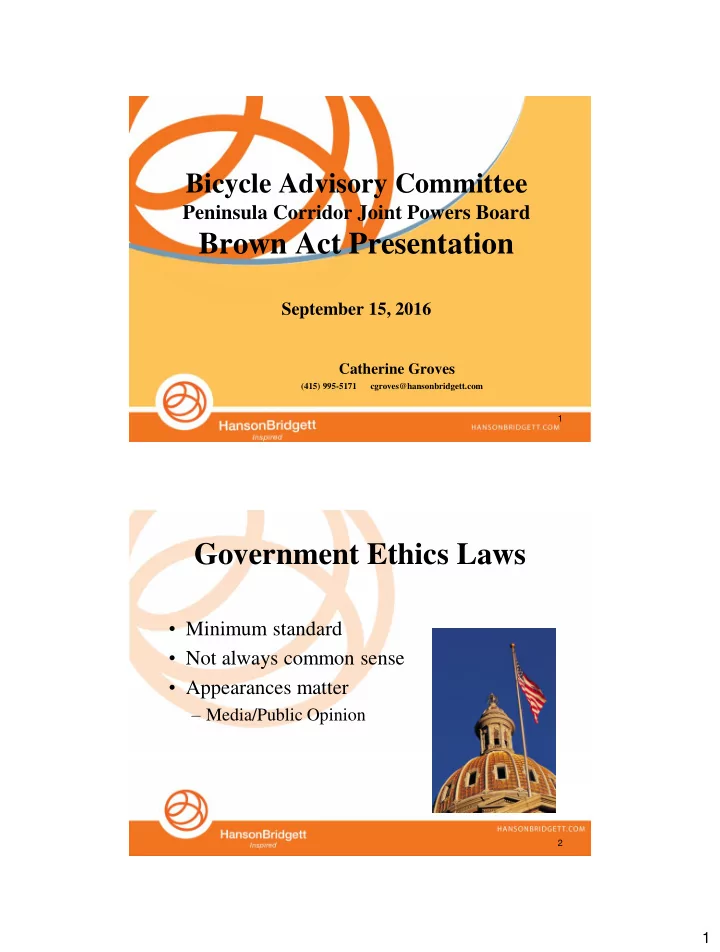
Government Ethics Laws

  • Minimum standard
  • Not always common sense
  • Appearances matter

– Media/Public Opinion

slide-2
SLIDE 2

2

3

The Brown Act

The Legislature finds and declares that the public commissions, boards and councils and the other public agencies in this State exist to aid in the conduct of the people’s business. It is the intent of the law that their actions be taken openly and that their deliberations be conducted

  • penly.

The people of this State do not yield their sovereignty to the agencies which serve them. The people, in delegating authority, do not give their public servants the right to decide what is good for the people to know and what is not good for them to know. The people insist on remaining informed so that they may retain control over the instruments they have created. Government Code Section 54950

4

Who Is Subject To the Brown Act?

  • Legislative Body
  • Any Committee created by Board of Directors
  • Any Committee Created by

Committee

  • Applies to BAC
slide-3
SLIDE 3

3

5

What Does the Brown Act Require?

  • Local legislative bodies’ meetings
  • pen & public
  • Agenda posted 72 hours prior to

meeting

  • Time for public comment
  • Report out individual votes of every

member present for all actions

6

What’s a “Meeting”?

  • Majority of members of

legislative body

  • Same place and time
  • Hear, discuss, deliberate
  • r take action
  • Within subject matter jurisdiction of

legislative body

slide-4
SLIDE 4

4

7

What is not a “Meeting”?

  • Contact between Member and a Non-Member
  • Conference open to public

– but no caucusing or discussion among members about business within the body’s subject matter jurisdiction

8

Closed Session Exception

  • Limited topics, usually just for JPB Board
  • Very unlikely to apply to BAC
  • Specified format, notice, requirements
  • Ask counsel first!
  • Duty of confidentiality
slide-5
SLIDE 5

5

Committees

  • Standing Committees (Brown Act bodies)

– Less than a quorum – Indefinite time period – Created by parent body & has regular meetings – Public can be part of committee – BAC charter prohibits standing committees

  • Ad Hoc Committees (Not Brown Act bodies)

– Less than a quorum

  • Other BAC members can attend as member of the public (can’t vote) as long as there

isn’t a quorum. BUT avoid serial meetings & be aware of public perception!

– Finite charge and must report back to parent body within a year – Parent body can’t create by formal action or establish meeting schedule – Public can attend, but cannot be part of committee.

9 10

Risky Business:

Quorums outside of noticed meetings

  • Serial conversations
  • E-mail, social media

sites, blogs, and

  • ther technology
  • Social engagements
  • Other agencies’

meetings

§ 54952.2 (b) (1) A majority of the members of a legislative body shall not,

  • utside a meeting authorized by this chapter, use a series of communications
  • f any kind, directly or through intermediaries, to discuss, deliberate, or take

action on any item of business that is within the subject matter jurisdiction of the legislative body.
slide-6
SLIDE 6

6

11

Frequently Asked Questions & Special Points

  • Can I call in?
  • I know it’s not on the agenda, but…
  • Can we go back to that item from

last time?

  • Can I respond to that?
  • What if there is less than a quorum?

12

Penalties/Enforcement

  • Opportunity to cure
  • Civil action
  • Criminal action
  • Public opinion
slide-7
SLIDE 7

7

Questions?

13