Brittany Clark, M.S., CCC-SLP Manager of Youth & Adult Rehab - - PowerPoint PPT Presentation

brittany clark m s ccc slp
SMART_READER_LITE
LIVE PREVIEW

Brittany Clark, M.S., CCC-SLP Manager of Youth & Adult Rehab - - PowerPoint PPT Presentation

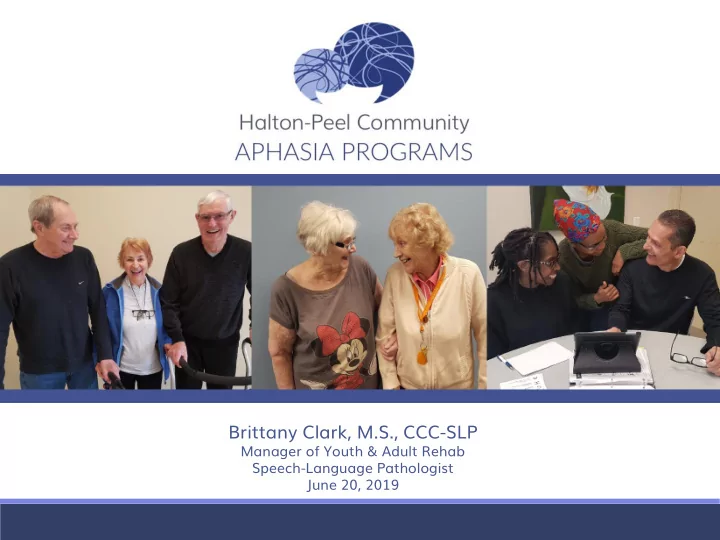
Brittany Clark, M.S., CCC-SLP Manager of Youth & Adult Rehab Speech-Language Pathologist June 20, 2019 Who We Are Aphasia Awareness What is Aphasia? Aphasia is an acquired communication disorder most often caused by stroke, brain injury,

slide-1
SLIDE 1

Brittany Clark, M.S., CCC-SLP

Manager of Youth & Adult Rehab Speech-Language Pathologist June 20, 2019

slide-2
SLIDE 2

Who We Are

slide-3
SLIDE 3

Aphasia Awareness

slide-4
SLIDE 4

What is Aphasia?

Aphasia is an acquired communication disorder

  • most often caused by stroke, brain injury, or brain

illness

Aphasia affects a person’s ability to communicate:

  • speaking,
  • understanding,
  • reading and writing
slide-5
SLIDE 5

Challenges of living with Aphasia

  • Other people may assume the person with aphasia is

not competent

  • Reduced participation in conversations and activities
  • Change in life roles (e.g., work, family, etc.)
  • Social isolation
  • Depression
slide-6
SLIDE 6

What We Do

  • Weekly supported conversation groups
  • We help and support clients, family, and friends
  • Have better conversations
  • Learn about programs in the community
  • Improve quality of life living with aphasia
slide-7
SLIDE 7

Eligibility Criteria

People who:

 have aphasia (and their family / caregivers)  are medically stable and live in the community  can attend & participate in a 2½-3 hour program  no / minimal cognitive difficulties  independent with eating, drinking, and toileting  have transportation to the program

slide-8
SLIDE 8

Referral Process

  • Referrals come from
  • Health-care professionals
  • Community agencies
  • Family members, caregivers
  • Self-referrals
  • Referral forms are available online at www.h-

pcap.com and can be mailed or faxed to H-PCAP at Monarch House

slide-9
SLIDE 9

Typical Day

  • Program begins – song, check in
  • Opening
  • Practice asking and answering questions
  • Word warm-up
  • Small group conversation tables
  • Small or large group communication- based

activities

slide-10
SLIDE 10

Program Education

  • Community Resources
  • Stroke support groups,

counselors, day programs

  • Resources for improving

quality of life living with aphasia

  • Access 2 Entertainment,

Disability Travel Card

  • Aphasia wallet card
  • Disability tax credit
  • Caregiver support groups
slide-11
SLIDE 11

Aphasia Information & Training Sessions

  • Information and training in supporting

conversations

  • Hosted by a Speech-Language

Pathologist & Assistant

  • Four-hour training includes practical

scenarios, videos

  • Open to community members, health

care professionals, family members

slide-12
SLIDE 12

Program Locations

slide-13
SLIDE 13

Funding

Milton, Oakville, Mississauga – MH LHIN

  • Programs are fully funded by the LHIN
  • Eligible clients are able to stay for 9 months
  • SLP and CDA weekly, Social Work monthly

Brampton – CW LHIN

  • Programs are fully funded by the LHIN
  • Eligible clients are able to stay for 1 year or longer
  • SLP monthly, CDA weekly
  • No funded social work

Burlington – HNHB LHIN

  • Programs are partially LHIN-funded; client pays co-pay
  • Eligible clients can stay long-term
  • SLP and CDA weekly, Social Work monthly
slide-14
SLIDE 14
slide-15
SLIDE 15

Newsletter

Aphasia Program Newsletters

Read our aphasia-friendly newsletters for information about:

  • Aphasia and stroke-related events in the community
  • Special guest speakers and events at the aphasia groups
  • Community resources
  • Stroke support groups

... and more!

slide-16
SLIDE 16

Return to Work. Return to Your Community. Return to Play.

Return to Your Life

COMPR COMPREHENSI EHENSIVE VE APHA APHASIA SIA PR PROG OGRAM AM

slide-17
SLIDE 17

Monarch House

  • Interdisciplinary treatment centre (SLP, OT, ABA)
  • Serving clients across the lifespan
  • Highly individualized, evidence-based, family and client-

centred

slide-18
SLIDE 18

Return to Your Life - Ontario's first and only comprehensive, intensive treatment program for people with aphasia and communication challenges post-stroke and brain injury.

slide-19
SLIDE 19

Only about 12 ICAP programs exist in the world: 8 in the USA, 2 in Canada, 1 in Australia and 1 in the United Kingdom.

slide-20
SLIDE 20

Sample Client Weekly Schedule

slide-21
SLIDE 21
  • Highly individualized, interdisciplinary program
  • Based on client goals and desired outcomes
  • Increasing functional communication skills:
  • Send a text message to a friend without assistance
  • Write an email
  • Read a bedtime story to my grandson
  • Plan, grocery shop, and cook a meal on my own
  • Initiate conversation with my husband
  • Prepare and give a PowerPoint presentation
  • Order my own food at a restaurant
  • Explain to others about my aphasia and strategies that work for me
  • Understand a news article
  • Say all of my family members’ names clearly

Program Goals

slide-22
SLIDE 22
slide-23
SLIDE 23

Intensive program runs 5 hours per day, 5 days per week, for 3 months. Cost = $2,200 per week for a 3-month program. Private medical insurance

  • Critical illness insurance coverage
  • Speech-language therapy benefits
  • Occupational therapy benefits

Program Cost

slide-24
SLIDE 24

Aphasia Awareness

slide-25
SLIDE 25

Thank you!

Brittany Clark, M.S., CCC-SLP Speech-Language Pathologist Manager of Youth & Adult Rehab Phone: (905) 875-8474 Email: brittanyclark@monarchhouse.ca Vanessa Rotundo, Hons. B.A., CDA Communicative Disorders Assistant Volunteer Coordinator Phone: (905) 849-7993 ext. 10713 Email: vrotundo@monarchhouse.ca