
SLIDE 1
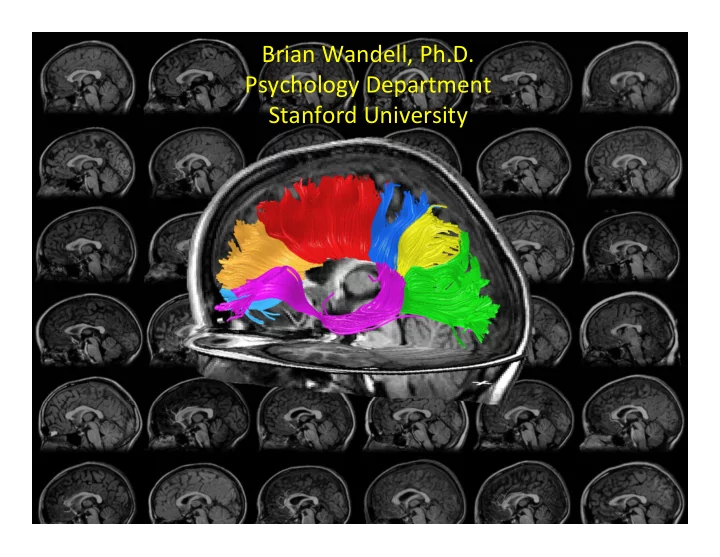
Brian Wandell, Ph.D. Psychology Department Stanford University - - PowerPoint PPT Presentation
Brian Wandell, Ph.D. Psychology Department Stanford University Purpose Explain measurements of developing brain connections Reading and Math Examples I am here for discussion Is anything I can do that is useful to you? Courtesy
Courtesy Professor Ugur Ture
Johns Hopkins is a leader in this technology
Corpus callosum Corpus callosum Ventricle Ventricle Fibers Gray matter White matter White matter
(Dougherty et al., PNAS, 2007)
Reading-related standard scores
O P S T
T r(45) ~ 0.58 p < 0.001
The Dana Foundation
The horizontal axis shows lifetime hours of music training; the vertical axis shows the improvement in reading fluency between years 3 and years 1.
We incidentally discovered that visual art experience is correlated with math skills. The horizontal axis shows a weekly average of hours spent
(year 1). The vertical axis shows a measure of math skill. The correlation explains 10% of the variance in children’s scores.
Michal Ben-Shachar Jessica Tsang
Green shoots
A B
Cantlon et al., PLOS Bio, 2006
A
anterior superior longitudinal fasciculus (aSLF)
r(25) 0.49, p < 0.02 Explains about 25% of the variance.
Left Right
Robert Dougherty
Michal Ben-Shachar, Bar-Ilan, Tel-Aviv Jessica Tsang, Stanford
Gayle Deutsch, Stanford
Visual fields and pRFs
Alyssa Brewer, UC Irvine Alex Wade, Smith-Kettlewell Serge Dumoulin, Helmholtz Institute Hiroshi Horiguchi, Stanford Kaoru Amano, Tokyo University Jon Winawer, Stanford
Adult cortical plasticity
Yoichiro Masuda, Jikkei Hospital, Tokyo Stelios Smirnakis, Baylor College of Medicine Alyssa Brewer, UC Irvine Satoshi Nakadomari, Jikkei Hospital, Tokyo Netta Levin, Hadassah Hospital, Jerusalem Hiroshi Horiguchi, Stanford Nikos Logothetis, Tuebingen
Reading and Math
We gratefully acknowledge support from : NIH, DARPA, IBM, Dana Foundation, Schwab Foundation, Microsoft Co.
Anthony Sherbondy, IBM, Almaden Nikola Stikov, Stanford Aviv Mezer, Stanford
Diffusion-methods and qMRI