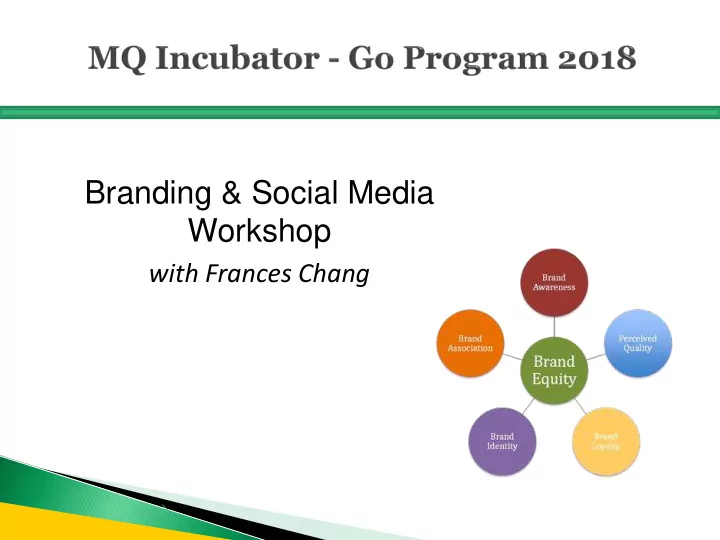
SLIDE 1
Branding & Social Media Workshop
with Frances Chang
SLIDE 2
- Let’s try to get to know each other
- Building a brand – why, how, for whom?
- Moving forward – who’s our target market? What do
we want to tell them? How do we tell them? Where do we tell them?
- We will all get a chance to do some work on this!
SLIDE 3
- Plenty of time to network after the Workshop
- I’ll start … a bit about me …
- Now your turn – Name, your business or
product, a bit of why you’re here and maybe, your fantasy??
SLIDE 4
- A brand is the set of attributes—positive or negative—that
people associate with your company
- Encompasses a name, logo, a sign and/or symbol
- Power of a Strong Brand
– Can be a very powerful asset for a firm – Able to charge a higher price for its products and services – Over 50% of consumers say… a reason to buy a product. – Can increase the market value of a company by 50% to 75%
SLIDE 5 Communicate brand knowledge, beliefs, emotions. Create strong, favorable, unique associations:
- reliability (Toyota)
- caring (Hallmark)
- classy, sophisticate (BMW)
- safety, family values (Volvo)
- convenience, wide selection (Amazon)
SLIDE 6
Top of mind recall of brands by segment:
- Luxury cars/Family cars
- Fast food
- Yogurt
- Chocolate
- Ice cream
- Online storage
SLIDE 7
Top of mind recall of brands by segment:
- Cars BMW, Toyota, Honda, Holden
- Fast food Maccas, KFC, Subway
- Yogurt Yoplait, Danone, Activia
- Chocolate KitKat, Cadbury, Ferroro Rocher, Lindt
- Ice cream Bulla, Haagen Das
- Online storage Dropbox
SLIDE 8
- 1. Choose your brand name
- 2. Know your target market – your customers
- 3. Positioning your brand
- 4. Reach your customers – messages and media
channels
SLIDE 9 Think - Big Idea, Distinctive, Emotion:
- Meaningful – benefits, quality, eg. Dropbox, PizzaHut
- Memorable – helps recall, recognition, eg. Coles, Dell
- Likeable – aesthetic, appealing, eg. Dropbox, Instagram
- Transferable – to other categories, globally, eg. Amazon, Dell
- Protectable – do your research on IP,
- Easy to pronounce – domestic and global markets,
examples of no no..Nissan Cefiro, Edet toilet roll
SLIDE 10
Task 1: Develop a brand name for your new business
SLIDE 11
SLIDE 12
- Geographic – neighbourhood,
cities, urban/rural, country
- Demographic – age, income,
generation, life-cycle stage
- Psychographics - personality,
lifestyle, attitudes, values
- Behavioral – needs, benefits,
usage, purchase, decision roles, readiness
SLIDE 13
- Geographic – neighbourhood,
cities, urban/rural, country
- Demographic – age, income,
generation, life-cycle stage
- Psychographics - personality,
lifestyle, attitudes, values
- Behavioral – needs, benefits,
usage, purchase, decision roles, readiness Examples: Adults age 50 plus, with AI 100 to 200K, health-conscious, well- read, outgoing, enjoy life Professionals, working young adults, busy lifestyle. Looking for good meals that comes with variety and convenience.
SLIDE 14
- Positioning – How do you want your brand to be perceived?
Establish a unique position in the customers’ mind.
Develop a “tagline” to reinforce the position you have staked
- ut in the market, or a phrase that is used consistently in all
your marketing communication. Examples:
SLIDE 15
- Choose a frame of reference – what you are or are not
compared to your competitor
- Choose your optimal point-of-difference – your unique
proposition: benefits, value, image, personality
- Create a brand mantra – encapsulates the essence of
what your brand is about
SLIDE 16
Low image, cheap High image, expensive
Perceptual Map – Mobile phone
High Tech Low Tech HTC Huawei Nokia Sony iPhone LG Samsung
SLIDE 17 Task 2 and 3:
- 2. Define/describe your customers
- 3. Craft your brand’s positioning
SLIDE 18 Is all about:
- Key messages – (what do you want your consumers to
know?) Trusted, dependable, healthy, safety, high tech,
- Delivery, tone of voice – (how will you tell them?)
Informative, educational, serious, no-nonsense, humorous, fun, warm, fear appeal,
- Media channels – (where will you tell them?) Traditional,
non-traditional media
SLIDE 19
- Packaging
- Advertising
- Sales promotion
- Events and
experiences
publicity
marketing
- Personal selling
- Online and social
media marketing
SLIDE 20
Bootstrap marketing strategies:
Are unconventional, low-cost, and creative marketing techniques that allow a small company to realize a greater return from its marketing investment than do larger rivals. Think Guerilla marketing! Does not require large amounts of money to be effective – Be creative, nimble, fast,
SLIDE 21 1. Pinpoint the specific target markets the company will serve. (customers, customers….)
- 2. Determine customer needs and wants through
market research. (value to the customers…)
- 3. Analyze a firm’s competitive advantages and
craft a strategy to communicate its value proposition to the target market. (what product
value would you deliver,? how would you communicate them?)
SLIDE 22
Bootstrap marketing principles:
Use the power of publicity. Don’t just sell; entertain! Strive to be unique. Build a community with customers. Embrace social media Connect with customers on an emotional level. Build trust. Communicate your unique selling proposition (USP).
SLIDE 23 Be creative, think outside the box!
Viral Marketing
Facilitates and encourages people to pass along a marketing message about a particular product or service.
Guerilla Marketing
A low-budget approach to marketing that relies on ingenuity, cleverness, and surprise rather than traditional techniques.
http://www.boredpanda.com/cool-and- creative-street-ads/
http://www.topinteractiveagencies.com/digital/agenc y/articles/10-brilliant-examples-of-guerrilla- marketing-campaigns/
https://www.youtube.com/watch?v=qMOuF8oskRU
SLIDE 24
Social networks sites, such as Facebook, LinkedIn, and Twitter, allow entrepreneurs to connect with potential and existing customers at little or no cost. 90% of entrepreneurs use social media to connect with existing and potential customers.
SLIDE 25
SLIDE 26
SLIDE 27
62% of companies use blogs as part of their marketing strategies.
Economical and effective online communication.
Blog Guidelines:
Be honest, balanced, and interesting. Post blog entries consistently so that readers have a reason to return. Ask customers for feedback.
https://www.forbes.com/sites/robertadams/2017/03/02/top- income-earning-blogs/#1656fb742377
SLIDE 28
– Allows advertisers to buy keywords on the Google home page. – Triggers text-based ads to the side of (and sometimes above) search results when the keyword is used. – The program includes local, national, and international distribution. – Advertisers pay a certain amount per click. – Advertisers benefit because they are able to place their ads in front of people who are already searching for information about their product.
https://adwords.google.com/intl/en_au/home/#?modal_active=none https://www.youtube.com/watch?v=tx2L6EGa9DY
SLIDE 29
– Allows advertisers to buy ads that will be shown on other websites instead of Google’s home page. – Google selects sites of interest to the advertiser’s customers. – Advertisers are charged on a pay-per-click or a per-thousand impression basis. – Advertisers benefit because the content of the ad is often relevant to the website. – Website owners benefit by using the service to monetize their website.
https://www.google.com/adsense/start/#/?modal_active=none#section-one
SLIDE 30
Task 4: Design your marketing communication strategy
> Key messages (What) > Delivery (How) > Media channels (Where)
SLIDE 31 79% of unhappy customers tell others about their experiences.
48% of shoppers say they won’t patronize stores where they know others have had negative experiences. For every complaint a company receives, 17 other complaints go unspoken. Disgruntled customers often post their experiences
Address comments and complaints!
SLIDE 32
- Thank you for participating in this Event!
- All images are sourced from royalty-free sites.
Bibliography and reference materials are available on
- request. Just email me! frances.chang@mq.edu.au
“If this business splits up, I would give you the land and bricks and mortar and I would keep the brands and trademarks and I would fare better than you” John Stewart, Founder, Quaker Oats