BPS School Reopening Listening Session Brenda Cassellius, - - PowerPoint PPT Presentation

bps school reopening listening session
SMART_READER_LITE
LIVE PREVIEW

BPS School Reopening Listening Session Brenda Cassellius, - - PowerPoint PPT Presentation

How to Best Participate: Mute your microphone when you are not speaking Use the chat box (at bottom center of screen) to type in comments Use the Raise Hand function to participate in the discussion (click on


slide-1
SLIDE 1

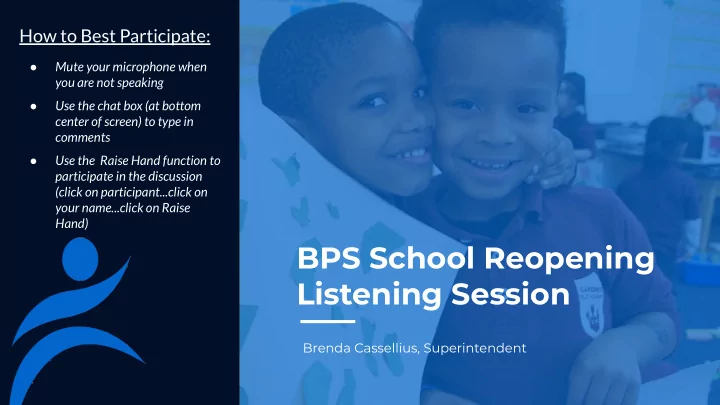
How to Best Participate:

  • Mute your microphone when

you are not speaking

  • Use the chat box (at bottom

center of screen) to type in comments

  • Use the Raise Hand function to

participate in the discussion (click on participant...click on your name...click on Raise Hand)

BPS School Reopening Listening Session

Brenda Cassellius, Superintendent

slide-2
SLIDE 2

Our Goal:

To create a space where students are joyfully learning - both academically and social-emotionally

slide-3
SLIDE 3
slide-4
SLIDE 4

Reopening BPS Schools

4

Boston Public Schools

Core Values Guiding Our Planning

  • Promotes Equity
  • Protects Public Health
  • Promotes Community
  • Increases the Quality of Student

Learning

  • Supports Parents as Workers
  • Accounts for Staff Abilities

DRAFT: For Policy Discussion, Illustrative Purposes Only

slide-5
SLIDE 5

Science-informed Decisions

BPHC Recommended Practices to be Implemented: ▫ All students are 6 feet apart and wear masks ▫ All teachers & staff are 6 feet apart from students and wear masks ▫ Increased sanitation protocols compliant with public health guidelines (disinfecting “foggers”; constant cleaning of high touch areas) ▫ 10 -12 people in classroom depending on size of room ▫ Breakfast/lunch served in classrooms

Rate (per 100,000) of New Confirmed COVID-19 Cases in the Past 7 Days by Emergency Medical Service (EMS) Region

What the Data is Telling Us:

  • Massachusetts is not seeing rising cases like

many other states are

  • BPHC is monitoring closely:

○ Number of new cases ○ Availability of testing ○ Systems’ capacity to safely care for the public

  • BPS will pivot based on science & public

health guidance

slide-6
SLIDE 6

Community Engagement School Committee | Chair Loconto | Vice Chair Oliver-Davila | ELL Task Force | OAG Task Force + School Leaders + Union Partners | Custodians | BTU | Bus Drivers/Monitors | Guild | Cafeteria Workers | Lunch Monitors | Planning/Engineering | Plant Admin | School Police | Storekeepers | BASAS + Boston Compact + BPHC + BPS Families + BSAC + State and Federal Guidance | CDC | DESE | USDOE | OSHA + SpedPac + CPC + DELAC + Elected Officials + City of Boston + Equity Roundtables + Partners

BPS Project Management Team School Committee Superintendent Brenda Cassellius

Academics

(Andrea Zayas) Kristen Daley

Student Health

(Corey Harris) Kelly Hung Suzanne Salter-Bennett Brian Marques Andria Amador

Food Services

(Sam Depina) Laura Benavidez

Transportation

(Sam DePina) Del Stanislaus Angela Zhang

Facilities

(Sam Depina) Teresa Neff-Webster PJ Preskenis Bob Harrington Brian McLaughlin Jamie Racanelli

Human Capital

(Al Taylor) Steven Chen Jeremiah Hasson

Engagement

(Monica Roberts) Myriam Ortiz Devon McCarley Margaret Farmer

Comms

(Jonathan Palumbo) Xavier Andrews

Equity (Charles Grandson) Becky Shuster Finance (Nate Kuder) David Bloom Partnerships & Athletics

(Monica Roberts) Margaret Farmer Avery Esdaile

Lanes of Work Community Engagement BPS COVID Core Team Senior Advisor, Tammy Pust

  • Dir. Strategic Projects, Maggie Riddell

Special Assistant, Dana Engle

Technology

(Mark Racine) Solimar Cruzado

Advisory Groups

DRAFT: For Policy Discussion, Illustrative Purposes Only
slide-7
SLIDE 7

BPS Family Reopening Survey Results

Data We’re Looking at: Snapshot of Family Survey Data

23% 40% 28%

*numbers will continue to change as we receive more responses (as of 7/13)

9%

DRAFT: For Policy Discussion, Illustrative Purposes Only

Number of Responses: 9,751

slide-8
SLIDE 8

8

Steps of the Equity Planning Tool Kit

Boston Public Schools

BPS is committed to equity. We seek to clearly understand how decisions impact students and families and to make choices that do not marginalize our most-marginalized students.

1. Identify desired results and outcomes 2. Gather the data 3. Stakeholder engagement 4. Strategies for racial equity 5. Implementation plan 6. Accountability and communication

23 Community Engagement Meetings to

date

>2,000 Stakeholders Engaged 14,000+ Family Surveys Completed

slide-9
SLIDE 9

BPS Fall Reopening Planning Updates

Academics: working on hybrid and remote learning improvements PPE: working on procurement, several orders underway Finance: have a specific COVID request tracking system; aiming to get budget requests approved ASAP for the procurement timeline [space?] Human Capital/LR: preparing for bargaining with union partners Transportation: deadline for yellow bus routes is fast approaching

DRAFT: For Policy Discussion, Illustrative Purposes Only

slide-10
SLIDE 10

BPS Fall Reopening Planning Updates

Facilities:

  • School level analysis of classroom size + walkthroughs completed
  • Cleaning protocols updated
  • Sanitation supplies identified, costed and in queue for ordering
  • Signage on walls; directional signage on floors - all planned and being
  • perationalized

3 Feet 6 Feet

DRAFT: For Policy Discussion, Illustrative Purposes Only

slide-11
SLIDE 11

Families as Partners:

❏ Complete the Health Screen Checklist ❏ Eat breakfast ❏ Wash your hands ❏ Bring your mask ❏ Bring your learning materials ❏ Make & bring lunch (optional)

11

Boston Public Schools

Before leaving for school Checklist for Safety

slide-12
SLIDE 12

At School: Safety & Operations

❏ New routines and protocols for behavior, transitions, grouping ❏ Reminders for social distancing ❏ Guides for hallway traffic ❏ Lockers socially distanced & sanitized ❏ Plexiglass dividers to help w/distancing ❏ Meals served in classrooms

slide-13
SLIDE 13

➔ Access to PPE/cleaning supplies ➔ Balance high academic expectations while recognizing family/community trauma, ➔ Expectations for students wearing masks all day ➔ Time/space for students to be

  • utdoors/active

➔ Access to school nurses & counselors, mental health resources ➔ Different planning for high schools and elementary and K-8 schools ➔ Considerations - building ventilation, meal distribution, outdoor space ➔ Opportunity to partner with community organizations / businesses for creative satellite learning spaces

➔ Cleaning and maintenance of school buses ➔ Social distance on school buses & public transportation ➔ Partnership with the MBTA & safety measures for students

Health & Safety Transportation Operations

Emerging Themes From What We’ve Heard

DRAFT: For Policy Discussion, Illustrative Purposes Only

slide-14
SLIDE 14

➔ Keep families together so younger and older siblings can attend the same days so parent/guardian can work. ➔ High quality remote learning/hybrid learning. ➔ Families might not want to go forth with having their kids move to the next grade due to the time/learning loss from Covid-19. ➔ Consider vulnerable student populations first, plan will work for the rest of the population. ➔ Can we prioritize in person sessions for students with IEPs? ➔ Many students require close proximity to adults to access education. How will the district address these needs with social distancing considerations? ➔ Access in home language is important ➔ We really need help navigating bilingual technology ➔ Worried about students, especially newcomers, who were already struggling with school engagement and are now even more falling through cracks

Academics, Learning & Tech English Language Learners Special Education

Emerging Themes From What We’ve Heard

DRAFT: For Policy Discussion, Illustrative Purposes Only

➔ Importance of relationship building with students & families ➔ Consistent, clear & accessible expectations & communications ➔ District transparency & accountability

Engagement

slide-15
SLIDE 15

Emerging Themes From What We’ve Heard

  • PPE, protocols for safe distancing,

punishment for lack of compliance

  • Learning loss, staying in same grade
  • SPED specialized services can not take

place remotely

  • Parents need to work
  • Parents who were struggling with

engagement and distrust for the district

  • Social-Emotional health for students,

staff and families

  • Safety inside buses
  • Improve remote learning infrastructure

with access to home language for students and parents (training)

  • Keep younger and older siblings on same

schedule

  • Improve district communications,

transparency and accountability

  • Increase hiring of nurses (floaters) and

additional support to redirect students

  • Expand opportunities for outdoor classes,

explore options for satellite sites via partners.

Concerns Recommendations

DRAFT: For Policy Discussion, Illustrative Purposes Only

slide-16
SLIDE 16

DESE Requires 3 Plans for Reopening Fully Remote

continuation of remote learning for all students

Hybrid

a hybrid of in-person and remote learning

All In-Person

in-person learning with new safety requirements

slide-17
SLIDE 17

DESE Requires 3 Plans for Reopening:

Fully Remote, Hybrid, All In-Person

  • All Students Remote through the Fall: All students stay at home for continued remote learning for (at least) first

semester and (perhaps) all year. We will need a virtual option no matter what option is chosen so as to be able to pivot if virus surges/clusters develop.

  • Hopscotch Days: Student Group A comes to school on Mondays and Tuesdays. Student Group B comes to school

Thursdays and Fridays. All students are remote on Wednesdays (buildings sanitized Wednesdays and weekends). Teachers teach remotely and in-person simultaneously.

  • Hopscotch Weeks: Student Group A reports to school for week 1 and Student Group B learns remotely in week 1,

then groups flip for week 2. Teachers teach remotely and in-person simultaneously. Building sanitation on weekends.

  • Special Populations In-Person/All Others Remote: In-person learning for a subset of students who are high need;
  • ther students have remote learning. Possible special populations: (1) special education; (2) English Learners

(especially ELD Levels 1-3); (3) children of “essential workers”; (4) students with high OI score (poverty &/or trauma); (5) from hardest hit (COVID) neighborhoods; and/or (6) etc.

  • Younger Grades in-Person/Older Grades Remote: Early childhood and elementary school students return to

school in-person and high school students continue remote education. Elementary students either spread out to use secondary buildings or return in an A/B hopscotch model.

  • All In-Person with Rolling Start by Grades – Remote until Rolled In: All students return to school buildings

gradually on a grade by grade basis, while all other students learn remotely.

  • All In-Person on Day One: All students and staff return to their school buildings on September 10th.

DRAFT: For Policy Discussion, Illustrative Purposes Only

slide-18
SLIDE 18

DISCUSSION

Ways to Engage: ▪ Type in the Chat: We read every comment submitted through the chat ▪ Share out Loud: Facilitator will read pre-submitted questions and call on participants from language groups.

18

Boston Public Schools

slide-19
SLIDE 19

Thank You!

If you have further questions, please contact:

19

  • Dr. Brenda Cassellius -

bcassellius@bostonpublicschools.org

Boston Public Schools