Boys s M Media a as s a Reso source i in Their O Own L - - PowerPoint PPT Presentation

boys s m media a as s a reso source i in their o own l
SMART_READER_LITE
LIVE PREVIEW

Boys s M Media a as s a Reso source i in Their O Own L - - PowerPoint PPT Presentation

Boys s M Media a as s a Reso source i in Their O Own L Literacy D y Development t Author of To Be a Boy, To Be a Reader: Engaging Teen and Preteen Boys in Active Literacy Literacy in the Digital Age Conference, Vilnius,


slide-1
SLIDE 1

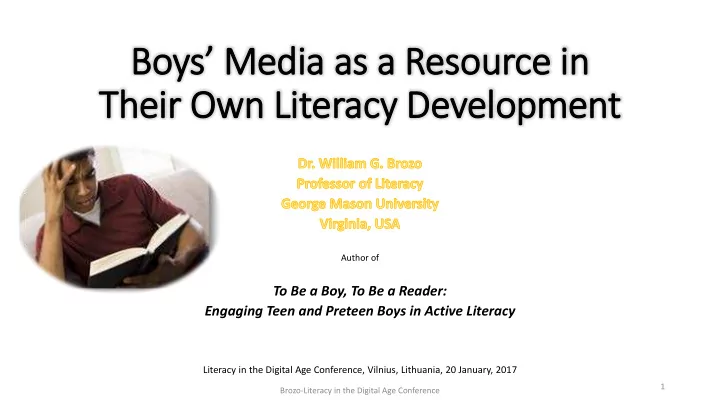
Boys’ s’ M Media a as s a Reso source i in Their O Own L Literacy D y Development t

Author of

To Be a Boy, To Be a Reader: Engaging Teen and Preteen Boys in Active Literacy

Literacy in the Digital Age Conference, Vilnius, Lithuania, 20 January, 2017

Brozo-Literacy in the Digital Age Conference 1

slide-2
SLIDE 2

Jacquis in As You Like It

And then the whining schoolboy with his satchel and shiny morning face creeping like a snail unwillingly to school. (Shakespeare, 1599)

2 Brozo-Literacy in the Digital Age Conference

Das Bildelement mit der Beziehungs-ID rId3 wurde in der Datei nicht gefunden.
slide-3
SLIDE 3

Reynaldo, a ninth-grader

I have no idea how my parents or someone else could get me to read, because I don’t like reading. No one ever read to me before I fell asleep. No one ever bought me a book

  • r some reading material they knew I might be into. And

no one ever said, “You can do it, man,” or something like that. (Washington, DC, 2010)

Brozo-Literacy in the Digital Age Conference 3

Das Bildelement mit der Beziehungs-ID rId2 wurde in der Datei nicht gefunden.
slide-4
SLIDE 4

2nd Edition of To be a Boy, To be a Reader: Engaging Teen and Preteen Boys in Active Literacy

Brozo-Literacy in the Digital Age Conference 4 To Be a Boy, To Be a Reader

slide-5
SLIDE 5

Brozo-Literacy in the Digital Age Conference 5

“A Bo A Boy’ y’s L Love ve of R f Rea eadi ding ng Doe

  • esn

sn’t ’t Begin gin with with Sc Scholar

  • larship…

ip… It B It Begin gins with s with Disc iscove

  • very”
slide-6
SLIDE 6

Why a an n adv dvoc

  • cacy pos

position toward bo boys’ l liter eracy cy de devel elopment?

Brozo-Literacy in the Digital Age Conference 6

slide-7
SLIDE 7

Soc Social & & Econ

  • nomic

c Justice ce

  • Immigrant boys have the lowest levels of

reading achievement

  • Boys from low-income households have

very low reading achievement

7 Brozo-Literacy in the Digital Age Conference

slide-8
SLIDE 8

Male Soc e Sociopathy

  • Males commit most suicides
  • Males perpetrate most homicides
  • Males commit most acts of family violence
  • Males comprise most of the homeless
  • Males comprise most drug addicts
  • Males comprise most AIDS carriers

*Low levels of literacy are often associated with these syndromes

8 Brozo-Literacy in the Digital Age Conference

slide-9
SLIDE 9

Liter eracy a and nd a academ demic a c achi hievem ement: T The U e U.S. S.

  • The average high school grade point average for girls is significantly higher

than for boys

  • Boys are almost twice as likely as girls to repeat a grade
  • Boys are twice as likely to get suspended as girls, and three times as likely to

be expelled

  • 25% more boys drop out of school than girls
  • Among whites, women earn 57% of bachelor’s degrees and 62% of master’s

degrees

  • Among African American women, the figures are 66% and 72%
  • On national writing tests, 32% of girls are considered “proficient” or better;

for boys, the figure is 16%

Brozo-Literacy in the Digital Age Conference 9

ement mit der Beziehungs-ID rId3 wurde in der Datei nicht gefunden.
slide-10
SLIDE 10

Liter erac acy a achiev evem ement: Gl Global ally

 Boys underperform relative to girls on most measures of verbal

ability at the primary and secondary school levels

 Boys comprise much greater percentage of weak readers on PISA

(Program for International Student Assessment) as compared with girls

 Boys have significantly lower levels of reading engagement than

girls

 One of the four major “gaps” to be addressed as identified by the

European High Level Group of Literacy Experts report

10 Brozo-Literacy in the Digital Age Conference

slide-11
SLIDE 11

Score P Point Difference ce i in n favor of r of Girl rls on PI

  • n PISA

for S Selec ected N Nor

  • rdic & Baltic C

Countries es

Estonia Finland Lithuania Norway Sweden OECD Average 2000 25 51 40 43 37 32 2009 44 55 59 47 46 39 2012 44 62 55 46 51 38 2015 28 47 39 40 39 27

Brozo-Literacy in the Digital Age Conference 11

s Bildelement mit der Beziehungs-ID rId2 wurde in der Datei nicht gefunden.
slide-12
SLIDE 12

Challenges t s to this p s posi sition: Insi sidious se s sexi xism

  • Males continue to dominate political, corporate, and institutional life

in the U.S., Europe and elsewhere in the world

  • As girls make significant strides academically and professionally,

advocates of boys’ academic needs ensure male primacy by regularly invoking “crisis” to rally popular support

12 Brozo-Literacy in the Digital Age Conference

slide-13
SLIDE 13

Challenges t s to this p s posi sition: Heg Hegem emoni

  • nic m

masculinity

  • “Boy-friendly” curricular schemes do little more than

perpetuate gender myths and stereotypes

  • Binary notions of gender as a basis for literacy curricular

decisions exclude all the different ways of “being male” or “being female”

13 Brozo-Literacy in the Digital Age Conference

slide-14
SLIDE 14

Framing the issue as a boy “crisis”… Or seeking to find responsive instruction for boys

“Failing to meet the literacy needs of all young boys isn’t so much a crisis as it is an imperative educational challenge. Furthermore, concerns about boys’ reading attitudes and achievement should be framed around more responsive literacy instruction and interactions for all children. Boys need to be engaged and capable readers not solely to be as good as

  • r better than girls, but to increase their educational, occupational, and

civic opportunities and, above all, to become thoughtful and resourceful men.” (Bright Beginnings for Boys, Zambo/Brozo, 2009)

Brozo-Literacy in the Digital Age Conference 14

Das Bildelement mit der Beziehungs-ID rId3 wurde in der Datei nicht gefunden. Das Bildelement mit der Beziehungs-ID rId3 wurde in der Datei nicht gefunden.
slide-15
SLIDE 15

Proposed causes f for b boys’ under derachi hievem emen ent

  • Peer pressure exerts a negative influence on boys who don’t see

reading as “cool”

  • Boys reading interests clash with more feminine curriculum texts
  • Boys’ media and texts are not valued in schools and classrooms
  • Male reading role models are absent in their peer group and at home
  • A largely female school workforce impacts on boys’ perceptions of

reading and their reading behavior

Brozo-Literacy in the Digital Age Conference 15

Das Bildelement mit der Beziehungs-ID rId2 wurde in der Datei nicht gefunden.
slide-16
SLIDE 16

Proposed causes f for b boys’ under derachi hievem emen ent

  • Girls are favored by assessment (See Rauch and Hartig, 2010 re: PISA)
  • Boys have more active learning styles that are less compatible with

traditional school-based reading and writing literacy

  • Boys’ challenges with proper classroom decorum influences teachers’

perceptions about their achievement and translate into lower grades for boys

Brozo-Literacy in the Digital Age Conference 16

Das Bildelement mit der Beziehungs-ID rId2 wurde in der Datei nicht gefunden.

Zyngier, D. (2009). Doing it to (for) boys (again): Do we really need more books telling us there is a problem with boys’ underachievement in education? Gender and Education, 21(1), 11-118.

slide-17
SLIDE 17

Are c classrooms more f favorab able t to girls?

According to Whitmire (Why Boys Fail: Saving Our Sons from an Educational System That's Leaving Them Behind, 2011):

  • Teaching methods are not designed to engage the minds of boys
  • Boredom is an all too familiar side effect of classroom teaching, which

leads to frustration and causes boys to exhibit behavioral problems and/or dislike of school According to Jones and Myhill (2004):

  • Teachers tend to associate boys with underachievement and girls with high

achievement According to Cornwell, Mustard, and Parys (2013):

  • Boys commonly display worse behavior than girls, which can cause

teachers to assign higher grades to girls over boys

Brozo-Literacy in the Digital Age Conference 17

Das Bildelement mit der Beziehungs-ID rId2 wurde in der Datei nicht gefunden.
slide-18
SLIDE 18

Cornwell, , C., , Mus ustard, D.B., , & Par arys, s, J J.V. (2013) 2013). Noncogniti tive skills a and the gender disparities in test scores a and teacher assessments: E : Evi vidence from primary school. Journa nal o

  • f Hum

uman n Resources es, , 48 48(1 (1), 2 ), 23-264. 264.

  • Analyzed the performance data on more than 5,800 students

from kindergarten through fifth grade on standardized tests in reading, math and science and linked test scores to teachers' assessments of their students' progress, both academically and more broadly

  • Gender disparities in teacher grades start early and uniformly

favor girls

  • In every subject area, boys were represented in grade

distributions below where their test scores would predict

Brozo-Literacy in the Digital Age Conference 18

Das Bildelement mit der Beziehungs-ID rId2 wurde in der Datei nicht gefunden.
slide-19
SLIDE 19

Cornwell, , C., , Mus ustard, D.B., , & Par arys, s, J J.V. (2013) 2013). Noncogniti tive skills a and the gender disparities in test scores a and teacher assessments: E : Evi vidence from primary school. Journa nal o

  • f Hum

uman n Resources es, , 48 48(1 (1), 2 ), 23-264. 264.

  • This misalignment is attributed to non-cognitive skills,
  • r "how well each child was engaged in the classroom,

how often the child externalized or internalized problems, how often the child lost control and how well the child developed interpersonal skills."

  • They also report evidence of a grade bonus for boys

with behavior similar to their girl counterparts

Brozo-Literacy in the Digital Age Conference 19

Das Bildelement mit der Beziehungs-ID rId2 wurde in der Datei nicht gefunden.
slide-20
SLIDE 20

Brozo-Literacy in the Digital Age Conference 20

Das Bildelement mit der Beziehungs-ID rId2 wurde in der Datei nicht gefunden.

Jan Steen’s The Feast of Saint Nicholas 1665-1668

Crying boy who must have been “naughty” receives coal in his shoe for Christmas Good little girl receives a dolly, fruits, and other presents

slide-21
SLIDE 21

Is boys’ u under derachi hievemen ent a a new p phenom enomenon? enon?

  • In the U.S., gender-based achievement disparities evident in the early

1940s (Stroud & Lindquist, 1942)

  • There may have always been a significant numbers of boys who have

underachieved; more noticeable since the decline of industry and manufacturing

  • Changes in the workplace focus attention on boys’ underachievement
  • -up until the 1970s low academic qualifications were not necessarily

a barrier to relatively high-paying jobs in manufacturing and industry

  • Today there is a direct correlation between low qualifications and

both joblessness and being trapped in low pay and unskilled work

Brozo-Literacy in the Digital Age Conference 21

Das Bildelement mit der Beziehungs-ID rId2 wurde in der Datei nicht gefunden.
slide-22
SLIDE 22

I haven't read any presidential

  • biographies. I despise reports that

run more than three pages, and my office doesn’t have any books

  • n the shelves…except my own.

Go on, try to sue me! Who says boys and men need to be active engaged readers to be successful?

Brozo-Literacy in the Digital Age Conference 22

“The man who does not read has no advantage over the man who cannot read.”

  • -Mark Twain
slide-23
SLIDE 23

Privileg ege e and R nd Rea eadi ding P g Profici ciency cy

  • Boys who grow up in families and communities with high levels of

class and status (according to social theorist Max Weber), and the privileges that come with these, have financial and social protections against disengaged literacy, aliteracy, poor academic performance, and lack of academic motivation

  • Boys without these protections, need to “read for their lives”

(according to Al Tatum)

Brozo-Literacy in the Digital Age Conference 23

Das Bildelement mit der Beziehungs-ID rId3 wurde in der Datei nicht gefunden.

Tatum, A. (2009). Reading for their life: (Re)building the textual lineages of African American adolescent males. Portsmouth, NH: Heinemann.

slide-24
SLIDE 24

Privileg ege a e and R d Readi ding P g Proficienc ency

  • Hill’s (2014) path analysis of 117 African-American males who

participated in PISA 2009 revealed a strong and significant direct effect of their fathers’ status and class on their sons’ print reading literacy proficiency

  • Overall reading scores of these Black male participants were linked

directly to the financial well-being and occupational status of their fathers

  • As Hill stated it: “The more material resources Black fathers’ can

provide to support their adolescent sons’ print reading literacy proficiency, the better they performed on PISA 2009 reading examination.”

Brozo-Literacy in the Digital Age Conference 24

Das Bildelement mit der Beziehungs-ID rId2 wurde in der Datei nicht gefunden.
slide-25
SLIDE 25

What a about t those se b boys w s without fi financia ial a l and soci cial privileg eges es?

  • Hernandez (2011) determined boys who can’t read on grade level by

3rd grade are four times less likely to graduate by age 19 than those who do read proficiently at that time

  • If boys who can’t read on grade level live in poverty, then they are 13

times less likely to graduate on time

  • Many of these dropouts find themselves among the ranks of the

United State’s growing prison population

Brozo-Literacy in the Digital Age Conference 25

Das Bildelement mit der Beziehungs-ID rId2 wurde in der Datei nicht gefunden.
slide-26
SLIDE 26

What a about ut t those b e boys w without

  • ut f

financ ncial a and s d social privileg eges es?

  • Sum and his colleagues (2009) found that about 1 in every 10

young male high school dropout is in jail or juvenile detention centers as compared to one in 35 young male high school graduates

  • The picture is even bleaker for African-Americans, with

nearly 1 in 4 young black male dropouts incarcerated or

  • therwise institutionalized on an average day

Brozo-Literacy in the Digital Age Conference 26

Das Bildelement mit der Beziehungs-ID rId2 wurde in der Datei nicht gefunden.
slide-27
SLIDE 27

What a about ut t those b e boys w without

  • ut f

financ ncial a and s d social privileg eges es?

  • There is an undeniable relationship between lack of

literacy and the probability of being imprisoned in the U.S.

  • Cohen (2010) has shown that more than 60% of

America’s inmates are illiterate, and 85% of all juvenile

  • ffenders have reading problems

Brozo-Literacy in the Digital Age Conference 27

Das Bildelement mit der Beziehungs-ID rId3 wurde in der Datei nicht gefunden.
slide-28
SLIDE 28

The higher boys’ PISA scores at age 15, the more likely they are to:

 Enroll in post-secondary education  Choose more complex and higher-status major

areas of study in post-secondary education

 Complete higher education, which slows skill loss as

they age

 Have high earnings and low unemployment rates  Speak two languages resulting in a salary premium

Brozo-Literacy in the Digital Age Conference 28

slide-29
SLIDE 29

Wha hat do bo do boys des desire i e in a n a liter eracy c cur urricu culum?

  • Blair & Sanford (2002)
  • Canadian elementary school boys were tracked
  • ver three years.
  • They were interviewed, observed in their

classrooms, and observed during classroom literacy activities in which the boys were engaged

Brozo-Literacy in the Digital Age Conference 29

Das Bildelement mit der Beziehungs-ID rId3 wurde in der Datei nicht gefunden.
slide-30
SLIDE 30

Wha hat do bo do boys des desire i e in a n a liter eracy c cur urricu culum?

Analysis revealed five themes around which the boys’ literacy practices were constructed and which teachers would need to incorporate into their instructional activities to engage boys:

  • personal interest
  • action
  • success
  • fun
  • purpose

Brozo-Literacy in the Digital Age Conference 30

slide-31
SLIDE 31

Boys and New Literacies

 Definitions of literacy are expanding to include digital

literacies, youth media, and virtually any act of meaning making as “reading.”

 Evidence can be found for male youth participating

actively in the “mediasphere”

 Boys’ expertise with digital and media literacy may not be

privileged and/ or valued in most academic contexts

Brozo-Literacy in the Digital Age Conference 31

slide-32
SLIDE 32

PISA 2009: Elec ectronic R Rea eadi ding & g & Gend ender er

  • 16 OECD countries took part in both assessments
  • Girls outperformed boys by 38 points – the equivalent of one year of

formal schooling – in print reading, but by 24 points in digital reading.

  • In each country, the increase in the percentage of top performers in

digital reading over print reading was always greater among boys than among girls, as was the reduction in the percentage of poor performers.

  • For girls and boys who were similarly proficient in print reading, boys

scored an average of six points higher in digital reading.

Brozo-Literacy in the Digital Age Conference 32

Das Bildelement mit der Beziehungs-ID rId2 wurde in der Datei nicht gefunden.
slide-33
SLIDE 33

PISA 2009: Elec ectronic R Rea eadi ding & g & Gend ender er

  • Boys appear to be more competent than girls in

selecting, organizing, and navigating pieces of information found in hypertexts

  • Boys’ interest and abilities in digital reading could

be exploited

  • More frequent reading of digital texts could result in

greater enjoyment of reading and better proficiency in print reading

Brozo-Literacy in the Digital Age Conference 33

Das Bildelement mit der Beziehungs-ID rId2 wurde in der Datei nicht gefunden.
slide-34
SLIDE 34

Bo Boys in t n the he Medi ediaspher ere

  • O’Brien has demonstrated how boys who fail with traditional school

literacy tasks demonstrate literacy skills and competencies with their

  • wn media and technology
  • Importance of creating spaces in schools for striving male readers’

everyday literacies so they can showcase and build on their strengths with the print and digital media they use on their own

  • O’Brien, D. (2001, June). “At-risk” adolescents: Redefining competence through the multiliteracies of intermediality, visual

arts, and representation. Reading Online, 4(11).

  • O’Brien, D. (2003, March). Juxtaposing traditional and intermedial literacies to redefine the competence of struggling
  • adolescents. Reading Online, 6(7).

Brozo-Literacy in the Digital Age Conference 34

slide-35
SLIDE 35

Brozo-Literacy in the Digital Age Conference 35

“Dane”

Science – D Math – D English – C History – D+ PE - B Tardy often, Several detentions

slide-36
SLIDE 36

Dane’ e’s l s literate p e practi ctices s outside o e of sch chool: Ra Rappin’ w with h his “Wingmen en”

This beat ain’t right,” Dane tells Kwame and Jovan, stopping his rap after just a few lines. “It’s gotta be more lazy for the mood I’m trying to create.” “That’s cause you lazy,” Jovan quips, leaving the three of them laughing. Dane and his two friends are in a small room adjacent to Dane’s bedroom that has become a make-shift recording studio. Kwame searches another website where they usually find the best beats and calls up a slower, almost jazzy one with a muted though emphatic bass. Jovan returns to the cheap Casio keyboard, the one he had since he was a kid, that he excavated from the back of his closet, and puts down a repeating pattern of chords to go with the beat. Dane, using the handle King Negus, smiles, shifts his head from side to side with the rhythm, and restarts his rap:

BROZO, W.G. (2013). The many faces of Dane: Viewing boys as a resource in their own literacy

  • development. In N. Nilsson & S. Gandy (Eds.), Struggling readers can succeed: Teaching solutions based on

real kids in classrooms and communities. Information Age Publishing.

Brozo-Literacy in the Digital Age Conference 36

Das Bildelement mit der Beziehungs-ID rId2 wurde in der Datei nicht gefunden.
slide-37
SLIDE 37

Da Dane’s l liter erate p e practices es o

  • utside o

e of school: Rappi pin’ ’ with h his s “W “Wingmen”

One plus two plus three ways to be It don’ matter to me ‘cause I’m divisible by three Other brothas wanna be one thing, one thing only But there’s a whole lotta lonely in acting one way Thinking one way like this is yo last day to live Give, unable to deliver when somethin’ new Comes yo way When I was a kid I got these faces from my dad One had a smile one was sad Like my face when my rap goes down Or goes down in flames…

Brozo-Literacy in the Digital Age Conference 37

slide-38
SLIDE 38

Take advantage of boys’ relative strengths with media and literacy outside of school

  • playing computer and video games
  • reading comic books and graphic novels
  • reading related to their hobbies (skateboarding,

collecting, sports, Rubik’s Cube)

  • listening to music and reading and writing song

lyrics

Brozo-Literacy in the Digital Age Conference 38

Das Bildelement mit der Beziehungs-ID rId3 wurde in der Datei nicht gefunden.
slide-39
SLIDE 39

Brozo-Literacy in the Digital Age Conference 39

Sirasak By eliminating barriers between students’ competencies with outside-

  • f-school texts and classroom

practices it is possible to increase engagement in learning and expand literacy abilities for striving readers (Sturtevant, Boyd, Brozo, Hinchman, Alvermann, & Moore, 2006).

Bridge Competencies with Familiar Texts to Academic Literacy

slide-40
SLIDE 40

Rea eader ders t thea heater er with gr graphic c novel to to imp mprov

  • ve

fluency cy a and nd ha have e fun un

Brozo-Literacy in the Digital Age Conference 40

Timofey, Sirasak, Fabrizzio

slide-41
SLIDE 41

Reader ders T Theater er w with c h comic book v version o

  • n of The

e Odys yssey y to increa ease c e compreh ehen ension an and h have fun un

Brozo-Literacy in the Digital Age Conference 41

slide-42
SLIDE 42

Reader ders T Theater er w with c h comic book v version o

  • n of The

e Odys yssey y to increa ease c e compreh ehen ension an and h have fun un

Brozo-Literacy in the Digital Age Conference 42

slide-43
SLIDE 43

Br Bridge Bo Books a and nd T Texts

  • Goal is to motivate reluctant and disinterested boys to read

required academic texts

  • Canonical and required texts, even if “readable,” may turn

boys off to reading without prior exposure to bridge texts

  • Transition boys into challenging academic texts with texts that

are engaging and put knowledge bases in place for academic literate tasks

43 Brozo-Literacy in the Digital Age Conference

slide-44
SLIDE 44

Brozo-Literacy in the Digital Age Conference 44

Professional Note

My newest book with Teachers College Press demonstrates how to integrate graphic novels into the four major disciplines. This approach appears to have particular appeal to boys.

slide-45
SLIDE 45

Brozo-Literacy in the Digital Age Conference 45

slide-46
SLIDE 46

46 Brozo-Literacy in the Digital Age Conference

slide-47
SLIDE 47
  • United States Poet Laureate, Natasha Trethewey –

poems set in New Orleans in early 20th century

  • Graphic Novel about Katrina
  • Story of Islamic man’s generosity after the New

Orleans’ flood and then is a victim of racial profiling

47 Brozo-Literacy in the Digital Age Conference

Das Bildelement mit der Beziehungs-ID rId2 wurde in der Datei nicht gefunden.
slide-48
SLIDE 48

48

The full text of a roadmap to peace in the Middle East, presented to Palestinian and Israeli leaders by Quartet mediators - the United Nations, European Union, United States and

  • Russia. A

performance-based roadmap to a permanent two- state solution to the Israeli-Palestinian conflict

http://newsvote.bbc.co.uk/mpapps/pagetools/print/news.bbc.co.uk/2/hi/middle_east/2989783.stm Brozo-Literacy in the Digital Age Conference

slide-49
SLIDE 49
  • Poetry of Palestinian poet, Mahmoud Darwish
  • Graphic Novel about Palestine
  • Road Map to Peace to settle the Israeli-

Palestinian conflict

49 Brozo-Literacy in the Digital Age Conference

Das Bildelement mit der Beziehungs-ID rId2 wurde in der Datei nicht gefunden.
slide-50
SLIDE 50

Brozo-Literacy in the Digital Age Conference 50

slide-51
SLIDE 51

The he O Ody dyssey

  • Homer’s original epic poem
  • Graphic novel about Ulysses (Roman version of

Odysseus)

  • Enrique’s Journey, Sonia Nazario’s novel about

a Honduran boy’s own epic journey to find his mother in the United States

Brozo-Literacy in the Digital Age Conference 51

Das Bildelement mit der Beziehungs-ID rId2 wurde in der Datei nicht gefunden.
slide-52
SLIDE 52

Graphic N Novel el as Br Bridge T e Text in Histor

  • ry:

Cas ase S Study

  • “Mr. Brown” – American History teacher
  • Incorporated graphic novels into units and lessons
  • Had students read Incognegro (Pleece, 2008) in connection with a study of

pre-Civil Rights era southern U.S.

  • Students also read To Kill a Mockingbird and Letter from a Birmingham Jail
  • “Dane” – 10th grader in Mr. Brown’s history class, unmotivated,

struggling reader, African-American

Brozo-Literacy in the Digital Age Conference 52

Das Bildelement mit der Beziehungs-ID rId2 wurde in der Datei nicht gefunden.
slide-53
SLIDE 53

53

“Letter from a Birmingham Jail”

To Kill a Mockingbird

Incognegro

Brozo-Literacy in the Digital Age Conference

slide-54
SLIDE 54

54 Brozo-Literacy in the Digital Age Conference

slide-55
SLIDE 55

Dane’ ne’s jour

  • urnal r

res esponse e to

  • Incog
  • gne

negro

The main character is a real light colored Black guy named Zane

  • Pinchback. So am I. My mother is white. She’s from Germany and my

father was from Ethiopia. Some kids with tans look darker than me. My hair is curly but not kinky. My mom is cool about who I hang out

  • with. My friends are all Black. I also like this book because it’s a

graphic novel. For me, these kind of books are a lot easier to read. I can read the words and if I’m not sure what’s going on or if the dialog isn’t too interesting, I can also look at the illustrations. The illustrations in this book are awesome. They really help you get into the story.

Brozo-Literacy in the Digital Age Conference 55

Das Bildelement mit der Beziehungs-ID rId2 wurde in der Datei nicht gefunden.
slide-56
SLIDE 56

Dane’ ne’s jour

  • urnal r

res esponse e to

  • Incog
  • gne

negro

I have a lot of respect for Blacks who fought for civil rights. They risked their lives. Zane is afraid whites will figure out he’s black, but he does what he can for his brother anyway. Reading about Zane and looking at the drawings of him, his brother, the angry whites and the other people made the book so real. Could I ever show the kind of courage Zane does or all those people who fought for their rights? I don’t

  • know. But I think I am strong enough and proud enough. There’s one

part of the book where Zane is looking right into your eyes. He is in Mississippi and he has found out who really killed the white woman. When I look into Zane’s eyes in that picture, it’s like I can see myself. He’s scared but confident that he must do the right thing.

Brozo-Literacy in the Digital Age Conference 56

Das Bildelement mit der Beziehungs-ID rId2 wurde in der Datei nicht gefunden.
slide-57
SLIDE 57

Graphi phic N Novel el as Bridg dge T Text i in S Scienc ence: e: Case S Study udy

  • Where

8th grade science class in a suburban community in the national capital region

  • Who

Melissa—the science teacher, doctoral student in literacy/policy, former engineer Students—culturally and ethnically diverse group; 10% Els

  • Gender Ratio

24 total: 17 boys; 7 girls BROZO, W.G., & MAYVILLE, M. (2012). Reforming secondary disciplinary instruction with graphic novels. New England Reading Association Journal, 48(1), 11-21.

Brozo-Literacy in the Digital Age Conference 57

Das Bildelement mit der Beziehungs-ID rId3 wurde in der Datei nicht gefunden.
slide-58
SLIDE 58

Grap aphic N Novel in S Science

  • Background
  • Melissa concerned about a mismatch between the school-

provided texts and the reading abilities and interests of her students.

  • Assigned textbook was written at a level that exceeded the

abilities of many of her students, especially English Learners (ELs), struggling readers, and reluctant readers—most of whom were boys

Brozo-Literacy in the Digital Age Conference 58

Das Bildelement mit der Beziehungs-ID rId2 wurde in der Datei nicht gefunden.
slide-59
SLIDE 59

Grap aphic N Novel in S Science

  • Melissa made alternative texts available to her students at a

lower reading level than the textbook

  • Many boys, who could have benefited from these texts

rejected them because their peers perceived them as “easy stuff” or “baby books”

Brozo-Literacy in the Digital Age Conference 59

Das Bildelement mit der Beziehungs-ID rId2 wurde in der Datei nicht gefunden.
slide-60
SLIDE 60

Grap aphic N Novel in S Science

  • Examined the results of state-level test data to isolate a

curricular area in science—in this case, chemical reactions-

  • which was problematic for her students and decided to

use a graphic novel that was related to that curricular strand

  • Finding a science graphic novel that was appropriate for

her eighth grade science class involved visits to the school and local public libraries, as well as extensive Internet searches

Brozo-Literacy in the Digital Age Conference 60

Das Bildelement mit der Beziehungs-ID rId2 wurde in der Datei nicht gefunden.
slide-61
SLIDE 61

Grap aphic N Novel in S Science

  • The Materials & Method
  • Graphic novel: Chemical Reactions with Max Axiom (Biskup, 2011)
  • Written in a story format, with textbook features that include a table of

contents, a glossary and suggestions for further reading

  • Main character is Max Axiom, an African American scientist working in an

innovative laboratory, and just the kind of character who could make the science of chemical reactions interesting for her students

  • Illustrations are vivid and the vocabulary-rich; text is broken into frames and

supported by insets that reinforce vocabulary and important concepts.

Brozo-Literacy in the Digital Age Conference 61

Das Bildelement mit der Beziehungs-ID rId2 wurde in der Datei nicht gefunden.
slide-62
SLIDE 62

Brozo-Literacy in the Digital Age Conference 62

Using powers he acquired in a freak accident, Max teaches science in ways never before seen in a classroom. Whether shrinking to explore an atom or riding on a sound wave, Max does what it takes to make science super cool.

slide-63
SLIDE 63

Grap aphic N Novel in S Science

  • Using the graphic novel, Melissa’s goal was to help students

attain a deeper understanding of the new vocabulary and to reinforce the familiar vocabulary on chemical reactions

  • One week unit
  • In addition to the graphic novel for this unit, a variety of

materials, including class textbook, magazine articles, and video were used

Brozo-Literacy in the Digital Age Conference 63

Das Bildelement mit der Beziehungs-ID rId3 wurde in der Datei nicht gefunden.
slide-64
SLIDE 64

Graphi phic Novel el i in Scienc ence

Overall Findings

  • Of particular interest was how a handful of the boys who

were generally indifferent to class activities and assignments were much more engaged during this unit

  • The test, quiz, and assignment grades for these students

were well above their average scores on previous units

  • This was encouraging, since the unit on chemical reactions

always posed significant challenges to the students, especially struggling ones

Brozo-Literacy in the Digital Age Conference 64

Das Bildelement mit der Beziehungs-ID rId2 wurde in der Datei nicht gefunden.
slide-65
SLIDE 65

Bo Boys’ Com Comments a abou bout t the he Uni nit

  • Miguel

“My English isn’t good, but Max Axiom had pictures that showed me what I needed to know.”

  • Louis

“The book is too hard; this was a lot easier.”

  • Dre

“Max is cool. He shows you stuff you can’t get in the book. I got a good grade over it.”

  • Manolo

“This is the first book (in English) I read all the way through.”

Brozo-Literacy in the Digital Age Conference 65

Das Bildelement mit der Beziehungs-ID rId2 wurde in der Datei nicht gefunden.
slide-66
SLIDE 66

With the American rapper Snoop Dogg’s lyrics for “I Love to Give You Light” a 7th grade special reading class of mostly boys found numerous examples of words with /ck/ and /ch/

  • blends. These words were written into a t-chart in their vocabulary notebooks.

Popular Music as Context New Vocabulary

ch ck such preach chuuch teachin watchin each preachin reach purchase beach child background jackers glock block locked black

Brozo-Literacy in the Digital Age Conference 66

Popular Music as Contexts for Learning and Using Vocabulary

slide-67
SLIDE 67

Popular Music as Context for Learning and Using New Vocabulary

  • The students worked with a partner to think of new words with the /ch/ and /ck/

sounds and add them to the t-chart.

  • Student pairs then wrote their own rap lyrics that contained all or some of the new

words they generated for the two word families.

  • As one student read the rap the other kept rhythm on his desk top:

I put my socks in my backpack when I go to school. I put my backpack in my locker or I look like a fool. I get my socks from my backpack when I go to gym Where I catch the ball then stick it in the rim.

Das Bildelement mit der Beziehungs-ID rId3 wurde in der Datei nicht gefunden.

 As a result, students were better able to recognize and pronounce words with these elements that they encountered in their school-related and everyday reading.

67 Brozo-Literacy in the Digital Age Conference

Das Bildelement mit der Beziehungs-ID rId3 wurde in der Datei nicht gefunden.
slide-68
SLIDE 68

Cro ross-age a e and nd r rea eadi ding bu buddies es

Brozo-Literacy in the Digital Age Conference 68

“The most potent benefit of such a program (cross-age tutoring partnership program) is that it imbues struggling readers with a sense of responsibility and purpose for improving their own abilities” --Brozo & Hargis, (2003)

slide-69
SLIDE 69
  • Gender- and cultural-matched role models have the

most positive effect on educational outcomes (Zirkel, 2002) and are sorely needed in the lives of many boys (Brozo, 2010)

Brozo-Literacy in the Digital Age Conference

Reading Buddies for Boys

69

slide-70
SLIDE 70

Brozo-Literacy in the Digital Age Conference 70

COMPONENTS OF A CROSS-AGE BUDDY READING PROGRAM FOR BOYS

  • One older struggling male reader paired with one younger novice or struggling reader
  • Older student prepares reading material and strategies
  • Reads to and with younger male student, helping with word attack and comprehension
  • Makes a book or some other project together based on younger student’s interests and

experiences

  • One to three sessions per week
  • Can occur in the school or public library
slide-71
SLIDE 71

Rea eadi ding Bu g Buddies es

  • 17-year-old Tremayne & 2nd grader LaBron in a cross-age tutoring program
  • Read about and researched Chicago Bears American football team and

players

  • Led to reading about performance enhancement drugs, steroids
  • Explored the exaggeratedly muscled heroes and villains in computer

games, such as True Crime: Streets of LA (Activision), WWF Wrestlemania (THQ), Take No Prisoners (Red Orb), The Hulk (Vivendi-Universal), Army Men: Sarge's Heroes (3DO), and X-Men: Mutant Academy (Activision)

Brozo-Literacy in the Digital Age Conference 71

slide-72
SLIDE 72

Rea eadi ding Bu g Buddies es

  • Pictures were then downloaded into Adobe Photoshop so they could be

altered

  • Tremayne and LaBron learned how to rework the main characters'

physiques, reshaping them in ways that were more proportional to normal muscle development

  • They displayed their work in a PowerPoint presentation with "before"

slides, accompanied by captions warning of the dangers of steroids and

  • ther illegal substances for building muscle, and "after" slides with

statements about good health, diet, and fitness

Brozo-Literacy in the Digital Age Conference 72

slide-73
SLIDE 73

Brozo-Literacy in the Digital Age Conference 73

FINAL THOUGHTS ABOUT BOYS AND READING…

  • Discover who each boy is individually
  • Focus attention on boys who are the neediest, the most vulnerable, the most reluctant readers
  • Find the right reading material, at the right levels, and offer it in the right ways
  • Respect boys’ interests in texts and media and work cooperatively to gain and hold boys’

interests

  • Support relationships between younger and older boys and men who can model the pleasures

and benefits of active literacy

  • View boys as a resource in their own literacy development to improve the chances of elevating

their achievement

slide-74
SLIDE 74

Brozo-Literacy in the Digital Age Conference 74

slide-75
SLIDE 75

References

  • Sarroub, L.K., & Pernicek, T. (2014). Boys, books, and boredom: A case of three

high school boys and their encounters with literacy. Reading & Writing Quarterly, 1-29.

  • Tatum, A.W. & Muhammad, G. (2012). African American males and literacy

development in contexts that are characteristically urban. Urban Education, 47(2), 434-463.

  • Chudowsky, N., & Chudowsky, V. (2010). State text score trends through 2007-08,

Part 5: Are There differences in achievement between boys and girls? Washington, DC: Center on Education Policy.

  • Lietz, P. (2006). A meta-analysis of gender differences in reading achievement at

the secondary school level. Studies in Educational Evaluation, 32(4), 317-344.

  • White, B. (2007). Are girls better readers than boys? Which boys? Which girls?

Canadian Journal of Education, 30(2), 554-581.

Brozo-Literacy in the Digital Age Conference 75

slide-76
SLIDE 76

References

  • Harris, T. S., & Graves Jr, S. L. (2010). The influence of cultural capital

transmission on reading achievement in African American fifth grade

  • boys. The Journal of Negro Education, 447-457.
  • Logan, S., & Johnston, R. (2009). Gender differences in reading ability

and attitudes: Examining where these differences lie. Journal of Research in Reading, 32(2), 199-214.

  • Peterson, S. S., & Parr, J. M. (2012). Gender and literacy issues and

research: Placing the spotlight on writing. Journal of Writing Research, 3(3), 151-161.

  • Wheldall, K., & Limbrick, L. (2010). Do more boys than girls have

reading problems? Journal of Learning Disabilities, 43(5), 418-429.

Brozo-Literacy in the Digital Age Conference 76

slide-77
SLIDE 77

References

  • Husband, T. (2012). Addressing reading underachievement in African

American boys through a multi-contextual approach. Reading Horizons, 52(1), 1-25.

  • Sokal, L. (2010). Long-term effects of male reading tutors, choice of text

and computer-based text on boys’ reading achievement. Language and Literacy, 12(1), 116-127.

  • Sokal, L., Thiem, C., Crampton, A., & Katz, H. (2009). Differential effects of

male and female reading tutors based on boys’ gendered views of reading. Canadian Journal of Education, 32(2), 245-270.

  • Sokal, L., Katz, H., Chaszewski, L., & Wojcik, C. (2007). Good-bye, Mr. Chips:

male teacher shortages and boys’ reading achievement. Sex roles, 56(9-10), 651-659.

Brozo-Literacy in the Digital Age Conference 77

slide-78
SLIDE 78

References

  • Sun, Y., Zhang, J., & Scardamalia, M. (2010). Developing deep

understanding and literacy while addressing a gender-based literacy gap. Canadian Journal of Learning and Technology/La revue canadienne de l’apprentissage et de la technologie, 36(1), 1-20.

  • Sokal, L., & Katz, H. (2008). Effects of technology and male teachers on

boys' reading. Australian Journal of Education, 52(1), 81-94.

  • Kirkland, D. E., & Jackson, A. (2009). “We real cool”: Toward a theory of

Black masculine literacies. Reading Research Quarterly, 44(3), 278-297.

  • Harrison, B. (2010). Boys and literature: Challenging constructions of
  • masculinity. New Zealand Journal of Educational Studies, 45(2), 47-60.
  • Moeller, R. A. (2011). “Aren't these boy books?”: High school students'

readings of gender in graphic novels. Journal of Adolescent & Adult Literacy, 54(7), 476-484.

Brozo-Literacy in the Digital Age Conference 78

slide-79
SLIDE 79

References

  • Watson, A. (2011). Not just a ‘boy problem’: an exploration of the

complexities surrounding literacy under-achievement. Discourse: Studies in the Cultural Politics of Education, 32(5), 779-795.

  • Steinkuehler, C., & King, E. (2009). Digital literacies for the disengaged:

creating after school contexts to support boys' game-based literacy skills. On the Horizon, 17(1), 47-59.

  • Moss, G. (2011). Policy and the search for explanations for the gender gap

in literacy attainment. Literacy, 45(3), 111-118.

  • Gibb, S. J., Fergusson, D. M., & Horwood, L. J. (2008). Gender differences in

educational achievement to age 25. Australian Journal of Education, 52(1), 63-80.

  • Jones, S. (2012). Mapping the landscape: Gender and the writing
  • classroom. Journal of Writing Research, 33, 161-179.

Brozo-Literacy in the Digital Age Conference 79

slide-80
SLIDE 80

References

  • Limbrick, L., Wheldall, K., & Madelaine, A. (2011). Why do more boys than girls

have a reading disability? A review of the evidence. Australasian Journal of Special Education, 35(1), 1-24.

  • Ma, X. (2008). Within-school gender gaps in reading, mathematics, and science
  • literacy. Comparative Education Review, 52(3), 437-460.
  • Brozo, G.W., Sulkunen, S., Shiel G., Garbe C., Pandian A., & Valtin, R., (2014)

Reading, Gender, and Engagement: Lessons from five PISA countries. Journal of Adolescent & Adult, 57(7), 584-593.

  • Stroud, J.B., & E.F. Lindquist, E.F. (1942). Sex differences in achievement in the

elementary and secondary schools. Journal of Educational Psychology, 33(9), 657- 667.

  • Jones, S., & Myhill, D. (2004). ‘Troublesome boys’ and ‘compliant girls’: Gender

identity and perceptions of achievement and underachievement. British Journal

  • f Sociology of Education, 25(5), 547-561.

Brozo-Literacy in the Digital Age Conference 80