Box 5 (section 2): Assessment Medications a. Postural Hypotension - - PowerPoint PPT Presentation

box 5 section 2 assessment
SMART_READER_LITE
LIVE PREVIEW

Box 5 (section 2): Assessment Medications a. Postural Hypotension - - PowerPoint PPT Presentation

Box 5 (section 2): Assessment Medications a. Postural Hypotension b. Gait, balance, mobility and muscle strength c. TUG and Chair Stand a. Evaluate Pain related mobility decreases b. Visual Acuity d. Other Neurological Impairments e.


slide-1
SLIDE 1

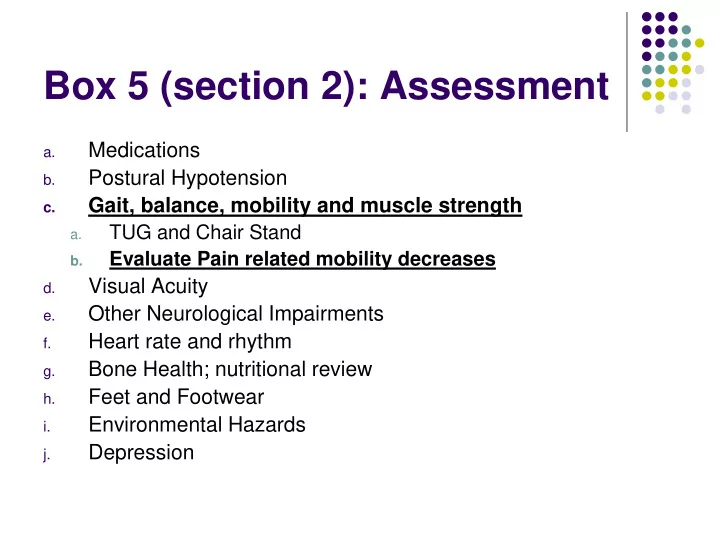
Box 5 (section 2): Assessment

a.

Medications

b.

Postural Hypotension

c.

Gait, balance, mobility and muscle strength

a.

TUG and Chair Stand

b.

Evaluate Pain related mobility decreases

d.

Visual Acuity

e.

Other Neurological Impairments

f.

Heart rate and rhythm

g.

Bone Health; nutritional review

h.

Feet and Footwear

i.

Environmental Hazards

j.

Depression

slide-2
SLIDE 2

Box 5 – 2c. Gait, balance, mobility and muscle strength

 Romberg  Get Up and Go  Timed Up and Go  30 second Chair Stand Test  Question?

 Which, if any, of these do you feel are useful in

clinical practice?

slide-3
SLIDE 3

Romberg's Test

is NOT a test of cerebellar function

 It is a test of the proprioception receptors and

pathways function.

slide-4
SLIDE 4

Romberg’s Test

 What is Being Tested in the Romberg Test?

With the eyes open, three sensory systems provide input to the cerebellum to maintain truncal stability. These are vision, proprioception, and vestibular sense. Proprioception-The brain's awareness of a joint's or limb's position in relation to the rest of the body Vestibular Sense- Equilibrium

slide-5
SLIDE 5

EYES CLOSED

 If there is a mild lesion in the Vestibular or

Proprioception systems, one is usually able to compensate with the eyes open. With the eyes closed, however, visual input is removed and instability can be brought out.

 Increased swaying with eyes closed

would indicate postural position sense is affected, posterior column disease or a peripheral neuropathy.

slide-6
SLIDE 6

 When you do the Romberg

maneuver, you need to stand close to the patient and be ready to catch them in case they fall

slide-7
SLIDE 7

Romberg Test

Instructions:

 Stand with feet together, arms to the side,

and eyes open.

 Observe for substantial postural sway or

break in position

 Instruct to: close eyes and maintain that

position with closed eyes

slide-8
SLIDE 8

Romberg Test Scoring

 Romberg Sign- Present or Absent  Present- if the sway is considerable and/or

the patient breaks position.

 (note- patients unable to stand with feet

together while eyes are open are untestable)

 Absent- perform task with no sway or

minimal sway without breaking position

slide-9
SLIDE 9

Get Up and Go Test

The "Get Up and Go" test was developed by Mathias, Nayak, and Issacs in 1986.

 A general physical performance test

used to assess mobility, balance and locomotor performance in elderly people with balance disturbances. More specifically, it assesses the ability to perform sequential motor tasks relative to walking and turning

slide-10
SLIDE 10

GET UP AND GO TEST

 A simple & practical performance

measure of gait & balance

 Standardizes most of the “basic

mobility” tasks

 Subject is observed while he rises

from a chair, walks 3 meters & returns to the chair

slide-11
SLIDE 11

PROCEDURE

 Place a straight-back chair 3 meters from

and facing the wall (preferably one that does not have a seat which slants back)

  • 1. Ask senior to rise from chair, without

using arms for support & stand still for a moment

  • 2. Walk towards the wall

3.Turn without touching the wall & walk back to the chair& sit down

slide-12
SLIDE 12

Get Up and Go

Observe rising from chair-watch the speed

  • f rising, do they need assistance or a

boost, watch their shoulders to see if they lean forward on rising. Are you worried they might fall.?

slide-13
SLIDE 13

Get Up and Go

 Standing- what is their stance?, do they lean

to one side?, do they sway?, do they have any balance problems?, are you worried they might fall?

 Check for postural abnormalities  Do they complain of pain standing still?

slide-14
SLIDE 14

Get Up and Go

 Walking-watch the height and width of their

steps, are their steps irregular?, can they maintain their balance while walking?, are you worried they might fall? Look for asymmetric arm swing, abnormal arm and hand postures, and instability of the trunk. Hesitancy might suggest Parkinson's.

 Decreased step height might suggest CNS

disease, multiple Sensory deficits, Fear of Falling, Parkinson's, NPH, Habit. Path deviation might suggest Cerebellar disease, multiple Sensory deficits, sensory or motor Ataxia

slide-15
SLIDE 15

Get Up and Go

 Turning-watch the speed of turning

steadiness and number of foot placements needed to complete the turn.

 Are you worried they might fall?

Unsteadiness may suggest Parkinson's, multiple Sensory deficits, Cerebellar disease, Hemiparesis, loss of Visual Field, Ataxia

slide-16
SLIDE 16

Get Up and Go

 Sitting Down- watch if descent is

smooth, is the speed of descent normal, do they lean forward to sit?, do they need to hold onto the chair?, are you worried they may fall?

 Misjudgment of distance or falling into

chair could alert to decreased Vision, proximal Myopathy or Ataxia

slide-17
SLIDE 17

Uses chair to sit, does not control descent, nearly misses chair

Slow descent, hesitates or pauses during descent Smooth decent, does not use chair for support

Sitting down

More than 6 foot placements to turn or cannot safely execute turn, staggers

Slowness, hesitation, 4-5 foot placements to turn No hesitation, takes 2-3 foot placeme ments to turn

Turning

Severe trunk sway (5- 10 degrees), reaches

  • ut hand to balance,

staggers

Wide stance, irregular posture No signs of instability

Standing

Uses assist throughout rising, leans forward Uses assist to begin rising No slowness (< 4sec) or hesitancy

Rising from chair Mod/Severely Abnormal Mild Abnormalities Normal Maneuver

Get Up and Go Check List

slide-18
SLIDE 18

Scoring of Get up and Go

 It can be scored qualitatively  Normal or Abnormal

 Or on a scale from 1- 5

l (normal ) 2 (slightly abnormal) 3 (mildly abnormal) 4 (moderately abnormal) 5 (severely abnormal)

slide-19
SLIDE 19

TUG Timed Up and Go Test

  • The TUG was published by Podsiadlo

and Richardson in 1991 to address the issues of poor inter-rater reliability

  • bserved with intermediate scores in the

"Get Up and Go". The TUG incorporates time as the measuring component to assess general balance and function.

slide-20
SLIDE 20

TUG Timed Up and GO Test

 Uses standard chair with armrests (46 cm

seat height and 63-65 cm armrest height)

 Tape Measure and marker for distance  3 m path free of obstruction  Stop watch  One practice trial is permitted

 Senior wears their regular footwear and

uses their regular walking aids. No physical assistance is given.

slide-21
SLIDE 21

TUG Directions

 Begin with subject sitting correctly in

the chair, back resting against the back of the chair.

 “On the word GO you will stand up,

walk to the line on the floor, turn around and walk back to the chair. Walk at your regular pace”

slide-22
SLIDE 22

Time

 There is no time limit- may stop and rest

but not sit down

 Healthy elderly usually complete the task in

10 seconds or less

 Very frail or weak elderly with poor mobility

may take 2 minutes or more

slide-23
SLIDE 23

TUG scoring

Steffen, Hacker and Mollinger (2002) reported that on average, healthy individuals between the ages of 60-80 years complete the TUG in 10 seconds

  • r less.

Standardized cut-off scores to predict risk of falling -In one study, a cut-off score of ≥ 13.5 seconds was shown to predict falling in community-dwelling frail elders (Shumway-Cook et al., 2000).

slide-24
SLIDE 24

The 30-second Chair Stand Test

Purpose: To assess leg strength and endurance.

Equipment:

A chair with a straight back without arm rests (seat 17” high)

A stopwatch

Instructions to the patient:

  • 1. Sit in the middle of the chair.

  • 2. Place your hands on the opposite

shoulder crossed at the wrists.

  • 3. Keep your feet flat on the floor.

  • 4. Keep your back straight.
  • 5. On “Go”, rise to a full standing position
  • and then sit back down again.

  • 6. Repeat this for 30 seconds.

On “Go”, begin timing.

Count the number of times the patient comes to a full standing position in 30 seconds.

If the patient is over halfway to a standing position when 30 seconds have elapsed, count it as a stand.

Record the number of times the patient stands in 30 seconds.

A below average rating indicates a high risk for falls.

See Algorithm sheet for interpretation